Readings for the Feast of Jesus Christ King of the Universe: Ezekiel 34:11–12, 15–17 · Psalm 23 · 1 Corinthians 15:20–26, 28 · Matthew 25:31–46
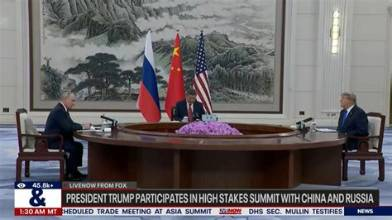
Last week witnessed an extraordinary reversal in Shenzhen, China. At the Asia-Pacific Economic Cooperation summit, Xi Jinping, Vladimir Putin, and Donald Trump sat down together at a large round table. Whatever agreements eventually emerge from their encounter, the meeting itself made a statement. Washington had to sit with two governments it has spent years trying to contain and acknowledge that the future would have to be negotiated among them.
I read that picture as another public admission that the unipolar moment following the Soviet Union’s collapse has run its course. For decades, our leaders behaved as though the United States could decide which governments were legitimate, which economies could trade, and which countries needed bombing into submission. Shenzhen brought a different picture into focus. China was hosting. Russia was at the table. The American president had to talk to both.
All this gives us something to think about as the Catholic Church celebrates a working man, tortured and executed by an occupying empire, under the astonishing title “King of the Universe.” There’s a great reversal for you. The man the authorities disposed of gets to judge the authorities. And in today’s Gospel, he tells us exactly whose treatment will determine the verdict.
But first, consider the histories those three men brought to the table. China continues to identify itself with the Global South. Its leaders repeatedly invoke the “Century of Humiliation,” beginning with the nineteenth-century Opium Wars. British merchants profited from selling an addictive drug to Chinese people. When Chinese authorities tried to stop the trade, Britain went to war. France joined Britain in the second war. Defeat brought China unequal treaties, concessions, and foreign interference in its affairs. Complete humiliation.
Think about that whenever Western leaders lecture the world about a “rules-based order.” Chinese people have reason to remember who wrote earlier versions of the rules and how they were enforced. At Shenzhen, the country once compelled at gunpoint to accommodate foreign merchants was welcoming the American president on its own ground. Anyone interested in understanding China should at least try to appreciate what that means.
Though Russia arrived with a different memory, it still finds itself connected to the Global South. After the Soviet Union collapsed in 1991, Boris Yeltsin’s government embraced market reforms welcomed and supported in the West. Russians endured economic collapse including ruined savings, lost pensions, healthcare, education, subsidized housing, and the transfer of public wealth into private hands. In the notorious “loans for shares” scheme, well-connected bankers acquired stakes in valuable enterprises at a fraction of their worth. The resulting oligarchs helped finance Yeltsin’s reelection. Ordinary people paid for a transformation that was supposed to make their lives better.
Russia’s humiliation of the 1990s helps explain why Moscow’s demand for equal standing resonates with countries accustomed to receiving orders from Washington and Western financial institutions. People who have lived through structural adjustment can recognize what happens when public assets become bargains for the wealthy and everyone else is told to tighten their belts.
China and Russia are also founding members of BRICS, alongside Brazil, India, and South Africa. The expanded grouping includes Egypt, Ethiopia, Iran, Indonesia, and other countries with varied histories of colonial rule, occupation, and foreign domination. Together they are building ways to cooperate and exercise influence beyond institutions long dominated by the West. Shenzhen gave that wider change a memorable image. Two major participants in that effort were sitting with the American president as powers whose agreement he needed.
For those accustomed to seeing their countries treated as problems to be managed, that carries enormous symbolic force. The powerful can be made to negotiate. Arrangements presented as permanent can change. Those who have been humiliated can acquire the means to insist on respect. Christians ought to recognize something familiar in that possibility. Jesus kept talking about reversals of just that kind.
Now listen again to the title of today’s feast. “Our Lord Jesus Christ, King of the Universe.” Say it slowly while remembering the man involved. He worked with his hands. He lived among people under occupation. He spoke about good news for the poor and a kingdom that belonged to them. He ended up in the custody of men who could have him tortured and killed. Rome displayed him on a cross with a royal title over his head, “King of the Jews.”
The soldiers could enjoy that joke. What sort of king hangs helpless while they divide up his clothes? What happened to his followers, his kingdom, his God? An empire knows how to make an example of somebody who gets ideas above his station. Yet Christians gather two thousand years later and announce that this executed man is king over everything. Imagine what that claim sounded like to people who still lived under Roman rule.
Over the centuries, Christians became accustomed to royal versions of Jesus. Artists dressed him in splendid robes. Popes, calling themselves his vicars, acquired courts, palaces, elaborate ceremonial, and the trappings of monarchy. A person could look at all that and conclude that Jesus had finally joined the class that once condemned him. The poor carpenter had been promoted, and his representatives on earth were enjoying the benefits.
Today’s Gospel makes that arrangement difficult to defend. Matthew’s king identifies himself with hungry people, strangers, sick people, people without adequate clothing, and prisoners. When the nations stand before him, their treatment of those people comes back to them as their treatment of him. The king has spent his time among the people who needed a meal, a welcome, or a visit. Their experience supplies the evidence in his court.
Here the joke turns on everyone who thought the prisoner could simply be forgotten. The dismissed, the despised, and the expendable turn out to matter more than the people making the decisions ever imagined. Jesus had promised that the last would be first. This feast invites us to imagine what happens when the people at the bottom finally have authority over the conditions of their lives.
Imagine workers having the decisive voice in how the wealth they produce is used. Imagine families whose homes have been bombed determining what reconstruction requires. Imagine prisoners and torture survivors being heard when governments explain what they did in the name of security. Imagine immigrants helping write the laws that govern their lives. That would give “Christ the King” a meaning people could recognize in their paychecks, their neighborhoods, and their children’s chances of surviving.
That brings me back to Shenzhen and to the people whose futures are discussed at such tables. A wider distribution of international power can give countries room to resist coercion and pursue their own development. The Gospel asks what they will do with that room. Will ordinary people gain security and a voice? Will hungry people eat? Will the displaced return home? Will smaller nations be able to make their own decisions?
I welcome the prospect of Washington having to negotiate with countries it once expected to obey. I also want the reversal to reach the people outside the conference room. Matthew gives them a claim on every leader seated there. Xi, Putin, and Trump will all have to answer the same question about the people whose lives their decisions shape.
The irony of calling Jesus “King of the Universe” comes home when we realize who has been entrusted with the judgment. The tortured working man gets the last word. The hungry, the stranger, and the prisoner have his ear because he has made their cause his own. Every government that expects a favorable verdict has been told where to begin.

