Pope Francis Calls Possession of Nuclear Weapons Sinful

Readings for First Sunday of Advent: IS 2:1-5; PS 122:1-9; ROM 13: 11-14; PS 85:8; MT 24: 37-44

Last weekend, Pope Francis outright condemned the manufacture and possession of nuclear weapons. (I’ll bet you didn’t notice that in the mainstream media.)

The pope did so during his visit to Hiroshima and Nagasaki, where he met with survivors of the two Japanese cities which were virtually wiped off the map when atomic bombs were dropped on them in 1945. The weapons of unprecedented mass destruction killed more than 200,000 people in matters of minutes.

During his remarks, Pope Francis said, “A world without nuclear weapons is possible and necessary. . .  The use of atomic energy for the purpose of war is immoral, just as the possessing of nuclear weapons is immoral . . .”

The pope’s visit and sharp condemnation could not come at a more opportune time either historically or liturgically (on this First Sunday of Advent). Historically, they follow hard upon the conviction of the Kings Bay Plowshares 7, a group of seven Catholic peace activists who in April of last year entered the Kings Bay Naval Submarine Base in Georgia to symbolically destroy the nuclear weapons housed there. (Kings Bay harbors at least six nuclear ballistic missile submarines. Each of them carries 20 Trident missiles.)

The Seven included Liz McAlister, the wife of deceased peace activist Phil Berrigan, as well as Martha Hennesy, the granddaughter of Dorothy Day, the legendary co-founder of the Catholic Worker Movement.  

As I pointed out a couple of weeks ago, the group’s own “weapons” for accomplishing their task were hammers, crime scene tape, and baby bottles containing their own blood. Once inside, they splashed their blood on the walls of the base’s administration building. They used their hammers to “destroy” the nosecone of one of the Trident missiles. They also posted a formal indictment of the U.S. government charging it with crimes against peace.

At their trial the activists had planned to mount a “necessity defense.”  However, the presiding judge forbade them to cite their religious motivations. That nullified their planned argument that their “crime” was morally necessary to prevent the far greater catastrophe of a nuclear war.

The Seven had also planned to present Daniel Ellsberg as an expert witness to articulate that defense. All of us recall Ellsberg as the most famous whistle blower in U.S. history. In 1971, he risked a lifetime behind bars when he leaked the famous Pentagon Papers that revealed Washington’s hidden strategy behind the Vietnam War. His recent book The Doomsday Machine: confessions of a nuclear war planner details his work as a Defense Department analyst and nuclear weapons strategist.

However, Ellsberg too was forbidden to testify. Had he done so, he would have argued that the Seven were faithfully following the prophet Isaiah’s command to “beat swords into plowshares” (IS 2:4).

(By the way, with the judge’s restrictions in place, the Plowshares 7 were convicted of conspiracy. On their sentencing within 90 days, the activists will face more than 20 years in prison.)

All of this – Pope Francis’ words about the sinfulness of nuclear weapons manufacture and possession as well as the conviction of the Plowshares 7 – is relevant to this Sunday’s liturgy of the word and historically relevant in the way just explained. That’s because today’s first reading contains those words from the prophet Isaiah.

Contradicting his people’s earlier understanding of God as a “Man of War,” Isaiah’s words describe divine opposition to all war and a fortiori, of course, to nuclear war. They envision a precisely enlightened human future when the people of the world will “beat their swords into plowshares and their spears into pruning hooks,” and where “one nation shall not raise the sword against another.”

Then in today’s Gospel reading from the 24th chapter of Matthew’s Gospel, Jesus (like the Buddha before him) calls his followers to simply wake up rather than prepare for war against their Roman occupiers led by a violent “Son of Man.” As Matthew’s readers will discover in his 25th chapter, “waking up” means recognizing Christ’s presence in the “least of the brethren.” Jesus implies that such recognition precludes war of any kind and (again a fortiori) nuclear war.

To get what I mean, please read for yourself today’s biblical selections. You can find them here. Despite their obscurity (especially in today’s apocalyptic Gospel passage), you’ll see that they’re about waking up and renunciation of war. At least that’s what I see in them, as you can tell from my “translations” immediately below:  

IS 2:1-5

For the prophet Isaiah,
Jerusalem and its Temple
Called people everywhere
To lift their gaze
Above the world’s
Hills and highest mountains
To the realm of peace and light
He believed possible.
To get there, he said,
Disarm and demilitarize.
Transform all
Weapons of mass destruction
Until they look like
Hoes and shovels,
Tractors and cultivators.
 
PS 122: 1-9
 
Yes, it’s possible to turn this world
Into a house of worship –
A City of Peace –
Where all human beings
Enjoy the prosperity
That disarmament makes possible.
That’s the key to reconciliation and happiness.
 
ROM 13: 11-14
 
St. Paul calls us to wake up!
Only our selfishness,
He says,
Prevents the advent
Of that other peaceful world.
So, don’t be deceived, he said,
By the world’s empty promises
Of fulfillment by (Christmas) consumption
And militarization.
Instead, seek that other world first
And everything else you need
Will follow automatically.
 
PS 85:8
 
Lord, please show us
How to get from here to there!
 
MT 24: 37-44
 
Jesus warned his friends
About using violence
To achieve peace.
They hoped that
Daniel’s “Son of Man”
Would dethrone imperial Rome
By force of arms.
“Be careful what you wish for,”
Jesus cautioned.
“Your hoped-for apocalypse
Will recall the devastation
Of Noah’s Flood.
Civilian casualties
Will run at 50% —
Killing innocent
Men and women alike
(Just as at Hiroshima
And Nagasaki).
True change however
Comes from disarmament
(as Isaiah taught)
And from extreme wakefulness
(as the Buddha instructed).
Pray then for blessed insomnia!
Wake up
To the signs of the time!”

Don’t you agree that Pope Francis is wonderful? His faithful following of Jesus and of St. Francis of Assisi has led him to call things by their right names. Nuclear war is sinful, he has said unmistakably. Possessing nuclear weapons is immoral. Catholics and the entire world need to take those words to heart and act upon them.

The Plowshares Seven show us what such open-hearted action means. The Seven are willing to go to prison for enacting the logical consequence of the words of Pope Francis and of Jesus in a world cursed by nuclear weapons.

But few are paying attention. Few take notice. Since Francis’ words weren’t about abortion, homosexuality, or refusing communion to politicians, the pope’s words of condemnation received little attention in the mainstream media. Moreover, those words seemed pointed sharply at the U.S. which alone has ever used nuclear weapons and possesses more of them than any nation on earth. And who among us (much less, among the corporate media) is willing to endure such condemnation?

Fewest of all among us are willing to take seriously the challenge of the Plowshares 7. Who among us is willing to do prison time for the sake of following the prophetic ones who identified disarmament, wakefulness and enlightenment as the only effective path to happiness and peace?

Advent is the time for entertaining those questions. What are your answers? What are mine?

(Discussion follows)   

Marianne Williamson, Reparations & Restorative Justice

Readings for 31st Sunday in Ordinary Time: WIS 11:22-12:2; PS 145:1-2, 8-9, 10-11, 13, 14; 2 THES 1:11-2:2; JN 3:16; LK 1:1-10

Today’s readings for the 31st Sunday in Ordinary Time bring up questions of restorative justice and reparations for the harm we may have caused others as individuals and as Americans.

The day’s main focus is the familiar story of the tax collector Zacchaeus.  This very wealthy man was inspired by Jesus to give half of his possessions to the poor and to restore to those he had defrauded four times as much as he had embezzled.

Zacchaeus’ example makes me think of Marianne Williamson’s campaign for president which has made reparations a central plank in her platform.  

Of course, Marianne’s reparations focus is the African American community. But her rationale for it suggests something far beyond race relations within the United States.  It intimates as well reparations to victims of U.S. foreign policy and to Mother Nature herself.

Let me explain and then show how the explanation is related to this day’s readings.

To begin with, yes, I’m still supporting Marianne Williamson for president.  She is the only candidate who confronts us with the undeniable truth that Americans need a fundamental change in consciousness if we are to address the unprecedented problems currently facing humankind.

That’s what Marianne means by “miracles” — changes in fundamental perceptions. That was also central to Jesus’ proclamation about the Kingdom of God. We must think differently about the world and act accordingly.

So, it’s not a question of merely tweaking the reigning economic system or of reviving Roosevelt’s New Deal. What we need is an entirely new world vision that operates from the premise that everything we see is completely upside down. Reality stands 180 degrees away from what our culture tells us. All of it. If our culture says “black,” we should think “white.” If it says “good,” we should think “bad.” If it says “peace,” we should know they’re getting us ready for another war.

Instead, we are all one – women, men, children, immigrants, refugees, animals, plants, and the very air we breathe. That’s the basis of Marianne Williamson’s candidacy. There are no foreigners, no sacrosanct borders – no America First. In fact, the United States must take 100% responsibility for the world’s ills.  

My decision to continue my support of Marianne Williamson was reinforced by listening to a campaign speech she gave at Yale University last week.

There she made the following points that she has always centralized in her approach to politics and to simply living as an evolved human being in our troubled world. Notice how they echo today’s Gospel themes, reparations and restorative justice:

  1. We all know that until we identify and address the root of our problems in our personal, family, and community relationships, we’ll never truly solve those problems.
  2. However, what is true in our personal lives also applies to our nation, because nations are simply groups of individuals.
  3. As Americans, we have been unwilling to face up to the harm caused by slavery, Jim Crow, and segregation on the one hand and to the resulting wealth accumulation in the white community on the other.
  4. The same holds true for U.S. foreign policy which has been based on colonialism and neocolonialism which are simply euphemisms for forcefully transferring wealth from the Global South to the Global North.
  5. Such transfer-by-force has been destructive not only to people but to the natural environment destroyed by industrialized agriculture, rainforest destruction, overfishing, and massive waste disposal in what’s been called the Third World.
  6. We thus owe reparations to African Americans, to the Global South, and to Mother Nature.
  7. Marianne’s presidency would have us directly confront those problems as the sine qua non for solving our national dilemmas, world poverty, and impending climate catastrophe.

Now, those are truly radical positions (in the etymological sense of that term). No other candidate – not even Bernie or Elizabeth Warren – addresses them at the level of consciousness emphasized by Marianne Williamson.

So, think about that and Marianne’s position on reparations and restorative justice as you read the selections included in this Sunday’s liturgy of the word. You’ll find them here. They all invite us to radically transformed ideas of God, ourselves and of those we live with – particularly on the other side of the street, on the other side of the tracks and on the other side of the world.  (Note that the first reading is from the Book of Wisdom which imagines God’s Spirit as female.) What follows are my reading’s “translations.” Please check for yourself to see if I’ve got them right:

 WIS 11:22-12:2

The Real Master
Of the Universe
Is immense
And intense
In her presence
In everything
And everyone.
To her
Our “sins” and addictions
Are trivial.
They mean nothing
In her vast
Scheme of things
Where all people
Are loved and cherished
Just as they are –
As God created them.
“Repentance”
Means rejecting
False guilt
And “wickedness”
While repairing
The hurts
We’ve inevitably inflicted
On others.
 
PS 145:1-2, 8-9, 10-11, 13, 14
 
Where God is recognized
As Love
Her name
Is constantly extolled.
She is lovely herself
And merciful
Never angry
But kind and compassionate
Always.
So, set aside
“Fear of the Lord”
And embrace your Queen
Who keeps her word,
Does nothing harmful
And favors her
Heavily burdened
And (necessarily) fallen
Children.
 
2 THES 1:11-2:2
 
Rabbi Paul’s
Constant prayer for us
Is that we might be
Like his teacher, Jesus
Who recognized
Everyone and everything
As lovable
And full of grace.
In fact,
Jesus is among us
Each day
Whenever we gather
Together
And not merely in some
Far distant future
As false teachers say.
 
JN 3:16
 
Yes, our wise Queen
Has given us Jesus
Who showed us Life
In its fullest form
That we might live
Happily ever after
 
LK 1:1-10
 
Zacchaeus,
The rich exploiter
Of his own people,
Was a tiny man
In more ways than one,
But as an example
Of repentance and reparation.
He rose above the crowd
To see Jesus differently.
Imagine his surprise
(And the anger
Of his victims)
When Jesus
Saw him differently
And invited himself for dinner.
The result?
Zacchaeus grew
Into a giant
On the spot
Giving half his possessions
To the poor
And paying
Four times
His extortions!
Four times!!
How’s that
For reparations?

I hope you can see the connection between those readings and Marianne Williamson’s emphasis on reparations for slavery and restorative justice for resources stolen in a system of unequal trades identified in the Global South as neocolonialism. The readings (and especially the example of Zacchaeus) show that such policies based on a clear moral sense of justice should represent the twin pillars of domestic and foreign policy.

No other candidate has identified those pillars with the clarity and conviction of Marianne Williamson. In the end, no other candidate — and very few spiritual leaders of any stripe — challenge us to rethink our entire understanding of life.

According to Williamson and Jesus, life, truth, and our health as a nation are to be found in exactly the opposite direction from that indicated by the reigning ideology.

Sunday’s Readings “Translated”

Here are my “translations” of the liturgical readings for the 26th Sunday in ordinary time. As we’ll see more explicitly in my Sunday Homily, they provide a virtual catechism of liberation theology, which I consider the most important theological development of the last 1500 years.

AM 6:1A, 4-7
 
The Spirt of Life informs us that:
Complacent “religious” people
Are in for a sad surprise.
They might be enjoying
Their “Sleep Number” mattresses
And Lazy Boy chairs;
While gorging on Wagyu Beef
And meats
No one else can afford;
They might be attending
A-list concerts
And drinking Chateau Lafite
While reeking of Chanel Grand Extrait.
But the world’s on fire!
And its flames will soon consume
Even the decadent lifestyles
Of the super-rich.
 
 
PS 146: 7, 8-9, 9-10
 
For the poor,
There’s a certain Schadenfreude
In all of this.
For God’s future assures
Downfall for the rich
While promising
Justice for the oppressed
Rich food for those now hungry
And liberation for the imprisoned.
The obtuse will see,
We’re told.
The overworked
Will be relieved.
Immigrants and refugees
Will be safe at last.
Children born out of wed-lock
And abandoned women
Will finally know peace.
 
1 TM 6:11-16
 
So, be of good heart.
Despite appearances,
That golden future awaits
Those who live like Jesus.
He was so committed
To the poor
To justice, non-violence
Patience and love
That the imperialized world
Could not stand it.
Nevertheless, his powerful
Christ-consciousness
(That you btw have promised
To live by)
Will bring the world
A completely new order
And enlightenment beyond
Our wildest imaginings.
 
2 COR 8:9
 
In fact, Jesus accomplished
All of that
By becoming a poor man
Not a rich one
So that we might know
Where true wealth lies
And live accordingly.
 
LK 16: 19-31
 
Jesus illustrates
His meaning
With the story
(Told to the complacent believers)
Of poor Lazarus
Who often begged
From a rich man.
But soon had Dives
Begging from him
And experiencing
The awful frustration
Of unbridgeable gaps
In consumption
And in ability
To communicate
The desperation
And torment,
Of hunger and thirst
Even if revealed
By a ghost from the other side.

Clarifying Economic (& Theological) Terms in the Capitalism-Socialism Debate

Readings for 25th Sunday in Ordinary Time: AM 8: 4-7; PS 113: 1-2, 4-6, 7-8; 1TM 2: 1-8; 2 COR 8:9;LK 16: 1-13

Last weekend, comedian, Bill Maher, and film-maker, Michael Moore, got into a shouting match on Maher’s show “Real Time.” Their point of contention was capitalism vs. socialism. Moore argued for socialism; Maher was against it. Their boisterousness reminded me of dinner-table arguments which (I’m ashamed to admit) I’ve been part of myself.

I bring all this up because the debate is intimately related to this morning’s liturgy of the word. Though the readings obviously pre-date the emergence of the modern system, they all criticize what has historically become “the spirit of capitalism.”  

In any case, the Maher-Moore debate is worth considering not only because it manifests the relevance of the Jesus tradition to arguments like theirs. The argument also demonstrates the counter-productivity of the squabble itself. It’s counter-productive because its terms fall into a trap congenial to the enemies of the biblical tradition. The trap frames alternatives to our present economic system in terms of “socialism” instead of in terms of social justice, mixed economy, and “preferential option for the poor.”

That’s a simple distinction I never tire of making, because (as I point out in my book, The Magic Glasses of Critical Thinking: seeing through alternative fact and fake news) it’s absolutely key to the discussions of capitalism and socialism that will inevitably characterize the election season we’ve just entered – especially following the eventual selection of any Democratic candidate. No matter who the candidate turns out to be, s/he will be predictably vilified for advocating socialism pure and simple – an economic system that simply does not exist.

Maher and Moore both missed that point. The rest of us shouldn’t. In fact, I recommend avoidance of capitalism-socialism framing altogether. I’ll explain what I mean, and then elucidate the connections with today’s readings.

To begin with, Moore’s mistake was to represent as “socialism” his advocacy of Medicare for all (Maher was against it), free college tuition, college loan-forgiveness, and the Green New Deal. In reality, those programs notwithstanding, each of them represents elements of mixed economies – the only form of economic organization that exists in our present context. And a mixed economy always has three elements (1) Some private and some public ownership of the means of production, (2) Some controlled markets and some that are free of control, and (3) earnings limited (usually by progressive income taxes).

Every economy in the world has those elements. There are no exceptions.

Mixed economies contrast with the three elements of capitalism as well as with those of socialism. Capitalism’s three points are (1) Private ownership of the means of production, (2) Free and open markets, and (3) Unlimited earnings. None of the world’s economies embodies those elements untempered by planning.

Meanwhile, socialism’s three points are (1) Public ownership of the means of production, (2) Controlled markets, and (3) Limited earnings. Like untempered capitalism, such economic arrangement exists nowhere (including in “communist” China or Cuba).     

For his part, Maher’s defense of capitalism was also a defense of mixed economy. He agreed with many of Moore’s points. So, Maher’s “capitalism” was no less mixed than Moore’s. The difference was that Maher wanted more market and less planning in economic policy.

This is not to say that all mixed economies are equal. (And this point is essential to keep in mind). The crucial question with them is “Mixed in favor of whom?” Those who mistakenly identify themselves as “capitalists” tend to advocate economies mixed in favor of the rich. They do so on the belief that wealth trickles down; a rising tide lifts all boats, etc.

Those who (equally mistakenly) identify as “socialists” want economies mixed more in favor of the working and unemployed classes. They recognize that unregulated markets respond primarily to those with the most money. Economies therefore have to be controlled to include those with limited (or no) resources.

With all of this in mind, Moore and Maher might have resolved their argument by recognizing that the choice before them is not between capitalism or socialism, but between an economy mixed in favor of the rich or one mixed in favor of the poor. And the formula for doing so might be: As much market as possible, with as much regulation as necessary (to assure a decent standard of living for everyone on the planet).   

Now, a formula like that not only avoids “the socialist trap;” it is also highly compatible with the biblical social justice tradition that’s expressed so clearly in this morning’s liturgy of the word. As I’ve translated them below, today’s selections point out the injustices inherent not only in the economies of the ancient world, but in today’s neoliberal order. Both, the readings imply, were and are rigged in favor of the rich and against the poor.  Check the readings for yourself here.

This is the way I interpret them:

 AM 8: 4-7

Money makes the rich
Exploit the poor.
It leads the wealthy
To distort religion
Manipulate currency
Put thumbs on scales
Sell shoddy products
And underpay workers.
But never doubt:
They will one day reap
Due karma.
 
PS 113: 1-2, 4-6, 7-8
 
For God will lift up
The poor
From the dirt
And “shitholes”
They’re forced
To live in.
Thank God:
The lowly
Will one day
Become their own
Masters instead.
 
1 TM 2: 1-8
 
In the meantime,
Pray that the powerful
Might change their ways
For God cares
Even for them.
Pray that they
Might know God
As revealed in
The poor man
Jesus who died
For them too
Despite their bitterness
Lies and self-serving
Talking points.
 
2 COR 8:9
 
Yes, don’t forget:
God chose
Self-revelation
In the poor
Not in the rich.
Ironically,
God’s Preferential Option
For the Poor
Is the only way
To prosperity.
 
LK 16: 1-13
 
In fact,
The poor man, Jesus,
Laughed at the rich
Who can’t use a shovel
To save their lives,
But blame the beggars
Their own policies have created.
The rich are so crooked,
He joked,
That they even admire
Shrewdness in those
Who end up stealing from them!
Their own small larcenies
Grow exponentially.
So they cannot be trusted.
Restitution is therefore in order.
But don't worry
About the bankers:
Their “generous” loans
Can easily be written off
Without in the least
Impacting their
Decadent life-styles.
Their basic mistake
Is believing that
Differentiating wealth and God
Are somehow compatible.
They are not!

Don’t you agree that sentiments like those favor economies mixed in favor of the poor? (That’s the way they appear to me.) The readings imply that if mixed economies are all we have, we shouldn’t allow ourselves to fall into the trap that ensnared Moore and Maher. Instead of arguing about non-existent “capitalism” or “socialism,” we should make sure to embrace the principle “As much market as possible, but as much planning as necessary (to insure a dignified life for all).”

But to avoid pointless shouting matches, it will be necessary to carry around in our minds those clear and easily understood ideas about what capitalism and socialism are. To repeat: capitalism’s essential elements are (1) private ownership of the means of production; (2) free and open markets, and (3) unlimited earnings. Socialism’s defining points are just the opposite: (1) public ownership of the means of production; (2) controlled markets, and (3) limited earnings. Once again, those two definitions make it clear that mixed economies are all we have. 

Finally, we should be emphasizing the incompatibility between  the Judeo-Christian tradition and the spirit of capitalism as characterized in today’s readings. Excessive wealth on the one hand and God on the other are not compatible. Or, as Jesus put it, “No one can serve two masters. Either you will hate the one and love the other, or you will be devoted to the one and despise the other. You cannot serve both God and money.”

Despite our culture’s claims to the contrary, that’s the faith we “People of The Book” (Jews, Muslims, and Christians) are called to embrace.

Marianne Williamson and the Power of Prayer

So, let me get this straight. Marianne Williamson should be disqualified as a viable presidential candidate because she has too much faith in the power of prayer, of mind, of love, and of God.

The disqualification was sparked by a tweet she made as Hurricane Dorian was bearing down upon the southern coast of the United States. It read: “The Bahamas, Florida, Georgia and the Carolinas…may all be in our prayers now. Millions of us seeing Dorian turn away from land is not a wacky idea; it is a creative use of the power of the mind. Two minutes of prayer, visualization, meditation for those in the way of the storm,”

It was a call to faith addressed to a nation where the majority considers itself followers of the one who said, “If you have faith, even as a mustard seed, and say to this mountain ‘move from here to there,’ it will obey you” (MT 17:20).

[Yes, faith and its power to “move mountains” is an idea that appears multiple times in the Jesus tradition, indicating that the phrase probably originated with the Master himself. But, of course, Jesus’ words presume that his listeners, like most of us, had no such minimal faith. Hence, he implied, our belief remains powerless.] 

Jesus’ faith aside though, consider the content of Ms. Williamson’s tweet. It simply asked her followers:

  1. To face the power of our human minds and spirits as much greater and connected with natural forces than we generally believe.
  2. In view of that fact, to activate their collective force to avert disaster.
  3. And to do so by stilling that mind through meditation, by praying for those in the hurricanes path, and by visualizing their prayers answered.

Read it again: that’s exactly what the tweet says! Nothing more; nothing less.

In other words, it was all quite harmless and potentially powerful. There was nothing in it of fear, hatred, climate-change denial or blame of victims – all the responses we’ve come to expect from the outrageous tweets of more conventional politicians. Instead, there was only expression of solidarity, compassion, faith, stillness, and acceptance of what traditional spirituality tells us of the untapped power of the human spirit that consciously aligns itself with the divine.

As I’ve already indicated, the tweet also implied a connection between human consciousness and Mother Nature herself – something underlined in the mystical traditions belonging to all the world’s great faiths and to mainstream science as well. (As Francis of Assisi would remind us, all of us are in some sense a part of “Brother Hurricane” Dorian.) 

But, horror of horrors (!) such expression of traditional faith and scientific insight was enough to disqualify Williamson from presidential candidacy. Whoopi Goldberg and panel members on “The View” ridiculed her. Others characterized her as no better than that of religious fundamentalists.

To my mind, however, it proves just the opposite.

Williamson’s tweet demonstrates how truly different she is from her fellow candidates as well as from the fundamentalists who have hijacked the faith of Jesus. And how refreshing! Her viewpoint is what our times require, where expressions of faith are limited to “thoughts and prayers” after mass shootings — or to divisive imposition of narrow beliefs about abortion and rejection of LGBTQQIAAPs.

In fact, Marianne Williamson is so different from what we expect from politicians and secular leftists that when she simply expresses solidarity with those in the Bahamas, Florida, Georgia and the Carolinas (whose prayers no doubt echoed Marianne’s tweet) she reveals herself as absolutely mystifying, incomprehensible, and unacceptable.

Let’s face that too: Williamson’s tweet expressed extraordinary solidarity with those in Dorian’s path. Without doubt, many of them were praying that the hurricane’s force might be mitigated or diverted. In fact, if we found ourselves in their circumstances, the religious among us (and “foxhole Christians” as well) would be offering similar prayers: “Please, Lord, save me and my family from this hurricane. Change its path. Keep us safe.”

And what would be wrong with that? It’s an absolutely human response to impending disaster.

No, the hubbub over Ms. Williamson’s tweet is but another demonstration of why her candidacy is indispensable. We need her to profoundly change our political conversation, to move that conversation from fear and denial to compassion, and to unveil the true nature of faith engaged with an overly-secularized world.

The Unique Importance of Marianne Williamson’s Campaign (Sunday Homily)

Readings for 24th Sunday in Ordinary Time: WIS 9:13-18B; PS 90: 3-6, 12-14, 17; PHMN 9-10, 12-17; PS 119: 135; LK 14: 25-33

Marianne Williamson’s campaign is not dead. True, she will not be appearing on the stage of the third Democratic debate. Although she has the required number of donors, Williamson has not yet attained the necessary 2% in four polls approved by the Democratic National Committee (DNC). Nonetheless, her campaign continues its concentration on Iowa, where she’s been working for the last several months. Her people confidently anticipate her participation in Debate # 4.

Recently, the New York Times (NYT) ran a long very positive column on Marianne. It was called “The Gospel according to Marianne Williamson.” It reminded readers of Ms. Williamson’s identity, her growing and highly enthusiastic audiences, and the persuasive power of her remarkable eloquence.  

The article assured readers that Williamson is far more than some New Age guru or the spiritual advisor of Oprah Winfrey. Jokes and criticisms aside, she has nothing to do with crystals or burning sage. Instead, she is a widely-hailed, best-selling author, spiritual teacher, counsellor, and generally wise person. For more than 40 years, she has been a student and teacher of A Course in Miracles (ACIM), a book published in 1974) which Williamson describes as “basic Christian mysticism.”

It’s that latter qualification – Williamson’s connection with Christian mysticism – that makes her continued campaign extremely relevant to this Sunday’s liturgy of the word. That’s because the theme of today’s readings contrasts the wisdom of God with the wisdom of the world just as does ACIM. Serious consideration of that contrast illustrates the unique importance of Marianne Williamson’s candidacy at this particular juncture in the history of our nation and world.

For ACIM, the world’s wisdom is based on fear; God’s wisdom is based on love. In fact, according to A Course in Miracles, love and fear are the only two motivational forces in the entire world. That’s true in our personal relationships, but also in politics. Either we see others as enemies poised to attack us at every opportunity, and act accordingly. Or we recognize our very selves in those the world would teach us to fear, mistrust, and hate.

More specifically, the politics of fear sees Muslims, Russia, China, the Taliban, ISIS, immigrants, people of color, LGBTQQIAAPs, and poor people in general as our enemies. Meanwhile, a politics based on love recognizes that none of those the world teaches us to fear is basically hostile. Rather, when we take 100% responsibility for the problems designated enemies ostensibly represent, a path opens up to achieving peace with all concerned.

Does such conviction seem woo-woo or unrealistic to you? If it does, please be reminded first of all, that such belief is basic not only to Christian faith, but (as Williamson constantly reminds us) to all the world’s great religious traditions, including Islam. It is basic also to many secular traditions that consider themselves atheistic or agnostic.

Secondly, remember that according to Christian faith, “God” is synonymous with “love,” so that Williamson’s “Politics of Love” means the politics of God. That means (thirdly) that rejection of political love as woo-woo trivializes Christian faith and Jesus himself.

With all of that in mind, please read for yourselves this Sunday’s liturgical readings. (You’ll find them here.) To repeat, they contrast the wisdom of the world with the Wisdom of God. In any case, and for what it’s worth, here are my “translations” of their content. Their thoughtful review will help you see what I’m getting at in saying that Marianne Williamson’s “Gospel” is far deeper than revealed in the NYT article just referenced.

 WIS 9:13-18B
 
The wisdom of God
Unlike the world’s
Is sure and decisive.
For human thought processes
Focused on the body
And its shifting reality
Are necessarily confused.
Hence, we cannot judge wisely
Without assistance
From the Holy Spirit
Who consistently reveals
God’s Reality
As filled with love.
 
PS 90: 3-6, 12-14, 17
 
This is because
Time has no meaning
For God.
Everything but Love
Passes in an instant.
Consequently
Our prayer must be:
“Teach us
Your changeless vision
Filled with kindness
Joy and gladness.”
Only such
Synonyms for love
Give meaning
To our lives.
 
PHMN 9-10, 12-17
 
For example,
An elderly and imprisoned Paul
Long ago
Rejected the world’s wisdom
About slavery.
Seeing with the eyes of Christ
He says
Miraculously transformed
Onesimus
From slave and chattel
Into a man
A partner
A son and brother.
“Follow my example,”
The shackled one implores.
 
PS 119: 135
 
We agree:
Show us your face,
O, Lord,
In slaves
And in those behind bars.
Yes, teach us your ways.
 
LK 14: 25-33
 
But the Master warns:
“If, like me, you live
According to God’s Wisdom,
The World
Will surely crucify you
As the subversive
You must be
To qualify
As my disciple.
But be sure to
Subvert non-violently
For otherwise,
The militarized
Powers of the world
Will surely crush you.
Sabotage instead
By insistent example
That refuses
To value anything
The world treasures.”

Those are radical thoughts. They are 180 degrees opposed to the “wisdom of the world.” Yes, the very wisdom of God teaches that we have no enemies other than those our thoughts and resulting actions have created. It’s reconciliation with our designated enemies (recognizing them as embodiments of our very selves) that holds the promise of our very salvation.

No Democratic candidate other than Marianne Williamson dares call us to such radicality. It’s that change in attitude that ACIM defines as “miraculous.” Only that sort of basic transformation in consciousness can save us from the unprecedented catastrophes facing our world today.

As Ms. Williamson puts it: “It’s unreasonable to expect those who drove us into the ditch we’re in now to be the ones qualified to get us out.”

No: our present context necessitates an entirely new leadership and consciousness – a new wisdom based on love rather than fear. That’s the vision Marianne Williamson offers us this election season. And it’s not New Age woo-woo. In reality, the wisdom in question is not new at all. It’s reflected in the teachings of Jesus. It’s the wisdom of Paul. It’s the theme of today’s liturgical readings.

Everyone Likes a Good Joke: Jesus Makes Fun of “Humble” Religious Hypocrites (Sunday Homily)

Readings for 22nd Sunday in Ordinary Time: SIR 3: 17-18, 20, 28-29; PS 68: 4-5, 6-7, 10-11; HEB 12: 18-19, 22-24A; LK 14: 1, 7-14.

[What follows is a dramatic re-creation of Luke’s rather abstract account of Jesus’ dinner at a Pharisee’s home. (See the narrative here.) While Luke seems to have the Master recommending impossible (for Jesus) hypocrisy and self-promotion, the re-creation seems more probable and gets at Jesus’ real message about the Kingdom of God and its preferential option for the poor.]

In this morning’s gospel episode, Jesus finds himself invited for dinner to the home of a Pharisee. All present, Luke tells us, are watching Jesus closely. No doubt, they’re keeping an eye on his disciples too. And they don’t approve.

After all, like Jesus, his disciples are mere riff-raff. But at least Jesus is the reputed peasant-rabbi. Everyone’s talking about him. And investigating Jesus is the whole reason for this dinner. So for the moment at least, the Pharisees are willing to cut him some slack. He’s sitting near his hosts towards the head of the table.

His hangers-on however are a different story. They’re rough. They smell of fish and sweat, and have no manners. And yet, as Jesus’ friends, they’ve been granted a place at table — down towards the end. Even there, they feel out of place, but for that very reason they are enjoying themselves tremendously. You can imagine their rough jokes and loud laughter.

Yes, the Pharisees are watching Jesus and his friends. But obviously, Jesus has been watching them as well. He knows they are expecting some words of wisdom. So . . . he tells them a joke. And the joke’s on them. It contains a sharp barb.

“Thanks for inviting us to this banquet,” Jesus begins. “Unaccustomed as we are . . .” He pauses and smiles. “That’s quite generous of you. After all, none of us can repay your kindness. We are homeless people, as you know. We’re unemployed too, so we are in no position to return your kindness.

The best I can do is offer you some wisdom. So let me tell you what I’ve been observing here.

“Evidently,” Jesus goes on, “it’s your custom to adopt the humility recommended in the biblical Book of Sirach. I can’t tell you how impressed I am; I’m edified by your piety. I mean, you have clearly taken to heart the words of the sage, Jesus ben Sirach – what he said about being humble, especially if we are ‘great’ as all of you are here, I’m sure.”

Jesus eyes his listeners. He can tell that they are waiting for the penny to drop. So he drops it.

“I can see that when you come into a place like this, you take the lowest place available — down there where my friends are.” With this, Jesus stands up bows his head, stoops his shoulders and slumps towards the lowest place at table. He laughs.

“That way,” the Master continues, “our host, of course, is obliged to publicly invite you to a more honored position at table. ‘Friend,’ he’ll say, ‘come up higher, and sit in the place you’ve merited not down there with the unwashed and poor.’”

Now Jesus is standing. He throws out his chest and strides towards the seat right next to his pharisaical host. He chuckles again. “That enables you,” Jesus continues,” with great protestations of unworthiness, to take your ‘rightful’ place at table. Your stock has risen in everyone’s eyes.

“So congratulations are in order,” Jesus says. “All of you have learned your lessons well. You’ve just created a show, and have actually exalted yourself by pretending to be humble. In a sense, you’ve received your reward.”

Jesus is seated again and looking intently at everyone. Their mouths are open with shock.

“So here’s my wisdom, friends. . . . Your ‘humility’ is not what Sirach was recommending. In fact, it’s a form of pride and self-promotion.

“Instead, real humility is this: when you throw a party like this one, invite the poor, the lame and the blind, and then serve them. Place them at the head of your table and treat them as honored guests. People like that can’t or won’t repay you. But in fact, YOU OWE THEM.” Jesus fairly shouts those last three words.

“I’m telling you the truth,” he says. And humility is nothing but the truth.”

Jesus pauses, but he hasn’t finished yet. “You see, those belonging to what you consider the Great Unwashed — like my friends — are actually God’s favorite people. Recall what the psalmist said about them in Psalm 68. He said God is the Father of orphans; he’s the defender of widows, of prisoners, of the homeless, and of farmers without land.”

Jesus is quiet now; his smile is broad and friendly. He searches the faces of his table companions one-by-one.

Then he turns to his host and adds.

“To be fair, my friend, you yourself are on the right track. By inviting us today, you’ve shown that you already understand what I’ve been saying. As I say, none of us can repay you, and yet you’ve invited us to this abundant table. We are sincerely grateful.

“But don’t think that you’ve somehow performed an act of charity by your invitation. No, it’s an act of justice – of compensation to make up for what you have stolen from the poor by underpaying them and taxing them heavily. In supporting the poor and even the “lazy,” you are simply imitating our generous God.

“I mean the earth and its produce are all gifts from God. No one has earned them. No one owns them but the creator. If you have food, then, you are obliged to share it with the hungry – even with those unwilling to work. As difficult as it might be to understand, that’s simply the divine dispensation.

“The earth and the life it supports have been freely given to everyone – even to people like me and my friends who refuse to work and live from the alms of people like you. No one deserves life or food more than anyone else. So in effect, you are obliged to do what you’ve done.”

(Homilist’s note) None of this needs commentary from me.

What’s your commentary?

P.S. You might be helped in formulating your thoughts by this short interview of scripture scholar, Reza Aslan, by Russell Brand. In the exchange, Aslan explains how Jesus, the Buddha, and Mohammed were more interested in economics than in theology. They were economic radicals intent on turning their societies upside-down. None of them intended to found a new religion.

Faith Is Belief in What the World Cannot See – In What the Mainstream Denies

Readings for 19th Sunday in Ordinary Time: WIS 18:6-9; PS 33 1,12, 18-19, 20-22; HEB 11: 1-2, 8-19; MT 24:42A, 44; LK 12: 32-48

Despite their apparent obscurity, this week’s readings should be powerful and encouraging for people of faith. They are about faith that enables followers of Jesus to see what remains opaque to a purblind world.

By definition faith cannot adjust to what the world takes for granted. It is commitment to what materialists cannot see – to what the mainstream denies. After all, the world’s normalcy exalts individualism, money-grubbing, meaningless entertainment, oppression of “the othered,” endless war, and the never-satisfied quest for pleasure, power, profit, and prestige.

Faith, on the other hand, believes in a world that remains unseen by the dominant culture. It’s the world as it comes from the hand of God: beautiful, simple, loving, forgiving, and belonging to everyone.

As a result, people of faith are called to stand with those our dominant culture rejects. In “America,” that means standing with the poor and homeless, with immigrants, Muslims, people of color, LGBTTQQIAAP humans, socialists, communists, environmentalists, and social justice warriors. . .  That’s the short list, today’s readings suggest, of those who are favored by God.

Put more simply, faith realizes that all of us are one. All are children of God. All creatures from smallest to greatest are loved by God. It’s that simple. It cannot be said too often. That’s why some of us formally celebrate creation’s oneness each week with others who share our simple outlook. That’s why the world’s spiritual teachers of all faiths insist that each day must begin with some spiritual discipline (such as meditation or centering prayer). Such quiet time reminds practitioners that we do not belong to this world. That’s why Jesus told us to “pray always.”

There is nothing more important than living from the truth that all creation is one. NOTHING! That faith alone can save our world from the impending disaster sadly looming on our near horizon in the form of nuclear war and climate disaster.

But it is so hard to swim against the stream, isn’t it? It’s exhausting. After all, we’re surrounded by daily events that contradict it at every turn. Everything in our world conspires to tell us that we’re atomized individuals hostile to everyone unlike us. Think of the daily mass shootings, endless sanctions of designated enemies, obvious public lies, redefinitions of truth, police brutality, worship of money, resources absolutely wasted on war, and the distortions of God and religion for selfish purposes. Think of our belief that our country, the principal cause of the world’s problems, is somehow special, exceptional, and favored by God. Nothing could be further from the truth.

Thank God for Sacred Scripture that calls us back to Center. (That’s the beautiful thing about the Bible – almost alone in ancient western tradition it represents the consciousness and voice of the poor, rather than those of kings, generals, and court prophets.)  

In any case, and for what they’re worth, here are my “translations” of this week’s readings as they’d be understood by their authors who were themselves marginalized people surrounded by Great Powers intent on exploiting and even obliterating them. Please read them for yourself here. At first, and in their original form, they might strike you as obscure. However, read thoughtfully, they are powerful. So, here’s what I take them to say in these dark times. See if you agree.

 WIS 18:6-9 (A reflection on Israel’s Exodus)
 
Our tradition is that of
An enslaved people
Exhibiting the meaning
Of faith
As courageous commitment
To an unseen glorious future
Where the mighty
Are dethroned
And brought to justice
While the exploited
Are exalted
As God’s own people.
 
PS 33: 1, 12, 18-19, 20-22 (Blessed are the people God has chosen to be his own)
 
Yes, God’s Chosen People
Are the famished
And those threated
By death.
They are driven by
A divine Life Force
Calling them
To struggle for justice.
The Force is kind
And protective
Of the oppressed.
 
HEB 11: 1-2, 8-19 (Follow the example of our forebears)
 
In fact,
Faith is a verb,
An active commitment
By the hopeless poor
To a just future
That the world
Cannot even see.
It’s what our ancient ancestors
Lived by
Giving them hope
Even when they were
Only a few immigrants
Among a hostile
Foreign people
Fearful that the poor
Unbelievably fertile “invaders”
Would eventually outnumber
And replace them.
 
MT 24: 42A, 44 (Don’t give up the fight)
 
So, wake up!
God’s future will dawn
Just when the World’s saying
“That can never happen.”
 
LK 12: 32-48 (These readings are meant for everyone)
 
Yes, we might be small in number
And it might take a long time,
But we are the agents
God has chosen
To bring about
Our Master’s future
Where money’s not important,
The rich serve the poor,
The thieves are thwarted,
And empires overthrown
By true humanists,
Yes, humanists
Like Jesus
And us!

Jesus (& Mary Magdalen) Rejects the American Work Ethic (Sunday Homily)

Readings for the 16th Sunday in Ordinary Time: Gn. 18: 1-10A; Ps. 15: 2-5; Col. 1: 24-28; Lk. 10: 38-42. 

This week’s Gospel reading is fun. It’s about work and relaxation. It contains Good News for workers that contrasts sharply with the attitude of their employers.

The reading has Jesus and his closest companion, Mary Magdalen, exemplifying the Master’s habitual attitude towards work which is exactly what American capitalists condemn as laziness. Its take-away: forget Martha’s overwork. Instead, be more like Jester Jesus and Lazy Mary.

I’ll explain that in a minute. But before I do, let me offer an amusing reminder of our culture’s deification of work. It came a couple weeks ago in a Fox News interview with Donald Luskin, the CEO of Trend Macrolytics, a prominent Wall Street consulting firm. As such, it’s his job to forecast market trends and offer stock market advice to institutional investors. I imagine he spends his day making phone calls, having three-martini luncheon meetings with clients, or maybe advising them on the golf course or in a luxury suite at the local baseball stadium. For him, that’s work. It ultimately ends in pressing computer keys to implement his momentous decisions to “buy” or “sell.” Whew!

In any case, Luskin was asked on Fox about a recent report showing that retirement is becoming a thing of the past. In fact, nearly one in four Americans will never have enough money to quit the daily grind. When asked if he found the trend worrisome, Luskin said it didn’t concern him personally. On the contrary, and employing theological language, the man actually called it a “blessing” and a “miracle” that people have been relieved of the burden of retirement that workers had to endure in less fortunate times.

He said:

“It doesn’t worry me personally. I guess I’m one of those people who plans never to retire. I mean, I’ve got to tell you, what do people do when they retire? You know, how do you spend a day? I mean, is bowling that interesting? Is fishing that interesting? I mean, I happen to love my work. Why do I want to stop it? You know, it’s not like it hurts. Why would I stop it? This is great. What a great country where we have the opportunity to keep working. What a miracle where our lives are long enough and we’re healthy enough and mentally alert enough, so we don’t have to retire like generations before us. This is a great blessing. You should embrace it.”

Such words need very little comment. What do retired people do? Are you serious? How about: what you always wanted to do but couldn’t while working two or three meaningless jobs involving physical activity, danger, heavy lifting or boring repetitious tasks for clueless employers like Luskin himself. How about: volunteering for Habitat, working for Marianne Williamson‘s campaign (with its commitment to changed political consciousness); how about spending time with your spouse and grandchildren? How about traveling, reading, writing poetry, listening to or playing music, making love, taking naps, meditating, playing checkers or chess, hiking, learning a new skill, painting – and yes, bowling or fishing.

What Luskin reflects is our entire culture that locates “real life” in the shop or market place. In fact, we’re taught to prize overwork. This is especially true of “American” culture where unlike our European counterparts, we spend an average of three hours per week more on the job. That adds up to something like a month more of work each year than our European sisters and brothers. Most important, Americans take fewer (and shorter) vacations. The average American takes off fewer than six weeks a year; the average Frenchman almost 12. Swedes take the longest vacations – 16 ½ weeks per year.

Today’s gospel reading from Luke urges us to correct our tendency to overwork before it’s too late. In doing so, it directs our attention to the counter-cultural nature of Jesus’ teachings about how we should spend our days.

Yes, Jesus was extremely counter-cultural even about work. We shouldn’t forget that. As Deepak Chopra points out (in his The Third Jesus), the Sermon on the Mount, which captures the essence of Jesus’ wisdom, has him explicitly telling his disciples not to earn a living, save money, plan ahead or worry about the future. He actually does! Read it for yourself.

And did you notice the description of the “Just Person” in today’s responsorial psalm? Man or woman, they harm no one, do not slander, speak ill of no one, and refuse to accept bribes. All of that raises no eyebrow. We yawn: none of that seems particularly counter-cultural.

But how about, “They lend not money at usury?” Could anything be further from the work Mr. Luskin idealizes? Yes, lending at interest is considered robbery and is forbidden in the Bible. [What if all Christians (and Jews) kept that commandment? Our world with its economy based on credit and interest, would be entirely different.]

More to the day’s point: the world would also be different – our lives would not be the same – if we acted like Mary instead of Martha.

The misdirection of traditional sermons obscures that possibility. Customarily homilists understand the story of Martha and Mary in a strictly spiritual sense. Their commentaries use the two sisters to compare the active and the contemplative lives – as though poor Martha stood for lay people having to wait on others with no time for prayer like the more otherworldly Mary. Martha’s sister “choses the better part” like a contemplative “religious” eschewing “the world of work” and spending their time pondering the spiritual teachings of Jesus and living a life rapt in prayer and contemplation.

I used to think that too – until I read Un Tal Jesus (“A Certain Jesus”) written by Maria Lopez Vigil and her brother, Jose Ignacio. (The book has been translated into English under the title Just Jesus.) The authors are Cuban and now live in Nicaragua. Maria is a former nun; Jose Ignacio, a former priest.

Together the Lopez-Vigils created a series of radio programs broadcast all over Latin America. The shows dramatized the four gospels and presented a very human Jesus – the one who emerges from recent scholarship on the historical Jesus.

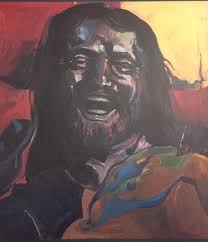
In Un Tal Jesus, Jesus is black, has a winning smile, and a very down-to-earth sense of humor. (The photo at the top of this blog entry shows Jesus as depicted in the Lopez-Vigil’s book.) The human Jesus portrayed in that radio series scandalized many and inspired even more throughout the Latin world and beyond.

As the Lopez-Vigils envision it, today’s episode takes place in a Bethany tavern owned by Lazarus, the brother of Martha and Mary. It’s a place of eating, drinking and lodging for travelers. It’s a place of laughter, joking, over-eating and drunkenness. And Jesus is right there in the middle of it all.

Passover is approaching, and the inn is full of pilgrims. It’s steamy, noisy, and loud. Martha is on the job, waiting on tables and controlling the rest of the staff. Meanwhile Mary (whom scholars increasingly identify with Mary Magdalene, Jesus closest female companion) is distracted by conversation with Jesus, who is bantering with his friends.

And what are they talking about? Religion? God? Spirituality? No, they’re joking. Jesus is posing riddle after riddle. And Mary finds it completely entertaining. In part, their dialog goes like this:

Jesus: What’s as small as a mouse but it guards the house like a lion. One, two, three: Guess what it is!
Mary: Small as a rat…and…it’s a key! I guessed it, I guessed it!
Jesus: Listen to this one: It’s as small as a nut, has no feet but can climb a mountain.
Mary: Wait… a nut going up the mountain…a snail!…Ha, ha, ha, tell me another one!
Jesus: You won’t guess this one right. Listen well: It has no bones, it is never quiet, with edges sharper than scissors.
Mary: It has no bones… I don’t know…
Jesus: It’s your tongue, Mary, which never rests!

Well, Mary and Jesus might have found that sort of patter entertaining, but Martha did not. She’s in charge of the inn and is worried about her guests waiting impatiently for their food while bread is burning in the oven. So, she makes her complaint to Jesus: “Stop your chatter and let my sister do her job!” It’s then that Jesus makes that remark about Mary’s choosing the better part. She’s chosen socializing and play over work.

Does that scandalize you – Jesus distancing himself from work? Well, it seems completely consistent with what I said about Jesus earlier. It coincides with his general approach to work, money, profit, saving, and anxiety about the future.

What difference would it make in our own lives if we accepted that message: socializing, community, and fun are more important than the work people like Donald Luskin would have us devote our entire lives to?

What difference would it make in our culture if, in a context of underpaid labor and long hours on the job we elected candidates advocating “spreading the work around,” spreading the money around, shortening the work week, and affording us more time with friends and family, eating, drinking, joking, and playing?

That’s the message of today’s Gospel reading: we need more free time, more vacations, and assured dignified retirement.

Wake up, Mr. Luskin! Wake up, American workers: You have nothing to lose but your chains.

P.S. Here’s the actual interview with Donald Luskin along with commentary by TYT‘s John Iadarola

Marianne Williamson: The Most Radical Candidate

Readings for Pentecost Sunday: ACTS 2: 1-11; PS 104: 1, 24, 29-30, 34; I COR 12: 3B-7, 12-13; ROM 8: 8-17; JN 20: 19-23

Today is Pentecost Sunday. Fifty days after Easter, it celebrates the day that followers of Jesus decided to overcome their fears and form a community to carry on Jesus work of introducing what he called the Kingdom of God as an alternative to Rome’s Kingdom of Caesar.

Whether the realization dawned on Easter day itself (as in today’s Gospel reading from John) or 50 days later (as described in the first reading from the Acts of the Apostles), today’s celebration reminds us that Jesus’ Spirit stands 180 degrees opposed to that of empire – the spirit of the world. That’s because Jesus’ Spirit is embodied in the victims of empire’s torture and capital punishment. It recognizes the poor rather than the rich as the bearers of peace, joy, and prosperity. That’s what John means by recalling that before conferring his Spirit of Peace, Jesus “showed them his hands and his side.” That’s what today’s Sequence means when it identifies Jesus Spirit as the “Father of the poor.”  

During this election season, I cannot help connecting those Pentecostal insights to Marianne Williamson. That’s because alone among Democratic presidential candidates, she specifically recognizes the incompatibility between Jesus’ teaching that prioritizes love and forgiveness and the spirit that governs our world characterized by fear, greed, lies, and violence. For Williamson, such opposition remains a spiritual truism, whether we connect it with Jesus, Moses, Mohammed, Krishna, the Buddha, or simply with LIFE or NATURE. Acknowledging that, Williamson’s candidacy is calling for a national change of consciousness from fear and greed to one driven by love and compassion.

Yes, she dares to do that with great specificity! And her wisdom and sincerity in doing so can hardly be questioned. In fact, we know more about Marianne Williamson, her philosophy, spirituality, and the workings of her mind than any other candidate. That’s because she’s spent, more than 30 years talking about nothing else. It’s all part of the public record. She’s used her spirituality (what today’s liturgy identifies with the Spirit of Jesus) to help individuals, couples, and congregations reach depths of critical thinking that even progressives might consider far too radical. For instance, she holds that:

  • We live imprisoned in a deceptive world much like Plato’s Cave.
  • There, what the world presents as truth is 180 degrees opposite of the truth of God (though no one need use that historically debased term).
  • The world’s truth is governed by fear and greed.
  • It identifies the “other” (e.g., poor people, Muslims, immigrants, refugees, non-whites, Iran, Russia, Venezuela, North Korea, ISIS) as the cause of our problems, while “we” are innocent.
  • The fact is none of those just listed is our enemy. All of us are more than brothers and sisters; in fact, there is really no meaningful distinction between us. What we do to them, we do to ourselves.
  • As a result, God’s ultimate truth is governed by love and compassion and by the realization that all humans are ultimately innocent.
  • That’s true even of Donald Trump, John Bolton, and Mike Pompeo. Though they are sociopaths who need to be removed from office and to face the consequences of their crimes, they too are performing the spiritual service of revealing as never before the corruption of the prevailing system that deceitfully serves the rich rather than the rest of us.

Insights like those have been among Marianne Williamson’s guiding convictions for more than 30 years.  And at least since 1998 and the publication of her Healing the Soul of America, she has scandalized many of her would-be followers by connecting her profound spirituality to deeply radical politics. In that book, she predicted the rise of a force like Donald Trump if the “higher consciousness community” and the rest of us failed to make similar connections. The title (and content!) of her latest book, The Politics of Love, doubles down on the radicalness of her analysis.

Imagine governing our country and the world according to the Spirit described in today’s readings. They are crystal-clear in their contradiction of what we’ve been led to accept as normal and unavoidable in the realm of politics. Review the readings for yourself. They tell us that Christ’s Spirit:

  • Is international; it loves equally people of all nations (Acts 2: 1-11)
  • Is abundantly creative and universal involving not just human beings, but all of creation (PS 104: 1, 24, 29-30, 31, 34)
  • Refuses to recognize religious distinctions, e.g. between Jews and “pagan” Greeks (ICOR 12: 3B-7, 12-13)
  • Embodies wisdom, understanding, counsel, fortitude, knowledge, and joy (Special Pentecostal Sequence)
  • Recognizes forgiveness as the key to peace (JN 20: 19-23)

Isn’t it true that most Americans, who describe themselves as somehow “Christian,” would find the convictions just listed as unrealistic or even suicidal if applied to politics?

But, of course, those ideals have never been tried. And, according to Williamson, that’s just the point. Failure to apply the spiritual insights advocated by Jesus and those other spiritual avatars have led us to our present impasse. That “realism,” she observes, is what’s really suicidal. It’s destroying our planet and threatening us with nuclear holocaust. For Williamson, making America great again means following a radically different path. It means following the example of Quaker-inspired abolitionists, of the similarly motivated suffragettes, of the Baptist preacher Martin Luther King, of war-resisters like the Catholic priests Phil and Daniel Berrigan, of Dorothy Day and Mohandas Gandhi. Those figures and the tradition they represent constitute the truly “great” part of the American tradition. 

To put it bluntly, Marianne Williamson, like the feast of Pentecost itself, is asking Americans to overcome their fears and form the beloved human community envisioned by Jesus, King and those others. But to do so, she says, we must completely reject everything empire values as true and worthy. Instead, Williamson invites us to recognize solidarity with those empire actually despises. Russians, Chinese, Iranians, Venezuelans, Syrians, North Koreans, Muslims, immigrants, the poor in general, even ISIS fighters, and especially the world’s children are beloved by God. Rather than rejection, wars, dronings and sanctions, they deserve respect and inclusion in any negotiations that affect them. At the same time, those actually in power are often thieves, sociopaths and criminals. They deserve compassion but must be treated accordingly. All of that encapsulates the radicalness of Marianne Williamson’s approach to politics. It also encapsulates the Spirit of Jesus – his ultimate gift celebrated this Pentecost Sunday. Is that too radical, even for Christians, even for progressives?  The alternative, Williamson reminds us, is just not working out.