More Happiness in the Barrios than in the Suburbs

Moon-lightening

Here is a thoughtful comment on my posting of February 6th, “Why Bother with the Historical Jesus?” It’s authored by a friend of mine, Jim Cashman (photo above), who studied with me for three years at St. Columban’s Major Seminary in Milton, Massachusetts when I was there from 1961-1967. Jim was an exchange student from Ireland, where he was ordained in 1964. Like most of us from that era, he left the priesthood after the Great Awakening which followed the Second Vatican Council (1962-’65). Jim writes:

In my view if all we have is subjective and “bias” and hence doubtful history on Jesus, then the more digging one does, especially based on modern science, the better it is for us getting to the reality on Jesus. The Jesus uncovered by science is vastly superior to the faith or propaganda-based version. I have always been dubious about taking anything on faith. It leads to too many wars! What we seek is the truth not support for our environmental brainwashing.

The thing which I regard as above debate is the focal point of your blog. I’m referring to the nature or qualities of God. Factually we know so little about that – maybe nothing. Given that reality, it seems better not to think of Jesus as the son of god or of God being Jesus, but as simply reflecting the nature of God. That seems to be the important point you make. I never had any hang-up/special needs for the divinity of Jesus or the virginity/motherhood of God. I do not feel it is central to the Jesus message. It might be central to Catholicism, but not to understanding of the meaning of my life. Why the hell am I here?

What I find central is that Jesus (like many of the prophets), reflects the core nature of God and that is Love. I feel this Love is not what we think it is. It’s not charitable foundations or helping old folks like me cross the street?

Maybe as Paul hints we are not yet sufficiently evolved or “spiritual” to accept Jesus’ very simple revelation about the nature of God as Love. Now we known in part; then we shall know fully – even as we are fully known. From Krishna to Christ this is the common unifying thread of human development: giving without any payback or satisfaction!. All of this contradicts where we are in the world of greed, self interest and now the ultimate decadence – endless ‘shopping.’

If we all take from nature only enough for what we need, then the poor we could “always have with us” – as equals. Even with the little they have, the stats show there is more happiness in the barrios than in the suburbs.

The worst outcome we could have from the present move against the hypocrisy of Rome (and Washington) is that we achieve “renewal” and leave the real task – the search for truth, for another millennium.

Keep pushing out the boundaries, Mike; we are at the early stage of evolution. And in your downtime you might find this of interest:
http://archive.org/details/ACanticleForLiebowitz The irony like. “1984”, is chilling. Jim

PS – the “stream” may need some manual help in this dramatized audio edition.

Why Bother with the Historical Jesus?

I’m about to offer a Lenten course on the historical Jesus to the members of my faith communities – to my fellow parishioners at St. Clare’s Catholic Church in Berea, Kentucky, and to an “Ecumenical Table” fellowship I attend.

A course on the historical Jesus? A friend of mine asked why. After all, everyone knows we can’t know much about the Jesus of history. Virtually all we have for sources are the highly subjective gospels produced by several Christian communities long after Jesus had died. And close examination of those gospels show them to be unreliable in terms of modern ideas about history. At best they’re propaganda intended to win converts to Christianity. They contain lots of made-up stories and words attributed to Jesus long after the fact. If that’s all we have, how can we really say anything about the Jesus of history? And what does it matter?

Many highly credentialed and very credible scholars have seconded my friend’s skepticism. Theologians as weighty as Rudolf Bultmann and Karl Barth have said in effect “fagedaboudit.” It’s not for nothing that St. Paul concentrated on Jesus’ death, resurrection and glorification “at the right hand of the Father.” And he was writing less than 20 years after Jesus’ death. For Bultmann and Barth (and it seems for Paul) that’s all Christians have to know. Jesus words and deeds actually matter very little.

Still, others have disagreed – most notably the four canonical evangelists (Mark, Matthew, Luke, and John) and the authors of more than 20 “gospels” discovered since the middle of the 20thcentury at the Dead Sea and Nag Hammadi in Palestine. They found it necessary to record what Jesus said and did.

Modern scholars on a par with Barth and Bultmann have followed suit. Albert Schweitzer, liberation theologians, and members of the Jesus Seminar have insisted that it’s necessary and possible to know what Jesus said and did. He after all (and not what later believers made of him) was the definitive Symbol of God. His every word and action is full of meaning in terms of revealing God’s identity. In that sense, Jesus is not God. Rather God is Jesus. Without the historical revelation of what Jesus said and did, we would have very little idea of who God is.

In order to know what Jesus revealed, it is therefore necessary to decipher the symbols of God that Jesus’ words and deeds provide. And besides, the Judeo-Christian tradition as a whole claims to be historical. It’s not mythological like Greco-Roman religious systems. So the historical Jesus is important as a final criterion of faith. We impoverish that faith by relying merely on Jesus’ death, resurrection and glorification as related by Paul and others.

Not only is it necessary to know what Jesus said and did in order to know the fullness of revelation of God that Christians find in him. It is also possible to do so – at least according to “Jesus scholars.” They have developed an elaborate set of criteria for separating the events of Jesus life that surely took place from those made up by the early Christian community. Similarly, their standards help readers identify what Jesus actually said from the words that early Christians put into Jesus’ mouth.

Chief among such criteria is the standard of “embarrassment.” That means that events and sayings that would have caused embarrassment to the early Christian community must have happened, otherwise early believers wouldn’t have recorded them. The crucifixion of Jesus is a case in point. And so is his baptism at the hands of John the Baptist – as well as his association with outcasts and “unclean” sinners. Jesus’ baptism gives the impression that John was superior to Jesus. His crucifixion was a huge stumbling block for those trying to convince people that he was the Messiah. Nobody would have made up such events from whole cloth. They were too embarrassing.

Still doubts remain about the historical Jesus – as they do by the way for all historical characters and events all of which become obscured by rumor, myth, falsehood, and the agenda of those writing the “history.”

What we can know a great deal about is Jesus’ historical context. In fact knowledge of Jesus’ context is knowledge about him. Take for instance the work of forensic archeologists. They can tell us what the people of Jesus time and place looked like – something none of the gospels offer. Forensic archeologists tell us that he stood about 5’1 and weighted about 110 pounds, and looked like this:

SON OF GOD

Not like this:

th[7] (2)

The bottom line here (and in the course I’ll offer) is that the work of the Jesus Seminar and others involved in quests for the historical Jesus is extremely helpful, but not crucial. What is crucial is to read the gospels we have with as much knowledge of context as we can. The gospel reading that results is called “historical literal.” It takes the gospels at their word keeping in mind what we can know of the author’s intentions, literary strategy, theology, and context (social, political, economic, religious . . .).

Reading the gospels with such new knowledge in mind yields an extraordinary picture of an individual the likes of whom mainstream history routinely ignores, denigrates and erases from the collective memory — a poor man who inspired other poor people to realize that they meant a lot more to God than their rich and powerful contemporaries.

Marx and Jesus: The Trouble with Prophets

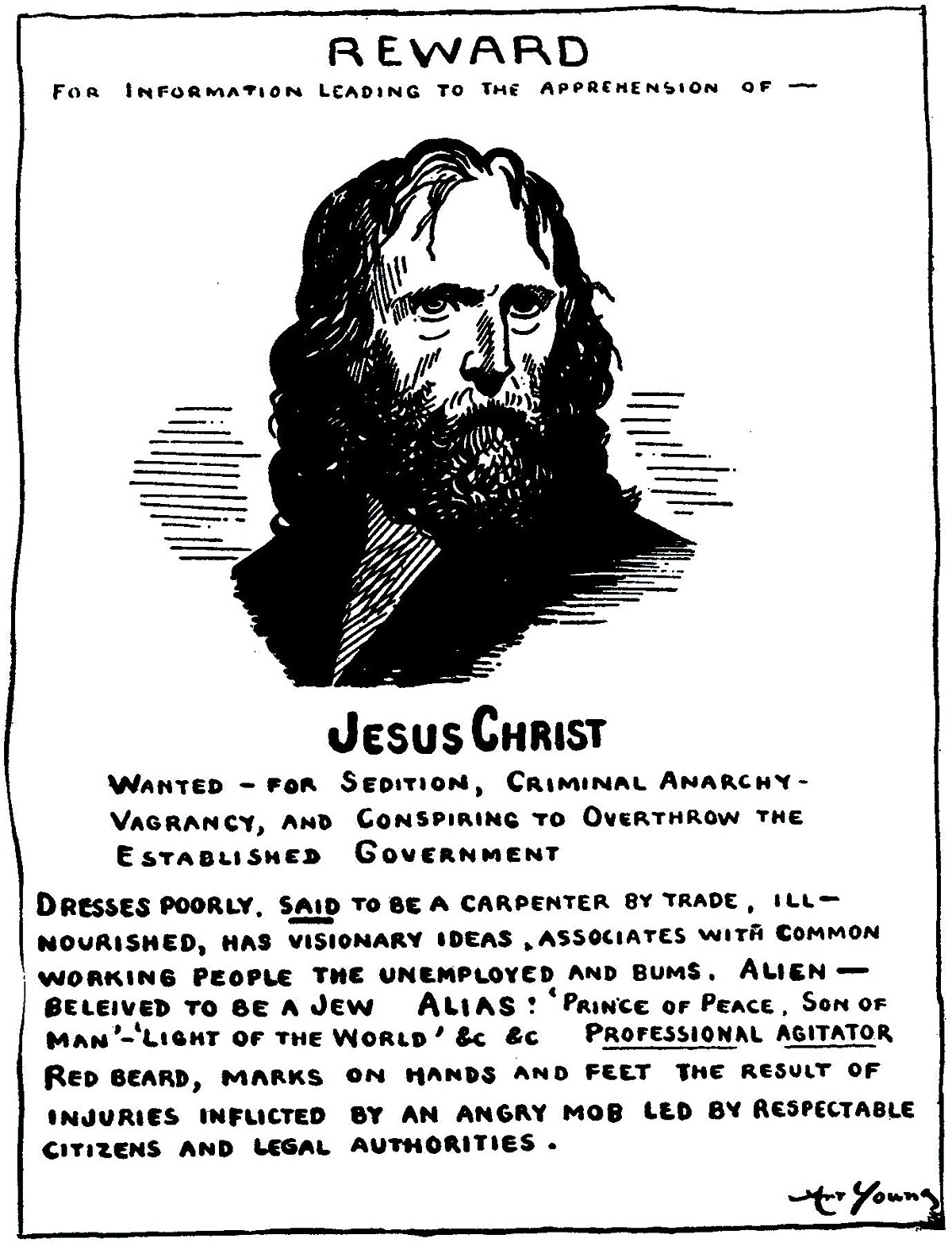
00-art-young-jesus-wanted-poster-he-stirreth-up-the-people-1913

Readings for 4th Sunday in Ordinary Time: Jer. 1: 4-5, 17-19; Ps. 71: 1-6, 15-17; I Cor. 12: 31-13; Lk. 4: 21-30 http://www.usccb.org/bible/readings/020313.cfm

I remember when my ideas about prophecy changed – when I really began to understand the term’s implications. I was a graduate student in Rome – already a priest – and completing my doctoral studies at the Academia Alfonsiana on the Via Merulana there in the “Holy City.” I was taking a class in I’ve forgotten what. But my professor (a German Redemptorist as I recall) got my attention during one of his lectures by referring to Karl Marx as “the last of the great Jewish prophets.” That was in 1970 at the height of the Cold War, and I had been reading Marx and about the then-flourishing Marxist-Christian dialog. I realized that my professor was right.

Marx of course was a Jew like Jesus, and Jeremiah who are centralized in today’s liturgy of the word. Like them, Marx was totally absorbed by questions of social justice for the poor and exploited. He was pretty much penniless, like most prophets, and spent his time thinking, writing, speaking, and organizing workers against exploitive employers. He was also highly critical of organized religion and its idols.

Marx’s insight (shared with the biblical prophets) was to realize that both Judaism and Christianity worshipped idols more often than the God of Israel. And by that he meant “gods” who not only justified an oppressive status quo, but who anesthetized the workers and unemployed to the fact that they were indeed oppressed by the capitalist system. Marx called such idols “the gods of heaven.”

We’re all familiar with what he meant. These idols are worshipped each Sunday – usually from 11:00 to 12:00 in what a theologian friend of mine used to call the “be kind to God hour.” You can encounter the “gods of heaven” any day at any hour on Cable television’s Channel 3 or in most Catholic Churches any Sunday morning. “God” there is concerned with correct worship, with bows, genuflections, and with correct terms such as “consubstantial,” “chalice,” “with thy spirit,” “under my roof” and so on. The stories or mythology upholding such idols have to do with “Jesus as your personal savior,” with “going to heaven,” and with avoiding hell.

Marx was also critical of what he called the “gods of earth.” They’re what people worship all those days and hours when they’re not in church. They include Capitalism, “America,” Nationalism, National Defense, Homeland Security, the Military, Money, and Profit. The issues of this God focus on sexuality: contraception, abortion, and same-sex marriage. This God is a War God – always on the side of “America.” He’s celebrated in songs like “The Battle Hymn of the Republic” and “Proud to Be an American.” He is the protector of “religious freedom” understood as privileging Christianity over other faiths while preserving tax exemptions worth billions each year. He blesses the bishops’ “Fortnight for Freedom” concerned as it is with protecting such benefits.

Marx’s prophetic work made him extremely popular with working classes. It was not uncommon for a worker to request that he be buried with a copy of “The Communist Manifesto” placed on his chest.

At the same time, Marx was vilified as the devil himself by factory owners, businessmen, bankers, and the professors and politicians representing their interests. Defenseless against such “education,” most of us have accepted such defamation of this last of the great Jewish prophets.

You see, that’s the trouble with prophets like Marx, Jesus and Jeremiah. They have to take on the “powers and principalities” of their cultures. They must swim against the torrential stream of public opinion.

In today’s first reading, Jeremiah is informed of his lot. But he must “man-up,” he’s told. He must steel himself to confront the “whole land,” along with kings and princes, priests and people. All of these, he’s warned, will fight against him. Nevertheless, God will make of Jeremiah a ‘fortified city,” a “pillar of iron,” and a “wall of brass.”

I suppose God followed through on those promises. But that didn’t prevent Jeremiah from being imprisoned, tortured, and left for dead.

Of course, the same thing happened to Jesus from the beginning to the end of his public ministry. He was vilified, demonized (literally!) and defamed.

That process begins for Jesus in today’s selection from Chapter 4 of Luke’s gospel. As we saw last week, he returns to his hometown of Nazareth and criticizes his neighbors’ narrow nationalism. In today’s episode his neighbors try to kill him. Later on, of course, Jesus goes more public. Like Jeremiah, he takes on his nation’s priests and scribes, princes and king. Ultimately his words and deeds threaten the Roman Empire itself which classifies him as a terrorist. Together those powers and principalities (national and international) not only defame Jesus the way Jeremiah and Marx were defamed; they actually kill him just as so many prophets have been killed from John the Baptist and Paul to Martin Luther King and Gandhi.

All of them – Jesus, Jeremiah, Gandhi, King, Paul and Marx – followed the same “prophetic script” whose inevitable directive prescribes that no prophet is accepted in her or his native place. It’s easy to see why. It’s because their “native place” bears the brunt of their prophetic words.

Meanwhile, it’s easier for outsiders to recognize prophets. The “outsiders” who concerned Jesus were the uneducated, poor, and unclean. However, even those seem to turn against him this morning. It’s unlikely that there were any rich or powerful resident in Nazareth – a place scripture scholar Ched Myers describes as “Nowheresville.”

Few of us are rich and powerful. Yet we’ve been schooled by those entities to reject prophets who speak in our name and defend our interests – those belonging to our “native land” to use the words of this morning’s gospel. It’s as though we’re looking at reality in that “darkened mirror” Paul wrote about in today’s excerpt from his letter to Corinth. The darkened mirror not only turns things backward, but it’s smudged with the fingerprints and dirt of ignorant and/or perverse propagandists.

The trouble – the trouble with prophets – is that most of us have bought into all that anti-prophet propaganda. So we hate Karl Marx without realizing that he’s on our side and speaks for us. We honor the Martin Luther King who has been reduced to a “dreamer,” but not the MLK who described the United States as the most violent and destructive country in the world. We don’t remember the King who was slandered as a communist and encouraged to commit suicide by the FBI and the COINTELPRO program.

We’re willing to stand by while Wikileaks journalist Julian Assange is persecuted by the governments of Great Britain and the United States. We presume that Bradley Manning is guilty of treason because our government, (despite its record of lies and heinous crimes) says so. We wonder what all the fuss is about Aaron Swartz.

These are the prophets of our time who, like Jesus, do not find a sympathetic hearing in their native place. It might be time to embrace them as our own and see what difference that makes in the way we look at the world and our country. The examples of Jeremiah, Jesus, and Paul — and the hopes of the world’s poor and victims of U.S. wars — beg us to do so.

Be Like Jesus: Break the Commandments!

Since last Sunday and a sermon I heard about Ezra reading “the law” to the people for hours, I’ve been thinking about Jesus and the law. Chief among my reflections is the one that sees Jesus as anything but the stickler for the law that Christians have made him out to be. Neither is God primarily concerned with “keeping the commandments.” Rather, as God’s Symbol, Jesus revealed a God of compassion, not the angry punisher we’ve been schooled to believe in. Let me explain.

To begin with, we often confuse the Jewish meaning of The Law with laws. “The Law” refers to the Pentateuch – the first five books of the Jewish Testament: Genesis, Exodus, Leviticus, Numbers, and Deuteronomy. Those books tell the story of Israel’s foundation with the focus on the account of the liberation from Egypt under the leadership of the rebel hero, Moses. Those readings reveal a God whose main interest is in liberating an enslaved people from oppression by the rich and powerful.

So when the priest-scribe, Ezra, read the Law to the people in last Sunday’s selection from Nehemiah (8:2-6, 8-10), he was telling them the basic story of Israel’s foundation – something they had apparently become foggy about during their more than fifty years of exile in Babylon (586-531 BCE). He was reminding them that they had been enslaved much more cruelly in Egypt than they had in Babylon.

Their oppression in both instances should have reminded them of The Law’s basic thrust – viz. Do not forget where you came from! As a result of such memory, the inheritors of the Mosaic tradition were to take care of slaves, widows, orphans, resident aliens, and “the poor” in general – people like themselves. “The Law” was a call to freedom and compassion – not to guilt, shame and judgment of others.

Over the years, however, especially under the tutelage of the priestly classes, understanding of “The Law” shifted from the myth of Israel’s origins to strict rules and regulations. These were also contained in the first five books of the Jewish Testament, but were not as central as the Exodus story. The regulations had multiplied over the more than a thousand years between their supposed formulation and the life of Jesus.

And by Jesus’ time the professional religious classes of priests, scribes, and lawyers had virtually identified being a good Jew with observance of the legal codes of the lawyers and priests. If you kept the laws, you were a good Jew and “clean.” If you did not (or could not) you were “unclean” and excommunicated. People were considered unclean because of their occupations (e.g. tax collectors, shepherds, and prostitutes). They could also become “unclean” for touching a corpse or, in the case of women, by simply experiencing their menstrual periods.

What I’m saying is that by Jesus’ time, Jewish laws had become burdensome and oppressive. They had assumed disproportionate importance over the story of Israel’s beginnings. They were interpreted as calling community members to invidious judgments rather than to compassion.

This is where “the Prophets” came in. Together “The Law and the Prophets” comprised the Jewish Testament I’ve been referring to. The prophets were people like Elias, Jeremiah, Isaiah, Amos, John the Baptist – and Jesus. They represented a counterbalance to legalistic interpretations of scripture.

When the prophets spoke of the Law, they were referring more than anything to the story of God’s compassion for oppressed people. That’s what Jesus meant when he said “I have come not to abolish the Law or the prophets but to fulfill them (Mt. 5:17). In fact, the prophetic task by and large was to call Israel back to its origins. The prophets (and Jesus in particular) harshly criticized the priestly classes and their legalist allies for giving too much import to the laws as opposed to Israel’s great Myth of Origin — the The Law.

So Jesus got into great trouble with the lawyers and priests for breaking the laws in the name of The Law. Especially galling to the religious leaders of his day was Jesus’ willingness to put compassion ahead of the Law of Laws, Sabbath observance. He even put that law in its place by giving it a completely humanist interpretation: “The Sabbath was made for human beings; human beings were not made for the Sabbath” (Mk. 2: 27).

That’s what I mean by urging “Be like Jesus: break the Commandments!” I mean we should be humanistic and put compassion above the legalisms we’ve come to identify as Christianity.

Jesus as Self-Hating Jew!

Readings for Third Sunday in Ordinary Time: NEH 8; 2-6, 8-10; Ps. 19: 8-10, 15; I Cor. 12: 12-30; Lk. 1:1-4; 4: 14-21 http://www.usccb.org/bible/readings/012713.cfm

Last week I published an editorial on my blog site that was picked up by the Lexington Herald-Leader (http://www.kentucky.com/2013/01/19/2482073/ky-voices-the-chosen-people-are.html) and by OpEdNews (http://www.opednews.com/articles/Unconditional-Support-for-by-Mike-Rivage-Seul-130118-813.html.) It was about Chuck Hegel and the criticism he has endured from the American Israel Public Affairs Committee (AIPAC) and people like Elliot Abrams, the former Undersecretary of State for Human Rights in the Reagan administration.

Hegel had been nominated for Secretary of Defense by President Obama. Abrams and the others had criticized the nominee for being insufficiently supportive of Israel and therefore unfit for the “Sec Def” position. Hegel’s critics were looking for “unconditional support” for Israel, and didn’t find it in President Obama’s candidate. Their criticism was so effective that Hegel has since been forced to apologize for his past criticisms of the Jewish-Zionist Lobby.

Many Christians probably felt vindicated by Hegel’s groveling before his Jewish critics. After all, they might reason, Israel is God’s Chosen People; they deserve unconditional support.

However, today’s liturgy of the word underlines the point I tried to make in my op-ed: the phrase “God’s Chosen People” does not primarily refer to a national entity, but to the poor and oppressed.

Biblically speaking, it is true that Israel did fit that profile at the time of its origin – in Egyptian slavery (13th century B.C.E.) – and later during its captivity in Babylon (6th century B.C.E.). They were oppressed as well as when Israel was under the control of the Assyrians (8th century), Persians (6th century), Greeks (2nd century), and Romans (1st century). Then, precisely as oppressed, they were the object of God’s special love and protection.

At Mt. Zion, Moses enshrined in the law protection of people like them – slaves, widows,orphans, immigrants, the imprisoned, and the poor.

That’s the Law that the scribe, Ezra is recorded as reading to the people for hours in today’s first reading. They had just returned from exile in Babylon. For them “The Law” (the first five books of the Bible) was a source of joy and strength. After all, those books recounted what for Jews was the liberation of all liberations – from Egypt under the leadership of the great rebel hero, Moses. With Ezra in charge, they were celebrating the end of a long and painful experience in the geographical area that is now “Iraq.” Ezra reminded the assembled people that in their return to the Promised Land, they were experiencing Exodus all over again. Indeed, he said, it was a time for celebration – eating rich meats and drinking sweet drinks.

Today’s second and third readings pick up on Ezra’s theme – that God favors the poor and oppressed. However both Jesus and Paul do so emphasizing the point that Yahweh’s favored ones are not always Jews. When Jesus said that in his hometown synagogue, it enraged his former neighbors. (Their response reminds me of Elliot Abrams and the AIPAC demanding “unconditional support” for Israel.)

By the way, did you notice the strangeness of the reading from Luke’s gospel today? It starts out with the very first verses of Luke, verses 1-4. There the evangelist announces his intention – to carefully draw on the oral traditions of eyewitnesses and present an orderly researched account of what Jesus said and did.

But then the reading suddenly jumps ahead to Luke chapter 4 and presents Jesus’ preaching in his hometown synagogue in Nazareth. That gives the impression that Jesus’ first significant act was that Nazareth sermon. Perhaps it was – since Luke’s “infancy narratives” belong more to the realm of poetic imagination than of history.

Today’s reading also leaves out the response of those who heard Jesus’ words in Nazareth. (And that’s where the theme of “chosen people” becomes relevant.) Verses 22-30 tell us that the Nazarenes were outraged by Jesus’ implied criticism of Jews and his openness to non-Jews. After all, he had charged that prophets like Elijah and Elisha found more receptivity to their work in Lebanon (Sidon) and Syria than they found among Jews in Israel.

“Who does this guy think he is?” the Nazarenes asked indignantly. “We know his family; he’s nothing special. Yet here he is speaking critically about his own people! He must be one of those ‘self-hating Jews’.” Luke says Jesus’ hometown citizens were so outraged that they tried to kill him. (Chuck Hegel is in good company!)

Jesus’ words before the Nazarene’s attempted assassination do not merely underline the identity of God’s chosen as the poor and oppressed rather than exclusively the Jews. The words are also central in terms of Luke’s definition of Jesus’ entire project. In fact they connect that project with God’s very identity as described throughout the Jewish Testament particularly by the prophet Isaiah whose words Jesus quotes: “The Spirit of the Lord is upon me, because he has anointed me to bring good news to the poor. He has sent me to proclaim release to the captives and recovery of sight to the blind.”

Did you notice the importance of the word “because?” It absolutely identifies the “Spirit of the Lord” with Ezra’s good news to the poor about release from captivity and recovery of sight? Jesus is saying we know that “The Spirit of the Lord is upon” him because he brings good news to the poor, those in captivity and the blind. Jesus goes on to say that his commitment to the poor is what will define his entire mission. (The implication here is that anyone who brings good news to the poor, those in captivity and the blind embodies the Spirit of God.)

Today’s excerpt from Paul’s letter to the Greeks in Corinth continues that theme of Isaiah, Ezra, and Jesus. Only Paul does so in terms of a familiar yet powerful metaphor – what he calls the “Body of Christ” enlivened by the “One Spirit” of God. For Paul followers of Jesus constitute the way the Master is present today long after Jesus’ death. As that presence, we are Jesus’ hands, feet, eyes, ears, and tongue. And Paul specifically says it makes no difference whether one is Jew or Greek, slave or free, male or female.

What does make a difference though is one’s social standing. Paul goes out of his way to say that the “less honorable” and the “less presentable” in Christ’s body are to be more honored and cared for than the more presentable and more honorable according to the standards of the world. The weaker parts, he says are somehow “more necessary” than the stronger parts. This could hardly be a clearer reference to the poor and those who are normally neglected and looked down upon. Here Paul is following the thrust of Jesus’ words and deeds by turning the social order upside-down. The poor and oppressed come first in God’s order.

Today’s readings are calling us to grow out of our nationalism that understands Jews or Americans as God’s favorites. They call us to become citizens of the world – or in Jesus’ words to be cured of our blindness.

He wants us to finally see, the readings suggest, that the Jews as such are not God’s people. Neither are Americans. In God’s eyes, (despite the protests of our politicians and talking heads) our country is not the greatest in the world. For in the body of Christ there is neither Jew nor Greek, American, Afghani, Iraqi or Cuban.

Instead, true followers of Christ recognize that our allegiance belongs to the Body of Christ. This means that our care should be showered on the widows, orphans, undocumented immigrants, beggars, and social outcasts – LGBTQs, victims of AIDS, mothers on welfare, and on Mother Earth herself. These are the poor and oppressed. These are God’s people.

Our presence at this Eucharist represents our pledge to put the needs of those groups and individuals before our own.

Given the numbers of those who claim to be Christian, if we followed through on that pledge, how drastically different our world would be! Don’t you agree?

Unconditional Support for Israel? Even God Couldn’t Pass that Test!

Bible

In last week’s debate about Chuck Hegel’s nomination for Secretary of Defense, the phrase “unconditional support for Israel” surfaced as the expressed or implied criterion for Senate approval of nominee Hegel. Individuals like Elliot Abrams and organizations such as the American-Israel Public Affairs Committee (AIPAC) implicitly used that criterion to criticize the nominee for failing to offer such support despite Mr. Hegel’s unblemished record of voting for Israel’s interests. In doing so the AIPAC and its allies were evidently hoping to find receptive ears in the conservative Christian community which typically constitutes Israel’s strongest support-group on the grounds that the Jews are God’s “Chosen People.”

However, even passing acquaintance with the Bible shows that God himself (sic) never offered “unconditional support” of Israel, nor did the prophets, or Jesus of Nazareth. In fact, the Bible’s stories are largely accounts of Israel’s infidelities, of prophetic criticism of those failures, of their severe punishment by God. (Prophets, of course, were routinely denounced, persecuted, and killed for not offering unconditional support to the Jewish state.)

Usually divine punishment came in response to neglect and mistreatment of those who arguably represent God’s real “chosen people,” viz. the poor and oppressed – the widows, orphans, and resident immigrants. In fact, it might be argued that the Jews were God’s chosen people only insofar as they made up a paradigm of the poor and oppressed when Jacob’s descendents were enslaved in Egypt and exiles in Babylon. Given that understanding, the Palestinians today far better fit the profile of “chosen people” than do Zionist Jews.

Imagine the changes that would take place in U.S. domestic and international politics if Christians adopted the understanding of chosen people as the country’s and world’s poor and oppressed. Imagine if they demanded that nominees for Secretary of Defense or of President (!) show evidence of unconditional support for inner city children, the homeless, LGBTQs, AIDS victims, and the billions on our planet living on less than $2 a day. Imagine if they recognized Mother Earth herself as oppressed by U.S. consumption patterns and demanded the reforms necessary for her unconditional support.

If Christians made such demands (as we should), our country, our world would be an immeasurably better place. Because we do not, but concentrate instead on a nationalistic understanding of chosen people, Christians end up aggravating the world’s problems rather than pointing the way to solutions.

It’s time to change, read the Bible through the eyes of the poor and oppressed, and make demands accordingly.

Jesus Decides to Redeem His Wasted Life (Sunday’s Homily)

Readings for Feast of Baptism of the Lord: http://www.usccb.org/bible/readings/011313.cfm

Today is the Feast of the Baptism of the Lord. In that context, let’s think about baptism and the differences between the understandings we’ve inherited and those reflected in the practice of John the Baptist and Jesus of Nazareth. Those differences hold practical implications for our own lives as we wrestle with a faith that may have lost meaning for us, and as we struggle with the relative smallness and insignificance of our lives.

To begin with, think about traditional beliefs about baptism. If you’re like me, you may find them hard to swallow. A friend of mine, theologian Tony Equale, has recently pointed out that theology doesn’t really determine worship patterns. Instead superstitious temple and church rituals have shaped our beliefs. Practice determines belief, not the other way around. (See http://tonyequale.wordpress.com/2013/01/03/the-religiosity-of-the-people/)

What my friend means is that theology’s job has traditionally been to rationalize what people actually do in their efforts to tame life and achieve contact with the numinous, the mysterious, and the transcendent. They sacrifice chickens, behead bullocks, or vivisect lambs and then burn the animals’ carcasses. The smoke thus ‘feeds’ the Gods who are believed to need nourishment, placation, and cajoling in order to do the will of the people and their priests. Those congregations actually turn out to be more intelligent than the God who must be informed of their needs and what is best for their welfare. That’s superstition.

Catholic beliefs around baptism and the “sacrifice of the Mass” are cases in point. They were actually formed by the People’s credulous practice of baptism which was informed more by ancient ideas of all-powerful angry Gods than by Jesus’ radical teaching that God is Love. I mean early on, in a time of very high rates of infant mortality, popular belief came to see infant baptism as necessary to somehow save deceased children from a hell created by a threatening God.

This practice of the people rather than reflection on the words and deeds of Jesus led St. Augustine at the beginning of the 5th century to theorize that people have been born guilty – at enmity with God. Augustine thought that since children were condemned even before any personal sin on their parts, they must be born in sin. And that must be, Augustine reasoned, because they had inherited sin from their forebears and ultimately from the first human beings, Adam and Eve. Because of that “original sin,” God is justly angry with humans.

Now, as I said, the ancients believed that sacrifice was necessary to placate an angry God like that. So, in the Roman world, where sacrifice was understood in the terms I’ve just explained, Jesus’ death eventually became to be seen as a sacrifice whose primary purpose was to secure God’s approval of the Roman state. In this way, the “Mass” was transformed from a memorial meal to a re-enactment of Jesus’ sacrificial death. It was moved from a table with friends gathered around sharing food, to a “sacrifice” performed at an “altar” by a priest with his back turned to the people who watched the show from afar.

This Mass differed very little from what Romans were used to before Christianity became the state’s official religion in 381. In fact, it is entirely possible that ordinary people saw no difference between the “Mass” and the religious ritual they had been accustomed to when Jupiter or Mithra were worshipped as the official Gods of Rome. In other words, Christianity was transformed by the Roman Empire rather the empire being transformed by Christianity. There was a “theogony,” a battle of the Gods, between Jupiter and the Bible’s Yahweh; and Jupiter won. We’ve been worshipping him ever since.

How different all this is from what happens to Jesus at the baptism which today’s liturgy of the word celebrates! (And that brings me to my point about meaning in our seemingly wasted lives.) In today’s gospel, there is nothing suggesting “original sin.” Nor is Jesus presented as the incarnation of a God who needs to be mollified by sacrifice. Rather, Jesus comes as a disciple of John. (Scripture scholars tell us that John’s words about his inferiority before Jesus were inventions of the early church in a Jewish context where many still believed that John rather than Jesus was the long-awaited Messiah.)

So at the age of 30 or so, this young peasant from Nazareth presents himself for a ritual washing at the prophet’s hands in the legendary Jordan River. In Israel’s idealized past, that river had been crossed by slaves escaped from Egypt who on the river’s opposite shore found the “Promised Land” that became their national home. Eventually that crossing came to be understood as transforming a motley horde of renegade slaves into a unified nation of free people at the service of the God who had liberated them from demeaning servitude.

John’s practice of baptism in the Jordan (far from the corruption of the priests’ Temple and its endless sacrifices) summoned his Jewish contemporaries to reclaim their ancient identity that had been lost by the priests and scribes who had sold out to Roman re-enslavement of a once proud and liberated people.

John’s was a revivalist movement of Jewish reform. Those presenting themselves for baptism were expressing a desire to return to their religious roots and to alter their lives in a profound way.

Evidently, that’s why Jesus came to be baptized too. This country boy who (according to Luke’s “infancy narratives”) had begun his life with such promise is now about 30 years old. Perhaps in view of his parents’ expectations of him, his life so far seemed wasted. Perhaps he had resolved to finally make a difference. In any case, by approaching John in the Jordan’s waters, he expresses an intense need for change in his life. He wants to be John’s follower.

So John performs his baptismal ritual. And the miraculous happens. An epiphany occurs for Jesus. He hears a voice. It informs him that he is a child of God. Immediately he sets out on a vision quest to discover what those words might mean. Forty days of prayer and fasting bring on the visions – of angels and devils, of temptations, dangers and possibilities.

In the light of his desert experience, Jesus chooses not only to follow John as the leader of a reform movement. He chooses as well to follow Moses as the liberator of an enslaved people. He has truly crossed the Jordan. So he brings his message to the captive poor. Like him, they too are children of God — God’s specially chosen people. God’s kingdom belongs to them, he says, not to their rich oppressors. The poor must not allow themselves to be misled by the stultifying and domesticating doctrines of the priests and scribes. That was the thrust of Jesus’ teaching.

Coherent acts follow Jesus’ words. He discovers wondrous healing powers within himself. By touch, by faith, by his friendship, he cures stinking lepers, dirty beggars, street walkers who have lost their self-respect, the deaf, the dumb, the blind and lame. Jesus eats food with the social outcasts and street people of his day, sharing nourishment the way God does – without cost or expectation of reciprocation. Jesus finds himself explaining the mysterious, transcendent and ineffable in unforgettable stories that capture the imaginations of simple people hungry for the spiritual sustenance that he offers – that he embodies. No wonder his early followers tried to imitate Jesus by choosing John’s baptism as a sign of membership in their community and by following the Master’s example of sharing food the way God does in their re-enactment of the Lord’s Supper.

That was the understanding of baptism and Lord’s Supper that the first generations of Christians embraced. But it didn’t last long. Within a few generations (and especially after Christianity became the official religion of the Roman Empire at the end of the 4th century) the superstitions I referenced earlier had replaced the understanding and practice of Jesus and the Baptist. Soon baptism became an instrument for saving babies from original sin and hell. Soon the Lord’s Supper became the “Holy Sacrifice of the Mass” differing very little in ritual and spirit from offerings to Jupiter and Mithra.

Today’s liturgy of the word calls us beyond all of that. It summons us to follow Jesus who shows us the way to truly change our lives. Change comes by leaving behind the superstitious faith that supports empires past and present. Transformation comes when we share our food with each other and with the poor. It happens by committing ourselves to the “other world” represented by God’s Kingdom that has room for everyone, not just for the 1% served by our own churches, priests, scribes and their superstitious rituals.

Today’s liturgy of the word summons us to the banks of the Jordan to stand with Jesus and to hear God’s voice calling us from what has been so far wasted in our lives. Like Jesus, we are daughters and sons of God. We are beloved by the God of Love. Jesus’ example reminds us that It’s not too late to change our commitments and way of life.

After all (if we take our tradition literally) Jesus redeemed the insignificance of his own life in a single meaningful year – or maybe it was three.

Summary and Conclusions about the Historical Jesus (Part Two)

(This is the fourteenth in a series of “mini-classes” on the historical Jesus. Together the pieces are intended to assist those who wish to “dig deeper” into the scholarly foundations of postmodern faith and to understand the methodology behind the postings on the blog site. Today’s post is the last of a two-part conclusion of the series.)

In searching for the historical Jesus, it helps to remember that we know much more about the object of our quest than ever before. Mid-twentieth century discoveries at the Palestinian locations Qum Ran and Nag Hamadi have yielded manuscripts that have acquainted scholars with previously unknown sources about Jesus. Just as importantly, developments in the fields of history, linguistics, and archeology have made us more knowledgeable about Jesus’ historical context than any previous generation. Acquaintance with such context constitutes actual knowledge about Jesus and the people with whom he interacted.

Similarly, the disciplines like sociology, economics, psychology, and political science have developed principles that describe how individuals within given networks typically act in particular circumstances. One such standard might be termed the “principle of analogy. It holds that: We should ordinarily expect to have happened in the past what routinely happens in the present as described by the social sciences.  For instance, we know that Jesus grew up under Roman oppression. About the time of his birth, the recently unearthed capital of Galilee (Sepphoris – just six miles from Nazareth) was destroyed by Roman soldiers trying to wipe out insurgent patriots. Sociologists tell us (and imperial armies act upon this knowledge) that such wars of resistance end up involving virtually the entire local population. This means that Jesus and his family were likely involved as well. All such extra-biblical information helps us better understand the historical Jesus.

Such determinations also coincide with two interpretative guidelines that have emerged from third world scholarship over the last forty years or so. One standard is called the “preferential option for the poor.” The other is “the hermeneutical privilege of the poor.” Both signal a source of knowledge of the historical Jesus that is often neglected and even denigrated by mainstream biblical scholarship.

The option for the poor highlights the biblical fact that the God of the Bible in general and of the Christian Testament in particular takes sides with the poor in their ongoing struggle with the rich. In the Jewish Testament this taking sides is evident in two of what Jesus scholar, Marcus Borg, terms the tradition’s three “macro-stories.” These are the Bible’s primary stories that fired the imaginations of Jewish people and early Christians. They are the tales that gave coherence to their interpretations of life, their relationships with God, and of sacred scripture itself. The first two of these macro-stories tell of the Exodus and the Exile. The third is what Borg refers to as the Priestly Story.

Both the Exodus and Exile stories reveal God’s preference for the poor – 13 century slaves in Egypt and 6th century exiles in Babylon. They show God’s preference for slaves over their slave-masters and for prisoners of war over their captors. For its part, the priestly story prioritizes temple worship and the priesthood. It is a narrative of sin, guilt and forgiveness mediated by an ordained priesthood. The priestly story was the object of criticism by the prophets of the Jewish Tradition including Jesus of Nazareth.

Above all, the New Testament’s Jesus story is one of God’s preferential option for the poor. In that story God is understood as literally siding with the under-classes. First and foremost, it is no accident that the Divine chooses as its site of revelation a poor person rather than a figure of royalty or priesthood. Theologically and sociologically speaking, this point of incarnation represents God’s fundamental disclosure about divine commitment. Such commitment is underlined by the words and practice of Jesus as described in all the sources of the Christian Testament. In the gospel traditions, Jesus’ program consists in bringing Good News to the poor (Lk. 4: 16-21). The Kingdom of God, he insists, belongs to the poor and persecuted (Mt. 5: 3& 10). Moreover, the beneficiaries of Jesus’ acts of healing and exorcism are overwhelmingly the poor and outcast (Mk. 1: 41; 6:34; 8:2; Mt. 9:36; 14:14 15:21-28; 15:32; 17:14-29; 20:29-34; Lk. 7: 13-14, 17: 11-19 . . .). The Final Judgment will be based on one’s attitude and actions to relieve the sufferings of the hungry, thirsty, naked, sick, and imprisoned (Mt. 25: 31-46).

All of this means that God’s Chosen People are the poor. (Hebrew slaves in Egypt are merely the paradigmatic example of such divine preference.) What we know more than anything about the historical Jesus is his embodiment of God’s choice. Jesus is the symbol par excellence of the divine one’s preferential option for the poor.  For our purposes here, this divine fundamental option provides an interpretative principle for locating the authentic words and deeds of the historical Jesus.  Words and deeds attributed to Jesus’ favoring the poor over the rich are probably authentically his. Words and deeds placing the rich or privileged classes favorably must be interpreted in the light of their impact on the poor who are the primary beneficiaries of Jesus proclamation and practice.

God’s preferential option for the poor leads us to the second important tool of discernment. It is helpful not so much for locating the authentic words and deeds of Jesus but for interpreting them in his spirit – for getting at the underlying ideas and values of his words and actions. This is the principle of the hermeneutical privilege of the poor. This principle recognizes that the poor (i.e. our contemporaries closest in sociological position to the primary intended recipients of Jesus’ Good News) find themselves in a better position to interpret the words and deeds of Jesus than do the non-poor.

For example, when the well-to-do read Jesus’ words, “Blessed are you poor, for yours is the Kingdom of God” (Lk. 6:20), they are likely to unconsciously substitute Matthew’s less radical version (and therefore less likely to have come from the historical Jesus), “Blessed are the poor in spirit, for theirs is the kingdom of heaven” (Mt. 5:3). As a result, the well-off are prone to spiritualize even the surprising Lucan text. For them Jesus’ words become a promise of an after-life heaven for those who though rich are not attached to their wealth.  However, when the poor read Luke’s words, they take it as a divine pledge that God is on their side in their struggles with the rich.  Luke’s Jesus assures them that the future belongs to them precisely because they are poor, and that God’s kingdom will bring happiness to them and their children on this side of the grave.

Summary and Conclusions about the Historical Jesus (Part One)

(This is the thirteenth in a series of “mini-classes” on the historical Jesus. Together the pieces are intended to assist those who wish to “dig deeper” into the scholarly foundations of postmodern faith and to understand the methodology behind the postings on the blog site. Today’s post is the first of a two-part conclusion of the series.)

In the early first century BCE, a prophet called Jesus of Nazareth is said to have lived in Palestine. We find record of his existence not only in the 4 canonical gospels of Mark, Matthew, Luke, and John, but also in as many as 200 other “gospels” that were rejected as “heretical” by early church authorities. Additionally, there are references to Jesus’ existence and execution in sources outside the Bible including the Jewish historian Josephus, and the Roman historian, Tacitus.

All of this is quite remarkable, since Jesus was not a member of the ruling classes, but a common working man from a very remote village in a remote province of the Roman Empire. The ancients (and even our contemporaries) did not usually keep records of such people. Moreover, Jesus’ contemporaries were mostly illiterate and not able to leave documentary records themselves. In fact, far from being a member of the literate royal or priestly classes, the Jesus of the gospels is presented as alienated from such groups. He was excommunicated by the religious authorities of his community and finally condemned and executed by the civil and imperial powers of his day. Given Jesus’ social insignificance on the one hand and the abundance of record about him on the other, there can be little question about the actual existence of the historical person, Jesus of Nazareth.

However, the historical details of Jesus’ life are another matter. Strictly speaking, we have no historical records of Jesus’ life. What we have instead are “gospels” which are faith documents highly colored by the beliefs of their authors. In fact, the purpose behind the gospels is not primarily to convey biographical detail, but to present the figure of Jesus as seen in a light that was not apparent to most of the people who witnessed his life – the light of faith. Additionally, evidence shows that the authors of the gospels were not above inventing words and deeds they attribute to Jesus in order to make their point about his being the Son of God.

In chronological perspective, what we have in the gospels is a kind of layered “onion” based on an historical event (the life of Jesus) but subsequently enhanced by a “resurrection” experience, by an overwhelming infusion of a “Holy Spirit” (on Pentecost), by an initial proclamation (called “kerygma”), by a long oral tradition of nearly 50 years, and by the eventual writing down of that tradition adapted for communities in vastly different historical circumstances.

In addition those traditions were melded with   “pagan” elements provided by contact with the Greco-Roman world. (This is not even to mention other elements that were eventually syncretized with Christianity. These came, for example, from Germanic nature religions after the 5th century fall of the Roman Empire. They came as well from sources as distant as Egypt, India, and China as Christianity blended its own spiritualities with religious traditions from those geographical locations.)

After peeling that onion, the question remains, “Are the peels all we have left?” Is it impossible to know anything at all of the historical Jesus? The question is important for believers since what Jesus really said and did and not the later interpretative traditions determines the content of the actual revelation embodied and communicated in Jesus of Nazareth. Jesus words and deeds are the final court of appeal when discrepancies or contradictions arise concerning the doctrinal or moral content of Christian faith.

For instance, did the God Jesus revealed favor the poor over the rich? Was the Kingdom of God Jesus preached more open to the values of socialism or of capitalism? Must followers of Jesus espouse non-violence or are the teachings of Jesus compatible with modern warfare or violence of any kind? Should taxes be paid to the state? Is divorce permitted or not? Did Jesus really claim to be God’s unique son? Is he the “only way” to the Father? And what about the virgin birth and infancy narratives; did the events allegedly behind them actually happen?

To answer such questions and in general to “get at” the historical Jesus, scholars have developed those “tools of discernment” described earlier in this series. The criteria include multiple attestation, embarrassment, discontinuity, rejection and execution, and coherence. “Multiple attestation” refers to traditions about Jesus’ words and deeds found in two or more of the canonical gospels and/or in several non-canonical sources. The criterion of “embarrassment” applies to elements the Jesus tradition includes even though such inclusion runs counter to the apparent intention of the author.(For instance, presenting Jesus as baptized by John gives the impression that Jesus was subordinate to the Baptist.) “Discontinuity” refers to words or deeds of Jesus that cannot be derived from either the teachings of Judaism or from the early church. [An example of discontinuity would be Jesus’ rejection of voluntary fasting for his disciples (Mk. 2: 18-22).] The standard of “rejection and execution” is based on the historical fact of Jesus’ crucifixion (established by the criteria of embarrassment and multiple attestation).  It authenticates words and acts of Jesus that alienated, infuriated and outraged the religious and political authorities of his day – that led to his execution. (A Jesus who does not alienate people, especially the powerful, cannot be the historical Jesus.) The standard of “coherence” applies to gospel inclusions that agree with the previously described criteria.

(Series Conclusion on Wednesday)

Homily for the Fourth Sunday of Advent Based on Lk. 1:24-39 (?)

(For this week’s homily, I’ve invited my good friend and resigned priest, John Capillo to share his thoughts. In his formal priestly days John worked in the archdiocese of Brooklyn in New York, and in El Salvador. A prophet and  father of  four grown children, John has spent his informal priestly days in public service — most notably working for the Kentucky Environmental Foundation. He is a wonderful teacher, and has often visited my classes and those of my bride, Peggy. I know you will love his words below.)

Mary set out
and traveled to the hill country in haste
to a town of Judah,
where she entered the house of Zechariah
and greeted Elizabeth.

Recall the previous scene in Luke.  Who is this Mary who sets off?  What is her state of mind?

She has been greeted by the angel Gabriel

who tells her that she is favored,

and that the LORD is with her.

She is troubled.

Let’s let her talk.


“What does it mean that the LORD is with  me?

I do not understand the greeting,

What do you mean I am favored?”

And the angel’s lines:

“Don’t be afraid,

you are not alone,

you are loved.

And I want to tell you something,

Sit down.

Breathe deeply,

Stay calm

Remember.   You are loved.”


And then the bomb shell,

blowing up all plans and status and expectations:

“You are to conceive and give birth to a son who will be great,

the Son of the Most High

A king like David,

who will reign forever.”


“Whoa.  Back up a bit. Let me think this through.

You are saying that I am favored and I am going to become pregnant?

But I am only betrothed to Joseph and if I am judged to be pregnant out of wedlock I can be stoned.

Am I hearing you correctly?

And I am to have a son who will be a king like David, complete with sword and shield, going off to war?

And he will reign over the House of Judah which is now reigned over by the Romans, and contested by the Zealots?

And who did you say you were, a messenger from God?

Maybe I am nuts, seeing visions, hearing voices.”


And in an understatement that lives with lack of understanding, she says,

“How can this be?

You gotta be kidding?

Do you know who you are talking to?

I am a young girl who does not even have a husband, and in this world that is no small potatoes.”


But the story goes on.

The angel says,

“Oh, I did not tell you how this is going to work, how you are going to explain this to

to your mother who raised you to be a good girl

to your father, who has this betrothal deal with Joseph,

to Joseph, who is expecting a wife who is a virgin,

to the priests who will be ready to stone you,

to the governor, who will see your son as a pretender to the throne,

and to the Empire, that now rules and with an iron fist.

Just tell them that the Holy Spirit has come upon you, and the power of the MOST high will over shadowed you, and your son will be the Son of GOD.’


And Mary’s response?

‘Wow! You are not kidding around.  This is the whole enchilada.  And you think that I can pull this off.

And the only explanation that I get is that the Holy Spirit will come upon me and the power of the most high will overshadow me.

And you are waiting for an answer?

OK,

I accept.

I hope my mother understands that I made this decision because I had a vision and heard voices

I will hope my father is not ripping mad.

I hope that Joseph will still have me,

God knows what I will do about the governor and the Empire

and I will deal with this kingship thing and swords and overthrowing when the time comes.

Are you sure that you understand that you are dealing with a little poor kid from the wrong side of the tracks of a runt of a city in no-where’s-ville. I am not trying to give you any lip about this, but just to let you know.

But if you are for real, I am game.  I suppose you will get back to me about the details.

Oh and you say Elizabeth is pregnant, old barren Elizabeth. And that because nothing is impossible with God,

I gotta get up there and talk to her about all this.”


And so we start today’s episode.


Mary goes right away to Elizabeth’s.  It is a woman thing.

And Elizabeth is all excited,

filled with the Holy Spirit.

And her baby is jumping up and down,

gleefully,

in her womb.

And Elizabeth says,

all excited,

full of anima,

speaking like one possessed,

“Blessed are you who believed,

you who took the promptings as real,

who trusted her intuition,

who trusted her muse, her logos, her inner voice.

What a joy it is to know that you are willing to take what you heard out for a spin;

willing to step off the edge

to go with the flow

to glide in the air

to dance in the back room,

to put aside the fearfulness that her mother has,

to defy the anger that her father has ,

to test the love that Joseph has,

to stand up to the priests, the governor, the Empire

all because you saw a vision and heard voices.

You are one special person, and one great friend.

Give me a hug, squirt.”


That’s the miracle.  That’s the call. We are up to it, aren’t we?