Islam, Violence and Double Standards

Christian Leadership

(This is the third in a series on Islam as liberation theology. It is based on Karen Armstrong’s Muhammad: a prophet for our times. London: Harper Perennial 2006)

Since 9/11 the West has vilified Islam as a violent religion and Muhammad as a blood thirsty fanatic. Since the mid-sixties, liberation theology has suffered similar accusations. Critics ask: What about Islam and violence, jihad and holy war? Isn’t Islam – isn’t liberation theology – inherently violent?

The question is ironic.

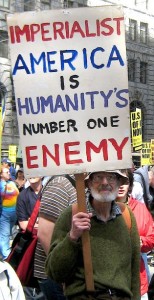
That’s because it is almost invariably posed by those wedded to the nation Martin Luther King called “the greatest purveyor of violence in the world today.” Conservatives there identify themselves as Christian. Yet they are among the strongest supporters of spending $2 billion per day (!) on the military. They love holy war.

Back in 1954, their government overthrew a democratically elected head of a Muslim state in favor of a brutal puppet, Reza Palavi. He proceeded to institute a quarter-century-long reign of terror in Iran, the birthplace of the Islamic currents so feared by Americans today.

Additionally the government of these Christians unconditionally supports Israel, a state which since 1948 has evicted Muslims from their ancestral homes in Palestine killing tens of thousands in the process. The majority of U.S. Christians not only support Israel in general (often on religious grounds), but even its possession of a vast arsenal of nuclear “weapons of mass destruction.”

In response, Muslims have used box cutters, stones, sling shots, primitive IEDs and homemade rockets, (along, one day, with hijacked planes) to defend themselves and counter-attack against forces that have declared a perpetual war against them.

Why this condemnation of the violence of the impoverished adherents Islam alongside virtual worship of the “Gods of Metal” by rich imperialists? The answer lies in Muhammad’s attitude towards war.

Like the vast majority of Christians since the 4th century, including our own day, and along with virtually all the prophets of the Jewish Testament, Muhammad was not a pacifist. Remarkably – once again like most Christians – Muhammad was a proponent of just war theory. In fact, he pioneered the theory’s development far ahead of its Christian proponents. Following its dictates, common sense and Muslim doctrine, the poor, he insisted, have the right to self-defense.

Yes, Muhammad recognized the right to jihad. Most of us are familiar with the term which is translated for us as “holy war.” Actually, the word means “struggle.” It signifies resistance to the forces of self-seeking within the individual believer, the Muslim community, and against those forces as represented by those who attack from without.

It’s that latter application that makes Islam so threatening to the West. The West wants no part of people who defend themselves against western depredations. Meanwhile western powers themselves claim not only the right of self-defense but even the prerogative of “preemptive strikes.”

What the West expects in return on the part of those attacked – especially if the attacked are “religious” – is a pacifism that for more than seventeen hundred years has never been a major part of “Christendom’s” belief system. As a matter of fact, western Christians tend to ridicule pacifists as unrealistic, unpatriotic, even cowardly “bleeding hearts.”

No, the West wants an enemy that simply rolls over for colonialism (in Israel), wars of aggression (in Iraq), policies of torture and illegal imprisonment, drone strikes, mass killings of innocent civilians, support of unpopular dictators, rigged elections, and a host of other crimes. In fact, when religious people defend themselves, westerners cry “foul” and condemn their victims for being hypocritical and “violent.” If the self-defenders are Christians influenced by liberation theology, they are characterized as Marxist, communist, totalitarian dupes. If they are not, their religion itself is perverse. Once again, all of this is as if westerners themselves were somehow religiously pacifist. They clearly are not!

Do you see why I used the term “ironic?” Actually, a stronger word is required but is likely unprintable.

And there’s more to this question of violence and Islam . . . . Muhammad’s own experience of being driven from Mecca by opponents of Islam closely tracks that of Israel’s treatment of Arabs in Palestine.

This becomes evident by recalling Muhammad’s basic story. It’s the account of a prophet and his followers attempting to return to a homeland from which (like today’s Palestinians) they have been exiled by force. Here are the elements of Muhammad’s career:

• An impoverished merchant from Mecca
• Living in a period of cultural crisis
• Characterized by neglect of the poor and vulnerable
• Receives revelations from God
• Centralizing surrender (Islam), humility, equality and peace
• He gradually draws to himself many devoted followers
• Drawn especially from society’s castoffs and despised – especially women
• This community is squeezed out of Mecca
• Its dwellings confiscated by the ruling class
• Now based in Medina, Muhammad and his followers (Muslims) wage a decades-long struggle to return home
• The struggle centralizes guerrilla attacks, economic blockade, “sit-ins,” and non-violent demonstration
• (At times, it is true, the tactics stood in conscious violation of basic Muslim commitment to peace and reconciliation)
• By these means, Muslims finally return to Mecca
• And establish Islam as the dominant religion of Arabia

In view of these details, it’s no wonder that Palestinians claiming “right of return” find inspiration in Muhammad. It’s no wonder that sister and brother Muslims throughout the world sympathize with the Palestinian cause and recognize Muhammad as a prophet for our time.

It’s no wonder that the U.S. and Israel vilify Muhammad’s religion so attractive to the impoverished people they are so intent on oppressing.

(Next week: Islam and Women)

The U.S. Is Indeed the Great Satan (Shaytan): Muhammad as Liberationist Prophet

Satan

(This is the second in a series on Islam as liberation theology and Muhammad as a prophet for our time. The series is inspired by Karen Armstrong’s “Muhammad: Prophet for Our Time” (London: Harper Perennial, 2006)

To understand Islam as liberation theology, it is important to place Muhammad in his historical and economic context. That setting shares important elements with the world’s current socio-economic circumstances shaped by an ethic of corporate globalization which ignores responsibilities for the world’s most vulnerable. Contextualizing Muhammad also helps us understand why Muslims consistently describe the United States as “the Great Satan,” or more accurately as the Great Shaytan.

Begin by trying to understand early seventh century Mecca. By the time the prophet had received his call, Mecca was already a prosperous focal point for Arabian culture. It had remained independent of control by both the Byzantine and Persian Empires which were then fighting for regional supremacy.

However, both empires found the hostile desert terrain of the Arabian Peninsula too forbidding for them to concern themselves with the area’s mostly Bedouin population. Moreover those constantly moving herds-people resisted domination in virtue of their fierce independence and absolute commitment to their tribes and ancestral ethos.

Bedouin culture lionized the karim – the tribal hero who was courageous, arrogant, violent and vengeful.The karim ideal was absolutely generous (not to say profligate) in dealing with his own people, but ruthless with others who were always considered inferior and expendable. Mired in chronic circumstances of scarcity, the karim economy required periodic wealth-redistribution in the form of “acquisition raids” on neighboring clans. Those attacks considered normal and necessary by the standards of the time, were careful to pillage but not kill – if only to avoid reprisals and vendettas.

In the 7th century, all of this was changing with the emergence of a strong commercial class interested in maintaining inter-tribal peace for purposes of facilitating business interactions. Hence, the merchant class developed a culture and ethos markedly different from the Bedouins’. Peace and order became much more important to doing business than they had been to Bedouin tribes struggling over scarce pastures. So conflict, violence, vendetta and vengeance were outlawed. Acquisition raids were particularly taboo.

This need for pragmatic peace was intensified by new technology related to commerce. The recent invention of a saddle for camels had dramatically increased the volume of goods capable of being transported. Consequently the quantity of foods, sandalwood, fabrics, spices and other products sold throughout the Arabian Peninsula increased dramatically. This impacted Muhammad’s birthplace (Mecca) in especially powerful ways.

Long since, Mecca had been important to Arab merchants. A “miraculous” water source (Zamzam) had been discovered there making it a natural stopping point for caravans circulating among a series of markets set up around the periphery of the Arabian Peninsula. A temple (Kabah) identifying the spring as a divine gift had been erected and included representations of all tribal deities from across Arabia. The final market of the year was held in Mecca and tribal merchants celebrated with inclusive “ecumenical” religious rites at the Kabah. There circumambulations of the Kabah helped the pilgrims integrate their mercantile journeys around the Arabian Peninsula into the divine scheme of things.

With all of this, Mecca became the logical location for a new religion emphasizing an empire-resistant trans-tribal Arab unity focused on peace and non-violence. At the time of Muhammad’s birth, there was great expectation of an Arabian prophet to crystalize such often-unspoken religious aspirations coherent with Mecca’s commercial and religious standing.

Before that would happen however, a downside to cultural dominance by the commercial class emerged. Slowly but surely tribal ties with their ancillary ethos were weakened. Ancestrally established obligations towards the widow, orphan, and infirm members of the community became less pressing and even rejected. Tribal arrogance reasserted itself in a new form of self-sufficiency that implicitly (and at times explicitly) denied the need for what we today would call “social justice.”

All of this strongly impacted the young Muhammad. True, he was born into one of Mecca’s leading commercial families. However, it had recently fallen on hard times. Muhammad himself had been orphaned early on. He was handed over to a series of clan care-takers who lovingly trained him in the ways of business and commerce. Though able strong and charming, Muhammad struggled to find his place in Mecca’s bustling marketplace. He would never forget those early struggles or his (non) status as an orphan. The poor would be centralized in his new religion.

At last, Muhammad improved his economic life by marrying a wealthy widow and businesswoman called Khadija. (In a culture that encouraged polygamy, she always remained his favorite wife.) It was Khadija who served as the prophet’s main support, confidante and advisor as he experienced his surprising call to become the prophet his culture generally expected.

Muhammad’s vocation story is reminiscent of similar accounts of Jewish Testament prophets. In a cave, he’s seized by God’s Spirit experienced (in Rudolf Otto’s terms) as fascinans et tremenda. The Spirit commands him to “recite.” (Qur’an means “recitations”).

Muhammad objects; he is unworthy. He is no orator or poet; he can’t even read or write. Yet he is literally pressed into the service of Allah and begins reciting sutras of extraordinary beauty and depth of meaning – even by exalted Arab standards of poetry. After an initial experience of this type, he is abandoned by the Spirit for a period of two years, only to have it return with even greater insistence and frequency. It would remain with him for 23 years, leading him to speak out on all manner of community problems.

The thrust of the prophet’s revelations was profoundly counter-cultural. It contradicted not only tribal arrogance, but also the ostentatious profligacy of the karim as well as the self-sufficiency of the commercial classes. Instead, Muhammad’s faith called for humility, service of others, complete submission (the very meaning of the word “Islam”), and care for the poor and weak.

Belief was to be backed up by action – almsgiving was centralized. But there were also ritual reminders of Islamic commitment. Five times each day Muslims were to adopt the position of a slave before Allah – on believer’s knees, prostrate, with forehead touching the ground. With all of this, it is no wonder that the first Muslims (like the first Hebrews and Christians) came from the poorer classes, with women more receptive than men.

Islam as conceived by Muhammad was inclusive and tolerant of other faiths – especially the ones just mentioned. Along with the rest of the Arab world, Muhammad deeply admired Judaism and Christianity for having their own Sacred Scriptures. Now with the emergence of the Qur’an, Islam joined that club as well. The notion of converting sisters and brothers in faith was a foreign concept for Islam’s great prophet.

Because of its counter-cultural thrust, the rest of Muhammad’s story is one of rejection and persecution by the guardians of the status quo. Muhammad is driven into exile in Medina. But eventually he returns to Mecca. His trans-tribal faith succeeds in uniting the Arab world conferring upon it a unifying power that is subsequently used by others the way Christianity was used by Christendom’s “Holy Roman Empire.” Islam becomes the unifying force behind an Islamic order that stretches from the Himalayas to the Pyrenees.

All of this is to say that imperial Islam (like the imperial Christianity that began under Constantine in the 4th century) is out-of-keeping with the faith of its founding prophet. Social justice, care for the poor, and recognition of transcendent human community, are not.

In the eyes of contemporary Muslims, all of this makes Muhammad particularly relevant to their situation in a world dominated by corporate globalization. As in the prophet’s day, globalization’s celebration of self-sufficiency contradicts Islam’s basic values of community, compassion and care for society’s most vulnerable.

As the leader and embodiment of the values that run so counter to Islam’s basic thrust, the United States is viewed as “Shaytan” (which is often translated for us simply as “Satan”). For Muslims however, Shaytan is not the prince of demons as he appears, for instance, in Dante’s Inferno. Instead, Shaytan is “the great deceiver,” whose promises mislead, corrupt and immiserate those who believe them.

In fact, while promising peace, prosperity, and happiness, the elevation of commercial values to a position of supremacy in the moral hierarchy could not be (in Muslim eyes) more deceptive and disastrous. Without care for society’s poor and vulnerable, commercial values lead to individualism, competition, war and unhappiness.

No wonder the U.S. is identified with Satan!

(Next: Islam and Violence)

Islam as Liberation Theology: Muhammad as a Prophet for Our Times (Part One)

Islamic World

I remember as I was finishing my teaching career of 36 years at Berea College in Kentucky that I experienced a spectacular failure regarding Islam.

In the light of the then-recent events of 9/11/01, I had moved that all students be required to study Islam either in a separate required course or as part of an already existing course (on writing or Western Civilization). After a brief discussion, my proposal was put to a vote. It received two (!) “Yeas” and about 148 “Nays” from a faculty of 150. “Next order of business . . . “

Despite going down in flames like that, I still think my proposal was a good one. That’s because ignorance of Islam lies close to the heart of our country’s highly questionable (not to say bogus) “War on Terror.”

Even more importantly, as a liberation theologian, I see “Islamists” as part of world-wide movement of poor people to use their religious traditions as a force for freedom rather than control and slavery. In fact, I consider this movement as the most important intellectual and social development since the writing of the Communist Manifesto in 1848. Grasping that fact and the true nature of Islam should be Job #1 for teachers and peace advocates.

Perhaps, like the Berea faculty, you find that assertion difficult to buy. And why shouldn’t you? Even in its Christian form, “liberation theology” has been misrepresented and distorted beyond recognition. Why shouldn’t we expect even more of the same for its Islamic counterpart?

So let me explain. Begin with the context of my proposal.

Once again, it came in the immediate aftermath of 9/11. On all sides Islam was being vilified as foreign, primitive, terrorist, and anti-female. U.S. military personnel regularly desecrated the Koran.

And their leaders like Lt. Gen. Wm. G. Boykin, were asserting the superiority of “our God” over “their God.” Republicans who otherwise ridiculed feminists as “femi-nazis” suddenly became champions of women’s liberation as they attacked Islam for preventing women from driving cars and wearing mini-skirts.

All of that made me suspicious. I knew a little about Islam from my poor attempts at teaching an introductory course part of whose intent was introducing freshman students to “world religions.” We had read Huston Smith’s The Religions of Man. If nothing else, Smith taught me that Islam, Judaism, and Christianity are sister faiths. There is no distinction between “their God” and “our God.” All three were “religions of the book.” At the very least, all recognized Jesus as a great prophet.

I had also taught Malcolm’s Autobiography. His embrace of Islam had called my attention to the attraction of Islam for poor people as an alternative to enslaving interpretations of Christianity. Malcolm’s passion for the Nation of Islam easily connected with my own for liberation theology – i.e. with the reading of the Judeo-Christian tradition from the perspective of those committed to the welfare and destiny of the world’s poor.

I remembered that somewhere in the literature of liberation theology, I had read that Islam was today’s most prominent example of a ”religion of the poor and oppressed.” As such Islam was influencing far greater numbers of the world’s poor than had Christianity’s liberation theology which was largely defeated by the U.S. military in what Noam Chomsky has called “the first religious war of the 21st century.” That religious conflict had pitted the U.S. government against the Catholic Church in Latin America.

Understanding Islam as today’s foremost expression of the liberating power of faith made the 1979 uprising in Iran a movement inspired by “liberation theology.” It did the same thing for other movements for liberation throughout the Asia and Africa. With all their triumphs and distortions, they too were movements against colonialism and its neo-colonial aftermath. In the name of God, they all stood against the exploitation and oppression of the East by the West.

That’s true, of course, for our contemporary “Arab Spring.” After all, did you think all those students and others protesting in Tahrir Square had suddenly left behind their devotion to Islam? What do you think motivated them? Had they suddenly become secularists? More obviously, what moved the “Islamic Brotherhood” to oppose the U.S. puppet Mubarak? Or why do you think the Egyptians elected the Brotherhood to lead their country?

Obviously, the motivation was largely found in Islam and in the realization that their faith as exemplified in the life and writing of the prophet Muhammad champions the Arab world’s poor in their struggle against the rich who have hijacked both Christianity in the West and Islam in the East.

It’s that liberationist understanding of Islam that the West must distort and vilify just as it did Christian liberation theology when it threatened to radically alter the political landscape of Latin America from the Medellin Conference of 1968 to the assassination of El Salvador’s most prominent liberation theologians in 1989.

It’s time to set the record straight in no uncertain terms. (That after all was the thrust of my proposal that evening on the faculty floor.) Reading Karen Armstrong’s Muhammad: Prophet for Our Time can help. In fact, Armstrong’s book would be required reading in the course I proposed. Without ever mentioning liberation theology, it reveals Muhammad as the champion of the poor and oppressed that Christianity’s liberation theology shows Jesus to have been.

(More about this in next Monday’s post.)

Dives & Lazarus: a liberation theology catechism (Sunday Homily)

Lazarus

Readings for the 26th Sunday in Ordinary Time: AM 6: 1A, 4-7; PS 146: 7-10; ITM 6: 11-16; LK 16: 19-31 http://usccb.org/bible/readings/092913.cfm

Today’s liturgy of the word provides us with a catechism of liberation theology – Christianity’s most important theological development in the last 1500 years, and the West’s most important social movement of the last 150 years.

I have come to those conclusions over a period of more than forty years studying liberation theology. My interest began in Rome during my graduate studies there, 1967 through 1972. There I first heard Peru’s Gustavo Gutierrez speak. (Fr. Gutierrez is considered the father of liberation theology.)

Subsequently I read Gutierrez’s book, A Theology of Liberation (1971) and was completely taken by it. Reading the book gave me the feeling that I was hearing Jesus’ Gospel for the very first time.

You might ask, what is liberation theology? To answer that question fully, please look at my blog entries under the “liberation theology” button. I’ve written a series on the question. In my blogs, you’ll find that I always define it in a single sentence. Liberation theology is reflection on the following of Christ from the viewpoint of the world’s poor and oppressed. That’s the class of people to which Jesus himself belonged. They constituted the majority of his first followers.

When read from their viewpoint, accounts of Jesus’ words and deeds – the entire Bible for that matter – take on depths of meaning and relevance to our contemporary world that are otherwise inaccessible to people like us who live in the heart of the wealthy world. From the viewpoint of the poor, God passes from being a neutral observer of earth’s injustices to an active participant with the poor as they struggle for justice here on earth. Jesus becomes the personification of that divine commitment to the oppressed. After all, he was poor and oppressed himself. The Roman Empire and its Temple priest collaborators saw to that.

My interest in liberation theology deepened as my teaching career developed at Berea College in Kentucky from 1974 to 2010. There I was encouraged to continue my study of liberation theology. So I spent extended periods in Brazil, Nicaragua, Costa Rica, Honduras, Guatemala, Cuba, Mexico, Zimbabwe, South Africa, India and elsewhere studying under liberation theologians, dialoging and publishing with them. The poor in all of those countries were suffering from the aggression the United States directed against them.

Meanwhile at Berea, I found the conclusions of liberation theologians validated by the college’s very fine scripture scholars. They had almost no acquaintance with liberation theology, and yet what they were teaching perfectly harmonized with its central tenets. It’s just that they stopped short of drawing what seemed to me the obvious political conclusions from their work.

More specifically, Berea’s scholars identified the Exodus (Yahweh’s liberation of slaves from Egypt) as God’s original and paradigmatic revelation. The whole tradition began there, not in the Garden of Eden. Moreover, the Jewish prophetic tradition emphasized what we now call “social justice.” Even more, Jesus of Nazareth appeared in the prophetic tradition, not as a priest or king. Jesus directed his “ministry” to the poor and outcasts. The Gospel of Luke (4: 18-19) has Jesus describing his program in the following words:

“The Spirit of the Lord is upon me, because he has anointed me to bring good news to the poor. He has sent me to proclaim release to the captives and recovery of sight to the blind, to let the oppressed go free, and to proclaim the year of the Lord’s favor.”

After his death, Jesus’ followers continued along those lines. They lived communally, having sold all their worldly possessions and distributed the proceeds to the poor.

All of that finds vivid expression in today’s liturgy of the word. As I said, it’s a kind of catechism of liberation theology. The reading from Amos the prophet describes the sin that most offends God – wealth disparity in the face of extreme poverty. Amos decries a “wanton revelry” on the part of the wealthy that sounds like the “American Way of Life” or the “Lives of the Rich and Famous” that we Americans find so fascinating. The prophet describes a rich class that lives like King David himself – in luxurious houses, overeating, drinking wine by the bowlful, and generally ignoring “the collapse of Joseph,” i.e. the poverty of their country’s most destitute. For that, Amos says, the rich will ultimately suffer. All their wealth will be confiscated and they will be driven into shameful exile.

In railing against the rich and defending the poor, Amos was calling Judah back to the worship of Yahweh whose attributes are described in today’s responsorial psalm. There God is depicted as loving the just and thwarting the ways of the wicked. The psalm describes Yahweh as securing justice for the oppressed, giving food to the hungry, and setting captives free. He gives sight to the blind and protects resident aliens, single mothers and their children.

Then today’s excerpt from 1st Timothy outlines the characteristics of those who worship that God by following in Jesus’ footsteps. They keep the commandment which is to do unto others as we would have them do unto us. According to St. Paul, that means pursuing justice and living with devotion, faith, love, patience, and gentleness.

Finally, the gospel selection from Luke chapter 16 dramatizes the sinful relationship between rich and poor and the destinies awaiting both. Luke tells the story of the rich man and “St. Lazarus” who is honored by the poor throughout Latin America.

It is significant that Lazarus is given a name in Jesus’ parable. Usually we know the names of the rich, while it is the poor that remain anonymous. Here matters are reversed. To remedy this anomaly, tradition has assigned the wealthy man a name. He’s called Dives, which is simply the Latin word for rich man.

For his part, Lazarus is quintessentially poor, hungry, and lacking medical care. His sores are open and the only attention they receive are from dogs that lick his wounds. Meanwhile, Dives seems completely unaware of Lazarus’ presence, though the beggar is standing at his very doorstep. Within the sight of Lazarus, the wealthy one stuffs himself with food to such a degree that the scraps falling from his table would be enough to nourish the poor beggar. But not even those crumbs are shared. How could Dives share? He doesn’t even know that Lazarus exists.

So the two men die, and things are evened out. The rich man goes to hell. We’re not told why. Within the limits of the story, it seems simply for the crime of being rich and unconsciously blind to the presence of the poor. For his part, Lazarus goes to the “bosom of Abraham,” the original Hebrew patriarch.

Lazarus is rewarded. Again, we’re not told why. Within the story, it seems simply because he was poor and Yahweh is partial to the poor, just as he was to the slaves God intervened to save when they were starving in Egypt.

Seated with Abraham, Lazarus feasts and feasts at the eternal banquet hungry people imagine heaven to be. Dives however is consumed by flame in the afterlife. Fire, of course, is the traditional symbol of God’s presence, or purification, and of punishment. This seems to suggest that after death, both Dives and Lazarus find themselves in the presence of God. However what Lazarus experiences as joyful, Dives experiences as tormenting.

And why? Simply, it seems, because Dives was rich, and Lazarus was poor.

Does the parable tell us that what awaits us all after death is a reversal of the economic conditions in which we now find ourselves? The first will be last; the last first. The rich will be poor, and the poor will be rich. That in itself is highly thought-provoking.

In any case, Yahweh is presented as champion of the poor in this parable, just as in the reading from Amos, in today’s responsorial psalm, and in Paul’s letter to Timothy. And according to liberation theologians, that’s the central characteristic of God throughout the Judeo-Christian tradition. God is on the side of the poor and hates obscene wealth disparity.

You can well imagine how such insight inspired the poor and oppressed throughout the world when it emerged as “liberation theology” following the Second Vatican Council. Poor people everywhere (and especially in Latin America) took courage and were inspired to demand social justice from the rich who had been ignoring them in the New World since the arrival of Columbus 500 years earlier. In fact, Liberation theology motivated social movements more powerfully than any thought current since the publication of the Communist Manifesto in 1848.

And that’s why the reigning empire, the United States of America took action against liberation theology. It initiated what Noam Chomsky calls “the first religious war of the 21st century.” It was a war of the United States against the Catholic Church in Latin America – yes against the Catholic Church. The war killed hundreds of thousands of priests, nuns, lay catechists, social workers, union organizers, students, teachers, and journalists along with ordinary farmers and workers.

Today’s liturgy of the word reminds us not to let the United States have the final word. We are called to divest ourselves of our wealth and to take notice of St. Lazarus at our gates. God is on the side of the poor, not of the rich.

Why I’m Not Celebrating July 4th This Year

Anti-Americanism

I remember in 1972, I was asked to give a 4th of July speech in some church context which I’ve since forgotten. I was a 32 year old Roman Catholic priest then. And my remarks were critical of the U.S. role in Vietnam and in the Third World in general.

Before I began however, an officer from the local VFW led everyone in the Pledge of Allegiance. I remember how he prefaced his part with a long July 4th introduction. He praised the flag for being “unsullied in emblemizing mankind’s struggle for freedom, unparalleled in standing in defense of human rights and the pursuit of justice, blessed by God above all others as the flag of his New Chosen People.”

It was enough to turn my stomach.

My nausea was induced by what I knew the U.S. was doing in Vietnam, Laos and Cambodia. Like everyone else, I knew about Mai Lai, Agent Orange, the Phoenix Program, the Pentagon Papers and merciless illegal bombings of civilians.

My revulsion was also fired by my growing awareness of what the United States was doing in the Third World in general and especially in Latin America where the liberation theology I was studying was powerfully shaping consciousness throughout the hemisphere. Its insistence on historical and structural analysis had caused a paradigm shift in my own perception. Increasingly, I was seeing the United States as the Sandinista Anthem would later phrase it, “the enemy of mankind.”

Somehow I got through my speech without having anyone walk out. I still wonder why.

These days I’m feeling even more alienated than I did more than 40 years ago. Contemporary realities have actually turned me against July 4th celebrations.

Afghanistan, Iraq, Abu Ghraib and the use of drone technology to execute U.S. citizens and anyone in the world without due process are only part of the syndrome this time around. It’s what we’ve recently learned from Ed Snowden, Bradley Manning and Julian Assange that make flag-waving and Pledges of Allegiance so repulsive. Now when I see fireworks, I can only think of Dick Cheney and the “Shock and Awe” pyrotechnics we all saw on CNN when Our Great Country used lies and false pretenses to attack a sovereign nation that had never done us any harm. As Allen Greenspan said in effect, Iraq’s curse and crime was having huge supplies of high grade crude.

As for celebrating our Great Constitution, Snowden’s revelations coupled with a mere reading of the Fourth Amendment are enough to give anyone pause: “The right of the people to be secure in their persons, houses, papers, and effects, against unreasonable searches and seizures, shall not be violated, and no warrants shall issue, but upon probable cause, supported by oath or affirmation, and particularly describing the place to be searched, and the persons or things to be seized.” Yes, the Constitution’s fine; but increasingly it’s a dead letter.

Similarly, my willingness to celebrate American democracy is tempered these days by memories of the 2000 “election” of George W. Bush through the intervention of his brother who happened to be governor of Florida with the power to deliver the White House to his dear sibling. The machinations of brother Jeb and a crony Supreme Court would have been comical in any Banana Republic scenario. Having it occur in the United States was more than embarrassing. Subsequent insistence on our privilege to monitor and invalidate elections elsewhere in the world has made us the international laughing stock we’ve hoped to make countries like Venezuela and Iran.

And then there’s Republican redistricting, voter suppression, Citizens United, and the recent SCOTUS evisceration of the Voting Rights Act. What’s that you say about free elections?

The crowning glory of all this embarrassment is our country’s willingness to end life as we know it on Planet Earth by blocking every serious attempt to reverse climate change. President Obama’s recent tepid declarations notwithstanding, the U.S. persists in catastrophic denial of what every serious scientific study reiterates: we are on the road to destruction with the “America” blazing the trail.

Our country’s willingness to end life as we know it on our marvelous planet (not to mention our wars and arms industry) is reason enough to believe that Mother Earth would be better off if the U.S. just dropped off the map. Think about it: the earth would be better off without the United States’ pollution, wars and “Way of Life.”

That’s why I’ll do no flag waving or banner display. I’ll recite no Pledges of Allegiance, nor stand for the Star Spangled Banner. Patriotic speeches and other jingoistic claptrap will draw no applause from me.

It’s all gotten so bad and such a matter of public record that it might even make my VFW friend turn over in his grave.

Ascension Sunday: What’s Christianity for Anyway? (Sunday Homily)

People attend the funeral mass for Cardinal Aloysius Ambrozic at St. Michael's Catholic Cathedral

Readings for Ascension Sunday: Acts 1: 1-11; Ps. 47: 2-3, 6-9; Eph. 1: 17-23; Lk. 24: 48-53 http://www.usccb.org/bible/readings/050913-ascension.cfm

This is Ascension Sunday. For us Catholics, it used to be “Ascension Thursday.” It was a “holy day of obligation.” That phrase meant that Catholics were obliged to attend Mass on Thursday just as they were on Sunday. To miss Mass on such a day was to commit a “mortal sin.” And that meant that if you died before “going to confession,” you would be condemned to hell for all eternity.

So until the years following the Second Vatican Council (1962-1965) Catholics would fill their churches on Ascension Thursday in the same numbers (and under the same threat) that made them come to Mass on Sundays. That’s hard to imagine today.

I suppose that difficulty is responsible for the transfer of the commemoration of Jesus’ “ascension into heaven” from Thursday to Sunday. I mean it wasn’t that the church changed its teaching about “holy days of obligation.” It didn’t. Catholics simply voted with their feet. They stopped believing that God would send them to hell for missing Mass on Ascension Thursday or the feast of the Blessed Virgin’s Assumption (August 15th), or All Saints Day (November 1st) or on any of the other “holy days.” Church once a week was about as much as the hierarchy could expect.

But even there, Catholics stopped believing that God would punish them for missing Mass on Sunday. So these days they more easily attend to other matters on Sunday too. They set up an early tee time or go for a hike in the woods. Afterwards they cut the lawn or go shopping at Wal-Mart. That kind of “servile work on Sundays” or shopping used to be forbidden “under pain of sin” as well. And once again, it isn’t church teaching that has changed. Catholics have just decided that the teachings don’t make sense anymore, and have stopped observing them.

And apparently they do so in good conscience. So you won’t find them running to confession after missing Mass or working and shopping on Sunday. In fact, that’s another way Catholics have voted with their feet. For all practical purposes, they’ve stopped believing in Confession – and largely in many of the mortal sins they were told would send them to hell – like practicing contraception or even getting a divorce.

I remember Saturday evenings when I was a kid (and later on when I was a priest). People would line up from 4:00-6:00, and then from 7:00 -9:00 to “go to Confession.” And the traffic would be steady; the lines were long. No more! In fact, I personally can’t remember the last time I went to confession. And no priests today sit in the confessional box on Saturday afternoons and evenings waiting for penitents to present themselves.

What I’m saying is that the last fifty years have witnessed a tremendous change in faith – at least among Catholics. Our old faith has gone the way of St. Christopher and St. Philomena and “limbo” all of which have been officially decertified since Vatican II.

In fact, since then the whole purpose of being a Catholic (Christianity) has become questioned at the grassroots level. More and more of our children abandon a faith that often seems fantastic, childish and out-of-touch. Was Jesus really about going to heaven and avoiding hell? Or is faith about trying to follow the “Way” of Jesus in this life with a view to making the world more habitable for and hospitable to actually living human beings?

That question is centralized in today’s liturgy of the word. There the attentive reader can discern a conflict brewing. On the one side there’s textual evidence of belief within the early church that following Jesus entails focus on justice in this world – on the kingdom. And on the other side there are the seeds of those ideas that it’s all about the promise of “heaven” with the threat of hell at least implicit. The problem is that the narrative in today’s liturgy of the word mixes each view with its alternative.

According to the story about following Jesus as a matter of this-worldly justice, the risen Master spent the 40 days following his resurrection instructing his disciples specifically about “the Kingdom.” For Jews that meant discourse about what the world would be like if God were king instead of Caesar. Jesus’ teaching must have been strong. I mean why else in Jesus’ final minutes with his friends, and after 40 days of instruction about the kingdom would they pose the question, “Is it now that you’ll restore the kingdom to Israel?” That’s a political and revolutionary question about driving the Romans out of the country.

Moreover Jesus doesn’t disabuse his friends of their notion as though they didn’t get his point. Instead he replies in effect, “Don’t ask about precise times; just go back to Jerusalem and wait for my Spirit to come.” That Spirit will “clothe you in justice,” he tells them. Then he takes his leave.

Presently two men clothed in white (the color of martyrdom) tell the disciples to stop looking up to heaven as if Jesus were there. He’s not to be found “up there,” they seem to say. Jesus will soon be found “down here.” There’s going to be a Second Coming. Jesus will complete the project his crucifixion cut short – restoring Israel’s kingdom. So the disciples who are Jews who think they’ve found the Messiah in Jesus return in joy to Jerusalem and (as good Jews) spend most of their time in the Temple praising God, and waiting to be “clothed in Jesus’ Spirit” of liberation from Roman rule.

The other story (which historically has swallowed up the first) emphasizes God “up there,” and our going to him after death. It’s woven into the fabric of today’s readings too. Here Jesus doesn’t finally discourse about God’s kingdom, but about “the forgiveness of sin.” After doing so, he’s lifted up into the sky. There Paul tells his readers in Ephesus, he’s enthroned at the Father’s right hand surrounded by angelic “Thrones” and “Dominions.” This Jesus has founded a “church,” – a new religion; and he is the head of the church, which is his body.

This is the story that emerged when Paul tried to make Jesus relevant to gentiles – to non-Jews who were part of the Roman Empire, and who couldn’t relate to a messiah bent on replacing Rome with a world order characterized by God’s justice for a captive people. So it gradually turned Jesus into a “salvation messiah” familiar to Romans. This messiah offered happiness beyond the grave rather than liberation from empire. It centralized a Jesus whose morality reflected the ethic of empire: “obey or be punished.” That’s the ethic we Catholics grew up with, that sent some of us to weekly “confession,” and that former and would-be believers find increasingly incredible, and increasingly irrelevant to our 21st century world.

Would all of that incredibility and irrelevance change if the world’s 2.1 billion Christians (about 1/3 of the world’s total population) adopted the this-worldly Jesus as its own instead of the Jesus “up there?” That is, would it change if Christians stopped looking up to heaven and focused instead on the historical Jesus so concerned with God’s New World Order of justice for the poor and rejection of empire?

Imagine if believers uncompromisingly opposed empire and its excesses – if what set them apart was their refusal to fight in empires wars or serve its interests. How different – and more peaceful – our world would be!

A sensitive discerning reading of today’s liturgy of the word, a sensitive and critical understanding of Jesus’ “ascension” presents us with that challenge. How should we respond?

(Discussion follows.)

Meet Declan Coyle, a Real Liberation Theologian (Sunday Homily)

Declan

My Easter homily two weeks ago evoked a wonderful response from one of my former priest-colleagues from the Society of St. Columban – the missionary community of priests I belonged to before I left in 1976. The colleague is Declan Coyle (pictured above).

Declan, it turns out, is a wonderful and witty writer. In a future blog I’ll share his moving piece on his son, Alexander who has Mowat Wilson Syndrome. It’s a truly inspiring essay on the meaning of living in the present moment.

When I asked for permission to share his Easter thoughts, here’s how Declan responded.

Of course Mike you can share it with you audience.

I soldiered (how easily the old militaristic verb crops up, “Who has a blade for a splendid cause … our horses are red to the hocks with the blood of the heathen”) with the Columbans for 27 years from seminary to moving on to marry Annette, an Australian in 1990.

I studied Liberation Theology in St Paul’s Ottawa after ordination, and then I asked the Superior General for five years in a slum in Latin America or Asia. After nine years of post-high school academic study I felt I was not fit to teach in Boston. But I knew that if I got some years in a slum where the slum dwellers who had survived and graduated from the University of Life taught me some life lessons, and I got these in my blood and my guts and my bones and my being, then I could teach Liberation Theology with passion and enthusiasm.

I got five years in the Philippines and six in Taiwan.

I got married to Annette, my wife in 1990. We have three children, Genevieve (19), Fionn (16) and little Alexander who is eight. He is a very special child. He has Mowat Wilson Syndrome. It was only discovered in 1997 and he was the first child in Ireland to be diagnosed with it. I’ll attach a reflection I wrote recently about him. He’s the epitome of the idea that he’s not a human being having the odd spiritual experience, he’s a spiritual being having a human experience.

The last 90 days I was in the Philippines I buried 65 children under two years old … all who died from hunger or hunger related diseases. In the slums we lived Jesus’ Synagogue Speech and Matthew 25 and life to the full and joy overflowing.

From where I’ve lived my so called Christian life, you’ve got your hand on the heart and the soul of the gospel and what the carpenter poet of Galilee was all about. I’m still baffled as to why John Paul II didn’t jump on a plane and go out and finish that Mass that stopped when Romero was shot. Would that not have been a symbolic gesture to lift the hearts of the poor and baffle Reagan?

Every blessing in your great work. You are real good news for the poor. You are real liberation for those oppressed by the historical accretions of the empire and real new sight for those of us who have been blind to the real meaning of the gospels for our world today. You remind me of the great prophet Micah whose words you live: To act justly, to love tenderly with kindness and to walk humbly with your God.

All the lovely things of the Holy Spirit on this Easter Week.

Declan

And now Declan Coyle’s Easter Reflection:

Years ago here at home our eldest two children Genevieve and Fionn were playing hide and seek all over the house. All I could hear all day was, “ready or not, here I come!”

That evening Genevieve asked me how did Jesus rise from the dead. I told her that on Easter Sunday morning the soldiers were outside the tomb, cooking their Easter eggs in a pot on the fire. Then suddenly from the tomb came this thunderous voice, “Ready or not here I come!” Then the rock rolled away and out came Jesus.

The two soldiers fainted with the fright.

The following week, the teacher asked the children to explain how the resurrection happened. Genevieve told her how. The teacher was not impressed.

I asked Genevieve which story she preferred. She said yours Daddy. In one fell swoop, she turned me into the fifth evangelist – a storyteller with a myth, a story, a lie that tells the truth. She understood hermeneutics.

In our recent discussions I told her that if ever she is tempted to go literal, she’ll lose the meaning. Always go symbolic. If you go literal, then you’re wondering at Christmas was Jesus born in a stable, or a cave or was it a kindergarten for the Essenes?

Literal is a dead end. But when you go symbolic you realize that the Christmas story simply means that great power comes in humble packages.

Keep up the great work Mike.

And send your material to Pope Francis.

Happy Easter. Declan

Christianity is the Enemy of Humankind (Reflections on the Historical Jesus)

To the least

Last night I concluded a Lenten series of classes on the historical Jesus. As always, the course had its ups and downs. But it was faithfully attended by about 25 soul mates who, like me, remain fascinated by and somehow in love with Jesus of Nazareth.

At last evening’s final meeting, one of the participants – a fierce unflinching seeker of truth, asked the question in the back of everyone’s mind. “So what?” she asked. “If, as we have learned here, Jesus has been distorted beyond recognition by the early church (and especially by Paul and Constantine) why should we believe any of it?”

What a good question! It has forced me to pull together (for myself!) what I have learned from this latest round of studies of the historical Jesus. Let me express them in as clear an unvarnished a way as possible both positively and critically.

First of all, my positive learnings . . . . The study forced me to face the fact that the historical Jesus, un-obscured by later developments is the touchstone for authentic Christian faith. That is, the Jesus of history (vs. the Jesus of later doctrines) trumps all other conceptualizations in terms of being normative for Christian faith. The teachings of the historical Jesus were extremely simple: God is love. God is bread. Salvation consists in sharing food – bread and wine. A world with room for everyone (the Kingdom of God) is entirely possible. Empire is the anti-thesis of love and sharing. It uses religion to enslave. It finds Jesus message of liberation abhorrent. Empire is the enemy.

Second of all, my critical learnings . . . . If anything the Christian Testament makes it extremely difficult to locate the normative historical Jesus. In fact, the canonical gospels often contradict the basic revelations of Jesus. When this happens, those contradictions have to be faced, learned from, and set aside as merely illustrative of the way history and religion are routinely distorted by the rich and powerful. It is evidence of what people either used to believe before Jesus’ revelation, or what they came to believe when the faith of Jesus subsequently interacted with and was domesticated by other cultures and times.

More particularly, examination of the gospels makes it abundantly clear that following the destruction of Jerusalem in the Jewish-Roman War (66-73), the Jesus of history increasingly receded from Christian perception. In his place a Jesus of faith came to prominence. The two are at odds with each other. The Jesus of history strove to liberate the poor. The Jesus of faith became the servant of empire and the rich who run it.

The Jesus of history was a mystic, prophet, teacher, healer, and movement founder. He was intent on reforming Judaism whose leaders had sold Judaism’s soul to the Roman Empire transforming it into a religion of laws, rituals and obedience to the powerful. This Jesus called himself the “Son of Man,” not the “Son of God.” He was perceived by the poor as a “messiah” who would deliver his people from Roman domination. He proclaimed a new social order which he referred to as the “Kingdom of God.” There Rome’s domination model of social organization would be replaced by a sharing model. In God’s kingdom everything would be reversed: the rich would be poor; the poor would be rich; the first would be last; the last would be first; prostitutes and “the unclean” would enter the new order before priests, the rich and the famous.

And although he shied away from accepting the conventional messianic identity associated with “The War” (against the Romans), Jesus’ program of “Good News for the poor” along with his healings and exorcisms confirmed that identification in the eyes of the marginalized and oppressed. It did the same for the Romans and their collaborators to such an extent that they ended up executing him as an insurgent.

The memory of this Jesus of history was preserved and celebrated by the Jerusalem community called “The Way” before its eradication in the horrendous Roman-Jewish War of 66 to 73CE. In obedience to Jesus, they adopted a communal life where food, drink, and material possessions were shared and held in common. Following Jesus’ death, some were even hoping for his “second coming” in their own lifetimes to complete the task of empire-destruction his execution had prevented him from fulfilling.

This prophetic Jesus was replaced by the Jesus of faith who emerged in the post-war world after the Jerusalem church and its leadership had been slaughtered by Rome. At this point, “The Way” (Jesus’ version of reformed Judaism) was replaced by “Christianity.” This religious movement was non-Jewish. It derived from the teaching of Paul of Tarsus (in Turkey) who never met the historical Jesus, and who thought of him in terms of God’s unique and only Son. Paul was a thoroughly Romanized Jewish rabbi intent on acquainting non-Jews with the Jesus he experienced in the visionary psychic experience recorded as his conversion on the Damascus Road.

By ignoring the Jesus of history, Paul’s experience and subsequent preaching laid the foundation for an understanding that centralized a Jesus understood as God’s only Son – a divine being who would have been (and was!) completely unacceptable to the fiercely monotheistic Jews. At the same time, this domesticated Jesus was not threatening to Rome. In fact, he was completely familiar to Romans resembling the “dying and rising gods” of Roman-Greco culture who offered “eternal life” beyond the grave rather than an anti-imperial Kingdom of God in the here and now. In other words, the Jesus of history was co-opted beyond recognition by the Roman Empire.

So what’s the take-away from the study of the historical Jesus? I think the following extremely important lessons:

1. History is unreliable. It has been distorted and manipulated by the powerful to suit their own needs. (If taken seriously, this in itself is an invaluable lesson.)

2. Hard work is required to find historical truth – not just about Jesus but about what happened yesterday!

3. Empire is the enemy. It is a system of robbery whereby the rich and powerful steal resources from the poor they oppress. It is entirely contrary to the will of God (the Principle of Life). It represents a “preferential option” for the rich and powerful. It is absolutely ruthless in its eternal war against the world’s poor and in falsifying history for its own benefit.

4. Those who resist empire can expect to be tortured and assassinated. Nonetheless, from time to time courageous and insightful prophets arise from the non-rich and non-powerful with Good News for the poor. Their very simple message: fullness of life is to be found not in empire, but among the poor and simple of the world (God’s people). Salvation, these prophets teach, consists in sharing the simple realities of bread and wine. In effect: God is Bread.

5. Among the west’s best known prophets of Jesus’ God are Moses, Jesus himself, Gandhi, Bartolommeo de las Casas, Karl Marx, Martin Luther King, Malcolm X, Dorothy Day, and the nameless martyrs (so many of them women!) inspired over the last fifty years by liberation theology.

6. Most people are in denial about these simple facts. They are powerfully assisted in their denial by politicians, scholars, priests, and the media who make the teachings of the prophets extremely complicated. They have transformed the prophets’ message about sharing bread and fullness of life in the here and now into “religion” and a promise of life after death. As such, religion is the enemy of humankind. Christianity is the enemy!

7. Those who accept these learnings should leave institutionalized “religion,” band together, internalize the teachings of the historical Jesus and change the world!

Thug Pope?

Cia Argentina

Last Friday I published a blog calling for the resignation of the newly elected Pope. Of course, I had no expectation that the pope would resign. We can even hope that as Francis I, Jorge Bergoglio will undergo or has undergone a conversion since the days when his silence gave consent to the brutal military regime of Jorge Videla during Argentina’s infamous “Dirty War.”

Nonetheless Bergoglio’s election forces us to face up to the role of religion under imperialism. The ascendancy of Francis I trains focus on the way both the fundamentalist Catholic Church and its Protestant counterparts habitually lie comfortably in bed with the forces of politico-economic exploitation, war, kidnapping, torture, and murder. As bed fellows they share the guilt of their thug partners.

Put otherwise, religious fundamentalism can easily be seen as the most conservative force in the world. Exhibit #1 is Roman Catholicism. The vast majority of its leaders have always lain supine not merely for Constantine, but for a whole host of dictators who followed including Hitler and with Mussolini. On the whole, Protestant fundamentalists have been no better. To reiterate: fundamentalist religionists are the problem, not just their embodiment in an unrepentant Francis I. If their partners are thugs, where does that leave them?

You see, the pope’s defenders are wrong when they say that archbishop Bergoglio was merely another Argentinian cowed by the military and lacking in the heroic courage of a few bishops and many liberation theology priests during Argentina’s “Dirty War” (1976-’83). At the hierarchical level, I’m thinking of heroes whose faith moved them to defy the military governments the U.S. established throughout Latin America from the early 1960s till the fall of the Soviet Union.

I’m thinking of Brazil’s Cardinal Paulo Evaristo Arns, Dom Helder Camara, or Bishop Pedro Casaldaliga — or of El Salvador’s Oscar Romero, or of Mexico’s Samuel Ruiz. All of them recognized that their status provided them with a literal “bully pulpit” for denouncing the oppression of their impoverished flocks which did not enjoy the relative invulnerability their own ecclesiastical status provided for themselves.

Put simply, Bergoglio didn’t have the courage of those men.

Granted, you can’t fault someone for not being a hero. However lacking heroism was not Bergoglio’s problem as his apologists imply. Even if he was merely silent, he lacked the moral responsibility absolutely required for the Christ-like fulfillment of his office. After all, muted and/or compliant churchmen represent an essential ideological cog in the system of oppression. Since the time of Constantine, they have been used to persuade ordinary Christians that God endorses the policies of their oppressors however brutal.

The hell of it is that many priests and preachers, especially at lower levels, are completely unaware of their role in the system. They think of themselves as good pastors, patriotic citizens, supporters of a brave military, and opponents of Godless Communism. This may have been the case even with archbishop Bergoglio. He may simply have been an unconscious, naive pawn. Nonetheless, he was part of the gang, and so are all religious leaders who end up underwriting oppression.

Like Bergoglio, they should know better because Jesus had to deal with the alliance between religion and colonialism too. The priests, scribes, and Sadducees of his day were an essential part of the Roman system of exploitation. In fact, it’s common to refer to the Temple’s “con-dominium” with Rome. The priests and scribes on the one hand along with the emperor and Pilate on the other, all ruled together. To attack one was to attack the other. And Jesus attacked them both.

Opposing imperialism goes beyond simply firing one’s chauffer or taking the bus to work. It goes beyond saying we’re on the side of the poor. (Even Rick Santorum says that!) Instead popes and bishops have to understand critique and oppose the structures that cause and sustain oppression – economic and political systems along with laws, customs, and institutions like those of church, government, and the military. All of those structures transcend the short reigns of popes, presidents and generals. Those occupants of office come and go, but the systems and laws they serve and enforce remain.

The sainted archbishop of Recife in Brazil, Dom Helder Camara understood that. He once said, “When I feed the poor, they called me a saint. When I ask why the poor have no food, they call me a communist.”

Let’s hope that Pope Francis will not only ask that latter question – the why of poverty and hunger. Let’s hope he will answer it strongly and unmistakably. The poor have no food because keeping them hungry is in the interests of the economic and political system that runs the world – international capitalism.

At the moment, hasty hagiographers are saying that Francis I’s concern for the poor makes him a saint. My prayer is that they will soon be calling him a communist. The alternative appellation is “thug.”

Will the Next Pope Continue the War on Liberation Theology?

jesus on cross

With the resignation of Benedict XVI and the papal conclave in process, friends have asked me to say something about it all. My thought is simple. The success of any new papacy and the prospect of the Catholic Church rebounding from its worst crisis since the Reformation hinges on one thing more than any other: the attitude of the new pope and of church leadership in general to liberation theology.

Let me be clear on what I’m talking about. I understand liberation theology as “reflection on the following of Jesus of Nazareth from the viewpoint of those committed to the emancipation of the poor and oppressed.” The commitment in question brings to light social implications of the Judeo-Christian tradition – for creating a world with room for everyone, beginning with the poor – that remain opaque for those without such commitment.

Liberation theology in the sense just defined represents the most important theological development of the last nearly 1700 years. More than that, it is arguably the most important intellectual development of the last 150 years – dating back to the publication of the Communist Manifesto.

Popes and presidents have implicitly recognized that importance and power over the last 40 years and more. In fact that reaction has given form to the Roman Catholic Church itself under the last two popes. More than anything else liberation theology has also influenced U.S. politics for the last 30 years. It has literally shaped our world. Liberation theology is the reason behind the current spate of unending wars against the poor people of the world.

When I express such judgment to friends, they remain dubious and unbelieving. Their response not only reflects tone-deafness to the power of religious mythology, it also illustrates how short our memories are. We have trouble recalling what Chomsky calls the “first religious war of the 21st century” – less than forty years ago. That war was fought not against Islam, but against the Catholic Church in Latin America, precisely because of its adoption of liberation theology’s “preferential option for the poor.”

In Latin America, the Reagan administration and its successors correctly perceived the grassroots social power of liberation theology. In Central America they saw a threat to control of its “backyard.” So U.S. officials allied themselves with a conservative Polish pope in the Vatican, with reactionary Evangelicals in the United States to strangle the revolutions of the poor who found great hope in powerful liberationist interpretations of their religious traditions which had been traditionally used to keep them in their places.

The threat of liberation theology was perceived well before Reagan. Already in 1969, the Rockefeller Report had identified liberation theology as a threat to the national security of the United States. By 1987, the Latin American Military Chiefs of Staff meeting in conference in Mar del Plata, Argentina, devoted several pages of their final report to liberation theology and the threat it posed to regional stability. In between, in 1979 the first Santa Fe Document advised the incoming Reagan administration that it had to do something decisive about the threat posed by liberation theology. The administration heeded the advice, and responded both militarily and ideologically.

Reagan’s military strategy against liberation theology issued in that religious war Chomsky referenced. It was perceived as necessary because in 1969, the Conference of Latin American Bishops had together dared to affirm a “preferential option for the poor” as their official position.

To combat that commitment, the U.S. sponsored blood baths throughout Latin America. Many of us are well acquainted with the best-known martyrs: Camilo Torres, Archbishop Romero, the Salvadoran team of liberation theologians killed at San Salvador’s Central American University in 1989, and with the U.S. women religious murdered years earlier in that same country. And then the unending list of martyrs in this war against the Catholic Church – 200,000 in Guatemala, more than 100,000 in Nicaragua, 90,000 in El Salvador, and literally untold killings and disappearances in Honduras. In every case, the carnage was a response to social movements inspired by liberation theology. Again, as Chomsky points out, official U.S. military documents show that liberation theology was a major target of those wars. In fact within those same official documents, the Army boasts specifically about defeating liberation theology.

As for Reagan’s ideological response to liberation theology . . . . On his accession to power, CIA Psy-ops began funding conservative alternatives to liberation theology in Latin America and in the U.S. So did business concerns that saw the leftward drift of Latin America as a threat to their presence there. Domino’s Pizza and Coors Brewery were prominent among the cases in point.

As a result, evangelicals throughout the region grew rapidly in number, and the recipients of those funds in the United States increasingly identified with Republicans, the “hand that fed them.” So the television programs of Jerry Falwell, Pat Robertson, Jim and Tammy Baker, Jimmy Swaggart, and others were beamed into every poor barrio, población, and favela. Right wing churches sprang up everywhere feeding and expanding an already robust evangelical presence in areas once completely dominated by the Catholic Church. The message was always the same – a depoliticized version of Christianity whose central commitment involved accepting Jesus as one’s personal savior and rejecting communism including the type allegedly represented by the theology of liberation.

All of this points up the extreme importance of LT. In effect liberation theology was not only responsible for spiritual and political awakening throughout Latin America, it was also indirectly responsible for the rise of the religious right in the United States, and ultimately for the Tea Party. On the other side of the aisle, so to speak, we currently have in the White House the first U.S. president directly influenced by liberation theology. For 20 years, Barack Obama was part of the congregation of Jeremiah Wright – identified by James Cone, the father of black liberation theology, as the latter’s foremost contemporary embodiment.
This is why it is possible to identify liberation theology not only as the most important theological development of the last 1700 years, but as the West’s most important ideological development in the past 50 – perhaps the past 150 – years.

As for liberation theology’s contemporary importance, today’s religious right and the Tea Party would probably not exist today were it not for liberation theology. And the 2008 debate about liberation theology (i.e. about Jeremiah Wright) nearly derailed Obama’s run for the presidency. That is, liberation theology has been far more influential than most are willing to recognize. In a sense, it has shaped U.S.-Latin American relations for a half-century. It has changed the face of Protestantism in the United States.

Reagan’s ideological strategy against liberation theology also changed the Catholic Church. As indicated earlier, it involved allying himself with a conservative anti-communist Polish pope, John Paul II, who proved to be an inveterate enemy of liberation theology. The apparent agreement between the two was that John Paul would be silent about the war against Latin American Catholics, if Reagan would help him in the pope’s campaign against communism in Poland. Over his reign of over 20 years, John Paul was to gradually replace Latin America’s pro-liberation theology bishops with conservative pre-Vatican II types. He did this throughout the world – mostly in direct response to liberation theology.

Even more virulently set against liberation theology was John Paul’s lieutenant, Joseph Ratzinger, whom the pope appointed head of the Sacred Congregation for the Faith (formerly the Office of the Holy Inquisition). In that capacity, Ratzinger penned an official warning about liberation theology in 1985. Basically, it rejected the movement because of its association with Marxist analysis of third world poverty. Of course, Ratzinger succeeded John Paul II in the papacy. He’s the recently resigned Pope Benedict XVI. So the onslaught against liberation theology continues with no end in sight.

Sadly, Reagan’s two-front strategy worked. Revolutionary gains in El Salvador, Guatemala, and most prominently, in Nicaragua were halted and reversed. Militarily, the “Guatemala Solution” was the template. It entailed using military and paramilitary death squads to kill everyone remotely connected with guerrilla movements. According to the Reagan strategy, that included priests, nuns, lay catechists and ministers of the word influenced by liberation theology. The theological strategy worked as well. The slogan promulgated by the Salvadoran military said it all, “Be a patriot; kill a priest.”

But despite the carnage, and despite the claims of victory by the U.S. military, liberation theology remains alive and well in grass-roots movements for solidarity. And in general, social movements inspired by liberation theology bore fruit in the ‘70s and ‘80s. They continue to bear fruit today. More specifically, one can credibly say that apart from the theology of liberation it’s impossible to explicate Allende’s rise to power in 1973 or the triumph of the Sandinistas in 1979, or the power the FMLN in El Salvador had and continues to enjoy today. The Zapatista movement in Mexico is also intimately connected with liberation theology. Even more, without reference to liberation theology, it’s impossible to fully understand the rise of new left governments throughout Latin America. All of them are indebted to liberation theology and its power to motivate the grassroots.

That same power to motivate is evident in the ongoing “Arab spring.” There the power derives from the liberation currents undeniably present in Islam. In fact, as Gandhi saw in changing the face of India, similar currents are found in Hinduism. All of this indicates that liberation theology has at its roots elements found at the center of all the religions of the world. In this light, the world-wide offensive against Islam represents the latest phase of the now Thirty Years War against liberation theology under wherever form it may appear.

To be on the right side of history and to move the world towards God’s Kingdom, any new pope must call off the war against liberation theology and embrace it fully in word and action. Imagine how the world would change if he did!