How I Became I Child of the Sixties – Thank God! (Personal Reflections Pt. II)

Hippie Art 

The craziness my children see in me isn’t simply knee-jerk. It was a long time in coming and accompanied by a lot of internal resistance.  

In fact, I’m the product of an extremely conservative upbringing. True: I come from a working class family where my dad (a truck driver) was a member of the Teamsters Union. And my parents both claimed to be “Independents” who voted for “the man not for the party.”  However, deep in their hearts, they were, I believe, Republicans. Nonetheless, politics wasn’t a big concern in our family. As a result, I grew up without clear ideas about differences between Democrats and Republicans.  

And then my formal education took over.  It occurred entirely within the Roman Catholic Church, one of the most reactionary forces in the world. That meant Catholic grammar school from K thru 8, then 12 years of seminary training, followed by 5 years of graduate school in Rome, where I received a doctorate in moral theology in 1972. All that time I don’t remember a single teacher who wasn’t either a nun (for the first 9 years) or priest (for the rest). The intense 26 years of indoctrination didn’t end till I was 32.  

The process was entirely apolitical even though virulently anti-communist. Throughout high school and the first years of college, we weren’t allowed to read newspapers or watch television. Luckily we had Christmas and summer vacations at home, where I lived with my family and worked with ordinary people (for me at a Sinclair gas station and later with the grounds-keeping crew on a golf course). I was suspicious of the Civil Rights Movement and of anti-war protestors. Throughout our years of training, missionary members of my order, the Society of St. Columban returned from China, Burma, the Philippines, and Korea with tales of communist atrocities. Communism, we were told, was the world’s worst evil.  (I remember the day Joseph McCarthy died. One of my seminary professors told me, “A great man died today.”

No wonder I ended up being a Republican myself.  I cast my first vote for Barry Goldwater.  

In the seminary I wasn’t a great student until my freshman year in college. I tried hard. But I remained pretty much a high “B” student.  I did well in languages – especially Latin, which was extremely important in those days, but also in Greek and French.

Outside of class, I was obedient and pious, so I always ended up being the equivalent of “the head boy,” which we called “Class Senior,” and eventually “Senior of the House.”  Till college (and long afterwards) my real interests were basketball, baseball, running, ice hockey, and (to some extent) football. If it hadn’t been for sports, I don’t think I would have survived the seminary.

Then as a freshman in college I met Fr. Jim Griffin, the most important teacher in my life. He finally awakened my inner student in a serious way. Father Griffin was tough: unmerciful in his criticism of our writing, and unsympathetic about excuses of any kind. He was a worldly, Renaissance man who loved poetry, classical music – and golf. Father Griffin enkindled in me a love for the kind of music I had always resisted, for art, drama and for poetry which till then I thought of as somehow unmanly. Most significantly he exposed me to what is now called “critical thinking” and to the art of literary criticism. (The latter joined with exposure to modern scripture scholarship subsequently gave me courage to trust my own analysis of biblical texts.) I am forever indebted to Jimmy G. who died about 15 years ago. I remember him every day in my prayers.

That was the other important element of my education – I mean exposure to modern scripture scholarship.  Here I must mention my second most important teacher, Eamonn O’Doherty. Over our four years of State-side post-grad theological studies (for which we received no additional degree) Eamonn helped us understand text criticism and form criticism. To this day that orientation remains the firm foundation of what I’ve learned since from the Jesus Seminar and liberation theologians (more about that later).

As for politics, a turning point came for me in Rome where I finally escaped the seminary hothouse. My real education began there as I was exposed to new thought and ways of looking at the world I had never considered before.  It was all so new to me after all those years cooped-up in the seminary. During two summers I traveled on my Vespa through Italy, Yugoslavia, Austria, Germany, Poland, France, Spain, England, Scotland, Ireland. I also studied German for two sessions at the University of Vienna. In 1970 and ’71, I spent two one-month periods in Ireland, where I was a delegate at the “Chapter” of my order which was rewriting its constitution.  Two of my summers I returned to the U.S. and worked as a priest in St. Augustine’s parish in Culver City CA. From the day I arrived in Rome, I began seeing the world in an entirely new perspective.

In “the Holy City,” it didn’t take me long to discover that the dozen or so young priests I was living with (from Ireland, England, Australia, New Zealand) at Corso Trieste 57 were much more advanced than I was in their understanding of the world – and of theology. I remember feeling embarrassed about that and determining to catch up. I became a voracious reader.

That was 1967, right after the conclusion of the Second Vatican Council which had ended two years earlier. The city, the church and its theological universities were still electric with the new ideas the Council represented. Everything was up for grabs. Everyone was calling the unquestionable into question: the church, the priesthood, mandatory celibacy. My student colleagues (mostly priests at the Atheneum Anselmianum and Academia Alfonsiana) were generally quite critical of the United States. They came from all over the world – Europe, Africa, Latin America, Australia, the Middle East . . . I was playing basketball for a minor league affiliate of the Roman pro team (Stella Azzurra) — scrimmaging the pros, interacting with my Italian teammates, fans, and officials. It was all so very exciting. I found myself reading all the important books, rethinking everything, and debating my friends endlessly.

It was the sixties! Back home the Civil Rights and anti-war movements were in full swing. Even from Rome I felt the influence of the Democratic Convention in 1968, the secret bombing of Laos and Cambodia, Jane Fonda’s visit to Vietnam. . . .  Martin King was shot, then George Wallace, and Bobby Kennedy. “What kind of country do you come from?” my friends asked. “What’s wrong with America?” Like other Americans, I was wondering that myself.

There is so much to tell. But I’ll cut to the chase. . .

A year or so before leaving Rome, I had already nearly decided to leave the priesthood. But before doing so, I requested from my sponsoring missionary group, the Society of St. Columban, a year of discernment. I had changed so much that I was suddenly perceived as too radical. I was no longer pious obedient Mike. So my superiors decided not to assign me to seminary teaching as they had originally planned. Instead, they wanted me to take up missionary work in the Philippines. However since that would involve even more (language) schooling, I asked to be given a more immediately pastoral assignment. After all, at 32 years of age and six years into my priesthood, I still didn’t really know what it meant to work full-time as a pastor.

My request was granted. I was assigned to work with the Christian Appalachian Project (CAP) in Kentucky.

(Part Three: next Tuesday)

(Sunday Homily) Pentecost: the Spirit of Jesus in Pope Francis & Oscar Romero!

Romero poverty

Today is Pentecost Sunday, sometimes called the “Birthday of the Church.”

Significantly, Pentecost’s vigil (yesterday) is the day the church has chosen to “beatify” Oscar Romero, the martyred archbishop of San Salvador, who was assassinated in El Salvador on March 24th, 1980. His beatification (the final state before canonization or sainthood) took place there yesterday.

The co-incidence of the two anniversaries is full of meaning for a community of faith desperately in need of rebirth.

Politically speaking, the unblocking of San Romero’s beatification process by Pope Francis represents the pope’s call to appropriate Jesus’ Spirit of Life and leave behind all traces of the political conservatism that characterized most of the archbishop’s life. Pope Francis calls us to boldness, radicalism and outspoken partisanship on behalf of the world’s poor. That’s the Spirit of Jesus, he says. It’s the Spirit Oscar Romero eventually embraced.

To get what I mean, please join me in reflecting on (1) Roman Catholic conservatism – at least as I currently experience it, (2) the conversion of Oscar Romero to the radicalism of liberation theology’s “preferential option for the poor,” and (3) the directions for similar change given by Pope Francis in his “Joy of the Gospel.” Following those directions, I argue, promises his church a New Pentecost.

I The Irrelevance of the Catholicism I Experience

To begin with, consider the Catholic Church I experience each week. Its present form is a construction of the reactionary popes, John Paul II (1978-2005) and Benedict XVI (2005-2013). I consider their papal reigns disastrous.

Because of their counter-reforms, my local parish not only ignores the progressive initiatives of the Second Vatican Council, it gives every indication of attempting to reverse them in the minds of my fellow parishioners.

In fact, the documents of Vatican II are rarely referenced in our church. Their place has been taken by the conservative invention, The Catechism of the Catholic Church.

“Masses” from one week to the next show almost no variation or planning. Everything seems rote. Sermons are full of clichés about heaven and churchy bromides. Not a word connects the Radical Jesus with Ferguson, Baltimore, Iraq, drone warfare, torture, the LGBTQQ struggles, or climate chaos. To introduce such topics might “upset” some people, so they’re completely ignored.

No such sensitivity, however, is displayed regarding conservative issues concerning abortion, gay marriage or climate change. The latter is almost never mentioned, while the former issues (abortion and gay marriage) are highlighted at every opportunity. Our diocesan newspaper, The Crossroads, communicates the distinct impression that good Catholics are good Republicans and vote accordingly.

II Oscar Romero’s Pentecost

For most of his life, Oscar Romero would have been comfortable in my local church.

Remember, Monsignor Romero started out conservative in every sense of the word. To a large extent, that’s why he was appointed archbishop in 1977. Romero was considered safe. He was patriotic. He unquestioningly supported his country’s military. He looked on the widespread rebellion of the poor in El Salvador with great suspicion. He considered the would-be revolutionaries communist subversives.

And yet, the archbishop had this close friend on the opposite end of the political spectrum. He helped Romero grow. That friend was Rutilio Grande. Grande was a Jesuit who took seriously his vow of poverty.

So Father Grande moved out of the parish rectory and lived with the poor. He knew first-hand their struggles, their family break-downs, their unemployment, hunger, low wages, and harassment by local police.

Worse still, Grande knew the Salvadoran military’s strategy for defeating the country’s impoverished insurgents. It was simply this: kill everyone who might possibly be sympathetic to rebel forces. That meant most of the country’s non-elite. It meant many of their parish priests. For Rutilio Grande, the slogan of the White Hand death squad represented an everyday reality and threat: “Be a patriot; kill a priest.”

Eventually, of course, the White Hand killed Rutilio Grande himself.

It was his martyrdom that pushed Oscar Romero over the edge and radicalized him. He utterly abandoned his conservatism. He would later say, “When I looked at Rutilio lying there dead, I thought, ‘if they have killed him for doing what he did, then I too have to walk the same path.’” (The “they” Archbishop Romero referred to was his own government, its military, and their backers in the United States.)

So Archbishop Romero started listening to the poor. He attended their “biblical circles,” where peasants shared their thoughts about Sunday gospel readings.

Once after listening to simple farmers sharing thoughts about “The Parable of the Sower,” the archbishop stood up without comment and walked away from the group. The local priest followed him and asked anxiously, “What’s the matter, Monsignor, did something offend you?”

“No,” the archbishop responded, “quite the opposite. It’s just that I think I’ve heard the Gospel of Jesus today for the first time.”

In other words, the archbishop discovered that when poor people read the Bible, they see things that remain invisible for conservatives comfortable with whiteness, patriarchy, and empire.

Jesus was none of those things, the archbishop realized. He was brown or black, poor, a victim of empire, and counter-culturally open to the viewpoints and experience of women. Those were the Master’s viewpoints. They deeply influenced how he saw the world.

More specifically, Jesus stood on the same ground as El Salvador’s poor (and the poor of the Global South). He was born out-of-wedlock to a teenage mother. He was an immigrant in Egypt for a while. He was a working man with calloused hands and sweat-stained clothes. He loved fiestas. His friends, people said, were drunkards and prostitutes. Rabbis expelled Jesus from the synagogue, and thought he was diabolically possessed. Even his family questioned his sanity. Jesus became a vagrant without visible means of support. He lived under an oppressive empire. Imperial authorities saw him as an insurgent and terrorist. He ended up on death row, a victim of torture and of capital punishment.

All those characteristics, Archbishop Romero realized, described Another Jesus that to him was far more compelling, inspiring and faithful to the gospels than the abstract and other-worldly Jesus elaborated in the theological texts that guided his doctoral studies in Rome.

So Romero concluded that the poor knew Jesus more deeply and authentically than he ever could. (They had what scholars called a “hermeneutical privilege.”)

Even more, the Jesus of the Poor revealed Another God who alone can save our world from the path to destruction we’ve embarked upon. (And this is where Pope Francis’ continuity with Romero’s vision comes in.)

III Pope Francis’ Pentecost

Like the converted, Spirit-led Oscar Romero, Pope Francis does not shy away from radicalism, controversy or partisanship in the name of social justice. In fact, the pope identifies the struggle for social justice and participation in political life as “a moral obligation” that is “inescapable” [“Joy of the Gospel” (JG) 220, 258].

And the pope walks his talk. Think about his:

  • Part in negotiating an end to U.S. policy towards Cuba, despite what Miami Cubans might think.
  • Recognition of the Palestinian state in the face of objections from Israel and its supporters.
  • Identification of the Palestinian Authority’s Mahmoud Abbas as an “angel of peace” over the same objections.
  • Famous “who am I to judge” statement about homosexuality.
  • Unblocking of canonization procedures for Oscar Romero, the patron saint of liberation theology.
  • Embrace of liberation theology’s “preferential option for the poor.”
  • Planned encyclical on climate chaos, even over objections by U.S. Republicans and their think tanks like the Heartland Institute.
  • Stated intention to influence the Paris Climate Summit next December.

Yes, (in U.S. terms) the pope has not been afraid to alienate Republicans and give the distinct impression that their agenda is largely incompatible with Christian faith.

I’d even go so far as to say that “The Joy of the Gospel” is like a manifesto against Republican approaches to social issues. I mean, JG:

  • Condemns wide disparities in income (188).
  • Advocates redistribution of wealth (189)
  • Rejects trickle-down economic theory as illusionary and entirely dysfunctional (54).
  • Sees unfettered markets as homicidal (53), ineffective (54), and unjust at their roots (59).
  • Demands market regulation as indispensable (56).
  • Views “each and every human right” [including education, health care, and “above all” employment and a just wage (192)] as intimately connected with “defense of unborn life” (213).
  • Presents environmental protection as a moral imperative (215, 216).
  • Dismisses war as incapable of combatting violence which the pope sees as caused by “exclusion and inequality in society and between peoples” (59).

Conclusion

It will no doubt offend some in my parish to read these words. But that’s the point of Pentecost, isn’t it – to shake us up?

After all, Jesus offended the conservative members of his parish-equivalent. Romero offended conservative Salvadorans and conservative U.S. “Americans.” Pope Francis makes no bones about offending Jewish Zionists, Miami Cubans, U.S. Republicans and climate change deniers.

The Spirit of Life is not conservative. It is not imperial. It wants everyone to survive and thrive – especially the ones the dominant order rejects as unworthy.

In those senses, It makes a preferential option for the poor.

The Long Reach of Pope Francis: how he (and Oscar Romero) touched our diocese & our parish

Pope francis oscar romero


I once was once skeptical about Pope Francis.

When he was elected, my first thought was “Can anything good come out of an Electoral College of Cardinals packed so tightly with clones of the reactionaries, John Paul II and Benedict XVI? Bergoglio must be one of those carbon copies.”

But I was wrong.

Jorge Mario Bergoglio turned into Pope Francis. Far from a triplet brother of his immediate predecessors, the new pope has proven to be truly Latin American. That’s so even to the point of embodying the ideals of liberation theology, or reflection on the gospel from the viewpoint of the poor and oppressed. He has espoused the latter’s “preferential option for the poor,” its trenchant critique of corporate globalization, and its openness to marginalized people of all kinds. What a surprise!

My second thought was, “But he’s already old. His papacy will be short. He won’t be able to accomplish much of enduring impact.

Imagine then my further astonishment, when a mere three years into his papacy, Pope Francis’ touched  in remarkable ways our  tiny and remote diocese of Lexington, Kentucky. Even stranger to say, his reach extended to our little Kentucky parish of St. Clare’s in Berea. It made me wonder if this is happening all over Francis’ world. I hope so.

First of all, consider what’s happened in Lexington.

Our previous bishop was a canon lawyer – an appointee of John Paul II. Bishop Ronald Gainer distinguished himself by urging pro-choice politicians to refrain from receiving Holy Communion. He has since shown other overriding concerns by forbidding Catholic School girls in his new diocese from engaging in sports (such as wrestling, rugby, and football) “…that involve substantial and potentially immodest physical contact.” You get the idea.

After waiting for more than a year, Bishop Gainer’s replacement was at last named. It was John Stowe, a Conventual Franciscan. Father Stowe showed his colors in his introductory press conference. There was not a word about abortion, contraception, or gay marriage, much less about girls’ wrestling.

Instead he introduced himself as “a Franciscan educated by the Jesuits and appointed by a Jesuit Pope who has taken the name Francis.” “I love Pope Francis,” Father Stowe said, “and I will do whatever he asks.”

Turns out, the new appointee is not only a disciple of the pope; he is also a sharp critic of reactionary politics – especially as they affect immigrants. (Fr. Stowe, BTW, speaks fluent Spanish.)

For instance, in 2006, when Fr. Stowe addressed the Mayor’s Congress on Immigration Reform in El Paso, Texas, he criticized the U.S. Congress saying, “We shudder to imagine what the inscription on the Statue of Liberty might read if it had been erected by the current U.S. Congress.” Promising words indeed.

And that brings me to our parish, the long reach of Pope Francis and its connection with our new bishop.

You see, during this past Lent, for the second year in a row, a small group of us met each week to study the pope’s “The Joy of the Gospel” – the Apostolic Exhortation published in November 2013. In one of our concluding sessions, we were searching for something practical to connect the pope’s words with our community of St. Clare’s.

The calendar told us that the beatification of El Salvador’s Oscar Romero was coming up on the 23rd of May. (Beatification is a major step towards canonization or sainthood in the Catholic Church.)

Romero, you recall, was the martyred archbishop of San Salvador. In 1980, he was gunned down at the altar by an assassin connected with El Salvador’s Arena party which was supported by the Reagan administration. Because Romero is considered the patron saint of liberation theology (which the pope saw as too influenced by Marxism), John Paul refused to even call the archbishop a martyr. Instead, he referred to him merely as “a zealous pastor.”

Pope Francis has changed all of that. Romero, he says, was not only a martyr, but has advanced him on the way to official recognition as a saint of the entire Roman Catholic Church.

Well, our little discussion group thought: Why not have our parish celebrate Romero’s beatification?

“Great idea” we all agreed; “We could hire a Mariachi band, invite the Hispanic community and folks from Berea College’s Union Church” (a Church of Christ with whom people from St. Clare’s traveled to El Salvador on more than one occasion). “And then we could follow it all with a big fiesta.”

Someone else added, “And why not invite the new bishop?”

“Wouldn’t hurt to ask,” was the consensus — although we thought his acceptance would be unlikely, since by the end of May, he’d barely have been installed as bishop.

Well, guess what? He agreed to come. That sends a strong signal about his priorities.

So did his letter written immediately after receiving our invitation:

Thank you for your kind words of welcome and the excellent suggestion of celebrating the beatification of Archbishop Romero. I am so happy to know that St Clare’s and Union Church are in a relationship with the Church in El Salvador. That is exactly what Pope Francis is encouraging us to do!

I just returned last night from visiting our Central American Friars; we celebrated the 35th anniversary of Romero’s martyrdom although we were in Costa Rica. This past February 1st, I was able to celebrate mass in the hospital where Romero was killed—all this to say, Oscar Romero is a great inspiration in my life and I am thrilled to know of a community that wishes to celebrate his witness.

I will look for possible dates to celebrate the beatification with your community.

Your message is most welcomed!!

Bishop-elect Stowe’s acceptance of our invitation means that everyone in our parish and from parishes nearby will surely attend an event that might otherwise have been overlooked. Everyone will want to meet the new bishop.

He is sure to have some inspiring words to say about Romero, and hopefully about liberation theology, and U.S. policy in Central America during the 1980s. This will indeed be a teachable moment.

Do you see what I mean about Francis’ long reach? This is already far better than I anticipated three years ago.

(Sunday Homily) Ten Reasons for Hope in a Time of Despair: Empire Is Crumbling before Our Eyes

Syriza (SYRIZA Poster: http://keithpp)

Readings for 4th Sunday in Ordinary Time: JB 7: 1-4, 6-7; PS 147: 1-6; I COR 9: 16-19; 22-23; MK 1: 29-39 http://www.usccb.org/bible/readings/020815.cfm

Today’s liturgy of the word is about hope in a world wracked by despair. All of us are starved for such hope. In fact, discouragement and apparent powerlessness describe not only our personal consciousness but the larger zeitgeist that is the constant focus of these Sunday reflections dedicated to confronting the world with the Bible in one hand and the newspaper in the other. Today’s confrontation should help progressives realize that our times are actually changing for the better.

Think of the most recent historical roots of today’s despair – the way the world was just 20 years ago. As described recently by Andre Vitchek, it was an unbelievably hard time for opponents of empire.

Then think of how things are different today. It’s the difference between the condition of Job in this Sunday’s first reading, and the healing Jesus brought to the poor in today’s gospel selection.

Twenty years ago Russia was controlled by Boris Yeltsin, a boozy western puppet who betrayed his own people. Like Yeltsin, other heads of state throughout Eastern Europe joined their western counterparts in a shameless surrender to imperial interests. They were largely “led” by the offspring of the elites who preceded them. China 20 years ago was still under the spell of the free market reforms introduced by Deng Xiaoping. Meanwhile, Latin America reeling from decades of dictatorships imposed by the West had turned its economies over to neo-liberals trained in the Chicago School of Economics. The same was largely true of the Middle East and Africa. In those cases, dictators and the one-percenters were firmly in control. Christian vision of a kingdom where the earth belonged to everyone had been completely hijacked by religious fundamentalists and reactionaries including in his own way, the pope of Rome. All of this was largely hidden by both local and international mainstream media (MSM) which applauded dictatorships and plutocracies as “emerging democracies.”

Those were indeed hard times for anti-imperialists. I remember the despair. We were like Job in today’s first reading sitting on a dung heap lamenting the loss of hope enkindled by the Civil Rights and Anti-War movements of the ‘60s and ‘70s.

Remember Job? He too was the victim of an incredible series of misfortunes. They reduced him to a condition worse than poverty. Without warning, he lost all his wealth; his children died; he became terribly sick; and his reputation went entirely south.

Job is the image of us all 20 years ago. Like Job, progressives couldn’t be blamed for wondering if our situation could ever change.

Perhaps believers among us had forgotten the general hope offered in today’s responsorial psalm. It reminds us of the goodness of Life – the divine energy in which we live and move and have our being. (Some call that Energy, “God.”) The psalmist reminds us that time and history itself have a way of healing broken hearts.  Life has a way of supporting even the most devastated.  And (as Job’s case illustrates) it eventually topples even those who appear to live on top of the world. God is good, the Psalmist reminds us. God is gracious and wise beyond our wildest imaginings. God unifies the poor, even when they’re hopelessly fragmented by elite strategies of “divide and rule.”

Today’s gospel reading offers more particular hope.  It recounts the first acts of a prophet from and imperial backwater, Israel – Jesus, the carpenter-preacher from Nazareth, a “Nowheresville” if there ever was one.

There he encourages the downtrodden every bit as crushed as Job. He heals with a touch, an embrace, a smile, a kiss of the foot, a word of encouragement as the afflicted assemble before him to find health and hope and relief from their demons.  In other words, today’s gospel locates hope outside the political structure of the day, outside the realm of priests, lawyers, kings and emperors. It finds hope on the margins of empire.

And when you think of it, that’s where hope is to be found today. It’s not grounded in American presidents, in our imperial army, in the European Union, or in “foreign aid.” As I said, it’s not even reported in the mainstream media.

And yet the world is changing for the better right before our eyes. And the locus of change is on the margins – in the 50% of the world that has almost invisibly (for Americans) broken free of the imperial order that has governed the world since the end of World War II. Eventually the gains of that 50% will change us too.

Think of the progress I’m referring to. To even perceive it you have to step outside the powerful system of propaganda that envelops us all. Here are 10 signs of hope emerging from the margins. They have for years been signaled by J.W. Smith and his Institute for Economic Democracy:

  1. World-wide people have lost faith in the western model of mainstream media (the Great Wurlitzer” as Smith terms it). Most have awakened to the fact that it’s all lies. In Latin America, Russia, China, and Iran, the new media is not even “alternative” any longer. Its mission is exposing the crimes of the West, its Empire and client states. Its message couldn’t be more straight-forward: No more torture, rape or genocide.
  2. Russia has risen from the ashes and is confronting the Empire on all fronts. Vladimir Putin has emerged as the world’s most effective international leader and practitioner of diplomacy and independence from Empire.
  3. Russia and China are both returning to their socialist roots advancing policies far more humane than their western counterparts.
  4. In Greece the overwhelming victory of SYRIZA has threatened the neo-liberal order in the heart of the European Union. The party’s anti-austerity message is already being spread to Italy, Spain, and France.
  5. Latin America has broken free of the shackles of the Monroe Doctrine. Cuba, Venezuela, Ecuador, Bolivia, Nicaragua, Chile, Argentina, Uruguay and Brazil are all forging their own paths while cooperating with and supporting one another. All are moving closer to Russia and China.
  6. The BRICS countries (Brazil, Russia, India, China, and South Africa) themselves represent at least half the planet’s population. They are trading with each other in their own currencies now making themselves immune from western sanctions.
  7. On June 17th of this year, under BRICS leadership, 133 of the world’s 196 countries declared their intention to “destroy the New World Order” championed by western Empire.
  8. For those paying attention, even the ISIS barbarians are unwittingly serving the cause of peace by demonstrating the horror of wars instigated by the West. They behead on YouTube videos, while U.S. moviegoers cheer American Snipers who blow the heads off unsuspecting Iraqis defending their homes from Seals. ISIS barbarians set fire to prisoners with matches, while their U.S. counterparts use napalm and white phosphorous. The clash of barbarisms highlighted by ISIS promises to make pacifists of anyone capable of seeing parallels. (It’s up to progressives to make them apparent.)
  9. Even the U.S. president (the first ever influenced by liberation theology) sees parallels like the ones just referenced. He has criticized American exceptionalism by challenging his people to “remember that during the Crusades and the Inquisition, people committed terrible deeds in the name of Christ. In our home country, slavery and Jim Crow all too often was justified in the name of Christ.”
  10. The pope of Rome is attempting mightily to defeat Catholic fundamentalism and to turn 1/7 of the world’s population (i.e. 1.2 billion Catholics) in the direction of social justice and environmental protection as advocated by liberation theology.

None of these are “pie in the sky” hopes. They are simply facts known to the world outside our borders but hidden from us by the MSM.

Along with today’s liturgical readings, such changes should be cause for hope and encouragement. More than half the world has left Job’s dung heap. The world’s poor whom Jesus served and embodied are leading the way. The rest of us will join them soon.

(Sunday Homily) Pope Francis Calls for a Global Catholic Climate Movement

Italy Pope Epiphany

Readings for 1st Sunday in Ordinary Time: I SAM 3: 3B-10, 19; PS 40: 4, 7-10; I COR 6: 13C-15A, 17-20; JN 35-42

Recently Pope Francis has come in for some hard criticism from the U.S. right wing. It’s not just because of his rejection of free market capitalism, trickle-down theory, and huge income disparities between the rich and poor. It’s not just his openness to gays and divorcees, and his refusal to obsess about abortion and contraception.

Yes, all of these have undermined what conservatives have seen as a close alliance between the Catholic Church and their pet causes and thinking modes.

However, the straw breaking the back of reactionaries is the pope’s unequivocal warnings about climate change. They’ve gone apoplectic about his intention to publish an encyclical on the matter, and his plans to convoke a conference of religious leaders to address it. The pope’s expressed intention is to influence this year’s U.N. Paris Conference on Climate Change. All of that has raised the specter of a global Catholic climate change movement potentially mobilizing the world’s 1.2 billion members. Think about that for a minute!

In such context, Francis visit this week to the Philippines is extremely significant. The Philippines is not only the home of 80% Asia’s Catholics – more than 100 million. It is also the poster child for the devastation that climate change wreaks on the principal victims of global warming, the world’s poor. In 2013 the archipelago was raked by Typhoon Yolanda whose winds and floods killed more than 7000.

So the world listened when on his way to Manila Pope Francis was asked if climate change is “mostly due to the work of man and his lack of care for nature?” In reply, the pope said:

(F)or the greater part, it is man who gives a slap to nature continually, and we have to some degree become the owners of nature, of sister earth, of mother earth. I recall, and you have heard, what an old peasant once told me: God always forgives, we men forgive sometimes, but nature never forgives. If you give her a slap, she will give you one. I believe that we have exploited nature too much, deforestation, for example.

With words like those, the pope’s critics charge he is speaking beyond his expertise, which involves matters of “faith and morals.” But that’s just the point. The pope is making climate change a moral issue, a matter of ethics even more important than more “traditional” Catholic moral concerns about sex which after all presume the survival of the human species and the planet.

The pope’s critics also ignore, of course, that Francis bases his judgments not only on the testimony of 97% of all climate scientists, but on the research of the Pontifical Academy of Sciences. Its membership roster features the names of the world’s most respected scientists. These include Nobel laureates such as Ernest Rutherford, Max Planck, Otto Hahn, Niels Bohr, and Charles Hard Townes. The Academy’s current president is Werner Arber, himself a Nobel laureate, and the first Protestant to head the group.

But why such right-wing fury? It’s because like Naomi Klein, conservatives see the (for them) disastrous implications of addressing the issue. As announced in the title of Klein’s book, they sense that This Changes Everything. That is, taking on climate change as a moral issue undermines the political right’s program of market deregulation and continued extraction of non-renewable resources.

So pundits like First Things blogger, Maureen Mullarkey have given up on lip sticking the pope and are now in full attack mode. According to Mullarkey Pope Francis is simply “an ideologue and a meddlesome egoist. His clumsy intrusion into the Middle East and covert collusion with Obama over Cuba makes that clear. Megalomania sends him galloping into geopolitical—and now meteorological—thickets, sacralizing politics and bending theology to premature, intemperate policy endorsements.”

For Mullarkey, Pope Francis pretty much stinks.

And that brings me to today’s gospel reading. It’s all about stink – about what Pope Francis calls “the smell of the sheep.” Famously, you recall, the pontiff called on Catholic priests to live closer to the poor, to recognize them as God’s people and their welfare as the guideline for economic and social policy – to “take on,” he said, “the smell of the sheep.”

In other words, conservatives are suspicious of Pope Francis and are on the point of vilifying him because he smells too much like sheep — like the poor. He smells too much like Jesus.

Notice that in today’s gospel, John the Baptizer identifies Jesus as “the Lamb of God.” To begin with, the phrase reminds us of the tribal, Bedouin origin of the biblical “People of God.” Abraham, Isaac, and Jacob, and the great King David were all shepherds. They were primitive people close to the earth. They were tribalists. Jesus was a tribalist. According to John’s image, Jesus didn’t just smell like sheep; he was a sheep! He was in spades like his slave and Bedouin ancestors — like the poor people the pope is centralizing in his visit to the Philippines.

Pope Francis is a tribalist too. And he’s practicing what he preaches — both liberation theology’s “preferential option for the poor,” and the traditionally Catholic principle of subsidiarity. Once again, that means endorsing economic and environmental policy not on the basis of market dictates, but according to human decisions about values like the common good. Humane policy, the pope implies, originates not on Wall Street, but in places like the Philippines’ Tacloban City which was leveled by Typhoon Yolanda. It’s there that the pope’s itinerary reportedly has him dining in the shack of a hurricane victim. (Can you imagine a humble Catholic housewife setting her family table to include the pope?)

As our century’s most powerful illumined voice of conscience, Francis is using his bully pulpit to wake us up. We’re like Samuel in today’s first reading – fast asleep even before the Ark of the Covenant (a reminder of Israel’s enslaved and Bedouin past). But we fail to recognize the biblical tradition’s significance to our lives – its call to tribal values which unfailingly center on animals, human family, and Mother Earth. We fail to see the implications of Paul’s observation in today’s second reading that all human beings – especially the poor and outcast – are temples of God’s spirit. That’s our tradition! That same Spirit resides, the pope says, in the planet that he (like St. Francis himself) calls our Mother and Sister.

So what would a global Catholic climate movement look like? It would entail:

  • Waking up like the young prophet Samuel. Like him we’ve heard God’s call many times. But at last in Pope Francis, we have a thought-leader speaking in a voice the simplest of us can hear. It’s the voice of conscience. And like Eli it’s giving us the proper way to respond: “Speak Lord, for your servant is listening.”

A global Catholic climate movement further entails:

  • Rejection of corporation-based globalization which has us (over)consuming imported necessities that could be home-grown. (This involves lobbying against the Trans-Pacific Partnership.)
  • Joining the fight against fracking and projects like the XL Pipeline
  • Voting accordingly.
  • Urging the institutions we can influence (churches, universities, hospitals . . .) to divest from fossil fuel industries.
  • Adopting a “zero waste” policy in our homes and places of work.
  • Cultivating home gardens.
  • Adopting a vegetarian diet.
  • Educating ourselves about “green burial” and including plans for that in our “living wills.”

The list, of course, goes on. But you get the idea.

This stinkin’ pope is waking us up. He’s showing us the way. Thank God!

Mike Silenced by the AIPAC: A Case Study of Zionist Control of Media and “Peace Groups”

AIPAC

Peggy and I are in San Miguel de Allende, Mexico. We’re here to give papers at the “Moving beyond Capitalism” conference of the Center for Global Justice (CGJ). I’m honored to be part of a panel with Rabbi Michael Lerner (editor of Tikkun Magazine, the Jewish left-progressive quarterly). My job will be to present the Palestinian viewpoint on the conflict with Israel.

Frankly, there’s only one reason I’ve been invited. It’s because of a crisis I created in San Miguel eight years ago when I spoke on the same topic. It nearly brought the end of the Center for Global Justice. It even threatened my job at Berea College.

The whole incident illustrates the way even small-time publications and good-willed advocates of social justice can be intimidated and silenced by champions of Zionism. The incident represents a summons to such agents to break the silence and speak the truth regardless of Zionist bullying and threats.

You see in 2006, Peggy and I were working with the CGJ directing a summer intern project for students from the U.S., Mexico and Cuba. Out of the blue, one week the program chair of the local Unitarian Universalist (U.U.) meeting asked me to speak at their Sunday gathering. I had done that in several places before and accepted without a second thought. The invitation came specifically because of my connection with the Center for Global Justice.

“Why do you want me to speak about?” I asked the organizer.

“Anything you want,” she replied.

“Well, I speak on conflicting understandings of Jesus,” I said. “As a liberation theologian, I like that topic.”

“Oh no,” came the immediate reply. “The last time someone spoke on Jesus we were all bored to tears. Can you talk about something else?”

That gave me pause. . . . But I had just returned from a three week trip to Israel sponsored by Berea College where I taught for 36 years. So I said, “How about sharing observations from my recent trip to Israel?”

“That sounds great,” the program chair said. “Let’s call your talk, ‘A Report from Israel.’”

I agreed, prepared my remarks, and delivered them the next Sunday. My thesis was clear and unambiguous. “The real terrorists in Israel, I said, “are the Jewish Zionists who run the country.” I didn’t consider my basically historical argument particularly original or shocking. Chomsky and others had been making it for years.

What I didn’t realize was that almost everyone in my audience was Jewish. (I didn’t even know about San Miguel’s large Jewish population – mostly “snowbirds” from New York City.) Nonetheless, my remarks that Sunday stimulated an engrossing extended discussion. Everyone was respectful, and the enthusiastic conversation even spilled over beyond the allotted time.

Immediately afterwards, during breakfast in the U.U. center, one of the founders of the CGJ said, “That was great, Mike. You really ought to put all of that down on paper. You can publish it as an article in San Miguel’s weekly English newspaper, Atencion. They give us column space there each week.”

“Great,” I said. (I already had the talk written out.) I sent it into Atencion and it was published about a month later. By then I was back in the states teaching at Berea.

I’ll never forget what followed: all hell broke loose:

• A barrage of angry letters flooded the Atencion pages for the next two weeks and more.
• As a result, Atencion threatened to cancel the CGJ’s weekly column.
• San Miguel’s Bibliotheca talked about ending the CGJ’s access to meeting space there.
• My article was removed from Atencion’s archives and (I think) from the archives of the Center for Global Justice.
• Someone from the AIPAC (American-Israeli Public Affairs Committee) phoned my provost at Berea College reporting me for my inflammatory article, asking whether I really taught there and if my credentials were genuine.
• The CGJ’s leadership was forced to do some back-pedaling distancing itself from me and my remarks.
• They lit candles of reconciliation at a subsequent U.U. meeting begging forgiveness from the community and absolution for that mad man from Berea.
• The guiding assumption in all of this was that my argument was patently false.

In other words, an article that should have stimulated discussion of its thesis (with CGJ activists leading the way as a voice for the voiceless) was met instead with denial and apology.

However, the ongoing slaughter of Palestinians in Gaza only confirms my original thesis. So let me repeat it here: the real terrorists in Israel are the Jewish Zionists. I’ll go even further and say that in the present phase of the conflict between Jews and Palestinians, the Jews have little or no right to claim they are acting in self-defense. They are clearly the aggressors guilty of extreme war crimes.

This time I base that argument on helpful analytic distinctions concerning “violence” commonly made be liberation theologians in general and by Palestinian liberation theologians in particular. I interviewed the latter back in 2006 at the Sabeel
Ecumenical Center for Liberation Theology in Jerusalem.

I’ll explain the relevant distinctions in the second part of this posting. For now my points are these:

• Zionist defenders are afraid of open discussion of the conflict in Palestine.
• Zionist media control extends far beyond The New York Times.
• It even blacks out Palestinian viewpoints in small-time publications like San Miguel de Allende’s Atencion.
• It threatens academic integrity as well attempting to reach into classrooms like my own at Berea College.
• It even intimidates well-meaning and highly informed activists like those at the CGJ.

My conclusion for now: the media and even would-be “radicals” need to own their power in fearlessly denouncing the war crimes of Israel’s Zionists which will be discussed in the article following this one: “The Conflict in Israel: the Perspective of Palestinian Liberation Theology.”

(Sunday Homily) Liberation Theology, BRICS and the Untelevised Global Revolution

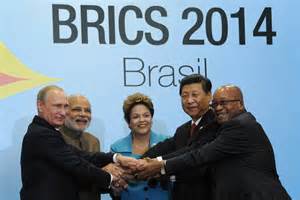
BRICS 2014

Readings for Seventeenth Sunday in Ordinary Time: I KGS 3: 5, 7-12; PS 119: 57, 72, 76-77, 127-130; ROM 8: 28-30; MT 13: 44-52; http://www.usccb.org/bible/readings/072714.cfm

The whole world was surprised when the Soviet Union dissolved in 1989. The dissolution represented an earth shaking paradigm shift to say the least. However, virtually no one claims foreknowledge on that one. One wonders how such oversight was possible.

Something similar is happening today. The poor of the world are asserting themselves against U.S. hegemony. Yet, virtually no one in the mainstream seems to notice. Once again, the revolution is not being televised.

Not even followers of Jesus’ Way are commenting. And this despite the fact that before all others, we should be attuned to paradigmatic shifts in world order connected with what Jesus termed the Kingdom of God.

Such paradigm contrast is suggested by today’s liturgy of the word. It juxtaposes the dream of Solomon, Israel’s would-be empire builder, and Jesus’ words about the contrasting nature of God’s Kingdom.

Let me show you what I mean by connecting the three elements I’ve just mentioned: (1) today’s untelevised revolution, (2) Solomon’s imperial ambitions, and (3) Jesus’ contrasting Kingdom of God.

Begin by noting that the current world order is dissolving before our very eyes. That became apparent two weeks ago at the Sixth Summit of Heads of State and of Governments of BRICS which took place in Fortaleza, Brasilia. Besides leaders from the BRICS countries (Brazil, Russia, India, China and South Africa), the presidents of UNASUR, the Union of South American Nations, all participated including Kirchner (Argentina), Bachelet (Chile), Santos (Colombia), Morales (Bolivia), Correa (Ecuador), Mujica (Uruguay), Maduro (Venezuela), and Umala (Peru).

Those present at the conference represent more than half the people in the world and fully 25% of its gross domestic product. That’s more economic power than the United States which controls 20% of the world’s GDP with 5% of the planet’s population.

And what did the BRICS Conference participants discuss? Not bombings, sanctions, debt ceilings, presidential impeachments, or lawsuits against heads of state – not birth control, abortion, gay marriage or border security. Instead they actually confronted the shared problems of the world – all the situations our provincial U.S. Congress systematically avoids, denies, and/or manipulates for political purposes.

Even more importantly, BRICS Conference attendees specifically planned the de-Americanization of the global economy and the creation of a multilateral, multipolar world prioritizing the needs of the Global South. Deliberation topics included:

 * Third World development in general
 * The industrialization of Africa in particular
 * The Creation of a BRICS development bank to replace the World Bank and the IMF
 * New international currencies to supplant the U.S. dollar as the world reserve
 * Sustainable responses to climate change
 * Building a railway from the Pacific Ocean in Peru to the Atlantic in Brazil
 * Installation of an IT cable from Vladivostok to Shantou, Chennai, Cape Town and Fortaleza (bypassing the United States).
* BRICS collaboration with the Shanghai Cooperation Organization (SCO) which binds Russia and China into a common security policy with Central Asia.

Such matters are world-transforming.

In fact, they represent practical steps towards something like the global wealth tax suggested by Thomas Picketty in Capital in the 21st Century – a tax dismissed by U.S. mainstream media as excessively idealistic, impractical and never-to-be implemented.

The thing is: those willing to impose such tax for the benefit of the developing world belong to the developing nations themselves. They are going their own way free from the hegemony of the United States.

All of this is relevant to today’s liturgical readings.

The selections implicitly compare the paradigm shift heralded by Jesus and his proclamation of God’s Kingdom to replace the imperial order not only of Rome, but of Israel itself. Israel’s leaders a thousand years earlier had hijacked the Mosaic Covenant favoring God’s poor.

In today’s first reading Solomon’s court historians mask the hijacking by predictably identifying their employer as “the wisest man ever,” just as before him they had identified Solomon’s cruel and womanizing father, David, as “a man after God’s own heart.” In this royally hijacked form, the Covenant connected God and the royal family. It assured a royal dynasty that would last “forever.” It guaranteed God’s blessings on Solomon’s expansionistic policies. (That’s like the clap-trap we have to endure from American Exceptionalists and from those anticipating a New American Century.)

The covenantal truth was much different. In its original Mosaic form (as opposed to the Davidic bastardization), the Covenant joined Yahweh (Israel’s only King) and escaped slaves – poor people all – threatened by royalty and their rich cronies.

The Covenant’s laws celebrated in today’s responsorial psalm protected the poor from their perennial antagonists, Israel’s court and its cronies. For instance, “Thou shalt not steal,” was originally addressed to large landowners intent on appropriating the garden plots belonging to subsistence agriculturalists.

Despite such prohibitions, those who established Israel’s basic laws knew the power of money. The rich would inevitably absorb the holdings of the poor. So Israel’s leaders established the world’s oldest “confiscatory tax.” It was called the “Jubilee Year” which mandated that every 50 years all debts would be forgiven and land would be returned to its original (poor) owners.

Like the BRICS Conference, the Mosaic Covenant prioritized the needs of the poor.

The advent of a Jubilee Year represented the substance of Jesus’ basic proclamation. No wonder the poor loved him. No wonder the refrain we sang together this morning repeated again and again, “Lord I love your commands.” That’s the refrain of the 99% in struggle with the rich 1% represented by Solomon and his court.

In today’s Gospel selection, Jesus indicates the radical swerve necessary for establishing God’s kingdom understood in Jubilee terms. It involves “selling all you have” and buying into the Kingdom concept as if it were buried treasure or a pearl of great price.

I’m not saying that the Kingdom has arrived with the BRICS Conference. I’m not claiming that Jubilee is about to dawn. However a power has emerged which actually prioritizes benefitting the poor instead of the 1%. And followers of Jesus’ Way should buy into it. We need to celebrate it and anticipate it in our own lives.

The New World Order anticipated by BRICS is certainly not perfect. However it’s far from the imperial order which protects the given order, constantly threatens sanctions if you disobey, and whose policies inevitably target the poor and most vulnerable.

In other words the emphasis of the BRICS Conference is not on policies causing Matthew’s “weeping and gnashing of teeth.” Instead it’s on cooperation, mutual respect and common good.

Now that’s a move Jesus’ followers can endorse. It’s moving us towards global change even more significant than the unforeseen fall of the Soviet Union.

That’s reason for hope.

Sunday Homily: Pope Francis’ “New Song” – Seven Points You May Have Missed in “Evangelii Gaudium”

Francis Singing

Readings for Second Sunday in Ordinary Time: IS 49: 3, 5-6; PS 40: 2, 4, 7-10; I COR 1: 1-3; JN 1: 29-34 http://usccb.org/bible/readings/011914.cfm

What will Pope Francis do next? Since his election nine month ago, he seems to be in the news on a daily basis.

We all know, for instance, that he was Time Magazine’s “Person of the Year.” And just last week, the New York Times ran two substantial articles on him. “He has already transformed the tone of the papacy,” one of those articles said, “confessing himself a sinner, declaring ‘Who am I to judge?’ when asked about gays, and kneeling to wash the feet of inmates, including Muslims.”

The article went on to describe the reforms the pope is making in the Vatican. He has disempowered influential conservatives favored by his predecessor, Benedict XVI. The demoted include American Cardinal Raymond L. Burke, and Italian Cardinal Mauro Piacenza, along with Archbishop Guido Pozzo. Such reactionaries have been replaced with Francis’ allies like Secretary of State Pietro Parolin whom the pope listed among those he will make a cardinal in February.

Even more broadly, the Times described the pope’s employment of six Jesuit “spies” to assess and report on various Vatican offices. That’s making Roman apparatchiks very nervous. As a result, job insecurity has become the order of the day in Vatican City, where clerical careerists , the Times said, have responded like sulking teenagers plugging in their headphones, retiring to their rooms, and hoping the storm will pass them by.

Another Times report last week detailed Pope Francis’ recent appointments to the College of Cardinals. The Parolin appointment notwithstanding, the nominations represent a departure from tradition in that the majority of the 19 new cardinals will come from Latin America, Africa, and Asia instead of Italy and Europe. The appointees promise to change the tone of the consistory the pope plans to convene at the end of next month where discussions will begin about decentralizing church decision-making processes and about pastoral responses to changes in family structure including questions of divorce and homosexuality.

Couple last week’s moves with last September’s hugely successful mass demonstration in St. Peter’s against the bombing of Syria, with his denunciation of free market capitalism, under-regulated financial speculation, and “murderous” world-wide income inequality, and you have a worthy successor to John XXIII, the soon-to-be-canonized Great Reformer who convened the Second Vatican Council (1962-’65).

Put otherwise, in a very short time, Pope Francis has made his own the words of today’s responsorial psalm, “The Lord has put a new song in my mouth.” The song the pope is singing takes the emphasis off formal religion – what the responsorial calls the “sacrifice and offerings.” That’s not what God wants, the psalmist says. Instead God’s desire is “a people that hear and obey” — specifically the law of justice that God has placed in the heart of all human beings whether they think of themselves as believers or not . So far, the pope’s actions show that he agrees.

In terms of today’s gospel reading – a continued reflection on last Sunday’s account of Jesus’ baptism – it’s as if we’re witnessing the descent of the Holy Spirit upon a man determined to follow in the footsteps of Jesus of Nazareth.

Like Jesus, Francis has made a “preferential option for the poor.” He’s signaled justice for the oppressed as the overriding theme of his papacy. He has completely rejected war as a solution to any of the world’s problems. This pope is no hawk or friend of hawks — or of the rich who advocate free market solutions to problems of poverty and its attendant hunger and disease. For him, terrorism is blowback for injustice.

As most of us know, all of this is clearly explained in Francis’ “Evangelii Gaudium” whose significance in terms of church reform cannot be overstated. But there are some important aspects of the pope’s exhortation that may have escaped notice. Let me name just seven that have special connection with today’s liturgical readings and their emphasis on peace, justice and the Spirit of God. (Parenthetical numbers refer to the relevant sections in the papal document.):

• “Evangelii Gaudium” is not trivial. The pope writes “In this exhortation my intention is to map out the path for the church to follow in the immediate future” (2).So the pope’s concern for the poor and rejection of war are not simply expressions of his idiosyncratic aspirations. They represent attitudes and actions he expects the church and Roman Catholics to adopt.

• As the Huffington Post has put it, “Evangelii Gaudium” also represents a “remarkable about-face” relative to liberation theology. Significantly, the pope met with Gustavo Gutierrez, the doyen of liberation theology, last September. Gutierrez’s themes are found throughout the pope’s Exhortation – the “preferential option for the poor” (198, 199), the affirmation of “popular piety” (122-126), the historical perspective (54), social analysis uncovering unfettered capitalism as homicidal (53, 57), and recognition of “structural sin” (59, 202). . . .

• The Exhortation’s position on private ownership is much more radical than many have acknowledged so far. The pope actually states that the goods of the earth belong to the poor, not simply to those who can pay for them. Quoting “an ancient sage,” the pope says “The goods we possess don’t really belong to us but to the poor” (57). Can you imagine a stronger rejection of capitalism’s understanding of private property?

• In general, the Papal Exhortation is friendly towards theologians. This also represents an about-face from his immediate predecessor who routinely investigated, warned, condemned and silenced theologians – 106 of them by Matthew Fox’s count. By contrast, Pope Francis values the role of theologians whatever categories of reason they might use – even, one might conclude, if the categories are Marxist. Consider the suggestion in these words: “When certain categories of reason and the sciences are taken up into the proclamation of the message, these categories then become tools of evangelization; water is changed into wine. Whatever is taken up is not just redeemed, but becomes an instrument of the Spirit for enlightening and renewing the world. . . The church . . . appreciates and encourages the charism of theologians.”

• The pope’s appreciation of theologians means that “Evangelii Gaudium” holds promise for women and the campaign for women’s ordination – despite its specific rejection of women priests (104). This is because virtually no theologians or scripture scholars find credible the reasons advanced for restricting ordination to males. Even the pope’s Exhortation suggests the contrary. No sooner does he reject women priests than he falls into the traditional language of “holy mother church” (e.g. 139). The pope writes “. . . the church is a mother, and . . . preaches in the same way that a mother speaks to her child.” Do you detect the dissonance here – of males alone being allowed to speak as women?? Sooner or later that penny will drop.

• The pope’s promotion of the “sensus fidei” (119) holds similar promise for changes in church teaching on contraception. According to the pope, “God furnishes the totality of the faithful with an instinct of faith – sensus fidei – which helps them to discern what is truly of God.” For theologians, sensus fidei means that when the bishops, theologians and laity agree on a matter of faith or morals, their agreement represents the work of the Holy Spirit. On the question of contraception, previous popes have cut the laity and theologians out of the equation entirely. In the spirit of Vatican II, the pope’s words promise to include them once again. Theologians and laity overwhelmingly agree that church prohibition of artificial contraception needs change.

• In his Exhortation, the pope shifts away from just war theory to complete pacifism (239). He devotes a whole section to the rejection of war (98-101). Moreover, he identifies inequality as the cause of violence and war. He writes, “Inequality eventually engenders a violence which recourse to arms cannot and never will be able to resolve . . . weapons and violence rather than providing solutions, create new and more serious conflicts” (60). What if the world’s 1.2 billion Roman Catholics took the pope’s words to heart?

All of this represents the work of the Holy Spirit – the same Spirit that today’s reading from John’s gospel describes as descending upon the just-baptized Jesus. John the Baptist describes Jesus as the gentle “Lamb of God.” The Spirit is pictured as a dove – the symbol of peace.

Like John the Baptist on Jordan’s banks, Pope Francis is calling the faithful to “Behold the Lamb of God” imitating Jesus’ identification with the poor and his gentle non-violence.

The Church’s Disastrous Domestication of Jesus (Sunday Homily)

King of the Universe

Readings for the feast of “Our Lord Jesus Christ, King of the Universe”: 2 SM 5: 1-3, PS 122: 1-5; COL 1: 12-20; LK 23: 35-43. http://usccb.org/bible/readings/112413.cfm

Today the Catholic Church celebrates the feast of “Our Lord Jesus Christ, King of the Universe.” The contrast between the feast’s grandiose title and the readings prescribed for the occasion illustrate a basic reason behind the irrelevance of the church (and Jesus) to the post-modern world. It’s irrelevant to the social and economic transformations necessary to redeem the church’s overwhelmingly Third World membership from globalized oppression.

The contrast I’m referring to involves the great makeover of Jesus of Nazareth changing him from the leader of an anti-imperial revolutionary movement into a pillar of the exploitative status quo.

Let me put it this way: through 4th century sleight of hand, the Jesus who sided with the poor and those oppressed by empire – the one who promised a new heaven and earth belonging to the simple and poor, and who was executed as a terrorist by Rome – was made to switch sides. He was co-opted and domesticated – kicked upstairs into the royal class. He became not only a patron of the Roman Empire, but a “king” complete with crown, purple robes, scepter and fawning courtiers.

Following that transformation, kings and popes (now themselves transformed into gaudy temporal rulers) claimed to govern by divine right on behalf of Jesus as his representatives and vicars. In this way, the poor and oppressed (who then and now constitute the world’s majority) lost their paradigmatic leader, example and advocate. Jesus became instead a key part of the apparatus oppressing them.

Reza Aslan’s recent best-seller, Zealot, attempts to rescue the revolutionary historical Jesus from the distortions of the royal classes just mentioned. Aslan connects his salvage project specifically with today’s account of Jesus’ crucifixion in Luke, Chapter 23. In doing so, the author pays particular attention to Jesus’ cross, to the Roman inscription identifying Jesus as “King of the Jews,” and to the dialog between Jesus and the two “thieves” presented as sharing his fate.

According to Aslan, all three – cross, inscription and dialog – mark Jesus as a dangerous revolutionary “terrorist” rather than a domesticated upholder of the given order. That terrorist remains as threatening to today’s dominant empire, the U.S.A., as he was to imperial Rome. So he continues to be erased from history and by “feasts” like today that mask his true identity.

Take the cross first. It was the mode of execution reserved primarily for insurrectionists against the Roman occupation of Palestine. The fact that Jesus was crucified indicates that the Romans believed him to be a revolutionary terrorist. How could it have been otherwise, Aslan asks? After all, Jesus was widely considered the “messiah” – i.e. as the one, like David in today’s first reading, expected to lead “The War” against Israel’s oppressors.

Moreover, he proclaimed the “Kingdom of God,” a highly politicized metaphor which could only be understood as an alternative to Roman rule. It would return Israel, Jesus himself promised, to Yahweh’s governance and accord primacy to the poor and marginalized. The Romans drew logical conclusions. Put otherwise, the Roman cross itself provides bloody testimony to the radical threat the empire saw personified in Jesus.

That threat was made specific in the inscription the Romans placed over the head of the crucified Jesus. It read, “King of the Jews.”

Typically, those words are interpreted as a cruel joke by the Roman procurator, Pontius Pilate – as if he were simply poking fun at those who saw Jesus as the worthy successor of Israel’s beloved King David.

However, according to Reza Aslan, nothing humorous was intended by the inscription. Instead it was a titulus. Every victim of crucifixion had one – a statement of the reason for his execution. The motive for Jesus’ crucifixion was the same as for the many others among his contemporaries who were executed for the same crime: aspiring to replace Roman rule with home rule – with an Israel governed by Jews instead of Romans. The titulus on Jesus’ cross, along with the cross itself identify him as the antithesis of what he eventually became, a Roman tool.

And then there are those two thieves. Aslan says they weren’t “thieves” at all. That’s a mistranslation, he points out. A better translation of the Greek word, lestai , would be “bandits” – the common designation in the first century for insurrectionists. And there probably weren’t just two others crucified the day Jesus was assassinated. There may have been a dozen or more.

And, no, the whole world wasn’t watching either. As scripture scholar John Dominic Crossan observes, Jesus would have represented hardly a blip on the screen of Pontius Pilate. And Jews would have averted their eyes from the spectacle depicted in this morning’s gospel. They wouldn’t want to see “one more good Jew” suffering the fate of so many heroic patriots.

In this context the dialog between Jesus and two of the terrorists crucified with him takes on great significance. Actually, it documents the beginning of the process I described of changing Jesus’ image from insurrectionist to depoliticized teacher.

Think about it. Luke’s account of Jesus’ words and deeds was first penned about the year 85 or 90 – 20 years or so after the Roman-Jewish War (66-70 C.E.). By then the Romans had utterly defeated the Jews, destroyed Jerusalem and its temple as well as slaughtered the city’s population including practically all of the eyewitnesses of Jesus’ messianic campaign. Virtually the only Christians left standing were foreigners – gentiles living in population centers like Rome, Alexandria and Antioch. Few of these had any understanding of or sympathy for Judaism much less for Jewish politics and its liberation movements.

Besides that, in the war’s aftermath, both Jews and Christians sought to distance themselves from the socio-political expectations that had brought on the disaster of the Jewish War. So Judaism tried to transform itself from a Temple-centered religion to one focused on the local synagogue and rabbinic teaching – both overwhelmingly concerned with simply preserving the culture and identity of a people in diaspora.

For their part, Christians became anxious to show the Roman world that it had nothing to fear from their membership.

One way of doing that was to distance the dying Jesus from the Jewish insurgents and their terrorist actions against their oppressors. So in Luke’s death-bed dialog among three crucified revolutionaries, one of the terrorists admits that Jesus is “under the same sentence” as he and his comrade in arms. Given what Aslan said about crucifixion, that fact was undeniable. All three had been sentenced as insurrectionists.

But now comes the distancing between Jesus and Israel’s liberation movements. Luke has the “good thief” (read good terrorist) say, “. . . indeed we have been condemned justly, for the sentence we received corresponds to our crimes, but this man has done nothing criminal.”

In other words, Luke (writing for a post-war Roman audience) dismisses insurrection as “criminal,” and removes Jesus from association with such crime – a fact endorsed, Luke asserts, by insiders like the honest lestai crucified with Jesus. Luke’s message to Rome: the killing of Jesus was a terrible mistake; he meant no harm to Rome. And neither do we, his followers.

Loss of the radical revolutionary Jesus is not a trivial matter in terms of Christianity relevance to a world ruled by a nation that styles itself as Rome’s worthy successor. Like its ancient archetype, the U.S. (and a majority of first-world Christians) found the historical Jesus so threatening, that it determined that Jesus’ followers deserved the same fate as their crucified Master. For this we have the evidence of the war that the U.S. fought against liberation theology when it first emerged following the conclusion of the Second Vatican Council (1963-65).

Liberation theology committed the unforgiveable sin represented by this homily. It was guilty of connecting the Jesus of history described by scholars like Aslan to post-colonial independence movements and struggles against the neo-colonialism spearheaded by the U.S. and its oligarchical clients in the Third World.

In that struggle Pope John Paul II and his henchman, Josef Ratzinger, threw in their lot with a neo-imperial Ronald Reagan. It was deja-vu all over again: Reagan as Pilate and J.P.II and Ratzinger as the temple priesthood. It was the deja-vu of the church melding its interests with Rome towards the end of the 4th century.

More specifically, the two reactionary popes looked the other way and actively supported Reagan’s policies that assassinated hundreds of thousands of Christians (200,000 in Guatemala alone!) who found the radical Jesus threateningly relevant to their struggles in Latin America, Africa, and South Asia.

To balance liberation theology’s threat, Reagan patronized Evangelical Christians who eventually morphed into the Tea Party. It finds Aslan’s understanding of Jesus anathema. Meanwhile, John Paul II and Ratzinger “cleaned house,” eliminating every single progressive bishop from the hierarchy and transforming seminaries into hot houses to nurture a pre-Vatican II reactionary clergy.

Recently Pope Francis delivered a long-winded, very general and content-less speech to the National Council of Bishops in Brazil. That group used to head a church that was a hot-bed of liberation theology I’ve been describing here. The term was never mentioned in the new pope’s remarks. Instead, he presented John Paul II and Pope Ratzinger as champions of Vatican II.

He’ll have to do better than that to fulfill his aspiration towards making the church relevant to the poor he professes to care so much about.

He’ll have to confess the Church’s sins against liberation theology and revive the cult of the historical Jesus – instead of the depoliticized imperial “King of the Universe” today’s feast calls to mind.