Readings for the Twentieth Sunday in Ordinary Time: Isaiah 56:1, 6–7; Psalm 67; Romans 11:13–15, 20–32; Matthew 15:21–28
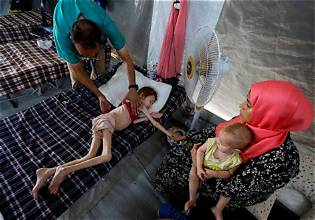
This morning, mothers in Gaza are still searching for food, clean water, medicine, and safety for their children. Even after a supposed ceasefire, Palestinians continue to be killed. Families already displaced again and again are being driven from one ruined shelter to another. Children are growing up hungry, traumatized, orphaned, and surrounded by the rubble of homes, schools, hospitals, mosques, and churches. With complete U.S. support, more than 20,000 of them have been killed by Zionists in the last 23 months.
Meanwhile, here in the United States, other mothers are afraid to take their children to school. They fear that masked immigration agents might seize them on the way, at work, in a courthouse, or even near a church or hospital. Families that have lived peacefully in this country for ten, fifteen, or twenty years are being separated. Refugees fleeing persecution find our doors closed. Human beings are confined in degrading prison camps, transferred far from their families and attorneys, and deported without anything resembling justice.
Most disturbing of all, these policies enjoy their strongest support among Americans who loudly identify themselves as Christians.
Many carry Bibles, display crosses, describe the United States as a “Christian nation,” and insist that they are defending Christian civilization. Yet they support bombs for Israel, starvation for Gaza, closed doors for refugees, and mass deportation for immigrants. They seem not to notice the glaring contradiction between the Jesus they claim to worship and the cruelty they applaud.
Today’s readings directly address that contradiction. The Gospel reading shows Jesus overcoming cultural prejudice in himself.
The reading begins with a mother’s desperate cry: “Have pity on me, Lord, Son of David! My daughter is tormented by a demon.”
Matthew calls the petitioner a Canaanite woman. Mark’s version remembers her as Syrophoenician. She lived near the twin cities of Tyre and Sidon, outside predominantly Jewish territory. She was therefore a foreigner, a Gentile, a religious outsider, and a woman addressing a strange man in public. She came from the land inhabited today by Palestinians, Lebanese, and Syrians.
At first, Jesus ignores her.
Then, when she refuses to go away, he tells his disciples, “I was sent only to the lost sheep of the house of Israel.” Finally, he responds to her with words that should shock us: “It is not right to take the food of the children and throw it to the dogs.”
We should not try to make those words sound nicer than they are. “Dogs” was a contemptuous designation for Gentiles. Jesus seems to be repeating the exclusionary language of his culture—language not far removed from an ethnic insult. As I have sometimes put it, he comes perilously close to calling this desperate woman a “b_tch.”
That kind of animalizing language is not incidental. It always prepares the way for persecution. Before people can be enslaved, imprisoned, deported, starved, bombed, or exterminated, they must first be described as vermin, invaders, criminals, terrorists, snakes, or animals. Once their humanity has been erased, anything can be done to them.
We have heard precisely such language applied to Palestinians. Israeli officials have described them collectively as “human animals” and treated Gaza’s entire population as responsible for the resistance of Hamas. The result has been the destruction of the conditions necessary for human life. The United Nations’ Independent International Commission of Inquiry has now concluded that Israel has committed genocide in Gaza.
We hear the same kind of language in our country. Immigrants and refugees are called “illegals,” “invaders,” “criminal aliens,” and poisoners of American blood. Their names disappear. Their individual stories disappear. Their children disappear. All that remains is a threatening category that can be hunted, detained, and expelled.
The Canaanite woman refuses to disappear.
She does not accept Jesus’ silence. She does not accept his restricted understanding of his mission. She does not even accept the insult. Instead, she turns Jesus’ own metaphor against him:
“Please, Lord, for even the dogs eat the scraps that fall from the table of their masters.”
Her witty reply stops Jesus in his tracks. He exclaims, “O woman, great is your faith! Let it be done for you as you wish.”
In other words, the woman converts Jesus. She forces him to recognize the contradiction between the inclusive Kingdom he proclaims and the exclusionary response he has just given her. The one the gospels present as a master of verbal riposte finds himself bested by this foreign mother.
That is what makes her faith so remarkable. Her faith is not primarily belief in a theological proposition about Jesus as the incarnation of God. It is confidence that the God Jesus represents must be more loving, more inclusive, and more merciful than the answer Jesus has just given her.
She believes that God’s love does not stop at a border. She believes that no child should suffer because she was born on the wrong side of a national, ethnic, or religious boundary. She believes that God’s table is large enough for everyone.
Were Jesus in Gaza today, countless Palestinian mothers could repeat the Canaanite woman’s words: “Have pity on me, Lord! My daughter is tormented by a demon.” And disgracefully, the demon in this case would be Zionists and Americans.
No follower of Jesus can hear that cry honestly and then applaud when an immigrant mother is separated from her children.
The contradiction could hardly be clearer.
The government says: protect the border by excluding the stranger. “Deport them” it growls. The gospel says: listen to the foreign mother.
The government says: some children receive bread, while others receive bombs, cages, or deportation orders. The Canaanite woman says: every child has a place at God’s table.
Today’s reading therefore asks us a disturbing question: If even Jesus could be challenged by a foreign woman and brought beyond the limitations of his inherited culture, why do Christians imagine that they have nothing to learn from Palestinians, Muslims, immigrants, refugees, and the undocumented?
The Canaanite woman’s daughter was healed because her mother refused to accept exclusion as God’s will. Palestinian mothers in Gaza are making the same refusal. Immigrant mothers threatened by ICE are making it too.
Their cry is addressed not only to Jesus. It is addressed to us:
Have pity on us. Stop calling us animals. Stop using your religion against us. Stop supplying the bombs. Stop separating our families. Stop pretending that God belongs only to you.
Our response cannot be sympathy alone. Faithfulness means demanding an end to U.S. military support for genocide. It means defending asylum, refugee protection, family unity, and due process. It means opposing indiscriminate deportations, accompanying threatened families, and confronting the Christian nationalism that places whiteness, borders, and military power above the gospel.
The Canaanite woman teaches us that faith sometimes requires arguing with the religion we have inherited. It means refusing every image of God that excludes the foreigner, abandons the refugee, or permits one people to live by destroying another.
For God’s table belongs to every hungry child. And until the children of Gaza and the children threatened with deportation are safe, none of us can honestly claim that God’s will is being done on earth as it is in heaven.