What Am I Doing with My Life? A Reflection on a “Left Forum” Event

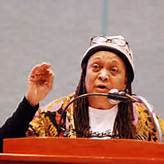
Pam Africa

“I don’t care if you’re 100 people, or 50, or 10. If there’s just one of you going against these mother f_ _ kers, it’s enough. Together we can warm their asses up!”

Those were the words of 70 year old grandmother, Pam Africa. I heard her speak last weekend at the annual meeting of the Left Forum – an organization of progressive thought leaders and activists. The meeting took place at the John Jay College of Criminal Justice of the City University of New York (CUNY). Its theme was “Rage, Rebellion, and Revolution: Organizing Our Power.”

Ms. Africa was talking about the necessity of organizing and taking to the streets in order to confront U.S. political, social and economic institutions she said were based on theft, murder, and perjury. The entire system, she added, has lost its legitimacy having become increasingly unresponsive to human need, and ever more violent in repressing those demanding their rights.

Pam Africa’s long experience gave her words credibility. She is the former Minister of Confrontation of the Move Organization, the Philadelphia African-American liberation community whose homes were bombed by Philadelphia Police Force back in 1985. Since that time, as the coordinator of the International Concerned Family and Friends of Mumia Abu-Jamal, she has been working for the release of Abu-Jamal and other political prisoners.

That was the theme of the panel discussion where Pam Africa was speaking – political prisoners.  It was the most inspiring of the events I attended, having chosen 6 of them from the more than 400 panels, workshops, and events that filled the Left Forum’s Events Directory.

There were 10 participants in the Political Prisoner presentation. About half of them were African American. Seven were women. Only 3 appeared younger than sixty. All but 1 had spent time in prison. And each and every one of them had dedicated their lives to the struggle for social justice. They’ve done so in the face of a Prison-Industrial Complex that reaps a fortune from the increasingly privatized criminal justice system currently incarcerating 2.3 million Americans – more prisoners per capita than any country in the world. The annual cost of doing so ranges from $24,000 to $47,000 per inmate.

Think of what could be done with that money, we were urged. What if it were it invested in housing, education, or mental healthcare rather than in prisons-for-profit?  Instead, those human warehouses have become a repressive government’s de facto programs for the homeless, poorly educated and mentally ill. Prison activist Anne Lamb described political prisoners there as “the most humble people you ever want to meet.”

How do so many prisoners end up behind bars?  Most of their cases do not go to trial, we were told. Instead plea bargains are struck. An arrestee is typically given the choice to plead guilty to one of a whole list of charges to avoid spending 15 rather than 5 years in prison. On the other hand, those who choose to go to trial get the book thrown at them. They end up doing 20 rather than 5 years and are held up as examples to potential plea bargainers. “You don’t want to end up like him, do you?” is the threat. The whole system saves (i.e. earns) the for-profit system millions.

Witnessing the intensity, commitment and sharp focus of participants in Pam Africa’s panel raised existential questions for me.

“What am I doing with my life?” I scrawled in my notebook. “Playing golf??”  I mean, I’m in my life’s final stage. And there is still work to do – especially around nuclear disarmament, climate change, and prison reform. As Pope Francis has pointed out, all of those issues are inter-related. Everything is! And the sad fact is that I’m largely avoiding the task.

Meanwhile, Pam Africa and the other panel discussants are out there in the streets. Once again, I’m not.

For me, the most logical response to the experience I’ve been describing here is to get involved in the Bard Prison Project. It’s a program for securing college degrees for prison inmates. Two years ago, Berea College (my former employer) was invited to join. I was asked to take part. I and other invitees did some preliminary work. Since then I haven’t heard anything.

It’s time to pursue that possibility.

As one of last weekend’s panelists put it, “We need to stand on the neck of the system and make it cough up justice.”

How Biblical Studies Helped My Critical Thinking: Part Two (Personal Reflections Pt. XIII)

Kennedy

These last three weeks I’ve been trying to show how critical reading of biblical texts is connected to critical reading of every other text — including that of my own life. In all cases, “ideological suspicion” Is central.

It alerts readers to the fact that vested Interests tend to distort analysis — but mostly in conservative ways Intent on supporting the status quo. That’s the way as well with most extra-biblical texts like the mainstream media, best-sellers and school text books.

By way of contrast, readings issuing from the viewpoints of the socially-conscious dispossessed tend towards subversion of the status quo. That’s significant for Bible reading because (as I was saying last week) the Bible largely represents the memory of poor and oppressed communities. As such, books within the biblical cannon are nearly unique in history whose records normally preserve the memories of the rich and famous.

So with that in mind, here are twelve more conclusions I’ve drawn about the Bible. Notice the connections to politics and the very complex question of violence so pertinent in a world characterized by a permanent war against terrorism. Again, I present this second list of 12 conclusions to expose the way biblical studies have influenced my political leanings and the ideas that seem so strange to my adult children. .

  1. The experience of the socially activist poor and oppressed leads them to discover a liberating God in the Bible. He habitually overturns political, economic and social structures oppressive of people like themselves.
  1. In other words, the God of the Bible is not a neutral God. The biblical God is a class-biased God who has made a “preferential option for the poor.”  Similarly, Jesus is class-biased, not averse to making sweeping statements about “the poor” and “the rich” as groups without specific reference to individuals within those groups.
  1. Neither is the Bible a neutral text.  In fact, there are no neutral texts at all.  Any text, biblical or otherwise, either supports the status quo or it attempts to subvert it.  A text which does not subvert supports.  There is no third position.  By and large (though not universally) the biblical texts predominantly produced in situations of persecution, attempt to subvert the order of the world; they support God’s order often described in terms of “the reign of God.”  Once again, it is an order which as the antithesis of the world’s present order favoring the rich and powerful, favors instead the poor and oppressed.
  1. Similarly, there is no neutral exegesis of the sacred texts. Every reading is done by a person of a particular gender, race, nationality, and creed, with a particular personal history, and located in a given historical era.  Inevitably such readers possess more or less definite political commitments, and have predetermined understandings of the world.  Each of these elements as well as others inevitably bias his or her exegesis of the text. Each interpretation facilitates some insights but excludes others.  With this in mind, it is revealing to note that almost invariably respected mainstream exegesis has been done by rather comfortable white males of European background.  This means that the vast majority of believers, women, people of color, the poor, the illiterate, as well as Christians of the Third World have been left voiceless.  All of these have been forced to accept as normative well-off European, white, male biblical interpretations.  And once again, these interpretations almost universally have supported maintenance of white male euro-centric privilege.
  1. Today our Third World brothers and sisters are asking us to open ourselves to the levels of meaning they are discovering. They do not claim these are the only possible meanings; for clearly there are others.  Neither do they hold that those who make diametrically opposed interpretations are insincere; for such a claim would obviously be false.  They do, however, observe that these latter interpretations are extremely partial, for normally such readings take no note of their contradictory alternatives produced for example by unlearned people in the Third World.  Meanwhile, the exegesis of the poor and oppressed is normally more comprehensive, for it is well aware of the mainstream interpretation and usually spends a good deal of its time contesting such understandings as ideological.
  1. Meanings uncovered in this way lead to judgments about the structures of poverty and oppression experienced in the world, and to action towards changing those structures. Here the emphasis is on judgment of sinful structures rather than on sinful human beings.  For although personal sin is a painful reality, it is not up to Christians to judge how others stand in God’s eyes.  Nevertheless, God’s word can shed light on the human institutions which victimize both oppressed and oppressors by facilitating and often appearing to necessitate injustice.  An example of such an institution is international capitalism particularly as it impacts the Global South.  Institutions of this kind must be eliminated by Christian action in the world.
  1. Unfortunately, those who profit from the world’s sinful structures do not usually allow them to be changed willingly; instead their more frequent response to movements for change is one of extreme violence often directed towards the most vulnerable, children, the elderly, women, the sick.
  1. As a last resort, defense of these “least of the brethren” may demand that Christians take up arms and give their lives on behalf of the otherwise defenseless. Here other Christians, especially those outside the violent and threatening context in question must exercise extreme caution in judging such actions as contrary to the spirit of the Gospel.  This is especially true if those tempted to judgements of this type are among those whose taxes and/or silence enable their own  government to sponsor the violence which prompts assumption of arms in defense of the otherwise helpless.

21. Likewise criticism of Christians who take up arms in defense of “the least of the brethren” must be restrained since the Gospel is by no means clear consistent in its judgment about such action. In fact, historically speaking, most Christians who read the Bible in good faith have found that it does not require non-violent resistance.  A close reading of the biblical texts, and an examination of church history seems to reveal that highly contextualized considerations rather than some unchangeable principle of non-violent resistance have dictated the responses of Christians in situations of persecution.

  1. In addition, it must be admitted that not all violence is the same. There is a real difference between (a) the violence of the unprovoked attacker (This is clearly against Gospel teaching); (b) the violence of one defending himself or herself against unprovoked attack (This is less evidently against Christian belief); and (c) the violence employed in similar circumstances by one risking his or her own life in defense of the lives of the otherwise defenseless such as children or the elderly (Arguably this may represent a positive response to the Gospel).  To neglect such distinctions is to obscure questions of violence and non-violence.
  1. For these reasons, advocates of non-violence for others must humbly examine their consciences to see if their advocacy is not unwittingly supporting the interests of those oppressing the defenseless. Here it must be noted that most robbers and perpetrators of other forms of violence are quite enthusiastic supporters of “peace” which takes the form of non-violent response on the parts of their victims.  It should also be observed that in this case those upon whom the strategy of non-violence is so enthusiastically urged are the least able to defend themselves.  In fact, historically speaking, the poor and working classes of the world who for the most part are the victims of oppression, stand virtually without means of self-protection, having no armies of their own.  They are the only ones to whom both state and church authority have forbidden violence  as a legitimate means of defending their loved ones from their oppressors of the propertied classes who have huge armies and defense budgets at their disposal.
  1. Perhaps in view of all this, the most that some North American Christians can say is that they themselves are hearing a vocation to non-violent resistance, and that Christians in other very different situations  are being called to determine how best to defend the “least of the brethren.” in their own contexts.  No doubt some Christians there will choose to arm themselves on behalf of their families, friends and fellow citizens.  Others will choose non-violent resistance. Still others will choose a combination of the two approaches.   A great deal will depend on the context in question. Christians living in the U.S.A. must overcome the affliction of tolerating violence in service to U.S. corporate interests while condemning the violence of those who resist such oppression.  “I would assert that people who have not actively opposed the violence of the powerful against the poor, at some cost to themselves,” writes Philip Berryman, “have no moral authority to question the violence used by the poor.”  (Jack Nelson PallmeyerThe Politics of Compassion.”  Maryknoll, New York: Orbis Books 1986, 87.)

Realizations like the ones I’ve noted here — all of them faith-based have inclined me to:

  • Understand world events in ways that privilege the viewpoints of the  world’s poor.
  • Side with them in their conflicts with the rich and powerful.
  • Acquaint myself with the reasons for what the privileged habitually describe as the unprovoked “violence” of those they habitually oppress.
  • See that the violence of the rich and powerful dwarfs that of the poor they exploit.
  • Perceive that since World War II all of the U.S. wars have actually been fought against the world’s poor and oppressed to keep them in that condition.

Dan Berrigan: in Memoriam

Dan Berrigan Resist

I just spent the last hour in tears. The occasion was a tribute to Dan Berrigan on Democracy Now (the best daily news program available).  The saintly Jesuit poet, peace activist and prolific author died on Saturday. He was about to celebrate his 95th birthday this week. What a giant!

Father Berrigan stands with Dorothy Day and Thomas Merton as the most powerful U.S. prophets and social justice activists or our era. They along with Martin Luther King are the true saints of our time.

All of them changed the way Americans approach issues of war and peace. In particular they changed the Catholic Church – challenging it to reverse 1700 years of belligerence and unquestioning support of imperial war, and to follow instead the clear teachings of Jesus the Christ.

Dan Berrigan not only wrote and spoke in ways that uncomfortably juxtaposed the Gospel of Jesus with United States imperialism; he also walked the walk – literally. He marched, spoke out, carried signs, and was arrested more times than he could remember. He spent years in prison, and staged creative protests against the Pentagon and the arms industry.

During the Vietnam War, Berrigan and other activists raided the Selective Service offices in Catonsville MD. They removed nearly 400 files from the place, and burned them with homemade napalm in the adjoining parking lot. They justified the act saying it was better to burn paper than children’s bodies.

Berrigan knew first-hand what he was talking about.  In 1968 he traveled to North Vietnam with historian, Howard Zinn. They had set out on an ultimately successful mission to free three U.S. airmen captured by the Vietnamese. In the process, he saw the burn wounds of children and the elderly scorched by the liquid fire that pursued them relentlessly even in their underground bunkers. He experienced war’s realities as he huddled there with the children and elderly during terroristic bombing raids by his own country.

On another occasion, Dan along with his brother Phil and other “Plowshares” members entered the General Electric nuclear arms plant in King of Prussia PA. There they found an (as yet unarmed) missile and used hammers to beat its nosecone to smithereens. They said they were following the injunction of the prophet Isaiah to turn swords into plowshares (IS 2:4).

I knew Father Berrigan personally. He spent a fall with us here in Berea in the mid-‘80s. His brother, Phil, visited Berea College more than once in connection with a wonderful course called “The Christian Faith in the Modern World.” Imagine actually conversing with saints like that!

I remember how enthusiastic Dan was in supporting the work of the “Berea Interfaith Task Force for Peace.” We were busy at the time with the Nuclear Freeze Movement and with resisting U.S. wars in Central America, especially in Nicaragua.

He met with us regularly – on at least one occasion, in Peggy’s and my home in Buffalo Holler in Rockcastle County. We have a snapshot of him there in our family album. He’s seated on our deck, eating from a paper plate with a bottle of beer on the floor beside his chair.

Another photo shows him standing up in protest with the rest of us at the Bluegrass Army Depot in Richmond Kentucky.  (The Depot holds WWII ordnance – mustard gas and chemical weapons still awaiting demolition.) We had infiltrated a patriotic celebration there.

Our Task Force had entered the facility with protest signs folded up under our shirts. We stood up to display them in the middle of a triumphant speech by one of the generals. Mine read “US out of Nicaragua!” Dan’s message was printed on his tee shirt. When he removed his outer shirt, everyone could see it.  “Stop the Arms Race!” it said.

One of my most memorable Ash Wednesdays came when Dan was here. In his humble understated way he celebrated a thoughtful Mass to begin the season of Lent. It reminded our packed church of St. Clare’s about the ashes created and left behind by brutal U.S. bombing campaigns and unending wars. He called us to repent by refusing our support of such conflicts.

I attended a class Dan taught three times a week during his semester at Berea. It analyzed the Book of Revelation written by John of Patmos – an otherwise unknown author who had been exiled to the Island of Patmos in the Aegean Sea by the Roman Emperor, Domitian at the end of the first century CE. Like Father Berrigan, the book’s author, “John the Revelator,” was a political prisoner. His crime was that of prophecy – of speaking truth to power. So Father Berrigan claimed a kind of “hermeneutical privilege” in dealing with the Book of Revelation. He said his exegesis was a matter of “one jailbird to another.”

I recall driving Dan to the Bluegrass Airport in Lexington the day he left us. Always on task, Father Berrigan spoke about the similarities between Israel’s occupation of Palestine and the apartheid system still flourishing in South Africa. “All these ‘settler societies,’” he said, “operate in the same brutal ways.” Sadly, his words remain true to this day.

In my early days of working at Berea College, I was privileged to give three lectures a year to the entire sophomore class assembled in Phelps-Stokes Chapel along with my colleagues, their teachers.  The context was a two-semester, primary-source survey course called “Religious and Historical Perspectives.” ( I loved the course. It taught me more than any other academic experience in my life.) My lectures were on Jesus (in the fall), on Marx (in the middle of the spring semester), and on Harvey Cox’s The Secular City (the last presentation of the year).

I remember centralizing Dan Berrigan in my Secular City talk.  I held him up (as I still do) as an example of what the great Jewish prophets, Jesus of Nazareth and Karl Marx, have to tell us about Christians’ relationship to the realities Harvey Cox described in his book.  I recalled Father Berrigan being arrested after spending four months underground resisting relentless pursuit by J. Edgar Hoover and the F.B.I.

Dan’s hands were handcuffed in front of him, I recalled. And he was asked by a reporter if he had anything to say before going off to Danbury State Prison. Father Berrigan gave a one-word response. He held up his handcuffed hands and made a peace sign. He said simply: “Resist!”  That’s his message to us today!

Thank you, Father Berrigan, for having the courage to resist and for challenging us so consistently to do the same. May we follow your prophetic example.

Biblical Study Helps Me Develop Critical Consciousness (Personal Reflections Pt. XII)

,


Biblical Criticism

Here are the first dozen of the twenty-four conclusions I’ve drawn after my years of biblical study. As the cartoon above indicates, what I gained from Eamonn O’Doherty at St. Columban’s  Major Seminary in Milton, MA was an introduction to the historical/critical approach to the Judeo-Christian tradition. It provided a foundation that was deepened and developed by the scholars I mentioned in my last posting.in this series.

The historical/critical approach acts as a corrective to misreadings that emerge from the naive literary/confessional approach that had previously been mine. I learned that the latter is too open to ideological manipulation at the hands of the dominant culture anxious to secure divine support for a status quo favoring the rich and powerful ruling classes..

Accordingly, those more conventional approaches must be treated, I realized, with “ideological suspicion” which methodically doubts the veracity of conventional interpretations.

Such doubt made me suspect of any interpretation issuing from the United States and Europe. There analysis tended to remain largely apolitical and by that very fact ended up supporting the socio-economic status quo.

That was not the case in the underdeveloped world. (I use that term deliberately. Latin America, Africa, and South Asia, I found, have been deliberately under-developed –robbed of their resources by over-developed nations.)

Scholars in the Global South saw clearly and articulated connections between the biblical texts and imperial exploitation. The texts of both the Jewish Testament and its Christian counterpart are unique in the ancient world in that they were largely produced by victims of imperialism at the hands of Egyptians, Assyrians, Babylonians, Persians, Greeks and Romans. To ignore that fact and to interpret them apolitically is to impoverish them and rob them of their critical power vis-a-vis contemporary imperialist situations.

I’m sure such remarks make it clear how the biblical studies I’ve pursued have sensitized me to the dark realities of empires and the intolerable situations they have produced in the past and continue to produce in the present.

In any case, the twelve conclusions I share here unveil my gradual progression towards critical consciousness engendered by biblical studies. As you’ll see, they inexorably become less general and more sharply political. Judge for yourself:

  1. For the Christian Bible reading is extremely important. In some sense, the Bible is the word of God. However its many separate texts were produced by very human authors concerned with addressing highly politicized situations.
  1. But living is more important still. After all, even in the Bible itself, life and history constitute the primary vehicle of God’s revelation. In fact, it was out of reflection on these basic elements that the sacred texts themselves arose.  In other words, the main purpose of the Bible is not preservation or study of tradition for its own sake, but to help believers make faith-full sense out of the lives they are actually living.
  1. Therefore, as important as it is, Bible reading for the believer is a secondary activity, carried on “after the sun goes down.” It illumines life’s primary activity and vocation, living itself.

Continue reading Biblical Study Helps Me Develop Critical Consciousness (Personal Reflections Pt. XII)

Biblical Studies Awaken Me to Political & Economic Realities (Personal Reflections XI)

Barth

Last week I was reflecting on the importance of Bible courses that were central to the training I received at St. Columban’s Major Seminary in Milton, MA. I was praising my most influential teacher there, Father Eamonn O’Doherty, who introduced us to modern scripture scholarship.

Now I see that what I learned from Eamonn went far beyond the Bible. It was more about process — about thinking for myself even In the face of the strongest authority imaginable — that of God himself. It was about making connections in economic and political terms between the world of the Bible and the world of today.

The kind of historical and analytic thinking to which Eamonn exposed me eventually spilled over into other areas of my life — to personal moral decisions, and to politics. Gradually, I reasoned that if I could question what I had understood to be the authority of God about the Bible, then why not raise questions about the Ten Commandments or what I had been taught concerning the goodness of my country. Perhaps my reading of American History was as erroneous as what I had understood about the Bible.

What I mean is that from my earliest schooling, the Sisters of St. Joseph had taught me that the Bible was the very Word of God. As such it was unquestionable. To even entertain doubts about its truth was sinful.

And though the good sisters taught me how to read, it never crossed their minds (in the 1940s and early ’50s) that the Bible could be read in any other way but literally.

.After all, Pope Pius XII (1939-’58) had then only recently granted permission to Catholic scholars to follow the example of their Protestant counterparts in applying the tools of critical analysis to sacred scripture. This meant approaching the Bible as an historical document — as ancient literature. It meant recognizing the host of literary forms it contained, It meant acknowledging that none of its contents is history in the modern sense of the term, and that it all found analogue in the sacred texts of other religions.

The pope did all of that in his encyclical, Divino Afflante Spiritu (1943).

By the time my formal biblical studies began (1963) Catholic scholars had used the pope’s injunction to catch up. More than that, by ’63, the Second Vatican Council (’62-’65) had already been in session for more than a year. Its reflections and changes all stemmed from re-readings of biblical texts in the light of the scholarship I’m referencing. And the resulting changes were profound touching understandings of church, priesthood, and the relationships of Catholics to the contemporary world.

In the 1960s that world was In turmoil; it was experiencing the birth pangs of a dawning new consciousness.  It was the era of the Civil Rights Movement. The missile crisis in Cuba (1962) nearly brought nuclear holocaust. President Kennedy was assassinated (1963) The Gulf of Tonkin (1964) plunged the U.S. more deeply into the Vietnam War.

.My first reaction to those “worldly” events was to dig in my heels. I was critical of war protestors.

I thought Dr. King had overstepped his competence when he criticized the War and U.S. colonialism (1967).I was more sympathetic to the government and police than to those calling for fundamental social change on behalf of African Americans, the colonized, the peace movement, feminists, Native Americans, prisoners, and the LGBTQ communities.

But after initial resistance, I couldn’t deny what I was learning about the Bible. And (as I was saying) that proved to be the thin end of the wedge for changes in other spheres. The evidence driving me to change my mind about the Bible was overwhelming. It had too much explanatory value.

So did the political and economic analysis behind what the biblical scholars I encountered over the years had to say about the connections between the ancient texts they explained and the underdeveloped world in which the majority of humankind lives. They are the ones responsible for awakening me to undeniable political and economic realities. I met them in Rome, and my travels throughout Europe, and in Brazil, Costa Rica, Nicaragua, Mexico, Cuba, India, the Holy Land, South Africa, and Zimbabwe.

I’m referring most prominently to Frei Gorgulho, Ana Flora Anderson, Franz Hinkelammert, Helio Gallardo, Elsa Tamez, Pablo Richard, Maria Lopez Vigil and her brother Ignacio, Ched Myers, Norman Gottwald, Resa Aslan, Marcus Borg, John Dominic Crossan, Robert Funk, Elaine Pagels, and a host of liberation theologians.

All of them helped shape (and continue to do so) my historical, political and economic understanding of the world. It was a long process. I summarize it in the two dozen points (which I’ll list here over the next two weeks). Readers will note how the points gradually become more political and related to empire, structural violence, resistance, and the struggle for justice. That gradualness reflects my own growth in consciousness over the last 50 years.

My point here (as I struggle to explain the origin of my crazy Ideas to my children) is that it’s all grounded In faith.

[Next week: My Understanding of the Bible (and of the world) in 12 of 24 points]

Waking Up To the Real Nature of the Bible (Personal Reflections Pt. X)

Merk

I don’t exactly remember what I thought about the Bible before beginning its formal study the year after receiving my B.A. in Philosophy (1961),

Ironically, although I had been in the seminary all those years (since 1954) the formal study of “religion” hadn’t at all been central in. the curriculum.

Yes, we attended Mass every day (and twice on Sundays). And there were all those daily chapel activities and devotions: morning and evening prayer, afternoon rosary, “visits” to the Blessed Sacrament before and after meals, nightly Benediction, conferences by the seminary spiritual director, etc. There were also those inspirational readings I mentioned accompanying breakfast and lunch in the “refectory.”

But formal study pretty much concentrated on languages (Latin, Greek, and French) and normal secular studies associated with high school, on the one hand, and on the other, college courses associated with a Philosophy Major.

So by the time I began the formal four year (and post-grad) theological curriculum (1962) my understanding of such matters, including the Bible was fairly uninformed. I’m sure I thought the Bible was the very word of God valid for all time.

That began to change with exposure to the teachings of Fathers Eamonn O’Doherty and Jack Moriarity, both of whom introduced us to modern scripture scholarship which emphasized the history behind the Hebrew and Christian Testaments. They introduced us to form criticism and redaction criticism as well.

Form criticism made us aware that the Bible is filled with various kinds of literature. Literary forms found there include myth, legend, debate, fiction, poetry, miracle stories, birth accounts, letters, apocalypse, annals of kings, law, riddles, jokes, parables, allegories, etc.  None of that, really, is history as we understand it. And if we read poetry, for instance, as if it were history we’ll commit huge interpretational errors.

Just realizing that can change one’s entire approach to the Bible. It did mine.

I remember sitting each day for classes in “Old” and “New” Testament in our aula maxima on the second floor or our Major Seminary on 1200 Brush Hill Road in Milton, MA. The entire student body – those about to be ordained, and the three classes behind them – took those classes together. There were probably sixty of us. So I found myself edified (and intimidated) by the good students among my elders whose questions and observations always seemed so sage, perceptive, and sometimes daring.

For a long time, I pretty much kept quiet. But the wheels were whirring at top speed inside my head. For a biblical literalist like me, it was all hard to swallow

For instance, I recall the day during our study of the Gospel of Luke that the penny dropped for me that the Three Wise Men never existed. It was all a “midrash,” we were told, on the part of the gospel’s author (whose real identity remains unknown). Midrashim, it turns out, are usually fictional stories meant to elucidate particular biblical texts or beliefs.

“Say what?” I thought. “The next thing you’ll be telling me is that the resurrection never happened.”

Well, that day never came – from the actual teachings of my Scripture Profs. But it sure did for me. So I remember one day screwing up the courage to ask Father Eamonn about it in class. I asked, “Is it possible, Father, that gospel stories about what’s called the ‘resurrection’ of Jesus were also simply creations of the early Christian community to reflect their gradually dawning consciousness that Jesus’ words were true: ‘Whatever you do to the least of my brethren, you do to me’ and ‘Wherever two or three are gathered in my name, I am there in their midst?’ In other words, might the resurrection, like the tale of the Three Wise Men also be a midrash?”

I awaited Father O’Doherty’s answer with bated breath. Perhaps my question wasn’t clear enough, I feared.

Well, the question was clear enough. Father O’Doherty paused a few moments. Then he responded: “No,” he said. And that was the end of it! He moved on.

Now that might give you the impression that Father Eamonn wasn’t a good teacher. Quite the contrary. I’m confident in saying that nearly all of my peers recall him as their most influential Prof during our four years of theological training. I agree with them. Eamonn imparted to us not only essential facts about the Bible, but an entire approach that stuck with us all.

In my case, his classes provided me better than any other a firm basis for what I would learn in Rome during my doctoral studies there (1967-’72). – and for what I internalized subsequently as I continued my studies with liberation theologians in Brazil, Costa Rica, Nicaragua and elsewhere in the  developing world. Of course, I’ll have more to say about that later.

But for now, I must tell you about Father O’Doherty’s teaching method. Again, it proved extremely effective. However, it’s not the sort of thing you’ll find in the best treatises on pedagogy.

The other day, I was looking at the basic primary source text we used in his New Testament classes.  It’s Augustinus Merk’s Novum Testamentum Graece Et Latine (pictured above). It’s the entire New Testament in its original language, Greek on one side of the page and Latin on the other. Originally published in 1948, its footnotes are filled with scholarly critical apparati. – mostly pointing up and evaluating variant readings of the Greek texts. I[n itself, that’s interesting. We were actually dealing with texts very close to the originals (none of which, it turns out, have survived. Instead all we have are copies of copies of bad copies. But that’s another story.)]

Besides the text itself, what was even more interesting to me were my notes in the margins of each page. Each was jam-packed with cursive scribblings in my smallest possible handwriting – so small, in fact, that I needed a magnifying glass to review some of them last week.

And that was evidence of Father O’Doherty’s teaching method. It involved (1) his lecturing to us each day reading mostly from his notes, (2) our transcribing notes as fast as we could, pausing occasionally for someone to ask questions, (3) Our transferring those notes into the margins of the relevant texts during out study periods, and (4) Recopying those detailed marginal notes onto exam papers in response to our teacher’s exam questions.

To me, in retrospect, that sounds pretty much like what the great Brazilian educator, Paulo Freire, excoriated as “Banking Education” – where teachers make deposits into the “accounts” of students who subsequently make withdrawals at exam time to purchase good grades.

But here’s the funny part: it worked! Father Eamonn wasn’t a particularly dynamic teacher. But what he taught us was so interesting and well-organized that we learned important lessons from a process that seems like pure regurgitation. Put that in your pedagogical pipe and smoke it!

Ask any of my peers. All of us love Eamonn. And we remain grateful to him to this day.

(Next Week: a full account of what I learned about the Bible over the years – in two dozen points)

Vatican II: My Alarm Clock Rings (Personal Reflections IX)

Vatican II

These weeks I’ve been trying to trace the origins of my own awakening to the necessity and power of critical thought.  I’m doing so even though the reaction of many kind enough to read my blog might be “Who cares?” From them, I beg indulgence.

However when the “who cares” thought occurs to me, I think, “I’m writing especially for my children (Maggie, Brendan, and Patrick) who might some day care – even if not now. I’m writing for some students at Berea College (where I taught for 40 years) and whose tuning into this blog suggests they might still be interested. Same goes for the hundreds of Evangelical college and university students whom I ended up teaching in the Latin American Studies Program (LASP) in Costa Rica where I worked off and on (as “Don Mike”) for more than 20 years.

So allow me to continue.

I was saying that insofar as any “awakening” has occurred in my life, it has happened in a world that I’ve gradually discovered to be mostly the opposite of what I’ve been taught by well-meaning parents, teachers and public figures in the United States. I don’t hesitate to say that in very important ways, most of what they taught me as “right” turns out to be wrong. Most of their “truths” I’ve come to see as falsehoods. And I’m referring to some of the most important aspects of life – women (yes, I list them first on purpose!), God, religion, history, and politics.

In that context, as I attempted to show last week in the case of my English professor, Father James Griffin, I experienced many caring people (especially Sisters of St. Joseph and professors within the Society of St. Columban) who while not necessarily exemplifying critical thought in the political sphere, encouraged me to think critically about poetry, literature, and the Bible at a time when the term “critical thinking” had not yet come into vogue.

Certainly, all of them were critical in a small but important aspect of the wider sphere because they were operating within the context of the Catholic Church. In the United states of  the ‘40s,‘50s and ‘60s the Church still found itself on the defensive before a population still prejudiced against it. So while the Church was trying desperately to fit in as Super American, it did so while defending its religious beliefs against hostility directed towards “Papists.” It was important for us to root for Notre Dame on fall Saturday afternoons. It was an act of cultural resistance.

My journey towards genuine critical thinking took giant strides when after finishing my undergraduate degree in philosophy, I entered the major seminary. “The Major’s” six-year curriculum comprised the final two years of undergraduate work in philosophy and was completed by four years of post-grad theological studies culminating with my ordination to the priesthood at the age of 26 in Milton, Massachusetts. (Thereafter, as you’ll see, I was sent to Rome for five more years of work towards my doctoral degree in theology.)

Actually, I don’t remember benefiting much from my philosophy major. However (paradoxically as I show here) one of my most memorable and in some ways influential professors was Fr. Norbert Feld. He taught us metaphysics and cosmology. Turns out that way back then in the early ‘60s Norbie was a precursor of today’s right wing Republicans. He was a fan of William Buckley and The National Review. He’d endlessly ridiculed “liberals” and even (as I recall) Pope John XXIII’s social encyclical, Mater and Magister (“Mother and Teacher,” 1961).  The encyclical’s title referred to the roles of the “Holy Mother Church” in the pursuit of social justice. In that connection, I remember Fr. Feld’s reading an excerpt from Buckley’s critical National Review article called, “Mater Si, Magister No!”

In fact, Norbie’s only “philosophical” utterance that sticks with me was his observation about Rene Descartes (1596-1650) – one of the great heroes of the Scientific Revolution. Norbie said Descartes “didn’t know his head from his elbow.” That shows you what Catholics even in the ‘60s thought about the “modern world.”

Despite all of that and in some strange way, Father Feld played a role in awakening me to the importance of politics. His right wing harangues did something to convince me that Barry Goldwater deserved my first vote for president. Still even at this late stage (21 or 22) I found myself content to slumber. I didn’t really see what all the fuss was about.

Even my theological studies those last four years in the major seminary didn’t make much impact at first. They were dry as dust and for me represented just one more hurdle blocking my way to the goal I wanted more than anything else –  to become a priest.

Then Pope John called the Second Vatican Council (1962-1965) and everything changed.

Suddenly, the Eucharist was celebrated entirely in English.  The seminary chapel was remodeled with the altar facing the congregation. The tabernacle (no longer located on the “Eucharistic Table”) now found its place off to the side quite distant from the altar.  Instead of a small golden cask, it became a huge wooden treasure chest meant to resemble the Ark of the Covenant. It was designed by a Jewish artist. (I remember engaging in heated debate about its appropriateness. “How could someone who did not even share the Catholic tradition,” I argued, “make a meaningful artistic statement about the Eucharist?”

Guitars now replaced organ music. We were singing songs that sounded like the Kingston Trio or Peter Paul and Mary.

Even more importantly, we left aside those dusty theological manuals that had been the basis of our boring studies. We were now reading protestant theologians. And all of a sudden theology was interesting – even exciting.  We were also reading the works of Edward Schilebeeckx’s  (Christ the Sacrament of the Encounter with God )as well as works by Hans Kung, Ives Congar, Teilhard de Chardin and other contemporary (mostly European) theologians.

We who had been cooped up in the seminary for so long were now allowed to travel at night together to the Paulist Fathers Lecture Series in Boylston Square. There we listened to scholars like Andrew Greely and Barnabas Ahern.

Ahern’s lecture about “The Human Jesus” impressed me tremendously. It changed the way I thought about Jesus. The talk’s central image was a “what if” analogy between Jesus and Pope John XXIII. “What if by night Pope John stole out of the Vatican precincts and in disguise travelled across the Tiber into Trastevere to consort with and teach the poor there as one of them?”  Jesus did something like that, Ahern argued – using his powerful grasp of modern scripture scholarship to make the point.

I was so impressed that the next day I sat down at my Olympus typewriter and wrote out the whole talk virtually verbatim from memory. Subsequently, I used it again and again to share Ahern’s insights with congregations I served. It was the best lecture I had ever heard.

However it’s not that I was yet completely comfortable with all the new things I was hearing. Ahern’s words were one thing, but I was uncomfortable with questioning issues I had thought long since resolved — papal infallibility and even mandatory priestly celibacy. We were now having constant though informal debates about those things. I remember once writing a “learned” essay in defense of Thomas a Kempis’ The Imitation of Christ. My classmates and others thought it too medieval and out-of-date. I loved the book and defended as if it were the Bible itself

But then, even the Bible, I found out, needed thoughtful critique. My most influential professor in the Major Seminary taught me that. And the evidence shook me to my foundations. (More one that topic next week)

Go Ahead: Blame My Crazy Thinking on Poetry! (Personal Reflections, Pt. VIII)

Golden Treasury

I skipped this “personal reflections” blog entry last week, because of a delightful visit by our four grandchildren over their spring break from Montessori School. So I was out scootering on Berea’s campus, eating ice cream, making breakfast pancakes, playing “Candyland,” and generally horsing around  for a week with Eva (age 7), Oscar (5), Orlando (3), and Markandeya (1 ½).  It was all great fun – unforgettable moments to treasure now and anticipate in the future.

It was all much more rewarding even than fashioning a blog entry, which I also love to do – though not nearly as much as being “Baba” for those four.

In the meantime, I heard from friends who could relate personally to what I had written about my best college professor, Fr. James Griffin. More than one former classmate had similar reminiscences of “Tiffer” (as we used to call him). Others with different backgrounds recalled professors like him who were  demanding, uncompromising , and (above all) eye-opening about literature, images, metaphors, similes, that (in the Tiff’s words) “capture, contain, and communicate” the reality they symbolize.

Many of us were also blessed with teachers of rhetoric who demanded short sentences confined as much as possible to subject-verb-object constraints (SVO! SVO!).

Such exchanges with friends made me realize that I could blame Fr. Griffin for the “Hamilton” fiasco I recounted at the beginning of this series.

Remember that Fr. Griffin had us wearing out our paperback Palgrave’s Golden Treasury of Poetry. We had to read and reread those metaphysical poets, keeping track of the images they used and finding new meaning in those word-pictures each time. Similarly we combed through Shakespeare, Dickens, Jane Austen and others. We learned to interact with their characters and talk about their thoughts, actions and motives as though those fictional women, children, and men were agents of flesh and blood. (I remember falling in love with Elizabeth in Pride and Prejudice and Nancy in Oliver Twist.)

Such readings had us constantly looking below the surface for hidden meanings and feeling triumphant and increasingly confident when we discovered them.

And there’s the “Hamilton” connection. My response to the play wasn’t the first time my children objected to my diving below the surface to reach some “outlandish” conclusion. For instance, I remember us arguing about my take on Tom Hanks’ “Captain Philips.” I saw it as a typical self-congratulatory “cavalry to the rescue” story that demeans indigenous people while exalting the U.S. military. (You can read my review here.)

Such “readings” of literature – and life – are guided by questions like these:

  • What’s really being said here?
  • What’s not being said?
  • What’s apparent?
  • What’s not?
  • Whose class interests are being served here – the oppressors’ or that of the oppressed?
  • What’s the ideology behind this presentation?
  • Does it support the status quo or subvert it?
  • How does this relate to history as told by Howard Zinn’s A People’s History of the United States, or by Eduardo Galeano’s The Open Veins of Latin America, or by Walter Rodney’s How Europe Underdeveloped Africa, or of Monica Sjoo’s The Great Cosmic Mother?
  • What can I learn from this about my own life?

That’s the sort of thing I began to learn from Fr. Griffin during my freshman and sophomore years at our seminary in Milton, Massachusetts. Later on, people called it “critical thinking.”  And (to be truthful), the approach sunk in only gradually over the years. I mean it’s not like I suddenly became a critical thinker as a college freshman or sophomore. On the contrary, I was mostly reluctant to challenge received wisdom. Remember I was trying to be an obedient model seminarian who followed all the rules.

(Next week: Learning to Read Even the Bible with Critical Perspective)

Fr. James Griffin: My Best College Professor (Personal Reflections Pt. VII)

Einstein

Last week I got a bit side tracked in my efforts to explain my growth in consciousness writing perhaps with excessive detail about the minutia of life in the minor (high school) seminary. “TMI,” my wife counselled.  So I dropped plans to share further episodes from the minor seminary.

Instead, let me get back on track this week by referring to an experience that directly helped me wake up from my culturally narrow stupor. (That, after all, is the purpose of these stories to my children.)

His name was Fr. James Griffin and he was indeed an experience.

Father Griffin was my English Professor each semester during my freshman and sophomore years in St. Columban’s College Seminary in Milton Massachusetts. He came from Ireland and was perhaps 50 years old at the time.

Father Griffin was a tough and merciless critic. He would review our papers in class, demanding that we stand up individually beside our desks while he ridiculed our errors, naiveties, and superficialities before our peers.

On one occasion, he got me on my feet for such purpose. He looked me in the eye, looked down at my paper, returned his gaze to mine, and then crumpled my essay into a ball and threw it in the wastebasket. “Sit down, Mr. Seul, he growled without comment. That was it.

Those first months as a freshman, I was terrified and dreaded English classes. I actually prayed that our professor would be sick and not show up. His health was delicate; so my petitions were often answered.

However, Father Griffin taught me how to write. “Keep your sentences short,” he demanded: subject/verb/ object – SVO. Keep that in mind.  I don’t want to read anything longer than that!”

He also gave me an appreciation of poetry, art, and classical music. He was our choir director.  He called all of us “Philistines” because he found us so uncouth and without a shred of culture. “You’re only interested in ‘shooting hoops’ (Isn’t that what you call it?)” he sneered.

Nonetheless, Father Griffin would bring his Wollensack tape recorder to choir practice and play German lieders for us.  He once sat with us through a televised concert by Pablo Casals.  His main text was Palgrave’s Golden Treasury of Poetry. By the end of my sophomore year, all of our copies were in tatters.

That’s because Father Griffin required us to read and re-read the Renaissance and Metaphysical poets keeping a journal of successive “encounters with the text” – always required to find something new. We assessed again and again the love poems of John Donne and Robert Herrick. Fr. Griffin enjoyed repeating Herrick’s lines.

WHENAS in silks my Julia goes
Then, then (methinks) how sweetly flows
That liquefaction of her clothes.
Next, when I cast mine eyes and see
That brave vibration each way free;          5
Oh how that glittering taketh me!


With the conclusion of that last line, he would invariably break out in a broad smile that revealed the pronounced gap between his two front teeth. He was great.

Yes, I came to treasure Father Griffin. He once astounded my puritanical sensibilities by talking of the love affairs of poets and artists. He remarked with a smile that they’re guided by exceptional moral standards beyond our ken. “Don’t blame them,” he advised.

Principally, Father Griffin helped me become a critical reader sensitive to images, symbols, metaphors and similes. He defined images as literary devices that “capture, contain, and communicate what they symbolize.”

I’ve since thought a great deal about that in the context of Catholic faith and what Protestants traditionally see as Catholics’ infamous devotion to “images” and our belief in the “Real Presence” of Jesus in the “Blessed Sacrament.”

Critics insist that the bread and wine of the Lord’s Supper are “just symbols.” And to a large extent they have a point.

I however would add that such images are SYMBOLS. That is, in Father Griffin’s words, they “capture, contain, and communicate what they symbolize” – viz. the Real Presence of the saints and especially of Jesus. In fact, all language about God (and life) is symbolic. Our theologies can’t get us much closer to divine reality than that.

More generally, Father Griffin taught me that words are powerful. They transform; they shift shapes, perceptions and therefore reality itself. The pen is indeed mightier than the sword. Once a new understanding has been internalized, the world can never be the same. Absolutes become relativized; certainties crumble.

With such instruction, Father Griffin prepared me for my subsequent scripture studies in the major seminary. It helped me approach biblical texts with the confidence that I could read them without excessive dependence on what the “experts” had to say. It also eventually helped me approach the text of my own life with similar self-confidence. I can unpack and understand it without undue regard for what others say.

Father Griffin was also a golfer. Once in Ireland after ordination while I attending a “Chapter” (i.e. a leadership conference) of the Society of St. Columban I played a round with him. We had a great time. And I had the chance to tell him how important he was in my own development.

He seemed surprised, but clearly appreciated that.

Later I heard that Jim was also surprised about my leaving the priesthood. He thought I’d be the least likely of all to leave the Society of St. Columban. He didn’t know, of course, that what he taught me about critical thinking played such a role in moving me out.

Thank you, Jim. I remember you every day in my prayers.

Life in the High School Seminary and What I Learned: Personal Reflections (Pt. VI)

Vocation

A good friend of mine responded to last week’s “Personal Reflections” by observing that my studies in the minor seminary from 1954-’58 hardly sounded  like what I described as “a standard high school curriculum.” To begin with, there was all that emphasis on classical languages. And then there was the rigor and regularly of the study regime in the absence of television, newspapers, and the distractions of girls and the accompanying social life.

So on second thought, I think my friend might be right. You be the judge.

However, the point here is not to convey information about my youth. It is rather to explain the foundation for my growth in consciousness towards those “crazy ideas” my kids complain about. I’m trying to get at how I grew from American nationalism and Catholic exclusivism to what I’d call a Cosmo-centric Mysticism that centralizes a “preferential option for the poor.” Surprisingly, all of that got its start in the high school seminary I wrote about last week.

Let me say a few more things about that experience and what it taught me. A lot had to do with discipline, survival, and introduction to the spiritual life.

As far as I can recall, our days at the minor seminary in Silver Creek, New York (and throughout my seminary years with suitable variations as we got older) were structured like this:  We got up each morning at 6:30 (7:00 on Sundays). We were in chapel at 7:00 for Morning Prayer followed by Mass and time for prayers of thanksgiving afterwards. Except on special occasions, meals were taken in silence, while we all listened to one of us read from Sacred Scripture, the lives of the saints, or some inspirational book. After breakfast (8:00-8:30) we had “free time” to make our beds and get ready for class at 9:00. Mondays, Tuesdays, Thursdays and Fridays we had three classes in the morning and one in the afternoon. Wednesdays and Saturdays there was no afternoon class; it was replaced by extended recreation periods during which we engaged in organized sports or outdoor work projects.

Except on Wednesdays and Saturdays, afternoon recreation ran from 12:30 till 2:00. Afternoon class would occupy us till just before 3:00. Then we’d have supervised study hall till 4:30 followed by a half-hour of spiritual reading. (The study hall priest-supervisor would patrol the long lines of desks making sure we weren’t reading novels on the sly.) After that, there was Rosary and Vespers at 5:00, then supper at 5:30. This was followed by a period for chores and recreation till 7:00. Study hall would resume then and run till 8:30, when we’d be allowed a half hour for recreational reading of approved novels.  Night prayer began at 9:00. Lights-out came at 10:00. The Great Silence reigned from night prayer till after breakfast the following morning.

Sundays we’d have a second Mass. And then there’d be intra-mural sports in the morning and extended free time in the afternoon. That’s when we could go on hikes to a nearby Howard Johnsons or somewhere for milkshakes or sundaes. Late Sunday afternoons we had a letter-writing period from 4:00-5:00 to keep us in touch with our families (no phone calls were allowed). Sunday evenings we’d have meetings of the Literary, Scientific, and Debating Society one week and of the Catholic Students’ Mission Crusade the next. We all took turns delivering papers at those meetings and serving as club officers. On special occasions, there’d be a movie. And on really special feasts (like St. Columban’s Day) we’d perform dramatic or comic plays (which, of course, required lots of rehearsals). Most of us got used to being on stage. Much later, in the major seminary (at the age of 24 and 25), I actually had the lead roles in Agatha Christie’s “The Mousetrap,” and in “Brother Orchid.”

Of course, not everyone responded to seminary discipline in the same way. Early on I saw that there were three seminarian types. There were those who “jacked around” (That’s what we called it) as much as they could. They took everything with a grain of salt and were always in trouble with the authorities. They fooled around in study hall. They habitually broke the Great Silence.  Eventually all those Jackers got bounced.

Then there were those who were mildly serious about the whole seminary routine; most of the survivors fell into that category. Psychologically they were probably the healthiest of any of us.

Finally there were the “saints.” They never jacked around, or broke the Great Silence. They practiced “custody of the eyes,” and always kept the rules. Almost invariably they were good athletes and smart students. I quickly decided to become like them.

I was “rewarded” (although it didn’t feel like that) by being made senior of my class mid-way through the first term of my freshman year at the Creek. That meant I was the liaison between my 31 classmates and the dean and rector of the seminary. That put me in line to be the Senior of the House (student body president) during my fourth year. That sort of thing happened to me throughout my 13 years of seminary training — mostly because I was a pious, obedient rule-keeper. My guides were a behavior manual called The Young Seminarian along with Thomas a Kempis’ classic The Imitation of Christ.

It also helped that I was trying hard to be a straight-A student. However I never quite made it into that category in the high school seminary. That would come later. Intellectually, I was a late bloomer and in high school had to settle for “Second Honors,” as they called it. My status in the eyes of seminary authorities was also helped by the fact that I liked sports and was good at them. That was important as well in the seminary pecking order among my peers.

While at the Creek, I used to hear our dean, John Healey, repeat, “You can take a boy out of Silver Creek, but you can’t take Silver Creek out of a boy.” I believe he was right. So much of Silver Creek remains part of who I am.

But what exactly has remained from the unusual training I received there. How did it contribute to my crazy ideas? After all, I’ve forgotten the rules for Latin ablative absolutes and how to form the conditional tense of irregular verbs ending in ere. I can no longer even pronounce Greek texts, much less translate them.  When I look at pictures from those days gone by, I can’t, of course, remember everyone’s name.

Yet many lessons remain valid for me. They come largely from the spiritual seeds that were planted so long ago by our unquestionably caring professors. They also come from living in community with boys like me who were the first in their families to aspire to post-secondary education. My peers were the sons of policemen, firemen, delivery truck drivers, and construction workers. (I don’t remember a single one referring to parents who attended college.) I remember all of my companions as clever, high-spirited, and often comically gifted. Many of them remain good friends – among the best I’ve ever had, even though these days we rarely connect directly.

Here are a few of the lasting lessons we learned together from living together, from our professors and from The Rule. Despite appearances, none of them are intended as clichés. I treasure these learnings:

  • There is a fundamental opposition between “the world” and its values and what Jesus called “the Kingdom of God.”
  • The values of “the world” are deceptive, illusory and not worth the effort. They promise happiness as the result of pursuing power, pleasure, profit and prestige. None of those things are what life and happiness are really about.
  • Instead, life is about what I identify as “working-class values:” family, hard work, cooperation, shared common property, and hospitality as opposed getting ahead and accumulating differentiating wealth. (Later on, I’ll share the theory about this – i.e. how the poor actually know much more about life than the rich.)
  • I don’t need much to be content – and I don’t believe anyone does. Shared community, nourishing food, a roof over one’s head, decent clothes (in the major seminary we wore the same outer garments every day) and stimulating ideas (education) are enough. Simple is better than complex.
  • One’s interior life is far more important than exterior comfort. In the end, life and “salvation” are about waking up to the illusions foisted upon us by “the world” and replacing them with the simplicity of the working class values just mentioned.

Personally, it would be many years before I would realize that I learned those things in Silver Creek and later in the major seminary and novitiate. In so many ways, when I left Silver Creek I was still asleep and would remain so for many years. To a great extent I’m still shaking the drowsiness from my head.

“The World” is seductive.

(More about seminary life and its painful lessons next week)