Cuba: A Frank Response to the President of Berea College

A few days ago, I received a disturbing email blast from Lyle Roelofs, the president of Berea College (where I taught for 40 years). It was about recent “Events in Cuba.” The notice was upsetting because it reflected the one-sided narrative of the U.S. government and its subservient mass media.

This is not to vilify Berea’s president who is sincere and well-intentioned. It is however to demonstrate the effectiveness of U.S. anti-Cuban propaganda that would have even academicians think that “our” government has a leg to stand on in its denunciation of anti-democratic measures anywhere, of intolerance of any dissent, or of police attacks on peaceful protestors.

See for yourself. In his characteristic spirit of compassion, the president had written:

Dear Bereans

Many of you are aware of the ongoing unrest in Cuba as the country struggles with severe blackouts, a food shortage, high prices, lack of access to COVID-19 vaccinations as outbreaks increase, and an unstable economy.  Residents of the island nation have taken to the streets to protest, filming conditions to share with the world. In response, the repressive government shut down the internet.

While we all care about the people of Cuba as our fellow human beings, a number of members of our immediate community have family ties there, as well, so our concern extends particularly to them in this worrisome time.

President Biden addressed the situation on Monday urging Cuban leaders to hear the people and address their needs rather than enriching themselves or trying to repress their human rights.

At Berea College, where one of our eight Great Commitments calls for us to create a democratic society, we align ourselves with the people of Cuba and echo the President’s sentiments. In a democratic society, organizations and the government can cooperate to address the sorts of critical problems currently being faced by Cubans, but which are found to a lesser extent elsewhere as well.  For example, at Berea College our Grow Appalachia program combats food insecurity in Appalachia working to ensure community members have enough to eat and teaching them how to grow their own food.

Globally, the U.S. and Cuba are among the countries that signed the United Nations Declaration of Human Rights, a list of 30 rights that every human being is entitled to. The right to free speech and health are most relevant to the current events in Cuba.  It is our hope that tensions will ease soon, the leadership there will work to provide food, access to vaccines, and make improvements to stabilize the country’s economy, and that this crisis will be an opportunity for improved relations with other countries, including our own, allowing urgently needed assistance to flow to the people of Cuba.

In solidarity with Cubans and Cuban-Americans,

Lyle Roelofs

What follows is my response in hopes that it might help Dr. Roelofs and the rest of us to be more cautious in accepting party lines about “official enemiessuch as Cuba, Venezuela, Nicaragua, China, Russia. . .

Dear Lyle,

It was with rather eager anticipation that I opened your recently emailed note entitled “Events in Cuba.” Because of Berea’s commitment black, brown and impoverished communities, I thought your notice would express solidarity with virtually the entire world in its yearly demand that the United States lift the Cuban embargo (Cubans call it a “blockade”) especially in view of the COVID-19 pandemic.

Instead, I found your comments quite incomplete and misleading. Together they gave the erroneous impression that:

  • All Cubans (“residents of the island nation”) endorse the anti-government street demonstrations
  • That Cuban leadership is ignoring the COVID-19 pandemic
  • That the same leadership is resisting improved relations with other countries including the United States
  • That Cuba should combat the island’s food insecurity by teaching people “how to grow their own food”
  • That Cuba is out-of-step with the United Nations and its “Declaration of Human Rights” by specifically depriving its people of health care
  • That President Biden has satisfactorily “addressed the situation on Monday urging Cuban leaders to hear the people and address their needs rather than enriching themselves or trying to repress their human rights.”

Such commentary appears to simply repeat the U.S. official story about Cuba without even once mentioning:

  • The U.S. economic embargo of more than 60 years
  • The blockade’s intensification under President Trump
  • That the Biden administration has kept all of the restrictions in place despite the pandemic and the president’s campaign promises
  • The resulting devastating effects of those measures
  • Cuba’s world-renowned health care system
  • Its development (unique in the former colonies) of several WHO-approved COVID-19 vaccines
  • The U.S. policy of blockading sale of syringes to Cuba thereby preventing the country from administering its own COVID-19 remedies
  • Cuba’s long-standing attempts to feed its own people by extensive, government sanctioned urban gardening projects and by environmental policies that make it arguably the greenest country in the hemisphere
  • The fact that similar demonstrations are happening all over the world including U.S. allies such as Brazil, South Africa, Haiti, Lebanon, Colombia, India, Ethiopia, Israel, Iraq, and Afghanistan (not to mention Black Lives Matter in the U.S. and the January 6th assault on the Capitol) — without comment on your part or emphasis in the mainstream media at large
  • The allied fact that “a number of members of our immediate community have family ties” in the countries just mentioned.

I am making these observations as a longtime friend of Cuba and (of course) Berea College. I have visited the island many times, never as a tourist, but always as an educator and researcher. In fact, the last course I taught at Berea (Summer 2014) had my wife Peggy and me leading another study tour of Cuba.

I have published many articles on Cuba including here and here about the country’s vaccine research and development. My daughter was treated for appendicitis while visiting Cuba two years ago. After spending five days in the hospital there, she was released virtually free of charge.

With Jose Gomariz (a Cubanist scholar, Jose Marti specialist, and former Berea College professor of Spanish) I once taught a Berea Short Term course at Havana’s Instituto de Historia de Cuba. The course was entitled “The African Diaspora in Cuba.” When I visited Cuba with the Greater Cincinnati Council of World Affairs, I was befriended by a family outspokenly and fearlessly critical of the Castro government. And in my many stints with the Latin American Studies Program of the Council for Christian Colleges and Universities, we took students to Cuba each semester to meet government officials, opposition forces, and diplomats at the U.S. Interests Section in Havana. In all, I’ve been there around a dozen times.

During the Fidel Castro years, I vividly recall a U.S. Interests Section spokeswoman revealingly lamenting the fact that Cuba (as she put it) did not hold presidential elections (thereby demonstrating her misunderstanding of Cuba’s electoral system). “As everybody knows,” she admitted, “he’d win hands down.”

What I’m suggesting is that there is much more to the Cuban story than we’re led to believe by United States propaganda against that beleaguered country.

By simply rehearsing the U.S. official story, Lyle, I suggest that (uncharacteristically) you are not helping the Berea community understand Cuba, its history, and the role of the U.S. in creating misery there, or what our government could do this very day to relieve it – namely lift the embargo and allow the import of syringes into the country.

Respectfully, Mike Rivage-Seul

Thomas Merton on Guy Patrick’s Life and Death

This Saturday, I’ll be traveling back to Berea, Kentucky where I lived and taught for more than 40 years. The sad occasion will be a memorial service for my life’s best friend, Guy Patrick who died at the very beginning of this year. Guy’s widow, Peggy, has asked me to read at the ceremony an excerpt from one of Guy’s favorite authors, Thomas Merton. What follows is my “translation” the Merton passage as applied to Guy’s life. Afterwards, I include the great Trappist monk’s original words, so you can see if I got them right.

Guy’s death has created a hole in my own life that will never be filled.  

Paradoxically,
Guy Patrick’s life
Affirmed itself
By all the endings
It contained.

He was blessed
To learn early on
The self-transcendent
Rewards and meaning
Of dying to himself and
Of using his time,
Effort, strength
And intelligence
To serve others
By giving them
Everything he had.

Doing so
Made Guy
The very embodiment
Of a mature man.
It set him apart
As uniquely
Productive and complete
Because he wasted no time
Seeking money or power.

So, at the age of 85
With nothing else
Left to give
To family world and humanity
He showed us
How to die
As his final bequest.

For Guy
The “end of life”
Meant culmination
Not termination.
It was an act of love
Of acceptance
And surrender
Of his entire life
With its good and bad
Sins and love,
Conquests and defeats
Into God’s gracious hands
Who then, no doubt,
Fulfilled Guy’s fondest hopes
By finally 
Revealing life’s meaning and worth
Its point and destiny – 
For all of us too.

Thank you, Guy
For your love, generosity
And wondrous example!

Thomas Merton On Worthful Living and Culminating Death

Thomas Merton

As a man grows into other stages of human development, he realizes that there are ways in which life affirms itself by consenting to end. For example, youth begins to discover that by bringing to an end some egoistic satisfaction, in order to do something for another, he can discover a deeper level of reality and of life. The mature man realizes that his life affirms itself most, not in acquiring things for himself, but in giving his time, his efforts, his strength, his intelligence, and his love to others. Here a different kind of dialectic between life and death begins to appear. The living drive, the vital satisfaction, by “ending” its trend to self-satisfaction and redirecting itself to and for others, transcends itself. It “dies” insofar as the ego is concerned, for the self is deprived of immediate satisfactions, which it could once claim without being contested. Now it renounces these things, in order to give to others. Hence, life “dies” to itself in order to give itself away, and thus affirms itself more maturely, more fruitfully, and more completely. We live in order to die to ourselves and give everything to others.

But since contingent lives must end — they are not interminable and there is nothing whatever in their constitution that justifies us thinking that they are — it is important that the end of life itself should finally set the seal upon the giving and the sacrifice which has marked mature and productive living. Thus man physically and mentally declines having given everything that he had to life, to other men, to his love, to his family, and to his world. He is spent or exhausted, not in the sense that he is merely burned out and gutted by the accumulation of money and power, but because he has given himself totally in love. There is nothing left now for him to give. It is now that in a final act he surrenders his life itself.

This is the “end of life,” not in the sense of termination, but in the sense of culminating gift, the last free perfect act of love which is at once surrender and acceptance: the surrender of his being into the hands of God, who made it, and the acceptance of the death which in details and circumstances is perhaps very significantly in continuity with all the acts and incidents of life — its good and its bad, its sins and its love, its conquests and its defeats. A man’s last gift of himself in death is, then, the acceptance of what he has been and the resignation of all final judgment as to the meaning of his life, its worth, its point, its ultimate destiny. It is the final seal his freedom sets upon the love and the trust with which it has striven to live.

Walks with My Granddaughter Eva

Our granddaughter, Eva, has just been elected Ms. President of our town, Westport, CT). We couldn’t be prouder.

In my declining years, I’m leading a charmed life. Here Peggy and I are living in Westport, CT, just down the street from our daughter, Maggie, her husband, Kerry, and five of our grandchildren.

Here’s a picture of our house where we moved just three years ago:

Our grandsons, Oscar (10), Orlando (8), Markandeya (6), and Sebastian (2) usually stay overnight on Fridays and we have breakfast together Saturday mornings. All of them (except little Sebastian) love baseball, so Peggy and I spend a lot of time cheering them on in their Little League games.

About three nights a week, Peggy and I also have dinner at our daughter’s beautiful home. And with the advent of warmer spring nights, we’ve been eating outdoors, where we share not only Maggie’s gourmet meals, but the day’s “roses and thorns,” i.e. all of us taking turns telling about the highpoint and low point of our days.

When my turn comes, my “rose” is often an account of my morning walk with my granddaughter, Eva (12), who is the reigning “Ms. President” of Westport. [That’s right, Eva recently ran (albeit unopposed) for our town’s Ms. President and was elected based on her compelling presentation of a platform promoting planet-saving vegetarianism.]

In any case and for years, Eva has often joined me for my daily four-mile fast walks (which are getting slower all the time). This often happens on weekends, but sometimes we end up walking together to her school about two and a half miles distant. About half-way through our routine, we invariably stop for coffee at Starbucks and spend about 30 minutes just talking there on the shore of the Saugatuck River that runs through Westport’s heart. Our conversations are uniformly wonderful.

We often discuss what we’ve seen and heard lately on “Democracy Now,” Amy Goodman‘s Monday through Friday news program which Eva watches faithfully every day. (I’ve told Eva that if she continues her practice, she’ll end up knowing more about the world than most of her teachers at her Pierrepont School which she absolutely loves.)

Pierrepont School, Westport, CT

Both Eva and I are admirers of Malcolm X. So, we’ve watched and discussed Spike Lee’s film together (along with “Fahrenheit 451,” “Soul,” and “My Octopus Teacher”). We’ve also read Malcolm’s autobiography, and we’ve talked about Les Payne‘s latest biography about our hero, The Dead Are Arising (which I’m sure Eva will read on her own when she gets a bit older). I can imagine her producing some kind of research paper on Malcolm in high school or college. Anyhow, we often talk about X; Eva is intensely interested — as she is about almost everything.

And our conversations are so much fun.

For instance, just this morning, we had maybe our best exchange yet. In her history class at Pierrepont, Eva’s studying the Illiad and Odyssey. While Eva loves the tale, she was mildly complaining that her teacher takes the classic too seriously — i.e. she leads discussions as though Homer’s work were something more than what Eva recognizes as historical fiction.

“You know, Baba,” she confided to me, “I think they’ve misplaced Homer in the history section of our library; it really belongs in the fiction aisle. I mean, all this stuff about Helen of Troy as the cause of the Trojan War doesn’t make sense. How does anyone know that her abduction started the whole thing?”

“That’s a brilliant question,” I said. “You should ask your teacher.

“But you know,” I said, ” that’s probably true of all of the books in your school’s library. I mean they all should probably be classified as fiction. That’s what historians and other authors do; they write accounts that reflect their own biases. And that goes for the Bible too.” (I voiced that last part, because Eva considers herself an atheist, so I wanted to be even-handed about fields of study — she knows I’m especially interested in questions of faith and biblical interpretation.)

“But don’t be too quick to dismiss fiction,” I added. “Fiction is often more revealing of truth than history or scientific theory. It’s like my friend, Guy Patrick, used to observe about the Bible. . . ‘All of it is true,’ he’d say, ‘and some of it even happened.’ Hemingway’s and Faulkner’s novels are true, even though they didn’t happen. You might say the same about the poems of Emily Dickinson.”

And Eva could see all of that. Despite her atheism, she even agreed that the biblical stories of creation might be truer (i.e. more revealing of human meaning) than Darwin’s revolutionary theory. Stifling a theatrical yawn, she said “Darwin might be factually true, but it’s more boring, I agree.”

Can you see what I mean about a charmed life — and about my charming granddaughter?

Jesus Is Not God!

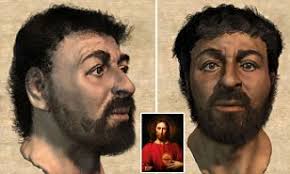
Forensic archeologists say that the historical Jesus looked like this. He was not white and stood about 5 feet tall and weighed about 110 pounds.

Last night we had another meeting of our church’s Lenten series discussing controverted questions of faith. So far, we’ve discussed (1) miracles, (2) healing, (3) Jesus and the poor, (4) the tension between American and Christian identities, and (5) what happens after death. Next week, we’ll address the question of resurrection. It’s all been interesting and at times quite inspiring to interact with more than a dozen gifted and earnest fellow seekers in a very admirable faith community.

However (if you recall), a couple of weeks ago when I was asked to lead the session on Jesus and the Poor, I got “hooked” into defending (at inappropriate length) the centrality of the biblical “preferential option for the poor” as the heart of Christianity. The one who hooked me is a very friendly, intelligent, articulate, and sincere church member whose faith convictions are undeniably robust. I admire him greatly.  

Nevertheless, during last evening’s meeting, it almost happened again. I mean, I was tempted to respond that same interlocutor rather than biting my tongue regarding a revisitation of our topic of two weeks ago about Jesus’ identity. (Remember, last night’s topic was to be what happens after death.)

Instead, my friend in the evening’s opening remark said something like the following: “We’re supposed to be Christians here discussing our faith. But the readings we’ve shared not only this week but two weeks ago, depart quite radically from central Christian beliefs. For instance, this evening’s reading is by Marcus Borg who sees Jesus is nothing more than a prophet. In this, he agrees with Judaism and Islam both of which of course honor Jesus – but as a mere religious genius, not as the Christ or as God. Christian faith on the other hand holds emphatically that Jesus is God, that he is indeed the expected Christ (Messiah). Without those beliefs, you’re simply not a Christian.”

As I said, I had other ideas, but bit my tongue.

However, here’s what I wanted to say in response (but thankfully did not):

Jesus is not God

Following the great Jesuit theologian, Roger Haight, I’ve come to believe that Jesus is not God. Instead, I believe that God is Jesus.

The distinction is not merely semantic. Saying that “Jesus is God” presumes that we know what the term “God” means. But that term, of course, has always been entirely problematic. What exactly is content? Answers to that query are legendarily diverse.

The problem is not only perennial, but in the case of Jesus is compounded by the ironic fact that the identification of Jesus as “God” took place under the aegis of the Roman Empire at the Council of Nicaea in 325. The irony stemmed from the fact that the Council was summoned by the Constantine, the emperor of Rome which had executed the prophet Jesus as an insurgent.

So, Constantine’s own problem was how to transform a rebel against Rome into a God (Deus was the Latin term) not only acceptable to, but supportive of his empire. His conundrum was how to transform Jesus into the son of a God whom worshippers of Zeus could understand.

[By the way, I hope you can see the significance of the similarity in terms Deus and Zeus. Its single consonant variation suggests that the Romans (who knew nothing of the Jewish God, Yahweh) couldn’t help but transform God into a thunder-bold throwing Zeus and Jesus into Zeus’ favorite son Apollo. In practice, no other understandings were possible for them!]

With all of this in mind, remember that Nicaea’s mandate was to answer questions like the following about the identity of Jesus:

  • Was he simply a man, a prophet?
  • Was he simply a god?
  • Was he a man who became a god?
  • Was he a god pretending to be a man?

In Constantine’s 4th century, there were “heresies” that represented each of these viewpoints.

But Nicaea’s answer to such questions was different. It stated that: Jesus was a divine being who was fully Deus/Zeus and fully man as well. The Council however left it for future theologians to explain exactly how that combination was possible.

[In my opinion, no one ever successfully did that. Marcus Borg, I think, came closest by holding that Jesus was fully human before his “resurrection” (however we might interpret that term) and fully God afterwards.]

In any case, throughout history Christians themselves have in practice resolved the fully God/fully human dilemma by emphasizing Jesus’ God dimension while neglecting almost entirely his humanity. Practically speaking, Christians have never truly endorsed Jesus’ humanity.

God Is Jesus

And that’s where the importance of holding that “God is Jesus” surfaces. On the one hand, the formulation recognizes the problematic nature of the term “God.” On the other, it resolves the dilemma by pointing to the Jesus of history to reveal the meaning of the term Deus. Look at the human Jesus, it says, and you’ll better understand the meaning of the word God.

And what do we find when we look at Jesus while bracketing official understandings of God as Zeus and Jesus as Apollo? The answer is entirely surprising and turns official theologies on their heads.

As revealed in Jesus, God shows up as the champion not of imperial majesties, but of slaves escaped from those same imperial majesties. More specifically, God’s embodiment (incarnation) is found in a man actually oppressed, not championed by empire. He is a peasant, the son of an unwed teenage mother, a refugee in Egypt, an enemy of the religious establishment, the leader of a poor people’s movement, a victim of torture and of capital punishment.

According to Christian faith, that’s who Jesus is; that’s who God is – found in the poor, the oppressed, in the torture chamber, on death row. . .

The fact that God chose to reveal God’s self as such is what is meant by the Bible’s “preferential option for the poor.”

Jesus is the Christ

All of this is intimately linked with my church friend’s insistence that Jesus is the Christ, the messiah.  Here too we must remember that “Christ” is not a Roman term; it is entirely Jewish and has specific Jewish meaning impossible to understand apart from its cultural context.

As Jesus-scholar, Reza Aslan, reminds us, the term “Christ” had one meaning and one meaning only for Jews: the Christ was (1) a descendent of Judah’s King David who would (2) reestablish David’s kingdom (3) in a once again sovereign state. And reestablishing sovereignty necessarily meant disestablishing Rome’s kingdom which occupied 1st century Palestine where Jesus lived.

Of course, the Romans understood that. Consequently, they executed Jesus precisely as an insurgent – along with the untold others in the same historical period who made the same messianic claim. Such was the point of the titulus, “King of the Jews” that the Roman procurator, Pontius Pilate insisted be displayed over Jesus’ head as he hung dying on his cross – the instrument of torture and death reserved for insurgents against the Roman empire (John 19:22). The titulus proclaimed the charges against the executed. Jesus’ crime was proclaiming himself “King of the Jews.”

So, historically speaking, claiming that Jesus is the Christ or messiah is a highly political statement. It signifies belief in Jesus as the quintessential opponent of empire and its inevitable oppression of God’s chosen – the poor and oppressed.

Conclusion

I’m glad I didn’t try to say all of that at last night’s meeting. Still, I’m happy for the evocation of such thoughts by my brother in faith at our Talmadge Hill Community Church.

It all reminded me of what I first learned at a memorable lecture by Passionist scripture scholar, Barnabas Ahern back in 1965 (when I was just 25 years old). Ahern’s topic was the historical Jesus. He inspired me to confront the fact that christians (myself included) tend to believe with all our hearts that Jesus is God, while at the same time paying only lip service to Jesus’ humanity. Ever since then, I resolved to avoid that mistake myself.

In fact, I was so impressed by what Fr. Ahern said that the very next day I wrote out from memory the scholar’s entire talk which has since then played a central role in driving me to internalize modern scripture scholarship about the humanity of the historical Jesus.

It has led me to Roger Haight’s formulation that Jesus is not God, but God is Jesus.

With Reza Aslan’s help, I’ve also come to grasp the revolutionary meaning the terms “Christ” and “Messiah” must have had for 1st century Jews. Then writers such as Marcus Borg have helped me understand the post-resurrection process by which the human Jesus himself appropriated his divine nature – human before his resurrection, divine afterwards.

And that entire sequence of lessons has immeasurably enriched my own faith and enabled me to share their insights.

Thank you, my brothers and teachers Barnabas, Roger, Reza and Marcus.

I Go Overboard in Explaining How the Judeo-Christian Tradition = God’s Preferential Option for the Poor

[This is a second reflection on a pair of Zoom experiences I had last Monday. I reported the first here – some comments I made at a meeting of the Y’s Men of Westport. What I said and my insistence on saying it had me wondering about my role in the world during this third stage of my life. How much should I say? To what extent should I just shut up?

Today, I’m reporting on a Zoom meeting later that same day. It had me co-leading a Lenten discussion at our new church in Westport, CT. It was our third pre-Easter session devoted to examining controversial topics connected with our faith. Two weeks earlier, we had discussed miracles, their nature and possibility. A week later, the topic was healing. The topic last Monday was the question of “Jesus for the poor.”

Because of my interest in liberation theology and its signature “preferential option for the poor,” one of our two pastors had invited me to co-lead the discussion with him.

With the pastor’s consent, here’s the way I approached it.]

Introduction

The question of Jesus and poverty is fundamentally a religious question. And religion, of course, is a language. It marries words and concepts to a fundamentally ineffable (beyond words) experience that is open to all people. When that experience occurs in China, it comes out as Buddhism or Confucianism; when it happens in India, it’s expressed as Hinduism; when it happens in Arabia, it takes the form of Islam.

When the religious impulse finds words among the world’s poor and oppressed committed to improving their collective lives, it is expressed as the Judeo-Christian tradition. Yes, I mean that: the biblical tradition (virtually alone among the world’s great literature) thematically reflects the religious consciousness of awakened and impoverished victims of imperialism.  

More specifically, the Judeo-Christian tradition found its origin among slaves in pharaonic Egypt. Those slaves formed a people (called Hebrews or “rebels”) who retained their worship of a God favoring ex-slaves, widows, orphans, and resident foreigners throughout their history of domination by empires of various sorts – under Assyrians, Persians, Babylonians, Greeks and Romans.

The Tradition’s Foundational Story

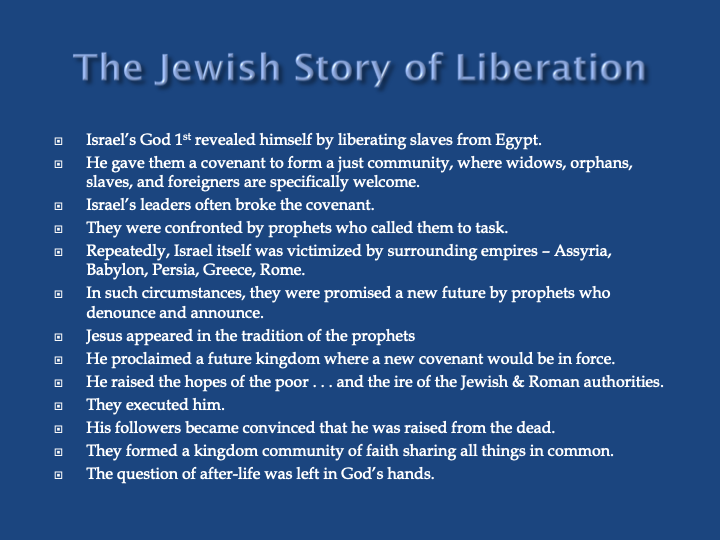
That fact becomes clear when we consider the basic biblical story. According to virtually all mainstream scripture scholars, that narrative begins not with Adam and Eve in the garden, but with the liberation of a motley group of slaves of various ethnic identities. The story told to give them a sense of national unity runs as follows:

Jesus the Christ

Here it is important to note that Jesus appeared precisely in the prophetic tradition. His message represented a defense of the poor. This is abundantly clear from the program he articulated in Chapter 4 of Luke’s gospel:

Jesus’ program represented a reversal of the world’s values. Everything in God’s kingdom would be turned upside-down. According to Luke’s “Beatitudes,” the poor would be blessed, so would the hungry and thirsty along with those suffering persecutions. Meanwhile the rich would be condemned. “Woe to you rich,” Jesus is remembered as saying, “you’ve had your reward.” “Woe to you who laugh now, for you will soon be weeping.” In other words, Jesus’ understanding of God’s future entailed a complete reversal of the world’s social arrangement. As he put it, “The first would be last and the last would be first” (MT 20:16).

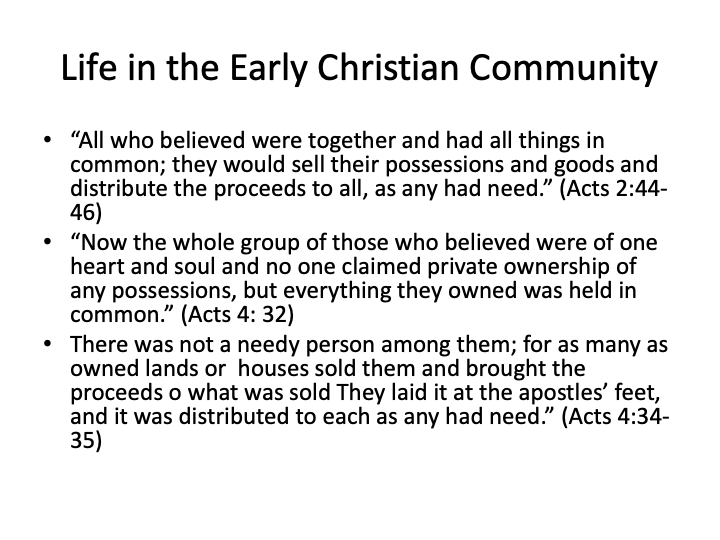
What’s more, the early Christian community’s interpretation of Jesus’ message underlined the entire tradition’s “preferential option for the poor.” In the first Christians’ efforts to follow the Master, they actually sold what they had and gave it to the poor. That way of life is reflected in three important passages from the Acts of the Apostles:

Jesus Romanized

With all of that in mind, you can see why the Christian message was so popular with slaves, the poor, with social outcasts. You can see how it inspired revolts as it spread throughout the Roman Empire. You can also understand why Rome became alarmed and famously ended up sponsoring all those persecutions which iconically fed so many Christians to lions and other beasts in the Colosseum. However, it was all to no avail – as Christianity continued to spread like wildfire.

So, at the beginning of the 4th century of our era, the emperor Constantine decided to co-op Christianity. But to do so, the new religion’s basic narrative had to be changed. It became Romanized and was effectively transformed into a Roman mystery cult.

Mystery cults worshipped gods like Mithra (whose feast day btw was Dec. 25th), Isis, Osiris, and the Great Mother God. Their stories had the god descend from heaven, die, rise from the dead and ascend to heaven from which s/he offered life everlasting to believers who ate the god’s body and drank the god’s blood under the forms of bread and wine.

In Christian form, the narrative supporting such belief was best expressed by St. Augustine in the 5th century. Drawing on stories in the book of Genesis and on statements found in Pauline writings, this is the story with which Augustine shaped and captivated Christian belief for the next 1500 years: 


Notice here how the story abstracts not only from the histories of Judea and Israel, but from Jesus’ message about the Kingdom of God and its Great Reversal in the here and now. Instead, everything is mythologized.

And that brings us to our discussion questions:

For Discussion

  1. What are your questions about the information in these slides?
  2. What surprised you about that information?
  3. What (if anything) do you find questionable or unacceptable about it?
  4. What are the implications of this approach to the bible and Jesus for your own faith?
  5. What are the implications of this approach for the Talmadge Hill Community Church?

My 1st & 2nd Mistakes

Of course, anyone reading what I’ve just presented can see that my first mistake was speaking too long and presenting too many new ideas for a 90-minute discussion. (My face is still bright red.)

My second mistake was even worse.

The slides I just presented had been shared beforehand with our group of about 20. And one member had done his homework. After expressing appreciation for my work, he went on to list in detail his points of disagreement. He began with his belief that the foundational story of the Judeo-Christian tradition was indeed found in Genesis, not Exodus. He went on to say that my presentation overlooked the crucial fact that Jesus is divine, the very Son of God, and that his words about poverty were meant to be taken in a spiritual rather than in a material sense.

In response, I should have kept silent. And if I chose to respond, I should have said, “I really appreciate your taking the time to express so well and clearly the most important points of the Augustinian story. What you’ve done sets us up perfectly for comparing the two basic biblical stories we’ve just reviewed. Does anyone else in the group have similar or different thoughts from the ones just expressed?”

That’s what I should have said.

However, instead (and forgetting all I’ve learned from 40 years of teaching this stuff) I attempted to respond point-by-point to the issues my friend had so well summarized.

Mine was such a bad decision that at one point, the pastor had to cut me off to give other people a chance. (As I said, my face is still a vivid crimson.)

Conclusion

I didn’t sleep well Monday night. I couldn’t help thinking, “When will I ever learn?” I even thought, “I’m getting too old to do this sort of thing. I think my days of teaching, public speaking, and playing leadership roles in church might be over. I’ve got to learn to say less and to stop trying to convince others about what I’ve learned over all my years of studying and dialoguing with Global South scholars. It’s all counterproductive.”

The next morning, however, things appeared a bit less dire. I received telephone calls of encouragement from the co-leading pastor and some others. Emails tried to console me. (But all of that almost made matters worse. It made me think, “They’re just trying to make me feel good. It must have been more awful than I thought.”)

The problem is that I still feel so passionate about rescuing the Jesus tradition from the irrelevance of its domestication by Augustine and subsequent theologians.

In a world of globalized poverty and exploitation, the life, words and teachings of the historical Jesus are too powerful to keep silent about. I’m just going to learn from this sobering, uncomfortable lesson and move on.

This is about something much bigger than my mistakes as a teacher.

At 80, Still Wondering Who I Am

Just yesterday, I had two experiences that made me wonder about myself. Even at the age of 80, I’m still questioning how I should present myself in this world that by all appearances is rushing headlong into terminal disaster? Am I being too outspoken? Should I temper what I say about politics and religion?

For me, those are constant questions. They arise not only in family conversations, but more publicly – e.g., in the context of a men’s group I’m part of in our new hometown, Westport Connecticut. My self-interrogations surface as well in the church that Peggy and are aspiring to enter. It’s the Talmadge Hill Community Church located in nearby Darien. In all three instances – family, the men’s group, and in church – I find myself wondering about transgressing the boundaries of polite discourse.

Today, let me first of all tell you about what happened yesterday with the men’s group. In a subsequent posting, I’ll share my questionable behavior in church – and then in my family.

The Y’s Men

In Westport, I’m a member of The Y’s Men. It’s a group of about 200 retired men, mostly Jewish and with backgrounds in international business, law, local government, and other administrative posts. The organization gets its cleverly ambiguous name from some distant association with the YMCA, which I can’t recall.

In any case, the Y’s Men meet every week and sponsor a myriad of activities that include (among other items) hiking, golf, sailing, a book club, and (before Covid) theater in New York City. I’m enjoying all of that. The Y’s Men are typically very bright and firm I their opinions.

That firmness takes center stage every other week, when a gathering of about 50 of us meet to discuss world issues. There, as we talk about matters such as China, 5G, the Middle East, and the Great Global Reset. In those contexts, the Y’s Men reveal themselves as basically patriotic, respectful of the military, and as “Americans” who understand their country as a splendid model honoring human rights, democracy and the rule of law.

I, of course, share none of those characteristics. Informed by social analysis reflected in liberation theology, my own tendencies have me looking at international affairs from the viewpoint of the world’s majority who are poor and under the jackboot of western imperialism led by the United States of America. As a result, I often find myself at odds with my fellow discussants.

U.S. Policy in the Middle East

This week was no exception. The announced topic is “Recalibrating US Policy with respect to Afghanistan, Iran and Saudi Arabia.” As usual, the conversation reflected the official position of the United States, viz. that “our” interests in recalibration are democracy and the protection of Israel from unreasonably hostile undemocratic forces represented principally by Iran, Islam, the Taliban, and Islamic terrorists.

For me, that position overlooked the provocative hostility of the U.S., Israel and Saudi Arabia towards Iran which is a major power in the area and whose interpretation of Islam has good reason for being defensively hostile towards foreign control of the Middle East. Consider the following:

  • Between 2010 and 2012, the intelligence agency (Mossad) of U.S. client Israel, assassinated four of Iran’s top nuclear scientists.
  • On January 3rd of 2020, the Trump administration itself assassinated Iran’s revered general, Qassim Soleimani, a national hero.
  • On November 11th, 2020, the Mossad also assassinated Mohsen Fakhrizadeh, yet another of the country’s leading nuclear scientists.
  • On May 8th, 2018, President Donald Trump unilaterally withdrew the United States from the internationally supported Joint Comprehensive Plan of Action (JCPOA) by which Iran had renounced alleged efforts to develop nuclear weapons. By all accounts, Iran had not violated the agreement.
  • Instead, the United States intensified economic sanctions on the country which increased Iran’s poverty rate by 11%.
  • The strengthening of sanctions persisted even during the Covid-19 global pandemic.

Despite such provocations, Iran has taken virtually no retaliatory measures either against Israel or the United States.

In the light of these facts, here’s what said at this week’s meeting:

What we’re calling a “reset” in the Middle East is really a recommitment to traditional U.S. anti-democratic policy there. It has us supporting not democracy, but client kings and potentates throughout the region particularly in Saudi Arabia as well as an apartheid regime in Israel. U.S. enemies here are Islamic nations who understand their religion as an affirmation of independence from outside control – independence from western imperialism and neo-colonialism. (For their part, the United States and its puppets call Islamic striving for independence “terrorism.”)  Of course, the point of that imperial control is what it’s always been, viz. transfer of resources. And in the middle east, the resource in question is oil. Nothing has changed. Nothing will change as long as our economy remains petroleum dependent.

My intervention was largely ignored. So, using other words, I reiterated the sentiment about three times more.

Too Insistent?

And that’s my point of self-questioning here.  Am I saying too much? Are my positions too radical? If so, are my efforts counterproductive in that they turn people against the very viewpoint I’m trying to share (that of the world’s poor, imperialized and silenced). Should I just shut up and listen?

Family members often caution me in the direction of such judicious silence.

Truthfully however, I find such restraint a species of self-betrayal. My role models – the people I find most admirable in the world – never bit their tongues in similar circumstances and even on the world stage. Their list is long and includes Gandhi, King, Rosa Parks, Fannie Lou Hamer, Malcolm X, Dorothy Day, William Barber II, Liz Theoharis, Naomi Klein, Cornel West, Jeremiah Wright, Chris Hedges, the Berrigan brothers, and the liberation theologians I’ve spent more than 50 years studying.    

Most of all, the list of such truth-tellers is headed by the great prophets of the Bible and by the one who has grasped and held my attention my entire life. I’m talking about Jesus the Christ.

I’ll explore that dimension of my outspokenness and self-doubt in my next posting.   

In Memoriam: Guy Patrick (1935-2021)

Guy (far left) posing with new homeowners in his capacity as director of Habitat for Humanity in Madison County, KY

I lost my best friend today. Guy Patrick died around 11:00 this morning, a couple of weeks after we celebrated his 85th birthday. For years, he had predicted his death “this Easter.” And then when it didn’t happen, he’d laugh and say, “I guess I’ve been given another year.”

I had known Guy for more than 40 years. Also former priest, he had a kindred monk’s spirit and was wonderful example of the deepest unshakable (though critical) faith. It let him settle for a date near Christmas rather than Easter.

I first met Guy (I forget exactly when) in the late 1970s. He was “in transition” as they say – exploring his exit from the priesthood and an anticipated move to Berea Kentucky. There, his future wife, Peggy Anibaldi (a former religious sister) had just secured employment as a head resident at Berea College where I ended up teaching all those years.

Earlier, Peggy had looked me up having got my name from the bulletin of CORPUS, a Catholic organization of ex-clergy and religious whose mission was to help members find employment and community.

I remember Guy’s Peggy visiting my Peggy and me in our home in Buffalo Holler 5 miles outside the Berea city limits. No sooner was Ms. Anibaldi inside our doors, it seemed, than my Peggy was on the phone to Ruth Butwell (the director of Berea’s residence halls) telling her of this wonderful woman who would make the perfect head resident. Ruth hired Peggy, it seemed, almost on the spot. (My Peggy is very persuasive!)  

In any case, when Guy finally joined his Peggy in Berea, we hit it off immediately. And there in my office on the 4th floor of the Draper Building, began a conversation that lasted through Guy’s final days. It was always the same: some about politics, yes, but mostly about God, philosophy, theology, church, life and death. Always the same. Always delightful. Usually over double Manhattans and popcorn. Sometimes quite animated. Never dull. I loved Guy.

And what was there not to love? He was a wise accomplished man. As he described it, his career path could be roughly divided into 10-year segments. It took him, he said:

  • From Catholic school and setting bowling pins as a kid in PA
  • To the seminary and ordination
  • To securing a degree in theology at DC’s Catholic University
  • To teaching in his diocesan seminary and later in an associated high school
  • To working as a youth minister (with Sister Anibaldi) at Mercyhurst College in Erie, PA
  • To serving as a Berea College head resident and later as a factotum at Emmaus House, an intergenerational home for the elderly which Guy’s Peggy directed as part of Fr. Ralph Beiting’s Christian Appalachian Project
  • To assuming his role as the truly legendary director of Habitat for Humanity in Madison County, Kentucky
  • To retiree status in which he continued to work for Habitat and (always with Peggy) to animate our local St. Clare’s Catholic Church until he (along with other progressive Catholics) surrendered in the face of restorationist pastors rejecting the spirit of the Second Vatican Council

Through it all, Guy retained a wonderful self-deprecatory sense of humor. A laugh or a joking remark was never far from his lips. Some of his more memorable sayings included:

  • “As my dad used to say in similar circumstances, ‘Meh. . .’”
  • “Well, we all have to be somewhere.”
  • “Organize? Hell, I couldn’t organize a two-car funeral.”
  • “They say I’m a pessimist, but I’m really an optimist. A pessimist says things couldn’t get worse. I always say, ‘Oh yes they could!’”
  • “In marrying Peggy, I was just following the advice of Martin Luther. He said ‘Every man should marry a nun.’ And that’s what I did. Never regretted it. Luther was right.”
  • “In fact, (again quoting my dad) here’s the way I’d summarize my life, ‘I loved every minute of it!'”
  • “For that reason, I like what Woody Allen had to say about death: ‘It’s not that I’m afraid of dying. I just don’t want to be there when it happens.’”

Woody Allen notwithstanding, Guy was indeed fully there when it happened. That became evident in meetings of “The Manhattan Club,” a men’s group in which 7 of us Berea types participated for years. At our meetings we each usually drank 2 Manhattans – as well as “cheating on our wives” (as guy put it) by eating non-vegetarian snacks. The conversations were always quite lively.

[And speaking of cheating on our wives. . . Guy and I loved to have our own men’s night out at Richmond’s “Golden Corral Steakhouse.” There we’d select steak, ribs, chops and roast beef from the buffet — not to mention mashed potatoes, gravy and rich dessert samples. Then we’d waddle across the street and bowl a few lines at the alley that always evoked stories about his boyhood days setting pins. (Guy was a good bowler and quite the competitor.) We’d finish at the bowling alley bar for a nightcap.]

But towards the end, our evening Manhattan Club gatherings switched to mornings with coffee. And week by week, we witnessed Guy’s health decline. Nevertheless, he always had reflections to share as well as gallows humor about his approaching end. To the very last he was reading Plato, Thomas Merton, and the postmodernist, Jacques Derrida. Guy went out puzzling over Derrida’s reflections on “the gift of death.”

And at our final Manhattan Club meeting with him, guess what Guy talked about? He was full of recollections of his 6 months spent in Americus GA with the great Millard Fuller, the founder of Habitat for Humanity. He expressed his intention to make one more appeal to his friends to contribute generously to the organization in his memory.

His final sentiments were characteristically prayerful. “After all of this,” he said, “my only prayer is ‘Oh God, be merciful to me, a sinner.’ Along with that, it’s just ‘Thank you.'”

That’s the kind of Guy he was.

A Blessing for Guy Patrick

Just before he left us, our men’s Manhattan Club met via Zoom to say a formal farewell to Guy. I was asked to give a final blessing. As we all extended our hands, this is what I prayed:

 I give this blessing
 In the spirit of the conversations
 All of us have shared
 Over the years
 When we debated questions of life, meaning
 God, and destiny.
 Those were intellectual,
 Head-centered conversations
 Full of laughter and joy.
 We absolutely loved them!
  
 At this important moment however,
 Let’s set all of that aside
 And enter the depths of our hearts.
 Let’s embrace the wisdom of sages
 Who throughout the millennia
 (Along with Guy)
 Have insisted
 That what awaits us all
 Beyond the threshold humans call “death”
 Is the fulfillment of everything
 That any of us can hope for or desire.
  
 Please enter that realm with me now.
 (Pause)
  
 Guy, we bless you
 At this transcendent moment.
 We send you with all our hopes
 On your way –
 Onto the path that all of us must trod.
 We send you into the realm
 Of all the wise people who have ever lived –
 Of angelic beings and light beings
 The realm of our Father-Mother God.
  
 Please know that
 You take with you
 Everything positive, holy,
 Constructive and good -- 
 Every holy thought, word and act
 That has ever crossed your mind,
 Your lips and your heart.
 (There are so many of them
 That you yourself
 Have blessed us with.)
  
 Go in joy, confidence, assurance
 And peace
 Knowing that we are with you in spirit.
 Ours is one of gratitude
 For the blessed life you have lived
 For the lives you have changed
 For the students you have inspired
 For the homes you have constructed
 For the love you have shared
 With Peggy, Gina, Anna, their babies
 With the rest of us
 And so many, many more.
  
 You have especially blessed this group of men
 Who now return the favor.
 You are our brother, our friend, our companion,
 And our inspiring conversation partner.
 You have been our priest, dear Guy
 You have always been that
 And will remain so
 Forever.
  
 (Dare I say it?)
 Yes, I will:
 Behold the Great Priest
 Who in his days pleased God!
 “Ecce sacerdos magnus 
 Qui in diebus suis placuit deo”.
  
 Thank you so much
 For all of that,
 For your wonderful life
 And for showing us
 So marvelously
 How to die.
  
 Go in peace, dear beloved brother.

Reimagining Religion — with the Help of Dietrich Bonhoeffer & Dan McGinn

Here in Connecticut, where we’ve been living these last three years, the non-denominational church that Peggy and I are aspiring to join is sponsoring a six-month “mindfulness dialog” on “Reimagining Religion.” About a dozen people are participating under the leadership of Danny Martin, a former Catholic priest and Thomas Berry scholar.

So far, I’ve found the whole experience both inspiring and a bit troubling.  As I’ll explain below, the inspiration comes from a very thoughtful mindfulness dialog process itself. The trouble comes from the tendency of the process to overlook the proverbial elephant in the room in terms of contemporary political realities. Those realities have an imperial United States of America assuming exactly the international dominance to which Adolph Hitler aspired almost a century ago. In the prophetic spirit of the Judeo-Christian tradition, such development cannot be ignored or given second place by those wrestling with religion’s significance.

The Mindfulness Approach

To begin with, our approach to reimagining religion has three phases, connecting, exploring, and discovering:

  • Connecting involves our trying to pinpoint the human experiences that give rise to the religious impulse.
  • Exploring has us discussing that experience in the light of relevant texts such as poetry, essays or sacred scripture drawn from various traditions.
  • Discovering means answering the question, “What then must we do?”

In the connecting phase, we’re combing through our lives in terms of experiences of mystery, beauty, love, and oneness with nature. These, we’re finding, put many in the presence of the “mysterium tremendum” that evokes awe, reverence, adoration – and religious responses involving story and ritual.

The exploring stage has most turning to poetry and non-Christian texts in search of meaningful story. Participants seem to share the conviction that we need a “new story” to replace the one most of us have rejected. The latter was based on belief in an old white man in the sky. He evicted our first parents from their original paradise. He then sent his divine son to redeem sinful humankind so we might gain heaven and avoid hell. We need a better story; we all seem to agree.

As for discovery. . . Our whole experience has us thinking more deeply about changes in our lives based on loving family members and neighbors precisely as ourselves (because in some real sense they truly are us) and on reverence for nature.

That Troubling Elephant

My reservations about our approach so far concern our apparent reluctance to address what strikes me as the main God-related experience facing humankind today (at least in terms of the Judeo-Christian tradition).

That experience involves the worldwide oppression of the former colonies and their resulting experience of poverty, hunger, environmental destruction and war. That entire syndrome directly involves people like us, since our country, the United States of America, is principally responsible for the oppression just referenced. In the words of Martin Luther King, we are the “greatest purveyor of violence in the world.”

To ignore such realities is analogous to German Christians in the 1930s overlooking the rise of fascism with its imperial ambitions and immediate persecution of communists, socialists, Jews, people of color, Roma, homosexuals, the disabled and immigrants. I can imagine the irrelevance of German Christians in 1933 gathering in a church basement to discuss reimagining religion. How would we judge them in that context if they focused primarily on their interior and interpersonal lives while Germany was ablaze and about to set the world itself on fire?  

Of course, not all German Christians did that. In fact, in the face of fascism’s rise and Hitler’s establishment of his Third Reich, Dietrich Bonhoeffer’s Confessing Church took on a project very like our own. As a result, just before his execution by the Nazis (for participating in a plot to assassinate der Fuhrer) Bonhoeffer in his Letters and Papers from Prison, advocated imagining “Christianity without religion.” That is, he wanted to reappropriate the faith of Moses and Jesus without the traditional trappings, rituals and language that narcoticized and blinded believers to the socio-political reality staring them square in the face.

The New Old Story

To my mind and in our analogous context, “connecting” should mean coming to grips with America’s role in creating the world that our system of political economy, neo-colonial ambitions, environmental devastation and militarism has set on fire. That in itself requires deep and serious study and discussion. It’s time to revisit official and competing stories of American history.

Then, “exploring” means linking the resulting new understandings with the authentic biblical narrative as revealed by modern scripture scholarship. Its relevance to the global circumstances I’m describing here is exceedingly clear. That’s because modern scholarship shows that the essence of the Judeo-Christian tradition does not centralize increasingly inapt Genesis mythologies. Instead, it tells a story of oppression and liberation that runs as follows:

  • Israel’s God first revealed himself by liberating slaves from Egypt.
  • He gave them a covenant to form a just community where widows, orphans, slaves and foreigners would be especially welcome.
  • Israel’s leaders often broke the covenant.
  • They were confronted by prophets who called them to task.
  • Repeatedly, Israel itself was victimized by surrounding empires – Assyria, Babylon, Persia, Greece, and Rome.
  • In such circumstances, they were promised a new future by prophets who denounced mistreatment of the poor and announced a new future of deliverance from imperialism.
  • Jesus appeared in the tradition of the prophets.
  • He proclaimed a future kingdom where a new covenant would be in force.
  • His teachings on God’s Kingdom described a world where God would be king instead of Caesar.
  • He thus raised the hopes of the poor and the ire of the Jewish and Roman authorities.
  • So, they executed him.
  • His followers became convinced that he was somehow raised from the dead.
  • They formed a Kingdom community of faith, sharing all things in common.
  • Questions of the afterlife were left in God’s hands.

In the light of this narrative, answering the question “What then must we do?” takes on highly political and threateningly controversial features that few outside the former colonies are willing to address. That’s because most even there who drew the obvious political conclusions about opposing empire have been assassinated by the current imperial power that is absolutely intolerant of anti-imperial faith.

A Reimagined Creed

In the light of truths like the foregoing, in Jesus against Christianity, Jack Nelson-Pallmeyer calls for reimagining fundamental Christian professions of faith such as the Apostles Creed. In concentrating on Jesus’ birth and resurrection, he says, they fail to honor the thrust of Jesus’ life towards resistance to domination systems, and identification with the poor and outcast. 

But what forms would a reimagined creed take?  Below are printed two responses to that question – the familiar Apostles Creed on the one hand and a reimagined form on the other. Personally, I find that the latter contributes mightily to our task of reimagining religion.

 The Apostles'Creed

 I believe in God, the Father almighty,
 Creator of heaven and earth, and in Jesus
 Christ, His only Son, Our Lord, who was
 conceived by the Holy Ghost, born of the
 Virgin Mary, suffer under Pontius Pilate,
 was crucified, died and was buried.  He descended
 into hell; the third day he arose again from
 the dead.  He ascended into heaven, sits at the
 right hand of God, the Father almighty; from
 thence he will come to judge the living and the
 dead. I believe in the Holy Ghost, the holy
 Catholic church, the communion of saints, the
 forgiveness of sin, the resurrection of the
 body, and in life everlasting.  Amen.

 A Reimagined Creed

 We believe in humankind
 and in a world in which
 it is good to live for all people
 in love, justice, brotherhood and peace.
 We must continually act out these beliefs.
 We are inspired to do so, because we believe
 in Jesus of Nazareth
 and we wish to orient our lives to him.
 In so doing, we believe that we
 are drawn into the mysterious relationship
 with the One, whom he called his father.
 Because of our belief in Jesus
 we make no claims to exclusivity.
 We shall work together with others
 for a better world.
 We believe in the community of the faithful,
 and in our task to be the salt of the earth
 and the light of the world.
 But all of this in humility
 Carrying our cross every day.
 And we believe in the resurrection
 whatever it may mean. Amen. 

Conclusion

Whenever I think of it, I’m drawn to the conclusion that my entire adult life has been devoted to reimagining religion. I was encouraged in that endeavor by my study and teaching of Dietrich Bonhoeffer’s life and works. Whether we’re aware of it or not, Bonhoeffer’s represents the kind of prophetic faith our CT church group is trying to reimagine.

At the same time, I bear in mind the words and example of an outspoken mentor of mine during my graduate studies in Rome so many years ago. His name was Dan McGinn. Dan was about 15 years older than me. By his example, he taught me how to celebrate the Eucharist spontaneously and without written text.      

In any case, Dan always said that if he were ever made bishop (There was absolutely no chance of that!) his episcopal motto under his coat of arms would read “No more bullshit.”

I’m tempted to recommend adopting Dan’s motto for ourselves as our church group tries to reimagine religion. While not exactly B.S., our traditional forms of belief (even the Apostles’ Creed) have been rejected as such by much of our world. Hence the relevance of our task.

What I’m suggesting here is that reappropriating the biblical story cited above and reformulating our creed accordingly would go a long way towards the culturally imperative assignment of making our faith relevant to the undeniable resurgence of fascism in our contemporary context.

80th Birthday Reflections Part 7: Priestly Disorder (continued)

St. Columban’s Seminary, Dalgan, Ireland where in 1970 & ’71 I took part in a General Chapter of the Society of St. Columban

[Before I continue with my 80th birthday reflections about my political development, I must add a brief account of a very important event in the process that eventually led me to leave the priesthood I had prepared so long to enter. The event I describe below gave me an insight into the inner workings of the missionary organization I had joined (the Society of St. Columban) — at the highest level.]

As indicated in previous postings, the changes represented by Second Vatican Council reforms introduced into my life a certain alienation from the Society of St. Columban, from traditional ideas of the priesthood and from my vow of celibacy. My immediate superior’s unfounded accusations recounted in part 5 of these octogenarian reflections were central to the process.

The feelings I described were compounded, when the Columbans convoked their post-Vatican II “Chapter” (leadership assembly) in 1970. The idea was to gather together the group’s leaders to determine how the Society of St. Columban might change in the light of Vatican II documents such as “The Church in the Modern World.”

The leadership in question was comprised of ex officio members such as our current Superior General and his Council. At large members were also either appointed or elected by the group which at its height had about 1000 priest-members. The majority delegates to the Chapter turned out to more than 60 years of age.

With that in mind and because of the objections of younger members, a compromise was reached to allow invitation as well of one representative each from Irish, American, and Australian members of the Society 30 years of age and under. Because of their junior status, the “young” invitees, it was determined, would have voice at the Chapter, but no vote. Joined by two bright counterparts from Ireland and Australia, I was elected to represent U.S. juniors.

The voice without vote restriction had all of us feeling like outsiders from the get-go.

My own alienation was brought to the fore by the ex officio presence of my rector from Rome. Soon after my arrival at the Chapter’s venue (the Columban major seminary in Navan, Ireland about 30 miles from Dublin), I learned that he had wasted no time before conveying to others my status as suspect and “dangerous.”

And why was I considered dangerous? It was because of positions I had taken on issues hotly debated at the time. In retrospect, the positions seem quite tame. But when I wrote them up in an “Introductory Note on Youth Representation,” even my Irish and Australian youth delegate counterparts thought them “too polarizing” to share with the Chapter at large.

The paper contrasted pre-Vatican II positions with post-conciliar approaches to church, mission, sacraments, priesthood and authority. Here’ the gist of what I wrote. Now, it almost seems laughable that such tame positions were considered polarizing:

  • Church: Pre-Vatican II theology, I noted, thought of the Catholic Church as an organization to which everyone must belong in order to save their souls – i.e. to get into heaven. There was “no salvation outside the church.” By contrast, the Post-Vatican II position envisioned the church as an often-small prophetic community at the service of the world itself – helping it towards the fully human life of love exemplified in the example and teaching of Jesus the Christ. Even a very this-worldly life based on self-giving constitutes the meaning of “salvation.”
  • Mission: According to older understandings that had shaped the Society of Saint Columban, our work as missionaries meant saving pagans in China, Korea, the Philippines, and Fiji by baptizing as many as possible into the Catholic Church without which it was impossible for them to get to heaven. In the newer view, quantity of membership took a backseat to quality of witness. And witness meant replicating Jesus’ life of healing, forgiveness and self-sacrifice – for the benefit of the larger world.
  • Sacraments: In the theology imbibed by most members of the Chapter I attended, the sacraments were rituals that made human events like birth, marriage, sickness and death holy. The faithful needed sacraments to turn such secular events into acts of supernatural worth. However, the newer vision saw those human events as already holy simply in virtue of God’s creative order. On this understanding, sacraments became occasions to celebrate life itself and the transcendent dimension found in every human birth, marriage, visiting of the sick, in every act of forgiveness and sharing – whether they might be formally celebrated or not.
  • Priests: Pre-Vatican II theology understood priests as men set apart – almost of a caste different from lay people. Post Vatican II theology understood priesthood as one function or charism among many others within the Christian community – e.g. counsellor, teacher, administrator, musician or prophet. 
  • Authority: In the world of my inculturation, authority was given to administrators. Obedience was a supreme virtue for the rest of us. According to the old view, the ideal superior was a “sound man” who was safe, took no chances and “runs a tight ship.” After the Second Vatican Council, authority is earned, not conferred. Here community leaders are listeners who articulate a community’s consciousness of itself.  They enable rather than direct. They are forward-looking, innovate and take chances. When mistakes are made, they are freely admitted.

I conveyed my initial impression of the Chapter in my journal when I wrote soon after my arrival at the end of September: “Reading over the Chapter publications and talking with various people here make it awfully hard to identify with the Society and with the approaches of this Chapter. It makes me wonder what my own future in an outfit like this can possibly be. I’m estranged; I really am.”

Meanwhile, I also noticed that the Irish seminary itself seemed behind the times. True, I hit it off well with the seminarians taking part in field day competitions and playing basketball on the outside courts. They even wanted me to play on the seminary team.

However, a November (1970) letter to my constituents had me making the following observation regarding the stage of renewal in our seminary in Ireland: “As for the stage of seminary renewal here. . . It’s about up to where we in the States were in the ’64-’66 period. Or maybe even a little before that. . .The difficulty with renewal here (in the seminary and in the Irish church in general) seems to be this: here the church is more or less coextensive with the culture. . . The Irish church can go on speaking in archaic terms, it can go on doing rather meaningless things and still have the impression that it’s communicating the Good News in a meaningful way to the world. However, it’s not. And, after speaking with young people here (outside the seminary), it has become clear to me that this kind of illusion will not be long-lasting. The young are being alienated here too, sad to say.”

The break I predicted came in 1973 with Ireland’s integration into the European Union and with the pedophilia scandals of the late 1980s. Together, they changed everything. Entry into the EU brought the secularization and eventually the Thatcherism and Reaganism of the 1980s that centralized money, entrepreneurism, and consumption just as they did elsewhere in the western world. And, of course, the pedophilia crisis completely discredited the clergy and hierarchy.

The changes introduced were so profound that by 2018 – the 100th anniversary of the founding of the Society of St. Columban – the head of the Society characterized Ireland’s culture as “post-Christian.” Hearing those words from a Columban superior was shocking to me even at the age of 78.

During the two Chapter sessions I attended in Ireland (1970 and ’71 — each lasting several months) all of that was only vaguely foreshadowed. But it certainly was part of the disorder I’ve been trying to explain in these 80th birthday reflections. My highly ordered world was disintegrating at very deep levels that were intellectual, ecclesiastical, very personal, and eventually highly political.