My Recent Hospitalization: Do I Really Need to Live Beyond 80?

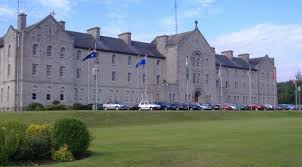
Norwalk Hospital: Scene of Last Week’s Five-Day “Retreat”

Is there something perversely magical about crossing the line between 79 and 80? All I know is that no sooner did I make that transition, than I found myself hospitalized for the second time in my life – the last time being more than 40 years ago.

In both cases, the cause was the same – complications introduced by atrial fibrillation (periodic rapid heartbeats). When that happened for the first time, I entered a medical labyrinth that I swore never to fathom again.

I’m sure many of us are familiar with the drill – endless tests, being sent from one doctor to the next, prescribed medicines with threatening side effects. (I didn’t like one doctor’s answer when I asked him how long I’d be on beta blockers. “For the rest of your life, of course,” he said.)

That experience along with the tale I’m about to share have me wondering about ensuring life beyond 80. After that, shouldn’t we just back off and let nature take its course?

Let me tell you how I came to that question – and to its surprisingly clear answer.

The Medical Nemesis

I recall that during my first serious run-in with the medical establishment (again, about 40 years ago), I was reading Ivan Illich’s The Medical Nemesis. There, the great philosopher, trenchant social critic, and (like me) an ex-priest advanced a thesis relevant to my then-emerging medical situation. He wrote that modern medicine was making westerners sicker rather than healthier.

All of that was in line with his wider analysis, viz. that after a certain point:

  • The more formal education we have, the stupider we become (knowing more and more about less and less, while understanding less and less about more and more).
  • The further we advance in the field of transportation, the more immobile we find ourselves (sitting in traffic jams and airports, separated from each other by increasingly greater distances, and dependent on machines that only the few can afford, and even fewer can repair).
  • The more “advances” in communication we experience, the less meaningful our interactions seem (as we use phones and computers to occasionally talk rather than enjoying the daily face-to-face conversations that are part and parcel of being human).
  • The more food modern agriculture produces, the less nourishing its content (due to monocultures, feedlot diseases, preservatives, and dependence on inputs such as artificial fertilizers, animal drugs, and poisonous pesticides).

It’s the same with modern medicine, Illich argued. Its takeover by hospital equipment and pharmaceutical companies has us all hooked on procedures and drugs whose side effects and interactions are only partially understood. Within the system, doctors claim authority due only to those who know everything about the human body, while in reality 90% of it remains a mystery.

Even more basically, hospitals serve patients typically terrible food, which should be the major source of health in any circumstance. But instead, already undernourished patients are further deprived in places that are actual germ farms – ranking high among the most dangerous environments human beings have ever produced. It’s all “iatrogenic,” Illich charged – a disease-inducing epidemic intensified by physicians and the medical establishment itself.

To reiterate, then: beyond a certain point, the more modern medicine we have, the sicker we become.

My Medical History

Well, my experience with the medical establishment 40 years ago confirmed Illich’s insight.

For instance, after I expressed my concerns about rapid and irregular heartbeats, doctors at the Universities of Kentucky and Louisville, had me doing things that seemed well, “iatrogenic.” At one point I recall, they gave me a “tilt table test.” That meant strapping me to an upright mobile board that was turned to various angles in attempts to induce (for purposes of analysis) the very symptoms I was complaining about. The resulting sight appeared quite self-consciously ridiculous and somehow comic to me. Something seemed wrong.

At another point, I found myself enduring a stress test on a treadmill while connected by electrodes to an electrocardiogram monitor. That was o.k.; I had already done several of those.

However, this particular time, the technicians were amazed by my endurance. They even called some colleagues over to witness the wonder of it all as they progressively increased the treadmill’s speed. Suddenly however, they realized I was approaching cardiac arrest. In panic, they shut down the machine, rushed me to a nearby couch and urgently sent for the emergency doctor to attend to me lest I expire.

Episodes like those led me to see the truth of Illich’s argument. I concluded, “These guys don’t know what they’re doing. Much of it just doesn’t make sense. I have to make my own decisions here.”

Eventually, I did. After obtaining a second opinion from an elderly Asian physician who explained my options, I decided to “self-medicate” in the sense of changing my diet, committing to a rigorous daily exercise program, and (most importantly) meditating twice each day for half an hour. And here I am, still alive, healthier than most of my physicians and telling the tale. The Asian doctor just mentioned had given his presumed medical authority straight back to me. His crucial question was, “What do you think?”

My Current Situation

Of course, I was carrying all of that in my mind when three weeks after my 80th birthday, and following the direction of my primary care doctor, I reported to the Norwalk (CT) Hospital’s emergency room complaining of extended heart palpitations, skin sensitivity, and shortness of breath. I thought I might have COVID-19.

Instead, following a COVID test, a couple of x-rays, a CT scan, two ultrasounds, an electrocardiogram, an echocardiogram, and innumerable blood tests, it was determined that I have blood clots probably caused by my recent 12-hour, single day drive from Canadian Lakes Michigan to our home in Westport Connecticut. The condition was aggravated by my chronic atrial fibrillation. Together, those inputs caused my shortness of breath and unusual fatigue. And, yes, I would have to submit to a regime of three medicines taken twice a day for “the rest of my life.”

Suddenly, this very healthy and strong person (me!) was rendered “sick” and reduced to invalid status.

So, I spent those five days hospitalized and ingesting intravenous drips containing various formulations of blood thinners and heart tranquilizers.

The doctors’ problem was determining the correct dosages of the three prescribed medicines. We experimented daily with blood thinners and heart calmers. The therapies worked while my body was at rest. But as soon as I started moving around, the heart irregularities and shortness of breath returned (though I hardly noticed). My heart continued to race at times even as the blood clots dissolved themselves. (This was natural, I was told, even without Heparin or its equivalent.)

With their alternatives apparently exhausted, an excellent pair of very bright and articulate staff physicians (and teachers in the medical school) with stellar bedside manners suggested a procedure reminding me of the term “iatrogenic.” They wanted to shock my cardiac system back into normalcy. According to the procedure, (1) I’d be sedated, (2) swallow a miniaturized scanning device in search of a possible clot in my heart, and if none were found, they’d (3) give my heart a normalizing electric shock and hope for the best.

Hmm. I wondered what Ivan Illich would say about all of that. I didn’t know. But I recalled his distinct suggestions that:

  • The less apparent the causes of one’s symptoms
  • The more exotic and complicated their diagnosis and anticipated cure
  • The more “sophisticated” the technology
  • And the more numerous the medications involved,

the less likely it is that a given therapy is on the right track.

Thinking like Illich, I wondered: given my age, does it make sense any longer to take such life-prolonging measures for someone who up to a few days before had been progressing quite nicely as far as his health was concerned? (I was taking only one med each day – for enlarged prostate. I walked four miles seven days a week at a rate of 14:30 minutes per, did 40 pushups midway through each of those walking sessions, and played golf regularly with great enjoyment – especially with my two sons. That along with the healthy diet provided me for the last 44 years by my gourmet vegetarian wife were keeping me quite healthy.) Why not continue trusting my body and Life itself to give me a few more relatively healthy years – or not? At 80, it’s been a good run. Who could ask for more?

Enter Ezekiel Emanuel

In asking that question, I was reflecting what I had read six years earlier in an Atlantic Monthly article written by University of Pennsylvania oncologist and medical ethicist, Ezekiel J. Emanuel. The article was called “Why I Hope to Die at 75.”

There (writing at the age of 57) Emanuel wrote that statistical concerns about physical and mental decline among aging Americans had inspired him to conclude that “Once I have lived to 75, my approach to my health care will completely change. I won’t actively end my life. But I won’t try to prolong it, either.”

Practically speaking that would mean, he said, no regular doctor visits, no colonoscopies, cancer screenings, cardiac stress or PSA tests, no pacemaker or implantable defibrillator, no heart-valve replacement or bypass surgery, no hospitalizations – nothing curative; only palliative medical procedures.

In Emanuel’s opinion, death according the natural lifespan of a post 75-year-old body is far preferable to the indignities of artificially prolonged life with its probabilities of immobility and mental decline.

I was convinced that Emanuel’s diagnosis of my “condition” would be that there is really nothing wrong with me at all. Despite appearances, I’m simply old. My body parts including my fibrillating heart and sometimes gasping lungs are showing normal signs of wear and tear.

It’s all part of life’s wonderfully mysterious process.

I found myself agreeing with that position. After all, I’ve already led a full productive life. Everything from now on is gravy.

So, once I’ve consumed my present supply of meds (to appease my family members), and after my next appointment with my cardiologist (for the same reason), I plan to swear off the whole thing. I’m going to follow Emanuel’s advice.  

Conclusion

As it has turned out, my time in the Norwalk hospital was a great gift – almost a spiritual retreat. The experience provided me time to focus on the topics I’ve raised here – the nature of U.S. medical care, the advisability of adopting curative (vs. palliative) measures after the age of 75 or 80, and other end-of-life issues.

Like Emanuel I’ll forge ahead without any exotic interventions whatsoever. If the heart attack comes, I’m ready to go. As I said, it’s been a good run.

If a stroke comes, same story. And should I become disabled, I’ve clearly asked my family members to simply put me in a nursing home without any life-extending treatments and let me die. Absent those medicines and treated only with palliatives, my life’s end will probably come quickly and painlessly.

Meanwhile, I’ve resolved to continue enjoying life, writing for social justice, following my spiritual practices, and concentrating on lowering those frustrating golf scores rather than my unfathomable heart rate.

80th Birthday Reflections Part 6: Political Order

Just in case readers might have forgotten: my project in this series of reflections on the occasion of my 80th birthday is to illustrate Richard Rohr’s observation about human growth in terms of the “three boxes” into which, he says, everyone’s personal growth trajectory more or less fits. According to Rohr, if we’re lucky, the first part of life is characterized by order, the second by disorder, and the third by reorder. In those terms, I’ve been very lucky.

I’ve tried to illustrate that luck in previous entries in this series. There I briefly described how I mostly benefitted from a highly ordered life starting in a very Catholic household with loving parents. Those years included nine years of education in St. Viator’s Catholic school on Chicago’s northwest side. Then, I shipped off at the age of 14 for a monk-like, highly regulated existence in a seminary preparing teenagers for a life of celibacy and service to God. In St. Columban’s minor seminary in Silver Creek, New York, we were already being shaped to convert what we understood as pagans in foreign missions like Korea, the Philippines, Burma, and Japan. 

So far, my story has taken me from my family home in Chicago and subsequently in Warrenville, Illinois to that seminary in Silver Creek. From there I attended a corresponding college seminary in Milton, Massachusetts. I then completed a novitiate-like “spiritual year” in Bristol, Rhode Island. That was followed by four years of “graduate” scripture and theological studies back in Milton. Then finally, following my ordination in 1966, I completed my formal education with five years of doctoral studies in Rome, Italy. By then, I was 32 years old.

When I left my story off, I was in the middle of telling about those halcyon years in Rome.

My hope is that sharing such reflections might help me better understand my own journey as I enter my ninth decade. In the process, it would be wonderful if readers would also be stimulated to similarly examine their own transitions from order to disorder and hopefully to the ongoing process of reorder.

In any case, I want this particular blog entry to help me (and anyone mildly interested) better understand my own political development. Recounting its story will stretch me far beyond Rome to most of western Europe. It will then take me to more than 40 years of teaching (and learning!) at Berea College in rural Appalachia. Sabbaticals and other travel opportunities sponsored by Berea ended up peppering my journey with subsequent long stopovers in Brazil, Nicaragua, Costa Rica, Guatemala, Honduras, Zimbabwe, South Africa, Israel, Jordan, Egypt, India and Cuba. At each of those stops, I learned political lessons that have informed and shaped my life. I’ve been lucky indeed.

But let me begin at the beginning.

My parents were basically apolitical. As a truck driver, my father was a Teamster Union member, but he never betrayed any corresponding political consciousness. (I just remember that he didn’t like paying union dues.) My mother sometimes spoke of her preference to “vote for the man, not the party.” Together, both mom and dad claimed to be Independents rather than Democrats or Republicans. However, their leanings were clearly towards the GOP.

Apart from that, my first recollection of a significant political thought came when I was a freshman in the high school seminary (1954-’55). We were off at some sort of day of recollection at a nearby rival seminary. And older priest (I’ll bet he was about 50!) was onstage giving a keynote address. In its course, the old man remarked for some reason that the dropping of atomic bombs on Hiroshima and Nagasaki (a decade earlier) amounted to the most heinous crime in human history.

I was completely shocked. At the time the McCarthy hearings were in full swing. Anti-communism was in the air. I wondered, “Why would a priest say something so unamerican? Was he perhaps a communist? Surely no priest could be a communist.”

My question was framed like that because at the time, anti-communism was in the very air all Americans breathed. After every Mass, we all offered specially mandated extra prayers “for the conversion of Russia.”

The sentiment invaded our minor seminary with a vengeance. The Columban Fathers had just been expelled from China by the 1949 Communist revolution. So “Old China Hands” returning from “fields afar” addressed us frequently about their experiences with such evil incarnate. They told us that the communists hated the Virgin Mary and her rosary. That was enough for any of us. Nothing could be eviler than that.

I remember that during one study hall on May 2, 1957, one of my most admired teachers who was monitoring the session came by my desk and whispered, “A great man died today.” He was referring to Wisconsin Senator Joseph McCarthy.

Politically speaking, that was the world I grew up in. I had no idea what communism was other than an anti-God, anti-Mary worldwide conspiracy by absolutely evil people.

Again, cut off as we were from the news and unexposed to any historical information other than that conveyed in standard (boring) history books, no wonder my political formation was so narrow. Everyone’s was.

It was also no wonder that when I cast my first ballot for U.S. president (1964), I voted for Barry Goldwater. I did so not only because of strict “American” indoctrination, but also because I greatly admired my mother’s brother, my uncle Ben. Of all my relatives, I thought he had the most respectable job. He worked in some capacity at Chicago’s First National Bank; he went to work in suit and tie each day. [Everyone on my father’s side of the family were laborers – brick layers, bartenders, plumbers and general construction workers. One of them was a bookie. (I remember him showing us one day his basement with a whole array of phones connected with his work.)]

So, in my desire to be more informed and sophisticated politically – more like Uncle Ben – I had long conversations with him about issues of the day. He steered me towards the Republicans and criticism of the Civil Rights Movement and Vietnam War resistance.

For instance, in 1967, when Martin Luther King voiced his searing criticism of U.S. aggression in southeast Asia, I thought, “It might be well and good for him to speak about civil rights for blacks, but now he’s gone too far. What does he know about foreign policy and Vietnam?”

That was the state of my political consciousness when I went off to Rome at the age of 27.

And that’s precisely when political disorder set in to complement the theological disorder I’ve already described.  

(Next time: the particulars of political disorder)

80th Birthday Reflections Part 5: The Priesthood & Disordered Celibacy

My first year in Rome, James Kavanaugh wrote a national best seller called A Modern Priest Looks at His Outdated Church. It was a general critique of the Catholic hierarchy for not going far enough with the Vatican II reforms. For Kavanaugh, the church was still too priest and hierarchy centered. It needed more democracy. 

However, what most of us remember about A Modern Priest was its rejection of celibacy as a prerequisite for ordination. The book sparked many discussions at the dinner and supper table where our community of 12-15 young priests took our meals each noon and evening.

There, debates about scripture, theology, politics were the liveliest and best-informed that I’ve ever experienced. And I took part with great enthusiasm. My studies at the Anselmo were radicalizing me. They took me beyond post-Vatican II positions I had previously never dreamed of regarding church reform, the inspiration of the Bible, Jesus’ divinity, Mary’s virginity, the Reformation, papal infallibility, the priesthood itself, and, of course, celibacy.

Reluctant Celibates   

Intense debates about that latter issue were influenced not only by Kavanaugh, but by the more general sexual revolution that was a central part of the ‘60s and ‘70s. The contraceptive pill had been introduced in 1960. And with the fear of unintended pregnancy largely shelved, sexual freedom became the watchword of the day. Priests were not immune from any of that.

Previously, I mentioned earlier my own concerns about “reluctant celibacy.” Every priest I knew shared them. In fact, as I traveled (on motor scooter) and worked with priests in Austria, Germany, France, Spain, England, Ireland, Scotland, Belgium, Poland and elsewhere during my summers in Europe, I couldn’t help but notice that some priests had openly set aside their reluctance. For all practical purposes, they had become married priests. (Later, in Brazil, Costa Rica and elsewhere in Latin America, Africa and India I came across evidence of the same phenomenon.)

That was one aspect of the priesthood and the sexual revolution; priests were voting with their feet against mandatory celibacy; mostly informally some were getting married. Another aspect was that priests in general were leaving in droves in order to marry; they were seeking Vatican dispensations from their vows – including 3/4 of those who had entered the high school seminary with me back in 1954. In fact, thousands upon thousands of priests worldwide were abandoning their vocations.

In between those two categories were priests I knew who had girlfriends – something totally unheard of in the church I had grown up in. There, particular female companionship was absolutely forbidden. Even more, it was entirely scandalous for ordained men to seek dispensation from their vows. And no one (at least in the U.S. church) would live openly with a female partner. At least, that was the church I knew.

The Big Ed Factor

The girlfriend phenomenon showed up with a vengeance on Corso Trieste with the arrival of a character called “Big Ed.” He was a bullshitter; there’s no other way of saying it. And he changed the atmosphere in our house. Not that he lived there, but he was greatly admired by a whole clique of my friends who did.

Big Ed claimed he was a priest. But I’m not sure about that. That’s because (as I said) he was an inveterate liar. His shtick was to tell the girls that he was Tom McNeely, the 1960s heavyweight prizefighter whom he apparently resembled. (He’d tell them that as he mixed, shared and downed pitchers of boilermakers.) I suspect the ruse worked with many women. But who knows if he was telling the truth about being a priest?

What I do know is that his shtick worked with that clique I mentioned. Not that they believed him about being McNeely. But they all thought he was very cool. And they certainly admired his savoir faire with the women. For a while there, it seemed that they went out clubbing with him almost every night. All of a sudden, every conversation the next morning at breakfast was about Big Ed this and Big Ed that. Suddenly the man was a legend; he could do no wrong.

I bring him up because Big Ed epitomized the changes I’m describing here around the issue of priestly celibacy. As the years lengthened following Vatican II, we all found ourselves loosening up in relation to the restrictions that were so much a part of our seminary lives. We were drinking more, clubbing more, and interacting more with women. Eventually, I was no exception – except in my doubts, suspicions, and reservations about Big Ed. Even according to my own more relaxed standards, he seemed over the top.

My Own Crisis

Yes, eventually, I succumbed – or rather, I would say I finally appropriated my own sexual identity and acceptance of close female friends. I made the decision to do so at the age of 30. I won’t go into detail about the resulting discoveries, relationships and repercussions – things that all of us have gone through, but at ages much earlier than 30.

Before any of that, my own decision was hastened by those lively discussions mentioned earlier. I mean my growing “radicalism” had not passed unnoticed by the rector of our house on Corso Trieste. So, one morning just before my 30th birthday, he said he wanted a word with me. I remember our walking together in our residence garden ‘round and ‘round the house in deep discussion.

The rector informed me that he had written a letter about me to the Columban Superior General. Because of what he heard me saying at table, the rector had identified me to our Society’s leadership as “dangerous” and unfit to teach in the seminary after the attainment of my doctoral degree. Moreover, the rector said, he was disturbed by the fact that some young females from a high school on our street had been seeking me out for spiritual guidance. He thought that was inappropriate and suspect.

I was completely shocked. First of all, I was amazed that the letter had been written before discussing it with me. But secondly, there was absolutely nothing inappropriate about those meetings with the girls in question. I was actually proud that my Italian was good enough to do something “pastoral” other than simply offering Mass at local churches and convents. (At this point, I was involved in an alternative, lay-led church connected with the high school. In the middle of each week, its members met to discuss and prepare the following Sunday’s liturgy. It was extremely inspiring). Thirdly, I knew that unlike others in our community, I was studiously avoiding relationships I still considered ill advised.

Processing It All

I remember subsequently writing such reflections in my diary. They drove me to think more deeply not only about celibacy, but about decision-making in the religious group I had joined and generally in the church. The celibacy obligation, I knew hadn’t been imposed on priests till about the 12th century. And it had largely originated from the desire on the part of church officials to protect ecclesiastical property from inheritance by the offspring of priests.

I now allowed myself to recognize that such avaricious motivation had created an entirely patriarchal, basically misogynist and hypocritical subculture. It inflicted guilt on young people for following the dictates of the second most powerful human drive (after self-preservation) viz. their sexual instinct (or as Darwin might put it, propagation of the species). The church did that in general. Practically speaking, it reduced faith to obsession with sex. It had in the process put unbearable burdens on unsuspecting young boys like me at the age of 14. In retrospect, all of that seemed like an unwitting form of abusing children too young to give informed consent. And then by the time age of consent was achieved, we were all too indoctrinated (not to say brainwashed) to escape.

With all of that more or less unconsciously in mind, the priests I was increasingly encountering were exercising what theologians called the “sensus fidelium” about celibacy. (Something similar had happened more widely regarding contraception and divorce.) As I was coming to understand it, that theologically recognized “sense of the faithful” referred to near unanimous agreement on the part of lay believers about a matter of faith or morals regardless of what the hierarchy might say. That implicit unanimity, I saw, had already been achieved among priests across the Catholic Church; they no longer believed in celibacy. Among other Christians, that consensus had long since been reached following the Protestant Reformation in the 16th century. Regardless of what the hierarchy might say, the people had spoken. In short, I concluded that celibacy was no longer a priestly obligation.

Conclusion

As I write these words, I’m not even sure I should be sharing their revelations. It would be very easy for readers to get the wrong idea judging harshly the young priests I’ve described (including myself) as hypocrites cynically unfaithful to a vow we had freely taken. It would be very easy to be shocked, repelled and (for Catholics) to feel somehow misled and even betrayed.

In retrospect however, I see it quite differently. As I knew them, the men in question had in no way abandoned their faith. They remained very good priests – compassionate, understanding, idealistic and kind. We were simply products of our time characterized by a sexual revolution that touched everyone.

Even more (as the great German theologian Karl Rahner put it) the young men in question were not sinners; rather, we had been sinned against. And the offending party was an ecclesiastical institution whose stubborn regulations had laid a nearly unbearable and certainly unnecessary burden on the shoulders of good willed, highly motivated youths who had accepted obligatory celibacy with little notion of its implications outside the seminary’s protective walls. We simply wanted to be priests, not celibates.

I’d go even further. The priests I’m talking about were implicitly or explicitly influenced by the very theological studies I’ve been celebrating here. Following Vatican II those studies affirmed the insights of secular disciplines such as history, sociology and psychology. Freud, Jung, and their successors had shown that the celibate decision involved much more than just saying no. And yet, no one was there to help priests figure out what that “more” entailed. In other words, many of us had moved from Rohr’s first “order” box into inevitable “disorder” around our celibacy. It would take most of us a long time and many errors before we could get to “reorder.”

(Next time: Political disorder)  

80th Birthday Reflections Part 4: Almost Famous – Sports & Music in Rome

Giulio Glorioso, Italian baseball’s Babe Ruth who offered me and a friend baseball contracts

Music, eventually acting, public speaking, and especially sports all came to play important roles throughout my life. All except acting became prominent for me in Rome too. Here, I’ll describe the forms they took once I escaped the seminary hothouse. All of them – music, public speaking and sports – contributed to my “disorder box” in a life and self-understanding that was changing and opening up to a world much wider, more complex, and far more interesting than the one I had known up until ordination.

Music

Like most teenagers in the 1950s, I paid close attention to the Top Forty there at the beginnings of Rock ‘n’ Roll. I loved Bill Haley, Connie Francis, Elvis Presley, Patti Page, the Everly Brothers, Buddy Holly, Jo Stafford, Chuck Berry, Little Richard and all of that crowd. Each week in the high school seminary, we all eagerly awaited clippings from home declaring the order of the day’s most popular songs.  

Then, in the ‘60s and ‘70s I fully embraced folk music stars like Joan Baez and Bob Dylan. When hootenannies were popular on TV and in everyone’s living room, I took up the guitar.

I recall my first public coming-out with the guitar. It was at a St. Columban’s Day celebration in the major seminary in November of 1966. I had only been playing for maybe six months. Yet, I actually had the gall to get on stage and “sing” Woody Guthrie’s “Talkin’ Guitar Blues.” It turned out to be a huge hit and thereafter, any time a guitar was passed around a group, I was asked to perform that song. It was fun to do.

Along those lines, one of the most delightful features of my years in Rome were the frequent dinner parties held in our house. They always ended with a songfest. Such special occasions were frequent since our house rector was the Roman liaison between the Society of St. Columban and the Vatican. So, we often had international dignitaries and associated friends and acquaintances over for elaborate dinners (including interesting women). Archbishops, bishops, and government officials were frequent guests. All of these occasions ended up in our community room where we’d retire for cognac and cigars, and where we residents (and some guests) would perform our party pieces – like “Talkin’ Guitar Blues.” My first taste of cognac actually took my breath away. But I quickly got used to that.

Acting

Late in my seminary career, I also discovered acting. My first role probably came during my second year of theology studies – i.e. two years after we all got our bachelor’s in philosophy. I guess I was 24 at the time. Mine was a bit part as “old Jim” in “The Boys in 509.” It was a comedy that originally was “The Girls in 509.” But the title and content were adjusted for obvious reasons. (Though in previous productions, some in the seminary proved to be quite good and comically convincing with their female impersonations. Eventually however, for some unexplained reason, such quasi-trans roles were discontinued.)

In any case, success as old Jim led the next year to a prominent role in Agatha Christie’s “The Mousetrap.” There I played Detective Sergeant Trotter, the character who actually done the dastardly deed in Christie’s famous who-done-it.

The following year, I had the lead role in “Brother Orchid.” Everything was going swimmingly until the final scene, when I was to take a drink before uttering a final crucial line. The water went down the wrong pipe and I virtually lost my voice. I ended up talking in a whisper that no one could hear. I was so totally embarrassed by the fiasco that I skipped the after-party celebration. That was not a good decision. . .

Luckily, acting and theater (other than attending movies and plays) weren’t part of my life in Rome.

Public Speaking

Late in my seminary career, I came to realize that I was an effective public speaker. That was important in Rome, where we were expected to preach – in Italian.

Like most people, I had always hated the thought of addressing a crowd. In fact, my earliest memory of trying to do so (in grammar school) was that I’d get laughing fits that just wouldn’t quit. It happened every time.   

I got over that in the high school seminary, where we took various courses in public discourse and had to deliver occasional papers before our “Literary, Scientific and Debating Society” and at “Catholic Students’ Mission Crusade” meetings.  By the time we got to the major seminary, those courses became “homiletics” – how to preach. However, I was never very good at any of it. It was the usual story – nervousness, awkward gestures, speaking too fast, not preparing thoroughly enough. The complete disaster.

Then came a breakthrough. It occurred after I had a pretty severe accident skiing at the Blue Hills Ski Area near the major seminary in Milton. I had taken a fall there that nearly broke my leg. Well, the next time my speaking turn came up in class, I told the story in a way that had everyone laughing. I described coming down the hill absolutely out of control, dodging other skiers and snow-making machines, and finally falling disastrously and limping home. For some reason, everyone loved it. And there was no stopping me afterwards. Later, I remember someone a couple of years ahead of me calling me a “gallery man” after I gave a paper at some meeting or other.  I guess I was becoming precisely that.

Eventually though, it all led me to work hard at preaching. I never read from a text. Instead, I’d more or less commit to memory what I had written out. Then I reduced the text to very brief notes – just words and phrases – which I held on a small paper in the palm of my hand – in case I got stuck. I would rehearse the talk six times and go from there. In almost every case, the final product would come out much better than my last rehearsal. I always used the same method – even for long and crucial talks like my dissertation defense my final year in Rome. I had learned to preach, to speak in public. That ability stood me in good stead not only in Rome but for more than 40 years while teaching at Berea College. (More about that later.)

Basketball

As for sports, I’m convinced I never would have made it through the seminary if it weren’t for sports. I loved them and from the beginning was fascinated by baseball, football, basketball, boxing, running, ice hockey, skiing, fishing, and golf. I did them all. Basketball and baseball surfaced as important in Rome as well.

From about the age of 10, boxing was one of my favorite sports. My dad and I watched “the fights” on TV every Monday, Wednesday, and Friday. Before that, I remember listening to radio broadcasts of fights between Joe Louis and Jersey Joe Walcott.

Personally, I even went so far as to secure an application to participate in Chicago’s “Golden Gloves” competition when I was in 8th grade. My mother went along with it till the last moment. Then she put her foot down. “No, Mike, I don’t think that’s a good idea,” she said. I got the message. In retrospect, my mother surely knew best. I can just imagine getting knocked silly by some much tougher kid from Chicago’s South Side.

As I mentioned earlier, sports were compulsory in the high school seminary. And I always felt sorry for the ones who weren’t athletically inclined and who often seemed tortured by having to swing a bat or run up and down the basketball court.

It was the opposite for me. (As a high school junior, I was even assigned the drill-sergeant role of calisthenics leader in the seminary gym each morning. “C’mon, you guys,” I’d shout, “quit jackin’ around and do real push-ups – all the way down! C’mon let’s do it!”). I was especially good at basketball and baseball – which, again, you’ll see below served me well in Rome.

That hadn’t always been the case. In seventh grade, I tried out for the St. Viator’s basketball team, but didn’t make it. So that summer, I practiced every day on the Independence Park courts near our home on Chicago’s Northwest side. Our family couldn’t afford to buy me a basketball, so every day I borrowed a volleyball from a neighbor kid and spent afternoons shooting and dribbling with that. It paid off.  

Then the spring before I left for Silver Creek, I discovered the jump shot. In 1954 that was new. Till then, no one shot jumpers. But then I saw it for the first time. It happened during a telecast of the Chicago City Basketball tournament — a game between two South Side high schools, DuSable and Dunbar. I still remember that DuSable had a player called “Sweet Charlie Brown.” He did it all. I decided to learn to shoot like him. Besides his jumper, I liked what we came to call his “Hesi,” i.e. his hesitation layup which involved leaping and maneuvering the ball deceptively to avoid defenders before laying it trickily in the hoop. Then there was Bob Cousy of the Boston Celtics and his behind-the-back dribbles. At that time, no one else did that sort of thing. I wanted to do it too. No one as yet was dribbling through their legs.

In any case in Rome, the other Yank in our house, Tom Shea, was a better athlete than me. Tom was a junior my first year in the high school seminary, so I really didn’t get to know him till the summer before our departure for the Holy City. There he was to study Sacred Scripture eventually finishing his work in Jerusalem.

Both Tom and I loved basketball and baseball. And the summer before our departure for Rome, we got to know each other a lot better as a result. The two of us were staying at the major seminary in Milton. I forget what Tom was doing, but I was taking a required course in Hebrew at Harvard.

Each evening after supper, we’d drive over to Boston’s West Roxbury section to play in b-ball pick-up games there. The courts were always crowded with really good African American players. (One night, even the Celtics power forward Satch Sanders showed up. He was exactly Tom’s age.) In those contests, Tom and I would always end up on the same team in what turned out to be take-no-prisoners contests. And we always held our own. We did that the whole summer. Obviously, it was unforgettable for me.

I mention that because the basketball dynamic carried over to Rome. Every year there, Tom and I ended up playing in the city’s developmental league. Our first team was affiliated with Rome’s then professional team (Serie A at that time), Stella Azzurra sponsored by Ramazzotti liqueur.  Sometimes we’d scrimmage against the pros who were really good of course.

Every team in Italian professional basketball was allowed one foreign player. For a time, Bill Pickens filled that role for Stella Azzurra, and Tom and I got to know him pretty well. Bill was 6’9” tall and weighed 275 pounds. He had been drafted by the Atlantic Hawks and had also played pro football for the Kansas City Chiefs.

(Bill drove a Maserati and once told me about chasing down some Italian guy who had cut him off in traffic. Any of us can imagine the terror of the poor man faced with this angry Yankee giant.)

Another U.S. player for Stella Azzurra (I forget his name) was arrested for possession of over a kilo of hashish. I became his “chaplain,” visited him regularly in prison and smuggled letters written on toilet-paper to his girlfriend and others. I often wonder what would have happened to me had I been caught.

The bottom line here is that basketball greatly enriched my stay in Rome. I still remember the team meals together following away games. I recall attending basketball games in Rome’s Palazzetto dello Sport and feeling so welcome because of all the greetings from fans, players, coaches and referees. Great fun.

Baseball

Then there was our near brush with fame in baseball. Tom was a great pitcher and shortstop. I played left field and had a decent arm. Tom hit with power. I was a singles and doubles guy.

Well, somehow (I’ve forgotten how) we ended up working out regularly with Rome’s Lazio entry in the Italian professional baseball league. We’d chase flyballs with the other players, hit fungoes, and take our turns in the batting cage.

Once in an exhibition game with Tom playing shortstop, I was in left field with a man on third and one out. I fielded a decently hit fly ball and the runner on third tagged up. I threw a perfect on-the-fly strike to cut the runner down. He should have been out by a good bit. But the throw went right through the catcher. He missed it. Really disappointed.

Nevertheless, the two of us impressed somebody. I say that because a few Saturdays later Tom and I got a visit from none other than Giulio Glorioso, the Babe Ruth of Italian baseball.

No kidding. I think Glorioso was managing the Lazio club at the time, and he wanted to know if Tom and I could play with the Rome team that summer. He told us we’d be traveling by train up and down Italy for away games.

Tom and I really didn’t know who Glorioso was at the time. We hemmed and hawed, but in the end said no. Instead, our plan had been to travel that summer to Vienna to study German at the university there. We stuck with that.

Regretfully by doing so, we missed out on that once-in-a-lifetime experience. Had we accepted, I’d still be telling the story. Oh wait, I guess I just did that.

(Next time: Rome and disorder around celibacy)

80th Birthday Reflections Part 3: Roman Disorder

The Anselmo, where I studied my 1st 2 years in Rome

I knew NOTHING about politics when I arrived in Rome. I knew little about the world. I knew even less of women. All of that was about to change.

Understand that in all those spheres, I had been cooped up in the seminary hothouse since I was 14. For years, we had no access to newspapers. And it wasn’t till after Vatican II that we were even allowed to watch TV news each night. As a result, I was very uninformed about a world that I was taught to consider not worth caring about. (After all, we were here on this planet to pass a test and prepare for heaven.)

With the Columbans, the saving grace was that we returned home each year for Christmas and summer vacations. So, the divorce from the world wasn’t complete. My family [my loving mother and faithful father (a commercial truck driver), my brother and two sisters] kept me more or less sane and in touch. The six of us lived in a tiny two-bedroom house that had my sisters sleeping in the same room and my brother and me sleeping on a pull-out couch in the living room. (I’m sure life was easier for them all when I wasn’t taking up so much space.)

During summer vacations, I worked for a couple of years in a gas station learning about cars and mechanics. Then, when I was 18, I took a summer job at a golf course not far from my family home now in Warrenville, Illinois. I worked there on the grounds crew every summer till I was ordained – and even a little bit afterwards.

Working at Arrowhead Golf and Country Club was a delight. Sometimes I could hardly believe that I was getting paid for that kind of labor (cutting grass, laying sod, felling trees, changing cup locations on the greens, working on small engines . . .) in such an idyllic setting. The job also allowed me to play golf for free. That was fun, but despite decent athletic ability, I was never able to master that highly frustrating game. (I continue to work on that.)

As for women. . .  They represented completely forbidden territory. “Custody of the eyes” was the order of the day. However, I do remember being fascinated by one of the girls who worked at Arrowhead’s lunch counter. I made sure to order from her during our grounds crew’s lunch half-hours each noon. I recall that she was also to be present at a year-end party I was invited to. But I decided for that reason not to attend.

With that kind of background, I flew off to Rome in 1967 taking up residence in the Columban house on Corso Trieste 57. Suddenly I found myself in a house with about 15 other young student-priests. They came from Ireland, Great Britain, Scotland, Australia, Tasmania, and New Zealand; two of us were from the U.S.

Our house was headed by an Irish Columban rector and his Irish assistant. In residence too was a retired Irish bishop from Vietnam. (Such recollections make me recall that most of my teachers over my 12 seminary years spoke with brogues – quite understandable, since the Society of St. Columban had been founded in Ireland.)

My first impressions of my new community were that its members were much more sophisticated and better-informed in every sphere than I was. These guys were good. Conversations revealed that they even knew more about U.S. history and politics than me.  I found that embarrassing.

So, I started reading – no, I started studying – Time Magazine. I couldn’t wait for each week’s edition. Eventually, I won one of our periodic light-hearted quizzes we all took (and joked about) on current issues.

As for academic life in Rome, I was soon faced with an important decision – which of the Roman theological universities to attend? Ironically, even though seminary education had required four extra years of scriptural and theological study following “graduation” from college (with a bachelor’s degree in philosophy) we had nothing to show for those added four years – no master’s degree, nothing. Instead, I suppose, our degree was ordination itself – something (in the eyes of the church) much more valuable than a mere graduate degree.

In any case, before I could enroll in moral theology courses at the prestigious Academia Alfonsiana, I had to get the equivalent of a master’s degree (a licentiate) in systematic theology. The question was where?

I had two choices. One could get me the degree in one year at a school called the Angelicum. The other option was to study for two years at what I learned was (at that time) the best school in Rome – even better than the gold-standard Gregorian Institute – viz. the Atheneum Anselmianum. I chose the latter, even though in those early Roman days, I wanted to get back to the states as soon as I could. (Little did I know that I’d soon be wanting to extend, rather than shorten my time in Rome. Even my eventual five years there would seem far too short.)

If I thought I was out of my depth when I met my housemates in Rome, imagine my feelings at the Anselmo.  Classes were in Latin. Students were fluent in Greek; they referenced New Testament texts in the original language. And if I was intimidated by the theological, classical, and general knowledge of those on Corso Trieste, that was nothing compared with the international students I was thrown in with there on Rome’s Aventine Hill. They came from all over the world – from every continent. I was especially impressed by the Italians, Spaniards, Africans, Indians, and Latin Americans. In seminars, some were so fluent (in Italian, English, Latin, Greek, and of course their native tongues) that it sounded like they had written down everything they said before speaking. I was really impressed (and frankly intimidated).

And my professors!  Wow. They were so inspiring, even in Latin. Two in particular, both German, impressed me greatly. (I continue to remember them prominently in my prayers each day and I find myself tearing as I write these words.) One was Magnus Lohrer; the other Raphael Schulte.  I’m so indebted to them for the knowledge, passion, interest, and joy in learning that they communicated and transmitted. I decided that I wanted to be like Magnus Lohrer!

Significantly in terms of this account of order and disorder, my licentiate thesis centralized the topic of “Ecclesia Semper Reformanda” – the always necessary reformation of the church.

(More about Rome and its welcome disorder next time.)

80th Birthday Reflections Part 2: Disorder Enters My Highly Ordered Life

In 1962, disorder began to enter my life. Its cause was the Second Vatican Council started by Pope St. John XXIII. Out of the blue, it seemed, he decided to reform the Catholic Church – to “open some windows,” he said to the modern world. And with that decision, my life was changed forever – but not overnight.

As a basically conservative person, I initially resisted Vatican II – or at least some aspects of it. I liked the church the way it was. Everything there was so clear and certain.

But now, they were introducing English to replace the Latin Mass. The priest celebrant was turned around and faced the community. Guitars replaced organs. And the music became folksier and less solemn. All of that was fine and rather exciting.

But then, colleagues of mine became critical of things like our nightly Benediction of the Blessed Sacrament, priestly vestments, and Thomas a Kempis’ The Imitation of Christ. (I loved that book.) The seminary chapel was radically remodeled so that the tabernacle now moved to the side, looked like a huge treasure chest. It had been designed, we were told, by a Jewish artist. I wondered, “How can someone who doesn’t share our faith in the Eucharist create art that reflects centuries of reflection on Jesus’ Real Presence in the eucharistic elements?” I remember writing a long screed in defense of The Imitation of Christ.

That was at the beginning. But gradually, I became persuaded. More progressive and better-read classmates and elders influenced me. One of them prevailed upon the dean of students to have our library subscribe to The National Catholic Reporter (NCR). It was fascinating.

But most influential of all were my classes in Sacred Scripture and theology. Our scripture professor was Eamonn O’Doherty. He was wonderful. He taught us about text criticism, form criticism, redaction criticism and more. For four years and line by line we went through biblical texts that I came to see as richer than my literalist, fundamentalist mind was ever able to imagine. What I had learned about poetry from Fr. Griffin when I was a college freshman and sophomore enabled me not only to understand what the scholars were saying, but to find my own textual meanings as well.

And then there were the theology classes. Their focus changed from preoccupation with bland traditional manuals written in Latin to actual books by controversial authors like Teilhard de Chardin, Bernard Haring, Hans Kung, Ivan Illich and Edward Schillebeeckx. I remember being greatly impacted by the latter’s Christ the Sacrament of the Encounter with God as we studied it under the guidance of another of our great professors, John Marley. Fr. Marley was a liturgist who helped us all develop sensitivity to the history and profound meanings associated with public worship and sacrament.

We were reading non-Catholic authors as well – something completely unheard of before John XXIII. I found Paul Tillich especially powerful.  I actually discovered sympathy with the Great Reformers we had previously been taught to dismiss and even despise. I read everything I could from the psychologists Erich Fromm, Rollo May, and Carl Rogers.

Yes, my ordered, predictable world was coming apart. Along with my seminary colleagues (and professors!!), I was questioning more and more – accepted doctrines such as papal infallibility, moral teachings on contraception, abortion, the uniqueness of the church itself, the role of priests, and, of course, mandatory priestly celibacy.

I remember reading an article in the NCR about “reluctant celibates.” Those were actual and would-be priests who felt called to the priesthood but unenthusiastically accepted the celibacy requirement without having an actual vocation to the celibate state.  

I feared I fell into the reluctant celibate category. Before my ordination to the diaconate, I discussed this with my spiritual director. We agreed that it was probably just a matter of pre-ordination jitters.

So, come December 22, 1966, I was finally ordained along with nine classmates – three of whom I had been with since my first year in the high school seminary. After 12 seemingly interminable years, I had finally reached my goal. However, by now I was a Vatican II product. The new theology and my scripture studies influenced every aspect of my priesthood from my homilies and the way I celebrated the Eucharist. Eventually, it shaped the way I dressed and the length of my hair; I even flirted with a moustache and beard.

I was at last on fire academically. During my final semester in Milton, I was honored with a request to teach an adult education class in a Boston parish. The topic was Vatican II and the Bible. I relayed to my class of 30 adults – some twice my age and more – exactly what I was learning under Eamonn O’Doherty. They loved it. The class was a great success. I was discovering that I could teach. And I loved that too.

So, I was delighted when my first priestly assignment was not to Korea, the Philippines or Japan, but to continue my studies in Rome. My Columban superiors wanted me to get a doctorate in Moral Theology there, so I could come back to Milton and teach in the seminary.

Rome still smoldering from the conflagrations set by Vatican II (’62-’65), held wonderful and unexpected surprises that would continue the disorder that I (and the entire world at the time) was coming to embrace.

[Next installment (still on disorder): Rome challenges me to grow up in every sphere – intellectual, political, and personal.]

My Recent Interview on the Rob Kall “Bottom Up” Radio Show

Here’s an interview posted last week by Rob Kall on OpEdNews, where Rob is the editor in chief and where I’m now serving as a senior editor. The exchange took place at the beginning of the Coronavirus pandemic. As you’ll see, I’m speaking from my basement office in our home in Westport, Connecticut. (I’m thinking that I should do something to make the venue seem less like a basement. . .) Anyway, it’s the third time Rob has had me on his show.

Weaponizing Cuba against Bernie: Childish Thinking and A Family Experience

They’re at it again – red-baiting Bernie Sanders. Because the senator from Vermont has (like President Obama) recognized the educational achievements of the Cuban Revolution, he’s being attacked as an apologist for brutal dictatorships everywhere. The syndrome played out in yesterday’s episode of “The View,” and last night in the South Carolina debate.

It’s all so tiresome – so 20th century, so chauvinistic.

It also contradicts my own personal experience of Cuba over many years of visiting the island, where Fidel Castro remains as revered as George Washington here in the United States. By most on the island, he’s considered the father of his country.  (I remember a U.S. embassy official in Cuba lamenting to my students that if free and fair presidential elections were held there, Castro would win “hands down.”)

However, more recently still, such demonization of Cuba and Fidel Castro flies in the face of an experience my daughter and her husband had of the Cuban healthcare system just two weeks ago. I want to share that story with you. It sheds light not only on Cuba and Castro, but on Medicare for All.

But before I get to it, consider the attacks on Mr. Sanders.

Forbidden Thought

According to the simple-minded received wisdom here in the U.S., no one is allowed to tell the truth about a designated enemy. That is, you can’t say anything good about any government that refuses obedience to U.S. empire. And that’s true even if, like Cuba, the said government provides enviable education and childcare, or if health services are free there for everyone.

Meanwhile, to say anything bad about a “friend” – apartheid Israel for example – is absolutely forbidden. As an international outlaw, Israel can transgress UN resolutions against its illegal occupation of Palestinian territories. It can even kill with abandon peaceful protestors including Palestinian children, the elderly and disabled. However, to criticize it for doing so – to propose boycotting, divesting, or sanctioning Israel’s internationally proscribed occupation of Palestinian territories – is not only unacceptable but actually forbidden by law.

(In case you haven’t noticed: no debate participant has or will ever accuse anyone on stage of supporting a “brutal dictatorship” in Israel – or in Saudi Arabia, Egypt, Brazil, Honduras, Hungary, Turkey . . .)

I mean, instead of thinking critically or just recognizing undeniable facts, U.S. citizens and candidates for public office are virtually commanded to see and describe the world in terms of good/bad, black/white, friends/enemies, vendors/customers. To make even unsubtle distinctions in those regards is beyond the pale. In terms of electability, its’ the kiss of death.

To put it kindly, such thinking is not only simple-minded; it is childish. It’s insulting. It dumbs us all down and makes us stupid pawns of publicists and propagandists supporting reflexive U.S. ideology.

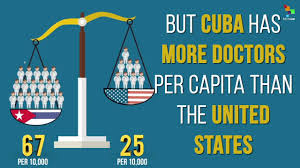
As a result of such stupidity, Bernie Sanders had to limit his “defense” of Fidel Castro to acknowledging the virtues of teaching people to read and write.  He could easily have added points about free education through university level and praise for Cuba’s medical system that provides healthcare for everyone on the island – including visitors from other countries. However, to do so would have opened him to attacks alleging that his free college tuition and Medicare for All programs will inevitably lead to the Cubanization of America.

Not even Bernie Sanders has that much courage.

Healthcare in Cuba: A Recent Experience

And that brings me to the personal story I promised earlier. Just two weeks ago, it involved my daughter, Maggie, and her husband, Kerry as they led a weekend excursion to Cuba.

The junket was the payoff of a fund-raising project for our local Montessori school in Wilton, CT which our daughter’s five children have attended. At an auction held for its benefit, Maggie and Kerry had “sold” the trip to several parental teams. That was last fall.

So come early February, everyone went off to Cuba, even though Maggie was feeling poorly from the outset.

By the time the group arrived in Havana, our daughter was experiencing severe stomach pain that literally brought her to her knees. The next thing she knew, she was being whisked off in a cramped taxi to the Clinica Central Cira Garcia, Havana’s “hospital for tourists.”

There, admissions officials checked very carefully to see that Maggie and Kerry had the required health “insurance” which is included in the purchase price of airline tickets to the island. Then, following an x-ray, our daughter was informed that she was having an appendicitis attack and that an immediate operation was imperative.

The long and short of it is that the laparoscopic appendectomy took place, that hospital care was excellent, and that it cost her and her husband not a dime for the operation or for her five days in the hospital. (They were however charged $50 for each of the two nights Kerry stayed overnight there, and a few dollars for laundry.) In other words, the operation had been paid for by the airline ticket “insurance” which was really a tax on all travelers pooled to meet the cost of health emergencies like the one I just described.

The same procedure in the United States would have cost on average $33,000.

Conclusion

The point here is twofold. The first is that “Americans” need to exit the 20th century once and for all.

Cuba is not our enemy. In fact, it never was until U.S. policy (intolerant of people-friendly socialism) made it so. Moreover, Fidel Castro remains a hero to most Cubans and to most informed people in the Global South. His “repressive” policies were absolutely necessary to protect his country from actual U.S. invasion (e.g. the Bay of Pigs in 1961), from numerous CIA attempts to assassinate him, and from a 60-year long embargo intended to undermine Cuba’s economy, including its health and education programs.

To understand that point, think about our own country’s response to 9/11. Think about the Patriot Act, about resulting restrictions on travel, about Guantanamo, Abu Ghraib, imprisonment without trial, torture of suspected terrorists, and extra-judicial drone killings even of U.S. citizens. Think about the panopticon surveillance systems uncovered by Edward Snowden. Think about encouragement to inform on neighbors and others.

Were those responses to 9/11 brutal and repressive? No doubt, they appeared that way to their victims. But undeniably it’s what governments do under threat from external enemies and their internal agents. In that regard, the U.S. is no different from Cuba. George W. Bush, Trump – or Obama for that matter – are no different from Castro, except in their wider swath of brutality.

The second point is that Cuba’s social system as experienced by our daughter is unprecedented in the impoverished world of former colonies. No other victim of colonialism has been as committed to caring for its people, its children, or its environment as Cuba. But instead of being rewarded for such achievements, it is consistently vilified by U.S. politicians and a mainstream media stuck in Cold War thinking.

Thank God that the Sanders revolution invites us to leave all of that behind. His opponents should follow suit.  

In Memoriam Rev. John Rausch (1945-2020)

Peggy and I were shocked Sunday night when we received the stunning news that Fr. John Rausch, a very dear friend of ours, had died suddenly earlier in the day. John was a Glenmary priest whom we had known for years. He was 75 years old.

At one point, John lived in a log cabin below our property in Berea, Kentucky. So, we often found ourselves having supper with him there or up at our place. John was a gourmet cook. And part of having meals with him always involved watching his kitchen wizardry while imbibing Manhattans and catching up on news – personal, local, national, and international. Everything was always interspersed with jokes and laughter.

That’s the kind of man John was. He was a citizen of the world, an economist, environmentalist, prolific author, raconteur, and social justice warrior. But above all, John was a great priest and an even better human being full of joy, love, hope, fun, and optimism.

Yes, it was as a priest that John excelled. Everyone who knew him, especially in the progressive wing of the Catholic Church, would agree to that. Ordained in 1972 [just seven years after the closure Vatican II (1962-’65)] John never wavered in his embrace of the Church’s change of direction represented by the Council’s reforms.

According to the spirit of Vatican II, the Church was to open its windows to the world, to adopt a servant’s position, and to recognize Jesus’ preferential option for the poor.  John loved that. He was especially fervent in endorsing Pope Francis’ extension of the option for the poor to include defense of the natural environment as explained in the pope’s eco-encyclical, Laudato Si’. (To get a sense of John’s concept of priesthood and care for the earth, watch this al-Jazeera interview that appeared on cable TV five years ago.)

His progressive theology delighted John’s audiences who accepted the fact that Vatican II remains the official teaching of the Roman Catholic Church. So, as two successive reactionary popes (John Paul II and Benedict XVI) subtly attempted to reverse conciliar reforms, and as the restorationist priests and bishops they cultivated tried mightily to turn back the clock, John’s insistence on the new orthodoxy was entirely refreshing.

I remember greatly admiring the shape of John’s homilies that (in the spirit of Pope Francis’ Evangelii Gaudium) were always well-prepared and followed the same pattern:

  1. He’d begin with two or three seemingly unrelated vignettes involving ordinary people with names and usually living in impoverished Appalachian contexts.
  2. For the moment, he’d leave those word-pictures hanging in the air. (We were left wondering: “What does all that have to do with today’s readings?”)
  3. Then, on their own terms, John would explain the day’s liturgical readings inevitably related to the vignettes, since Jesus always addressed his teachings to the poor like those in John’s little stories.
  4. Finally, John would relieve his audience’s anxiety about connections by perfectly bringing the vignettes and the readings together – always ending with a pointed challenge to everyone present.

The result was invariably riveting, thought-provoking and inspiring. It was always a special day whenever Fr. John Rausch celebrated Mass in our church in Berea, Kentucky.

Nevertheless, John’s social justice orientation often did not resonate with those Catholics out-of-step with official church teaching. These often included the already mentioned restorationist priests and bishops who harkened back to the good old days before the 1960s. Restorationist parishioners sometimes reported Fr. Rausch to church authorities as “too political.”

But Fr. Rausch’s defense was impregnable. He was always able to appeal to what he called “the best-kept secret of the Catholic Church.” That was the way he described the radical social encyclicals of popes from Leo XIII’s Rerum Novarum (1891) through Pius XII’s Quadragesima Anno (1931), Vatican II’s Gaudium et Spes (1965), and Pope Francis’ Laudato Si’ (2015).

John was fond of pointing out that all of those documents plus a host of others were consistently critical of capitalism. They favored the demands of working classes, including living wages, the right to form labor unions, and to go out on strike. Other documents were critical of arms races, nuclear weapons, and modern warfare in general. “You can’t get more political than that!” John would say with his broad smile.

All that perseverance on John’s part finally paid off when his local very conservative bishop was at length replaced by a Franciscan friar whom I’ve described elsewhere as “channeling Pope Francis.” I’m referring to John Stowe whose brown-robe heritage had evidently shielded him from the counter-reforms of the two reactionary popes previously mentioned.

When Bishop Stowe assumed office, he evidently recognized John as a kindred spirit. He respected his knowledge of Appalachia and his desire to connect Church social teachings with that context.  So, the new bishop asked John to take him on an introductory tour of the area. John was delighted to oblige. He gave Bishop Stowe the tour John himself had annually led for years. It included coal mines, the Red River Gorge, local businesses, co-ops, social service agencies, local churches, and much more. John became Bishop Stowe’s go-to man on issues involving those represented by the experience.

But none of that – not John’s firm grounding in church social teaching, not his success as a liturgist and homilist, not his acclaimed workshops on economics and social justice, not his long list of publications, nor his advisory position with Bishop Stowe – went to John’s head.

He never took himself that seriously. He was always quick with the self-deprecating joke or story.

In fact, he loved to tell the one about his short-lived movie career. (I’m not kidding.)  It included what he described as his “bedroom scene” with actress Ashley Judd. It occurred in the film, “Big Stone Gap.” I don’t remember how, but in some way, the film’s director needed a priest for a scene where Ms. Judd was so deathly ill that they needed to summon a member of the clergy. John was somehow handy. So, he fulfilled the cameo role playing himself at the bedside of Ashley Judd. (See for yourself here. You’ll find John credited as playing himself.) Right now, I find myself grinning as I recall John’s telling the tale. It always got a big laugh.

Other recollections of John Rausch include the facts that:

  • For a time, he directed the Catholic Committee on Appalachia.
  • He also worked with Appalachian Ministries Educational Resource Center (AMERC) introducing seminarians to the Appalachian context and its unique culture.
  • He published frequently in Catholic magazines and authored many editorials in the Lexington Herald-Leader. John’s regular syndicated columns reached more than a million people across the country. 
  • He had a strong hand in the authorship of the Appalachian bishops’ pastoral letter “At Home in the Web of Life.”
  • He led annual pilgrimages to what he called “the holy land” of Appalachia as well as similar experiences exploring the culture and history of the Cherokee Nation.
  • He was working on his autobiography when he died. (I was so looking forward to reading it!)

More Personally:

  • He graciously read, advised, and encouraged me on my own book about Pope Francis’ Laudato Si’.
  • I have fond memories of one Sunday afternoon when he invited me to a meeting in his living room with other local writers. We were to read a favorite selection from something each of us was working on.
  • John often came to my social justice related classes at Berea College to speak to students about Appalachia its problems, heroines and heroes. (Of course, to my mind, John ranked prominently among them.)
  • He gave a memorable presentation along those lines in the last class I taught in 2014. John was a splendid engaging teacher.

Peggy and I are still reeling from the unexpected news of this wonderful human being’s death. For the last day we’ve been sharing memories of John that are full of admiration, reverence, sadness – and smiles. It’s all a reminder of our own mortality and of the blessing of a quick, even sudden demise.

Along those lines, one strange thought that, for some reason, keeps recurring to me is that John’s passing (along with that of another dear friend last month) somehow gives me (and John’s other friends) permission to die.

I don’t know what to make of that. It might simply be that the two men in question (like Jesus himself) have gone before us and shown the way leading to a new fuller form of life. Somehow, that very fact makes the prospect of leaving easier. Don’t ask me to explain why or how.

Thank you, John.   

In Memoriam: John Capillo

Last week Peggy and I received the very sad news that our long-time friend, John Capillo, had died suddenly on New Year’s Eve. Mercifully, there was no long illness. Stomach pains brought him to the emergency room. He was diagnosed with pneumonia, suffered septic shock, and suddenly was gone. He was 76 years of age.

For us, it was John’s second death. Years ago, Peggy and I said goodbye to him as he lay in coma in a Lexington (KY) hospital. We laid hands on him as we left his bedside then and thanked him for all his gifts to us and the world. But afterwards the unexpected happened. He was given a reprieve; he came back from the dead to live among us for several more years. It seemed entirely miraculous.

In any case, this time it’s final. And our world won’t be the same without this extraordinary man. He was a priest, a prophet, a teacher, storyteller, and a social justice warrior of astonishing accomplishment.

I first met John Capillo 40 years ago, when he and Terri and their new baby, Maureen, moved to Berea, Kentucky. One Sunday, the three of them showed up for Mass at St. Clare’s Church, where Peggy and I had been parishioners since our own arrival in town 5 years earlier. By then, we had our own daughter, Maggie, who was just about Maureen’s age.

Immediately, I learned that, like me, John had been a priest – ordained in New York’s Brooklyn archdiocese. That did it: we soon became fast friends – as did Maggie and Maureen. Peggy and Terri also shared a deep friendship.

At the beginning, John’s day job was carpentry. He had learned the trade during his first priestly assignment in Puerto Rico (or was it Guatemala? I forget.) John had showed up there to help rebuild after a hurricane or something. However, (as he told me early on) when he declared his do-good intention, an old man took him aside and said, “Padre, we know how to build houses. We need you to be our priest.”

And so, John did just that with the enthusiasm, commitment and insight that characterized his entire life. However, his desire to make the gospel relevant moved him to take chances with liturgy and edgy homilies that rendered him suspect to his superiors. The resulting conflicts with authority eventually drove him from the priesthood and into family life.

Nevertheless, John never did give up carpentry or building. One Sunday shortly after arriving in Berea, he came to Sunday Mass with bandages on his left hand. The previous week, he had cut off a finger with his Skill Saw.

Undeterred, at one point, he built a solar addition onto our house in Buffalo Holler about 5 miles outside Berea’s city limits. The project was designed by Appalachian Science in the Public interest. It caught John’s imagination, because, like Peggy and me, he and Terri were going through a “back to nature” phase. He thrived on environmental harmony, innovation, recycling and simple living.

In fact, years later John built an even more innovative structure for himself. It was made entirely from strong woven-plastic bags filled with dirt. John had done a study on the process and technology. And soon he was filling the required bags and carefully laying out the building’s perimeter. Layer after layer created outside walls, interior divisions, and then a roof.

Everything was laid out carefully to take advantage of the sun, but also to orient the house towards sacred energies John perceived as housed in the east, north, west, and south. He wanted to steep himself deeply in such emanations, even while asleep. The whole project expressed John’s deep and never-abandoned desire for enlightenment and unity with God.

Yes, I saw John as a kind of saint. He was. I’ve met few people like him – always on point, never caught up in trivialities, deeply interested in meaning, and counter-cultural to a fault. That’s the way prophets are.

That’s the way John was. He cared little about externals. His diet was simple; he always ate what was set before him. He didn’t drink liquor. His beard was scruffy, his hair unkempt, his clothes always nondescript. But his soul was absolutely luminescent.  His laugh was raucous and full of joy. His loud Ha-Ha’s punctuated every story he ever told.

And he told many. In fact, he considered storytelling his calling and avocation. He studied its technique. And he always used that skill to talk about things that matter – as explained in the books he devoured as the voracious reader he was. John was an inveterate book clubber. He also read my blog, commented on it often, and frequently had us talking shop at Berea Coffee and Tea. Conversations always revolved around God, politics, philosophy and family.

But John was no armchair philosopher. He was a fierce activist on behalf of El Salvador during Central America’s troubled 1980s. As he put it, he “went to school” there – learning from the people during his frequent visits about the destructive role U.S. policy played not only in Salvador, but throughout the colonial world of Latin America, Africa, and South Asia.

John was a deeply, deeply critical thinker. At one point, he spent a month in El Salvador with Peggy and her class of Berea College students as they worked with local residents struggling to overcome the disastrous effects of U.S. policy.

John’s greatest activist accomplishments came after he joined our mutual friend, Craig Williams’ Kentucky Environmental Foundation (KEF). It was and remains a grassroots organization committed to environmental justice. KEF’s main focus became delivering Berea’s Madison County from arrogant U.S. Army plans to dispose of World War II chemical weapons containing mustard gas and other genocidal poisons. The Army had planned to simply burn it all in a thoughtless incinerator near our homes, schools and local businesses.

However, with John’s help, KEF stopped the planners in their tracks. KEF mobilized the entire county and state to prevent that particular disaster from happening. It actually defeated the U.S. Army! Eventually, KEF linked up with similarly victimized communities throughout the United States and the world to work for and celebrate analogous accomplishments.

It was all truly heroic. And John was a huge part of all that. For years, KEF was his final regular job. And in that capacity, he mentored numerous Berea College students including our own daughter, Maggie, who had the privilege of working closely with him and Craig as a student-volunteer.

Here’s a list of some other ways I experienced John as activist, prophet, teacher, and friend:

  • Any of us organizers and educators could always count on John to attend and participate in meetings of any kind, anywhere if they addressed issues of spirituality, activism, critical thinking and/or critical living.
  • He was an advocate and friend of Berea’s and Madison County’s large Hispanic community often working as a translator for its members in court and in social services offices.
  • He was a frequent guest in my own (and Peggy’s) Berea College classes where he edified and provoked students with his informative stories and explanations about our country’s Central American wars and about the environmental dangers of incineration. He was so effective with students.
  • For years, John was a faithful and active member of the Berea Interfaith Task Force for Peace, which during the ‘80s was organized around nuclear disarmament and opposition to our government’s tragic interventionism in Nicaragua and El Salvador.
  • One January, the two of us taught a month-long Berea College course on environmental justice. The course took place in Alabama, where another U.S. Army incinerator threatened the local mostly African American community. The offering was called “Taking on the Military Industrial Complex.” You can imagine the conversations John and I had in the process.
  • Years later, John joined Peggy and me in Oaxaca for a month-long course with Mexico’s Gustavo Esteva — himself an extraordinary critical thinker – who deeply influenced so many of us through his seminars, lectures, prophetic example and books like Grassroots Postmodernism. John loved Gustavo.
  • John was there for me when I tried to start a home church.
  • He visited me at our lake house in Michigan last summer. We spent the entire afternoon on our back porch talking of our usual things – family, politics, church, theology, books. John was extraordinarily proud of his four children and of his grandchildren. I treasure that memory.

As I said, John Capillo was a saint. He was one of my closest friends. Unfortunately, he won’t be coming back from the dead this time (physically, that is). Peggy, Maggie and I will miss him. The world is poorer for his absence.