Here’s What I’d Say If President Biden Asked for a Tarot Card Reading about Gaza

Recently, Rob Kall, the editor-in-chief of OpEdNews (where I’m a senior editor) asked me, “But what does one of your Tarot card readings look like?” It was a fair question. So I’ve decided to give an example of what I do according to the following procedure: (1) The querent (seeker) asks for a reading; (2) I do a spread with her questions in mind; (3) I write up the reading as fully as possible; (4) I email the reading to the querent; (5) we establish a SKYPE appointment where (6) we discuss the reading for an hour or so, (7) supplementing it whenever necessary with “clarifying cards” chosen by the querent in real time; (8) I send a final email summary of the entire interaction.

To show you what I mean, you’ll find below an example of one of my readings — this a fictitious one on behalf of President Joe Biden. It’s a spread responding to questions I imagine him asking about Gaza.

Dear Mr. President,

Thank you for your request for a Tarot reading about your dilemma in Gaza. I know you seek an answer from the cards hoping that they have access to the will of the Great Spirit that grounds all our lives. I for one am sure they do.

With that in mind, I take your question to be “What do I need to know about myself in relation to the ongoing conflict in Gaza? And what should I do?”

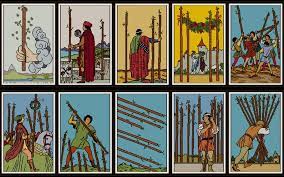
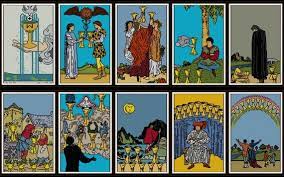
Seeking a response and using the World Spirit Tarot deck (based on the standard Rider-Waite-Smith deck, but much more dramatic) I did a “Celtic Cross” 10-card spread (see immediately below). Before beginning, I held the cards close to my heart. I reminded myself that the cards represent a marvelous packet of divine energy and light – and that you do as well, and so do I. Grounded in those convictions, I made the following invocation: “O, Great Spirit of Life, our Divine Mother and Father, let President Biden’s energy and light (channeled through me) meld with the energy and light of these cards so that the images chosen might reveal his current life’s situation and choices relative to Gaza. Let them show the deep unconscious source of the circumstances that concern him. Let them also reveal their more proximate and probably conscious source along with Mr. Biden’s present motivation, his immediate future, the relevant image he has of himself, the external influences on his life, his hopes and fears, and finally his destiny should he continue his present path.”

I then shuffled your questions into the cards and drew ten of them. This is the way they fell:

Before proceeding, please enlarge the spread and take a careful look at it to see what it says to you.

Now let me examine each card one-by-one. Before reading my interpretations, try to understand their meanings on your own.

  1. President Biden’s Present Situation in Gaza

What do you see in this card? It is the five of pentacles. Pentacles are concerned with material reality, with work, health, poverty, and wealth. Here I see you out in the cold.  You are isolated, and in a fetal position that contradicts your advanced age. Does your posture represent your deep desire to be born again – to change your position? In any case, you continue crouching outside a barred door with a golden handle you seem afraid to turn. The stained-glass pentacles behind you are arranged in a way that suggests spirituality and Kabbalah’s Tree of Life. It represents a summons to higher consciousness that contradicts the death and destruction so rampant in Gaza. Yet you seem to be shielding yourself from the Tree’s invitation. In fact, you’ve turned your back on it. Does the dark shadow behind the door represent your true self inviting you towards the golden horizon you fear to confront? Tell me, on which side of the barred door is freedom found? Who’s in prison here — you or the figure behind the door?

2, Challenges to the President’s Situation in Gaza

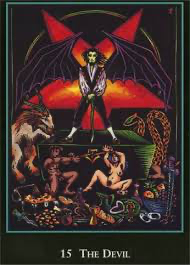
This is the 13th card in the Tarot’s collection of 22 Major Arcana (mystery) cards. The major arcana speak not merely of life’s changing circumstances, but of one’s character, one’s archetype. Sadly, this card suggests that an Evil Spirit has gotten hold of you, Mr. Biden. It may be what prevents you from opening the door to new life pictured in the previous card. The spirit in question is governed by base impulses (indicated by the serpent, goat, and the card’s inverted pentagram). It all supports a patriarchy that keep men and women frozen in hostile and defensive positions relative to one another. The reference may be to the IDF’s attacks on mothers and grandmothers deprived of their murdered children for the sake of power and the riches that lie strewn at the bottom of the card. The Evil Spirit depicted here is profoundly anti-woman. Does its appearance suggest a summons to honor the specifically female wisdom of martyred Gazan mothers, grandmothers and their children?

3. The Deep (probably unconscious) Roots of Mr. Biden’s Problem in Gaza

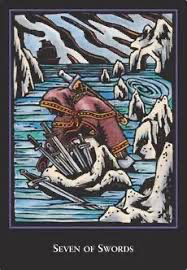
This is the Seven of Swords. Swords are about ideas and ideologies that control us. Sevens are about causal energies. This Seven of Swords shows you again isolated and out in the cold – this time waist deep in a freezing body of water with its dangerous whirlpools. Water, of course, is a feminine element. Swords are masculine. This card has you withdrawing your masculine swords from the feminine element. Relative to Gaza, the Seven of Swords asks you to recognize that ultimately (and unconsciously, I’m sure) the genocide you’re supporting there represents a war on women and their children. The card says, “Remove the swords (in the form of weapons and the ideologies behind their provision) from the hearts of Gazan mothers, grandmothers, their babies and children.” Such extraction means changing your ideas and the approach to Gaza your ideas support. There’s a suggestion of swapping military force for diplomacy here. Finally, this card communicates a sense of urgency. Do you see the dark ship in the card’s upper left corner? Your ship is coming in, Mr. Biden, but you’re ignoring it. The ship says your remaining time on earth is short. Drop the old ideas, change horizons, do what right despite ultimately irrelevant masculine concerns conditioned by false perceptions of “a man’s world.” Ultimately, it’s just the opposite. You’re waist deep in feminine energy!  

4. The Proximate Roots of Mr. Biden’s Gaza Dilemma

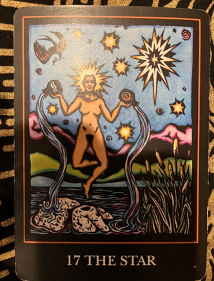
Another Major Arcana card. It is a card of hope and healing. Its female image dancing on the water reiterates the call to lift your head from the frigid waters of the previous card and scan the night skies for transcendent guidance. Miracles (like walking or dancing on water) are possible and within your grasp. The answer to your Gazan dilemma is mirrored in the sky’s celestial order – in healing rather than continuing support of war and destruction. Follow Bethlehem’s star of peace, not war.  

5. Mr. Biden’s Motivation vis a vis Gaza

Yet another Major Arcana card addressing your essence. This one is about a coming Judgement regarding your policies in Gaza. The card centralizes the Egyptian Hermanubis (god of judgment) weighing your destiny against the Feather of Truth. Surely it refers to history’s judgment of your presidency which by all accounts is being importantly and negatively shaped by your policy in Gaza. Will you be remembered as “Genocide Joe?” Surely, you don’t want that. The card also anticipates a more proximate judgment coming on November 5th.  If your driving motivation comes from your desire to be re-elected, the card suggests you must change policy in Gaza.  

6. President Biden’s Proximate Future Relative to Gaza

This card suggests that young people will determine your immediate future (in November). It is a “court card” that refers to important “Seekers” (young 20-somethings) among us. In the context of your Gaza dilemma, this card inevitably recalls the pro-Palestinian demonstrators on campuses throughout our country. They are determined to play a determinative part in your proximate destiny. Their attire in this card suggests Native American sensitivities to the ways of nature. It recalls peace pipes, and diplomatic discussions around a campfire. This is a call to diplomacy and dialog, to listening to your young constituents. Heed what young people are saying or else! That seems to be the message here. [BTW, please note that horse of the card’s Seeker has its hooves firmly rooted in the feminine element of water. The Seeker is calling attention to a mysterious Cup suspended above him. Cups are not about confrontations but about the creative relationships that women typically pursue more than men. Do you see a unifying theme here?]

7. Mr. Biden’s Image of Himself in This Situation

Here you are with your sword again, Mr. President. Surprisingly, the card says that despite your status as an octogenarian, you imagine yourself as somehow a contemporary of the Seekers pictured in the previous card. With sword aloft you’re riding a horse raring to charge into the future (framed by two rough pillars) despite the storm on the horizon. In the Gaza context, this card seems to say, “Take heed of that storm. Act your age. Back off from the trouble that inevitably lies ahead should you continue your sword-led charge.”   

8. The Context of Mr. Biden’s Gaza Situation

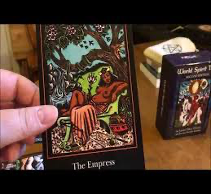
Another Major Arcana card – the Empress. Another reminder to change from male-led policies to those guided by feminine beauty and principles that should form the context of any Gazan policy – of any beneficially imperial order. And what might those principles be? The card says they are based on harmony with nature (signified by the Tree of Life sheltering above the empress). Similarly, the snake that appeared as a force of evil in the Devil Card now appears transformed into its traditional goddess meaning as a perpetual life force (since it repeatedly sheds its skin). The Empress’s own skin color reminds us that the world should be governed by its non-white majority rather than by white European colonialists. Her large breasts also signify a different kind of governance – this one by nurture, not destruction. This theme is continued in her shepherds crook and the unthreatening whip in the card’s foreground. Together, they suggest deemphasis of force in favor of gentle correction. And of course, the beautiful flowers and soaring birds, as well as the abundance of fruit all connect with sharing the earth’s cornucopia regulated by the scale of justice at the Empress’s feet. All of this relates to the ultimate feminine signified by flowing water. In summary, this card calls for a planet-wide change of context from masculine force to feminine gentleness, joy, and harmony with nature. What would that change of context look like in Gaza? The answer is largely up to you, Mr. President.  

9. Mr. Biden’s Hopes & Fears Relative to Gaza

This entire reading could hardly be more feminine. In Tarot all aces are about new beginnings and about unperceived potential. In the World Spirit Tarot deck we’re using, its aces consistently present us with the feminine yoni as a portal to life and new beginnings. And that’s what we have here. A feminine yoni, a portal to a new reality, where relationships (the essence of the suit of cups) are overflowing with life (water), not death (the reality in Gaza). I know, Mr. President, you’re hoping for something like that in Palestine. However, this card suggests you’re on the wrong track. What you’re doing is too male, too much based on force. This card calls you elsewhere. Enter its gentle female portal to New Life. Doing so will help you transcend your fears and offer hope to all of us.  

10. President Biden’s Destiny Relative to Gaza

Do you see what I meant about the feminine character of this entire Tarot reading? Look where we finish. Again, a yoni frame. Again, a fruitful goddess centralized. Again, a call to harmony with the world’s elements – fire in the lion, air in the eagle, water in the dolphin, and earth in the ox. This card asks you, Mr. President, to adopt a universal (rather than a narrow national) perspective. It says align with the forces of nature and the universe. Doing so will help you see beyond distorted views of “American Exceptionalism” and the destruction of the earth’s elements by use of modern weapons of war.  

Summary

Surely, I don’t need to again call attention to the female thrust of this reading. The cards are calling away from patriarchal, violent, and outdated thinking and action. The cards summon you away from a white colonial world towards one governed by the world’s non-white majority. They call you to empathy with Gazan mothers, grandmothers and their babies, children, and grandchildren. Another world is possible, Mr. Biden. And with your incoming ship on the horizon (along with the fast-approaching November elections) you haven’t much time left to change course. But (according to the cards) change course you must!

Tarot and Catholic Spirituality: Let Me Read Your Cards!

Believe it or not, even though I’m a Catholic liberation theologian, I’ve also become Tarot card reader. And this despite the teachings of my beloved meditation mentor, Eknath Easwaran, who always characterized Tarot as “Terror Cards.”

In fact (pace Sri Easwaran), it’s much more focused than that. I’m now using my ability to read Tarot as a fund-raising project for an impoverished women’s cooperative in Guanacaste, Costa Rica.

Let me address all that by first explaining my understanding of Tarot cards. Then I’ll show you how Tarot fits in with Catholic theology and my fund-raising project. Finally, I’ll issue an invitation to read your cards.     

My Introduction to Tarot

To begin with, I was introduced to Tarot during a year-long sabbatical that my family spent in Spain. There in Andalusia, I unexpectedly fell in with a group of street musicians and gypsies. Most of them made only five or ten dollars a day as buskers. As self-described troglodytes, they lived in caves without running water or electricity. They explained the cards and their interpretations to me in ways that made me drop my preconceptions and defensiveness.  If you’re interested, you can read about all that hereherehereherehere, and here.

In any case, I learned that Tarot cards represent a divinatory tool usually understood as helping “querents” (seekers) answer existential questions connected with work, relationships, anxieties, and what the future might hold. As expressed by Tarot master Joe Monteleone, those consulting the cards typically want to know about getting paid, getting laid, and staying unafraid, so they might reach a happy conclusion of their parade through life.

But as Monteleone insists, Tarot cards are about much more than getting paid, laid, overcoming what makes us afraid. In fact, the 78 cards of the Tarot deck represent a dynamic book about you, me, and anyone who opens the “book.” Tarot cards are dynamic because as packets of the universal energy filling the universe, they meld, tap into and blend with the energy packets of those reading and seeking guidance from the Tarot cards. Put otherwise, like the cards themselves, each of us is a bundle of energy that can select from the deck individual cards addressing our true identities and the granular circumstances of our lives.

Accordingly, the Tarot book is divided into chapters addressing the archetypes just mentioned, as well as spirit, relationships, thoughts, and our physical circumstances such as work, money, and health. All those elements come to light in suits of wands (for spirit and creativity), cups (for relationships), swords (for ideas), and coins (for physical circumstances). Additionally, a final chapter (called “court cards”) explores relationships with important others in our lives under images of pages, knights, kings, and queens.

As those images indicate, the relevant cards are replete with references to history, mythologies, sacred scriptures, astrology, and akashic records.     

Relative to all that, I’ve discovered that my background in the classics, history, poetry, and theology has prepared me well for reading Tarot cards. So, I’ve done it for family members and friends who have recognized (and have helped me see) my ability to interpret card meanings.

In fact, while still in Spain, I did so for two professional readers, who subsequently encouraged me to “go professional.” Since returning home, I’ve even read for my therapist (whom I consider my spiritual director), and she has very generously sent my way several “clients” for whom I’ve read on ZOOM and SKYPE.

[Oh, and recently during a three-month stay in Florida I read for many absolute strangers poolside at the Regatta Beach Club in Clearwater Beach. (Subsequently, however, I was informed by the Club’s authorities that such activity “for monetary gain” was forbidden.)]

What the authorities in Florida didn’t understand is that I’m forwarding ALL “monetary gain” to a women’s cooperative in Costa Rica. For clarification, here’ a flyer I’ve made to explain my project: https://acrobat.adobe.com/id/urn:aaid:sc:US:173ab9ae-7e78-406a-87e0-d8b16002fe46

As the flyer indicates, our (very poor) Costa Rican friends manufacture simple solar ovens and instruct their neighbors how to make them. They also maintain a large organic garden that provides food for themselves and their neighbors. (By the way, our friends in the co-op find themselves amused that I as a deinstitutionalized priest and theologian should be delving into the occult on their behalf.)

Theological Connections

It turns out, however, that no one should see any contradiction between Tarot cards, priesthood, and/or theology. That was brought home to me several months ago when I came across a book called Meditations on the Tarot: a journey into Christian Hermeticism. The book was published anonymously in 1985.

[By the way, the word “Hermeticism” refers to the teachings of Hermes Trismegistus, a reputed contemporary of Moses who lived 1600 years before Christ. Hermes explored the relations between human experience and the divine. Many have seen him as the wisest man who ever lived. It turns out that ancient Fathers (and Mothers) of the Christian Church have long explored connections between Hermes and the Judeo-Christian tradition. They are the Christian Hermeticists referred to in the title of Meditations on the Tarot.]

In any case, I found the enthusiastic endorsements on the book’s cover to be astounding.

They came from the Trappist abbot Thomas Keating (the colleague of Ken Wilber of Spiral Dynamics fame), from another Trappist Basil Pennington, as well as from the mystic and leader of the Christian ashram movement, Bede Griffiths. Even more surprisingly, the book’s afterword was penned by the great Catholic theologian and cardinal of the church, Hans Urs Von Balthasar.

The endorsements from all four men contained superlatives such as “the most extraordinary work I have ever read” (Pennington); “simply astonishing” (Griffiths), and “the greatest contribution to date toward the rediscovery and renewal of the Christian contemplative tradition of the Fathers of the Church and the High Middle Ages” (Keating). Cardinal Von Balthasar’s afterword praises the “formidable power of his (i.e. the anonymous author’s) spiritual vision.”

What surprised me about such testimony was not only that monks, mystics, theologians, and even a cardinal knew anything about Tarot cards at all, but that they knew them well and saw them as tools for spiritual growth.  My interest in reading cards had put me in good company indeed.

My Work as a Tarotista

So, I decided to become a card reader — a Tarotista. Here’s how I do it:

  • I receive a reading request in which the querent identifies the session’s focus (e.g., a relationship, a question about work, income, children, about a fork in life’s road, etc.)
  • We set a time to meet on SKYPE.
  • I ask the querent to hold her hand to her heart, while I press the tarot cards against my own heart and pray something like this: “O, Great Mother-Father let my sister’s energy and light (channeled through me) meld with the energy and light of these cards. Let the cards chosen reveal her current life’s situation, the deep unconscious source of her circumstances, the more proximate and probably conscious source, her present motivation, her immediate future, the image that she has of herself, the external influences on her life, her hopes and fears, and finally her destiny if she continues on her present path.”
  • I typically do a 10-card reading and we discuss it for an hour.
  • As suggested above and depending on the “spread” I use, the 10 cards in question usually identify (1) the querent’s present situation, (2) the challenges to that situation, (3) the situation’s deep (usually unconscious) roots, (4) it’s more proximate origins, (5) the querent’s true motivations for presenting the question, (6) what the immediate future holds, (7) the querent’s present image of herself, (8) the context influencing her question, (9) the querent’s hopes and fears, and (10) the outcome to be expected if the querent stays on her present path.
  • Finally, I write up a detailed summary and email it to the querent.

With good success, I’ve also simply:

  • Received a request with identification of the area of inquiry.
  • Done the prayerful reading ahead of time.
  • Emailed the reading to the querent.
  • Met with the querent online for a one-hour discussion.
  • Wrote up a summary of the entire process.

Conclusion

The summaries I’ve just mentioned are important, so that the querent might recall, review, and meditate upon the outcome of the Tarot reading.

The amount of time I invest in the process just described is approximately three hours. For this, I ask a donation of $100 for that women’s co-op. So far, I’ve been able to help them substantially.

So that’s my new endeavor. In future postings here. Next time I’ll give an example of my reading style by imagining that Joe Biden asked for a reading about Gaza.

My Granddaughter Eva Gives a Speech about Her Grandfather

Here’s a picture of Eva and me at Granada’s Alhambra, where nearly a year ago the two of us attended a Bob Dylan Concert.

This past year, my 15-year-old granddaughter Eva completed her freshman year at Northfield Mount. Hermon college-preparatory school in Gill, Massachusetts. She finished at the very top of her class. And even more impressively received an A+ in a Philosophy and Religion course where the teacher is famous for never giving an A grade. In any case, part of that course’s requirement was for students to give a concluding speech on the topic “Who Am I?” The written text had to contain three text references.

With Eva’s permission, I’m posting her speech because (to my surprise) it was about her grandfather — about me whom she’s always called “Baba.” Here’s what she said.

Who Am I?

Who am I? Everything you know about me can be traced back in some way or another to my grandfather, Baba. He always had way more faith in me than anyone else I know. Without him I would not be globally aware, I would not understand religion (particularly Christianity and Catholicism) the way I do, I would not have the public speaking and argumentative skills that I do and, in general, I would not be myself. He trusted eleven-year-old me with the economic systems and had me memorize definitions like: Capitalism is private ownership at the means of production, a free and open market and unlimited earnings. Or: Marxism is the philosophy of Karl Marx that states that capitalism necessarily exploits its workers, the workers will inevitably rebel and capitalism will be replaced with socialism which will evolve into communism. Basically, he taught me about the world. I owe my entire personality to him.

Ever since I was a toddler I have thought that he is just about the coolest person of all time. We played Candy Land and foosball and he never once noticed when I cheated! He gave second-grade me books to read like The Autobiography of Malcolm X and Howard Zinn’s A People’s History of the United States which made me feel smart and adult-like. We went on long walks through the neighborhood and I would scooter beside him to keep up. We still go on walks together to this day, though I ditched the scooter in about third grade. He has always treated me like my opinion matters equally to any adult. My relationship with him is probably the most meaningful thing in my life. It sounds weird to say an 84-year-old man is my best friend but it’s true.                                                                                                                                                           

When I first told my therapist about him and our relationship I remember so clearly she smiled grimly and said, “wow, it’s going to be awful for you when he dies.” I know it’s inevitable. Baba talks about it all the time. Unfortunately our walk goes by the cemetery which always brings that topic bubbling to the surface. I usually start crying. As the Stoics say, “we must appreciate that nature is an order transcending our efforts, and that [] [] death [is] to be respected.” (Samuelson 159). While I am not a Stoic, I agree that it’s important to be aware of the fact of death and respect it as an inevitable and important part of life because it’s part of being human. Part of loving is losing and part of joy is sadness. That doesn’t make it any easier.

For my 15th birthday, Baba was super excited about the present he had gotten me. He would not stop telling me that he had a surprise that I was going to love. The surprise? This yellow envelope. In it is a profile he wrote of his own mother, my great grandmother, and reading it was so impactful. It says that my great grandmother “retained a serenity which focused on the elements of life that do not change: God, family, domestic peacemaking, and optimism.” (Rivage-Seul 1). For some reason learning more of my history and imagining the generations before me was so powerful to me. I know that religion was a huge part of her life and my grandfather’s as well. Baba was a Catholic priest for ten years. As a non-religious person, I find this to be simply fascinating. Even though I don’t identify with Catholicism the way he does, because of him I appreciate theology and have a deep understanding of religion. Baba has taught me to agree with a lot of theological arguments like James Cone’s. For example, the idea that suffering is a profound theological problem and that “the more [] people struggled…the more they found in the cross the spiritual power to resist the violence they so often suffered” (Cone 22). These sorts of messages about liberation theology have been really influential to me and I know about them because of Baba.

Three weeks ago I found out that he was in the hospital. He was diagnosed with early sepsis. To say I was terrified would be the understatement of the world. I texted my grandmother at least three or four times a day asking how he was, I called him every evening to make sure he was doing alright. Luckily he’s doing incredibly right now. He is home and healthy. I absolutely cannot wait to see him again. The point is, though, I was seriously concerned for his health. For the first time I genuinely had to imagine what my life would be like if Baba weren’t with me every step of the way, supporting me, guiding and just being on my side. I hated it. 

Imagine losing an arm. You can technically live without it but your quality of life would decrease and you wouldn’t be the same person since that experience would be traumatic and painful. That, for me, is what losing Baba would be like. He is so crucial to my being. I need Baba the way I need my arms and legs. I need his support; I need to know he’s there for me and in my corner whenever I am upset or nervous. I am myself because of Baba. I am myself with Baba. Without Baba I am someone else. And I don’t like her.

I know he won’t always be around but because of that I don’t take him for granted. I don’t take anyone for granted. Thank you, Baba, for shaping your favorite granddaughter into the person she is.

Reporting In….

Just so you know, and as if you care, here’s why I haven’t been posting much lately. I’ve just had my second knee replacement (last Tuesday – 4 days ago).

Happily, the recovery process is going even better than the first which occurred five months ago. I’m already walking without a cane. And the pain is under control without use of opioids.

But, of course, that doesn’t mean that I haven’t been thinking about what’s happening in our world. Like you, I’m horrified by Gaza, the genocide unfolding there; Ukraine, what’s happening in the South China Sea; identification of Russia, China, and Iran as our mortal enemies; D.C.’s absence of any diplomacy whatsoever, and its complete reliance on force, regime change, and terrorism . . .. That’s just a short list of concerns.

And the hell of it is that the United States is ultimately responsible for all of it. ALL OF IT!! As Dr. King put it, the U.S. remains “the world’s greatest purveyor of violence.” If our country fell off the map tomorrow, the world would be so much better off.

Think about it . . .. We have 4.2% of the world’ population; China has 18.5%; India slightly more; Africa too. Then there’s Latin America, and South Asia. And yet despite being an extreme minority, “we” claim the right to rule the entire world, to fill it with weapons, and to maintain more than 800 military bases across the planet. It’s racism. It’s arrogance. It’s criminal.

Meanwhile I’ve heard that the rest of the world’s countries combined have 70 bases outside their national boundaries. China has like one! It hasn’t fired a bullet outside its national territory in the last 40 years. Yet, our “leaders” want us to believe the China is somehow our enemy and the aggressor.

It’s enough to make sick anyone with a pulse and functioning conscience.

And now they’re talking about winnable nuclear war! Are they completely crazy? Of course they are. They’ll kill us all. And lest there be any doubt, I’m talking about the ancient white men who are making catastrophic decisions about our grandchildren’s (lack of) future.

Do they have grandchildren? Do they love them at all? Are they completely nuts?

And I don’t see it getting any better. How can it? For instance, our choice next November is between Genocide Joe and Dumb Donald Trump. Dimwit incompetents! Neither of them and virtually none of our politicians are in the same intellectual and diplomatic league as Putin or Xi. Jinping.

The truth is that our system of government is completely outmoded. It just doesn’t work. It’s frozen. It can’t do anything about the real issues except make them worse. I’m talking about global warming, the threat of nuclear war, genocide unfolding before our eyes, and improving the lives of ordinary people.

They don’t care!

Instead, they focus on what in the large scheme of things are ultimately non-issues: immigration, abortion, appropriate bathrooms, the war in Ukraine (which they provoked). Billions and billions for war, while “Americans” live under bridges and are imprisoned at rates that dwarf those of China or Russia.

What, after all, is Ukraine to us? I don’t get the obsession.

Have you seen our subways? Have you seen theirs? China has more than 25,000 miles of high- speed rail in country and have built hundreds of thousands of railway miles elsewhere. We have virtually none.

Their economies are growing and prospering. Their leaders have approval ratings north of 80%. And we’re stuck with Genocide Joe and Dumb Donald whose plans for making America great are to exclude immigrants like our great grandparents. Yeah, that will fix it all, I’m sure!

Face it: we need revolution. As I said, our form of government is outmoded. We need to learn from China’s “whole process people’s democratic” model.

And get over it; there’s no question here about democracy vs. authoritarianism. We have two parties. That’s just one more than one. And both are in the hip pockets of the 1%. It’s a “uniparty” completely dedicated to the welfare of the politicians’ donors. They care NOTHING about us. Don’t be fooled.

Vote accordingly! There’s no future in what we have.  

New Year’s Reflections

Happy New Year to everyone. The last four years (with COVID and all) have been rough.

Let’s hope that 2024 will be better, despite the continued war in Ukraine and the horrific and ongoing genocide in Gaza. But before I get to that, let me share a personal note about my own privileged life.

I’m writing from Clearwater Beach Florida, where Peggy and I arrived last Saturday (December 30th). Like so many retirees, we’re seeking refuge from winter weather, and we find Clearwater to our liking. For a fourth or fifth year, we’re renting in a 10-story high-rise condo complex on a beautiful beach comfortably far from the honky tonk part of this small town. We’re about a mile’s walk from a state park called “Honeymoon Island.”

As some may have noticed, my blogging has been spotty lately. That’s largely because I’ve been recovering from knee replacement surgery which I underwent on November 8th. Recovery has been rapid for me. In fact, my replaced left knee now feels better than my right knee, which I intend to undergo an identical procedure sometime in April.

Peggy also had a knee replaced – about five weeks before my procedure. So, we’ve been busy helping each other convalesce. You know what they say: “A couple that has surgery together. . ..”

So much for such medical issues that I find myself talking about much more than I should.

Now, what about this New Year?

Sorry: my reflections are not happy. In fact:

  • I even find it hard to say the words “Happy new year!”
  • Don’t you?
  • I can’t stop thinking about the thousands and thousands of children, women, and old people being mercilessly slaughtered by the genocidal Zionists.
  • Or about the one many now refer to as “Genocide Joe” for his arming and otherwise supporting the Israeli war criminals. Who could vote for such a demon?
  • More than 22,000 massacred so far.
  • Again, more than half children, women, and old people.
  • I dreamt about them last night.
  • I’m wondering why the Pope and other religious leaders have not been more outspoken denouncing apartheid Israel’s atrocities that include collective punishment, population transfer, starvation, water deprivation, unrelenting attacks on hospitals, ambulances, schools, UN facilities, and members of the press.
  • Every item on that list is a war crime.
  • Where in all of this is “Love your enemies,” “Do unto others as you would have them do unto you,” “Whatever you do to the least of my brethren, you do unto me”?
  • It’s such a disgrace. It makes me wonder about the value of religion at all.
  • I’m also scandalized by the way war has become such a central part of U.S. policy. It’s now a first resort instead of a last one. And somehow, we all accept that as normal.
  • I mean our “leaders” now talk casually about use of nuclear weapons, and about war with Iran and China.
  • What for?
  • No thought of diplomacy. It’s simply a lost art.
  • And what about the U.S. with 4.2% of the world’s population overriding the expressed desire of virtually the entire world to simply stop the killing in Gaza?
  • Reluctance to call for a cease fire? What’s that about?
  • And did you see that Brown University report that since 2001, the United States has been responsible for as many as 4.5-4.7 million deaths in the war zones it has created?
  • And that’s just since 2001. Millions and millions before that!
  • Are we and the other colonial powers any better than the Nazis?
  • It’s hard not to draw the conclusion that “our” government (like Israel’s) is simply a criminal enterprise much, much worse than any Mafia you care to imagine.
  • That’s our tax dollars at work.
  • That’s us!
  • That’s U.S.

The only hopeful thing I can think of in this desperate situation is that THE TRUTH IS COMING OUT:

  • We are not the world’s good guys.
  • Quite the opposite.
  • Now the whole world unmistakably sees us for who we are.
  • The undeniable evidence is there in the ruins of Gaza.
  • In those piles of dead Palestinian babies, their mothers, and grandparents.
  • We are exactly in the position to which Adolph Hitler aspired.
  • The irony is that our Zionist allies are now the genociders and so are we and the collective West.
  • Our country is genocidal.
  • We’re basically white European colonizers who believe in our racial superiority and with less than 15% of the world’s population want to control the other 85%.
  • It looks like Hitler won that war, doesn’t it?
  • Fanon‘s Wretched of the Earth are now rising up to reverse his victory.
  • I find that Good News!

83rd Birthday Reflections: My Shamanic Interview with my Granddaughter Eva

Just before my 83rd birthday (September 6th) my 14-year-old granddaughter, Eva Maria, interviewed me as part of a class assignment at her new high school, Northfield Mount Hermon. (You can watch the exchange in the video above.)

During the interview, I somewhat surprised myself by owning my identity as a shaman. I said it clearly, “I’m a priest and a shaman.”

The two can be nearly synonymous. Let me try to explain.

As I understand it, a shaman is a person, male or female, who:

  • Experiences a strong vocation,
  • To consciously recognize, embrace, and inhabit at least three worlds,
  • (1) the Middle World of daily sense experience, (2) the Lower World of largely unconscious, suppressed, and/or denied emotions and thoughts, and (3) the Upper world of mystical union with Life’s Source, spirits, and ancient ancestors.
  • A shaman undergoes a long period of training and testing at the hands of spiritual mentors,
  • Who eventually confer formal recognition of shamanic identity on their trainee,
  • Who then uses traditional wisdom and ritual to connect with the three realms just identified,
  • To benefit her or his community.

Well, it has recently occurred to me that in those senses, I happen to be a shaman.

To wit:

  • I experienced a strong unwavering vocation. At the age of six (!), I decided that I would become a Catholic priest.
  • To that end, I entered the seminary at the age of 14 and entered a long (and sometimes spiritually painful) preparation for ordination that reached its culmination at the age of 26.
  • That was followed by 5 more years of study and further formal recognition of my identity as a teacher and “discerner of spirits good and evil” (with my doctoral degree in moral theology).
  • More specifically, progress towards ordination was marked by conferral of important (though often overlooked) shamanic “minor orders,” viz.:
  1. Lector: one recognized as having done at least the minimum reading and study to qualify as a worthy candidate for shamanic office.
  2. Porter: one who can therefore open doors to unseen realities in the lower and upper realms. 
  3. Acolyte: a beginner in the rituals evoking other-worldly Spirits at rites of initiation, special meals, marriages, healings, and reconciliations.
  4. Exorcist: one formally equipped to name and expel (largely invisible) evil spirits (such as those of war, injustice, racism, sexism, classism, and nationalism) afflicting individuals and communities.
  5. Subdeacon: a worthy initiate into service of the community.
  6. Deacon: a full-fledged community servant empowered to speak publicly about connections between community spiritual traditions and everyday life.
  7. Shaman: one whose mere words can infallibly bring the very Spirit of God from the upper realm to the middle world.

In all of this, the shaman in question was obliged to practice compulsory celibacy until he arrives at the realization that the fundamental eroticism of the universe is not primarily about genital sex, but about divine creativity, grace, and evolution.

Do you see what I mean?

Yes, I am a shaman. And so (potentially) are all Catholic priests, though (like me until recently) few of them recognize and much less embrace such identity – often specifically rejecting it as somehow pagan, “new agey,” and superstitious.

It is anything but.

In fact, at the age of 83, my recent experience in Spain has caused me to double down on the insights just expressed.

My new ritual (expressed here and in other recent postings) is causing me to adopt Tarot Cards as portals into the Upper and Lower realms just referenced. I’m becoming what my troglodyte friends in Granada call a “tarotista.” I’ve been reading my own cards every day, and occasionally those of friends. The cards are full of connections with the shamanic traditions, mysteries, and studies described above.

I’m actually thinking about starting a Tarot business to make money — not for myself of course. (I don’t need it.) But I’m thinking about an organization in Costa Rica called Casa del Sol (House of the Sun). They’re very poor people who make solar ovens and teach women there to construct and use them. They also teach ecological gardening and maintain a beautiful and quite extensive garden where they raise produce for market sales. Unlike me, they do need money.

Watch this space to find out the specifics about readings private and public.

The Fools’ Card Game: Won’t You Play Tarot With Me?

I'm a Fool who reads your Tarot Cards
To find the Magic in your soul
I see a Priestess there
An Empress, King, and Clown.
A Preacher’s within
And Lovers too
In Chariots down Life's road
Paved with Courage, Light, Fortune and Justice 
Turned Upside Down.

Death comes even to the Self-controlled,
To Devils Fallen and to Stars,
To howlers at the Moon
And in the Sun.
Till finally comes our Judgment Day
After mastery of the World
So we fools can start again
Our wayward run.

Chorus

Yes, I Play the Fool with Tarot.
Won't you play the game with me?
There are no rules.
We're all just fools
We're playing
Don't you see?

Just playing
Don't you see?
So, I throw the cards,
You read with me,
But not the way you think.
You see, the Tarot cards
End up reading you.
Wands speak of your power,
Your life evolved,
Of eros, strife and grace.
They open heart and soul,
To show what's true.
Cups tell of your loves, 
Your friendships,
They overflow; they break.
Sometimes they empty out
Their bitter dregs.
Does she still love me?
Will he say “yes?”
And why am I alone?
Tarot gives the answers
Every player begs.

Chorus

Yes, I Play the Fool with Tarot.
Won't you play the game with me?
There are no rules.
We're all just fools
We're playing
Don't you see?

Just playing
Don't you see?
Swords are about what's on your mind
Thoughts that wound, confine, and kill
About freedom from blindness, 
Nightmares and from pride,
About trickery and hurt feelings,
Crossed hearts and wounded souls
About blindfolds dropped
To see what others hide.
And then at last, 
There are those coins
“Pentacles” they’re named
About the world of matter,
Poverty, and wealth
About old age,
And days gone by
What's been lost and gained
About work and building
Children, choice, and health.
And finally we come to the Court Cards
Kings, Pages, Knights, and Queens,
Who stand for those in life
Who sometimes cause you pain,
Or for those at home or in the world
Through bitter and through sweet
Offer kindness and hope
Without any thought of gain

Bridge

Yes, the Tarot Cards
Reveal it all:
What’s inside,
And what’s out,
The future, past, and present,
Good and bad.
They open up the darkness,
So light can walk about
To show what makes us happy
And sometimes sad.

Chorus

So, join me in this Tarot game.
Yes, play the game with me.
There are no rules.
We're all just fools
We're playing
Don't you see?

Just playing
Don't you see?

Dan Brown’s “Origin”: Asking the Wrong Question about Religious Violence

Sadly, my nearly year-long saga in Spain is coming to an end. Today is my last full day here. Since last September, my wife, Peggy, and I have shared a sabbatical with my daughter and son-in-law and their family of five children (ages 4 to 15). Right now we’re in Mallorca.

The whole experience has been life changing – almost as important as my study of liberation theology in Brazil (1984), my frequent visits to revolutionary and post-revolutionary Nicaragua (beginning in 1985), all those times I’ve visited Cuba (starting in 1997), and my years of study and teaching in Costa Rica (1992-2013).

In Spain I’ve learned more and changed more than I could ever have anticipated.

Unexpectedly, I’ve entered an unusual community here – of street musicians, cave dwellers, hippies, and grassroots philosophers. I love them all, and as I said, it’s changed my life.

One of them, Simon (from Chile) introduced me to the great Chilean film director, Alejandro Jodorowsky, and to Ana Rodriguez Sotomayor and her milestone book, The Precursors of Printing.

My troglodyte friend, Simon

Those sources and my desire to improve my Spanish comprehension sent me back (via YouTube) to my early teachers from Chile, Costa Rica, Argentina, and Puerto Rico: Franz Hinkelammert (who died last week), Enrique Dussel, and (more recently) Ramon Grosfoguel. Together their drive to decolonize world history has rendered irrelevant my previous understandings (and teaching!) of Eurocentric universal history.

Simon and I also studied together the Mayan sacred book, The Popol Vuh. He introduced me to Tarot, marijuana, and mushrooms. At least once a week, we talked for hours.

Another dear friend, Francesco from Italy, showed me how to read tarot cards. Cesco’s a Bob Dylan scholar. My friend’s two long essays (in Italian) helped me appreciate Dylan more deeply and enthusiastically than ever.     

That made my attendance at Dylan’s Granada concert (with my 15-year-old granddaughter, Eva Maria) richer than I could ever have imagined. Eva and I had an artistic experience that night (in the Alhambra) that neither of us will forget. It was magical.

Eva Maria & I pose before entering the Alhambra’s General Life

So, I found it somehow fitting that just a few days ago, with my time in Spain running out, it was Eva who suggested that I read Dan Brown’s novel, Origin. Her suggestion was inspired by connections she saw between my recently published essay on artificial intelligence (AI) on the one hand, and our frequent conversations about faith and religion, along with our shared experience of Spain itself on the other.

Origin is a 2017 “who dunnit” that involves the biblical Book of Genesis, science and evolution, Christian fundamentalism, and artificial intelligence. All of it is set in Spain and many of the places my family and I have visited over the last year.

I’m talking especially about Bilbao and its Guggenheim Museum and Barcelona’s iconic Sagrada Familia cathedral created by Antoni Gaudi. Involved too is what I’ve learned here about Spanish politics, the enduring power of the Spanish Catholic Church, the dictatorship of Francisco Franco (1939-1975), the monarchy in Spain, and resistance to that apparently outmoded institution.  

Gaudi’s Sagrada Familia Cathedral in Barcelona

In short, Origin has Dan Brown’s perennial hero, Robert Langdon attempting to solve the murder of the brilliant futurist scholar, Edmund Kirsch. Kirsch claimed to have discovered definitive atheistic answers to religion’s two most persistent questions: (1) Where did we come from, and (2) where are we going?

Scholars from Christianity, Judaism, and Islam found Kirsch’s discoveries so threatening that the only solution to the problem he represented was to silence him permanently.

With the dastardly deed done, Langdon must locate the responsible forces.

Not surprisingly, doing so involves a stunningly beautiful heroine, several additional murders, frantic chases, and Brown’s usual long (sometimes pedantic) discourses on symbols, codes, architecture, history, mythology, science, and technology.

Also involved are long conversations with “Winston,” a computerized embodiment of the very artificial intelligence that my earlier-referenced essay had speculated might represent the next step in human evolution.

The whole thing was quite fascinating and even exciting from its opening interfaith exchanges to its cliffhanger conclusion.

Still however, the book’s central problem seemed somehow outdated. I found it difficult to imagine that in 2017 the “entire world” [actually, 250 million (of 8 billion) people with access to computers and iPhones] would still be interested in, much less threatened by long-resolved (or dismissed as irrelevant) questions of creationism vs. evolution explained in those pedantic screeds.

Except for a quickly shrinking cadre of Christian fundamentalists, that controversy was solved cinematically years ago by Spencer Tracy in “Inherit the Wind” (1960). Granted, the Scopes Monkey Trial (1925) did garner fevered national attention at least in America. But that was almost a century ago.

Since then, we’ve had the death of God movement, John XIII‘s Second Vatican Council, the Catholic Church’s pedophilia crisis, and the resulting general discrediting of organized religion that has all but emptied (Catholic) churches across the world. (Just go to Mass here in Spain on any given Sunday, and you’ll struggle to find anyone under 60 among the worshippers.)

Today (at least among Christians) only religious crazies (like bombers of abortion clinics) are willing to commit murder over differences about the Bible (in which btw, there’s no denunciation of abortion).

Yes, that’s true about questions of creationism vs. evolution, and believers who understand the Bible as:

  • A single divinely authored book with 73 chapters
  • Whose most important chapter is Genesis
  • Whose data conflicts with modern science
  • And whose meaning is confined to the personal sphere,
  • While supporting American patriotism
  • And “spiritual” questions
  • Of feeling good about oneself
  • And about life after death,
  • Punishment and reward
  • And an apocalyptic, God-willed
  • World destruction
  • As punishment for sin

To repeat: very few among Christians are willing to kill or die for such arcane beliefs.

But that’s not nearly so about the Bible and questions of social justice. Instead, as Noam Chomsky (a Jewish atheist) has shown, the U.S. government has shown itself quite willing to kill hundreds of thousands (including a whole team of liberation theologians in El Salvador in 1989) precisely over biblical interpretation that differs from that of the Christians whose irrelevant fundamentalism U.S. leadership approvingly identifies with Christianity.

On the other hand, the assassination-worthy theological enemies of the United States include those who ALONG WITH VIRTUALLY ALL OF MODERN BIBLICAL SCHOLARSHIP:

  • See the Bible as a library of books written by various authors in various historical periods for various reasons and from various theological (often conflicting) perspectives.
  • Within this canon, the Book of Genesis and its creation myths are peripheral,
  • While the Book of Exodus and Israel’s nation-founding story of the liberation of slaves from Egypt represents the Bible’s central focus
  • Reflecting ancient and modern conflicts between the world’s poor and its rich and powerful classes
  • Whose oppression of marginalized people stand in sharp contrast to the biblical God’s “preferential option for the poor,”
  • [And to “America’s” (and empires’ in general) preferential option for the rich],
  • While identifying the Book of Revelation’s “Apocalypse” as predicting not the end of the world, but the annihilation of the Roman Empire and (by extension) of empires in general.

With all of that in mind, it’s no wonder that Dan Brown chose a safer and less politically controversial approach to religious controversy than that pinpointed by Chomsky, biblical scholarship, and contemporary politics.

Instead, Brown chose to stick with worn out cliches and simplifications.

Regrettably, he steered far away from Chomsky’s advice: “Keep away from clichés, this world is much more complicated.”

So is faith and Sacred Scripture.   

An 82-Year Old’s First Experience with Marijuana

Well, o.k., I finally did it. I smoked some dope here in Spain.

I had always wanted to. It’s been on my bucket list. But the opportunity never really presented itself – not in all my nearly 83 years of life.

That’s all changed now that I’m in Granada where recreational marijuana is legal and easy to get.

Besides that (as I’ve written in recent posts) I’ve fallen in with a group of Albaycin street musicians. They routinely smoke marijuana mixed with tobacco. They’re always rolling joints, and nobody bats an eye.

As a matter of fact, smoking in general seems very popular here. And down in the gritty Plaza Larga, where I usually meet my troglydite friends, people constantly roll cigarettes.

One reason is because Lucky Strikes and Marlboros are now so expensive. They’re nearly five Euros a pack. Taken together, loose tobacco along with filters and paper (often sold in the same plastic pouch) are much cheaper.   

Nonetheless, my friends tell me that the people of all ages I see in restaurants rolling cigarettes for an after-dinner smoke are probably doing a joint. Again, nobody bats an eye.

Anyway, let me tell you about my recent experience, how it arose, its particulars, and resulting advice from smoking experts.

The Idea Occurs

As I was saying, my musician friends smoke all the time. But they’ve never offered me even a drag. I suppose that has something to do with my age. Also, they know I was a professor in some U.S. college, and a former priest. I think in some weird way, all that related to their never offering. But it made me wonder all the same.  

Anyway, head shops are plentiful here in Granada – especially if you count the omnipresent “Tabacs” where they sell lottery tickets, bus passes, cigarettes, loose tobacco, pipes, bongs, hash grinders, rolling machines, and other cannabis paraphernalia.

So, when I was walking down Calle Puentezuelas a week or so ago, I found myself amid tiendas like those. In fact, there were lots of interesting stores there – especially in the light of my practice with Tarot cards over the last few months. (I’m trying hard to become what they call here a “Tarotista.” I practice every day with readings exploring my own psyche and spiritual state.)

For example, one store not only sells cards, incense, crystals, etc., it also offers Tarot card readings (25 Euros), along with shell divinations, and cigar smoke interpretations (40 Euros). Another store offers similar services for twice the price.

For me, the most interesting shop is a rather large one that has a Buddhist orientation. It sells things like statues, medals, pulseras, fountains, meditation cushions and clothes, prayer flags, and those incense sticks and crystals I mentioned. I often go in there just walking around and looking. Very interesting and somehow calming.

On one of my most recent visits to Puentezuelas, I saw for the first time a shop specializing in legal marijuana. I went in and inspected.

“Just looking,” I said when the clerk asked if he might help. Later, I added, “What would you recommend for a beginner like me?” He showed me a node of “Wedding Cake.”

“This might be a good start,” he said. “It’s pretty mild.”

On impulse, I bought a packet for five euros. Later, I visited a Tabac on the Gran Via Colon and added a plastic grinder along with some paper, filters, and a butane lighter.

I went home, rolled a joint, and lit up.

My First Time

Well, to tell the truth, it wasn’t that smooth.

First, I had a hard time rolling the thing. Yes, I watched a video on YouTube. But that didn’t help much. Eventually though I did get it together — kinda.

Also, before smoking, I watched a well-done cartoon video about a college student’s first experience of marijuana. It was quite entertaining and raised my anticipation level. The student reported:

  • A non-stop laughing fit.
  • Disappearance of time-consciousness.
  • Seeing the colors of everything like trees, flowers, billboards, cars, and clothes with greatly enhanced hues and degrees of intensity.
  • Experiencing his feet and hands growing by meters in extension.
  • But being able nonetheless to walk with delight and exhilaration.
  • Having such a good time that he smoked another joint immediately afterwards.
  • With similar effect.

So, with all that in mind, as I said, I lit up.

At first nothing happened. After my first couple of drags, I started coughing. But I finished the joint anyway.

In a few minutes, I could feel my perceptions changing. It was like I was getting drunk. So, I went to my room and stretched out in bed.

Then I realized:

  • I had no urge to laugh.
  • My mouth was extremely dry.
  • My tongue felt swollen.
  • I couldn’t get out of bed.
  • If I were to try, I I’d fall down for sure.
  • I was immobile.
  • I felt completely drunk.
  • For about an hour.

Expert Advice (from Three)

1.     Matteo’s Counsel

The next day, while doing my daily walk down the Gran Via Colon in Granada’s center, I came across Matteo, a young musician friend from Italy. As usual, he was carrying his guitar uncovered despite the season’s slight drizzle.

We stopped and talked. I told him of my experience with “Wedding Cake.”

“Oh, that’s no good,” he said. “That’ll never get you high. Here, let me share what I smoke.”

So, then and there on the Gran Via, in front of the Cathedral, in that slight shower, he rolled me a joint all the while giving me step-by-step instructions about doing it right.

“Try that,” he said.

I went home and did.

Same effect as described above.

2.     Simon Knew Better

The next day, I spoke with my closest street smart friend, Simon. He’s the busker I first met in the Plaza Larga – the 60-year-old Chilean who’s helping me with my Spanish (with my “Castellano,” he insists on calling it).

Simon had already heard from Matteo about my experimentation and experience. He was laughing about it.

“The problem is,” Simon advised between chuckles, “you’re smoking alone. Also, even the stuff Matteo gave you probably isn’t strong enough for you. Give me ten euros and I’ll buy you some good stuff and we can smoke it together. It’ll get you laughing in no time.”

I gave Simon ten euros.

The next day, we met. We walked to Simon’s favorite haunt near the Plaza Larga, sat on a bench and lit up alternating drags and just talking.

Then it hit me. But it was the same experience I shared earlier. I soon felt completely drunk and unable to walk. My tongue was thick. My mouth was dry. And I was slurring my words. It was an hour before I dared to get up from that bench. The weed hadn’t produced even a smile.

I resolved that my experimentation was over. I don’t like that drunk feeling.

3.     Mauricio’s and Filson’s Guidance:

Nevertheless, the next day, when I went up to our roof patio overlooking the Alhambra’s environs, I found Mauricio, a 60-something next-door neighbor, smoking weed on the adjoining patio. He was talking and toking with Filson, a young African woman from London. Mauricio is a pianist from the Netherlands. Filson is a writer and lives in a cave not far from Simon’s. I had met her previously in the Plaza Larga, where we had talked about mushrooms.

Anyway, I had gone up to the patio for my morning coffee and tostada. I noticed the two smoking, so I interrupted. I told them of my two recent experiences with marijuana.

A suddenly interested Mauricio said, “Oh, that’s because the weed you smoked wasn’t the best. Here, let me give you some of mine. No, I insist. Take it. It’s great. See if it makes a difference.”

Mauricio went inside and returned with a handful of the stuff he was recommending.

“Anyway,” he added, “weed isn’t for achieving those changed perceptions that YouTube video described. It’s just about relaxing. Lots of times, when I can’t sleep because of some worries I might be having, I just light up. It relaxes me, and my worries disappear. The other stuff about colors and limb extension is a myth – at least in my experience.” Filson agreed.  

Conclusion  

Later, when I told Simon about Mauricio and Filson, he just smiled. He knew of my resolution to smoke no more.  

“Well,” he said, “why don’t you just let me roll you a joint with Mauricio’s stuff? And then when and if you might feel ready for another go sometime in the future, we can smoke it together.”

He rolled and gave me the joint. I put it in a safe place.

I’m still thinking about the matter.

I’m Stopped and Frisked by Granada’s Puta Policia

It was an extraordinary experience. As an 82-year-old American tourist, I never anticipated anything like it happening to me in Spain.  

I had spent the early evening in the nearby Plaza Larga with friends I’ve written about previously. It’s become my favorite spot in Granada.

Together, we had done some Tarot Card readings and discussed Bob Dylan, the Frankfurt School of critical thought (especially Herbert Marcuse’s Eros and Civilization), conspiracy theories, the U.S. Federal Reserve, the images on the back of U.S. dollar bills, and the direction of “universal history.”

About the latter, I had recommended to Francesco, a brilliant intellectual and bibliophile from Italy, the work of one of my Great Teachers, Argentina’s Enrique Dussel. His work on universal history has been mind-blowing to me. Since he is also an historian, I was anxious to hear Cesco’s evaluation of Dussel’s work.

In the midst of such conversation, as if from nowhere the puta policia (“effin cops” as my friends call them) showed up. There were four of them. – all about the age of 40, around the age of my own children. (Actually, I could have been their grandfather.)

They frisked us all (including me!) and wrote us up in their ledgers. (I’m not sure what they’ll do with the papers they filled out. None of us was given a copy.)

It was a clear exercise of “power over,” of classism and discrimination against people simply because they are poor.

Earlier in the day, I had witnessed something similar in a place they call “El Huerto” (the Garden) where I spend a good deal of time. The Huerto is an extensive park very close to the Alhambra. The still snow capped peaks of the Sierra Nevada stand breathtakingly in the far horizon.  

The park features a kids’ playground and exercise machines installed especially for elderly people like me. It’s also a gathering place for hippies and street people. Some of them sleep there overnight usually in sleeping bags. It’s also a kind of dog park as evidenced by dog waste lying here and their awaiting the morning visit of street sweepers who keep the Huerto relatively clean.

The place is also “decorated” with graffiti denouncing the puta policia, pledging love to Noemis and Rodrigos, and expressing support for Palestinians and Ukrainians. One of the inscriptions reads “I’m in the love.”

Anyway, I had just finished my morning workout and was sitting in the shade catching my breath.

A young African man sat off to my right, about 20 meters distant.

Then all of a sudden, two police motorcycles converged on him, seemingly from nowhere. They hemmed him in, though he made no effort to “escape.” The cops made him stand up with his hands in the air. They pushed him around a bit, had him empty his pockets, and then patted him down. I watched the whole thing thinking “I should be filming this.” I didn’t dare.

The young man offered no resistance and gave the impression of having gone through the drill many times before. He was harming no one.

I make that observation because my busker friend, Simon, constantly complains about gratuitous police harassment. It’s something I’ve previously written about here. Again, it’s all about classism and criminalization of poverty. When I later told Simon about what I witnessed in the Huerto, he said, “Of course, they harassed him. He’s black.”

In any case, and as I was saying these cops were suddenly on our case too – criminalizing us as we sat around a stone public bench not ten meters away from the outdoor Aixa Restaurant. That’s where I often take breakfast of tostada and café. Aixa’s patrons were enjoying wine, beer, and tapas.  

“You know you’re not supposed to be drinking beer in public, don’t you?” the cops accused, ignoring the diners so close at hand and the fact that no one harasses normal tourists walking around the Albaycin with red-canned Cervezas Alhambra in hand.  

“Empty your pockets, all of you,” they demanded. We all did so obediently. My friends demeanor showed me how to act. Eyes were cast down. No talking back. Serious looks on everyone’s faces. Wordless glances exchanged between us expressing exasperation about the whole reason for the unfolding process.

“They just don’t have enough work,” one of my friends growled sotto voce. He nodded towards the cops.

The latter were especially interested in examining and sniffing the tobacco pouches nearly all my friends carry. (All of them roll their cigarettes.) The cops were looking for marijuana. They found some. It was confiscated.

Then one of them turned his attention to me. “Stand up,” he demanded. I obeyed. “Turn around!” He patted me up and down and actually grabbed my genitals and squeezed them. Again, I’m 82 years old! I’m obviously a tourist. “Por favor!” I objected. The cop was unphased.

[By the way, I find interesting my internal reaction to that manhandling by the cop. I had never experienced anything like that. Afterwards I almost felt guilty – the way women who are sexually assaulted often report feeling.  I thought, “Why did I let him do that?” Should I have resisted or pushed him away? But of course, I couldn’t. That’s because the cop wasn’t really looking for something hidden in my crotch. (What, I, this elderly American tourist was hiding marijuana or something in my drawers?) No, he was asserting power. That’s what law enforcement does everywhere to poor people. It tells people like my friends, “You’re nothing. We can do whatever we want with you. Never forget that. We’re the law!”]

“Show me your identification,” the cop ordered. I obliged producing my residential permit.

“You’re an American, right? Why are you here?”

“I’m a tourist staying with my grandchildren and their parents. We’re all here to learn Castellano.”

“Are these your friends?” the cop asked bruskly.

“Yes, they are,” I confessed.

“They shouldn’t be,” came the reply. “They’re bad people.”

“That’s not my experience,” I said. “They’re some of the finest people I know.”