An 82-Year Old’s First Experience with Marijuana

Well, o.k., I finally did it. I smoked some dope here in Spain.

I had always wanted to. It’s been on my bucket list. But the opportunity never really presented itself – not in all my nearly 83 years of life.

That’s all changed now that I’m in Granada where recreational marijuana is legal and easy to get.

Besides that (as I’ve written in recent posts) I’ve fallen in with a group of Albaycin street musicians. They routinely smoke marijuana mixed with tobacco. They’re always rolling joints, and nobody bats an eye.

As a matter of fact, smoking in general seems very popular here. And down in the gritty Plaza Larga, where I usually meet my troglydite friends, people constantly roll cigarettes.

One reason is because Lucky Strikes and Marlboros are now so expensive. They’re nearly five Euros a pack. Taken together, loose tobacco along with filters and paper (often sold in the same plastic pouch) are much cheaper.   

Nonetheless, my friends tell me that the people of all ages I see in restaurants rolling cigarettes for an after-dinner smoke are probably doing a joint. Again, nobody bats an eye.

Anyway, let me tell you about my recent experience, how it arose, its particulars, and resulting advice from smoking experts.

The Idea Occurs

As I was saying, my musician friends smoke all the time. But they’ve never offered me even a drag. I suppose that has something to do with my age. Also, they know I was a professor in some U.S. college, and a former priest. I think in some weird way, all that related to their never offering. But it made me wonder all the same.  

Anyway, head shops are plentiful here in Granada – especially if you count the omnipresent “Tabacs” where they sell lottery tickets, bus passes, cigarettes, loose tobacco, pipes, bongs, hash grinders, rolling machines, and other cannabis paraphernalia.

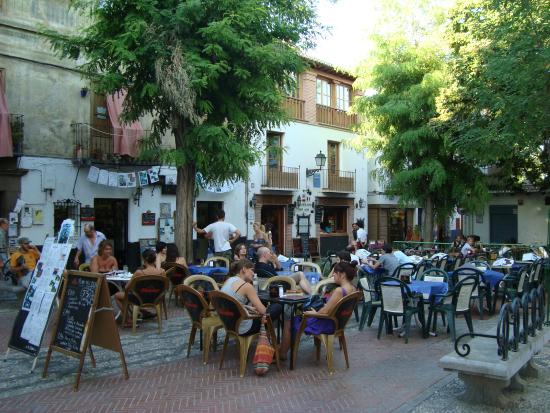
So, when I was walking down Calle Puentezuelas a week or so ago, I found myself amid tiendas like those. In fact, there were lots of interesting stores there – especially in the light of my practice with Tarot cards over the last few months. (I’m trying hard to become what they call here a “Tarotista.” I practice every day with readings exploring my own psyche and spiritual state.)

For example, one store not only sells cards, incense, crystals, etc., it also offers Tarot card readings (25 Euros), along with shell divinations, and cigar smoke interpretations (40 Euros). Another store offers similar services for twice the price.

For me, the most interesting shop is a rather large one that has a Buddhist orientation. It sells things like statues, medals, pulseras, fountains, meditation cushions and clothes, prayer flags, and those incense sticks and crystals I mentioned. I often go in there just walking around and looking. Very interesting and somehow calming.

On one of my most recent visits to Puentezuelas, I saw for the first time a shop specializing in legal marijuana. I went in and inspected.

“Just looking,” I said when the clerk asked if he might help. Later, I added, “What would you recommend for a beginner like me?” He showed me a node of “Wedding Cake.”

“This might be a good start,” he said. “It’s pretty mild.”

On impulse, I bought a packet for five euros. Later, I visited a Tabac on the Gran Via Colon and added a plastic grinder along with some paper, filters, and a butane lighter.

I went home, rolled a joint, and lit up.

My First Time

Well, to tell the truth, it wasn’t that smooth.

First, I had a hard time rolling the thing. Yes, I watched a video on YouTube. But that didn’t help much. Eventually though I did get it together — kinda.

Also, before smoking, I watched a well-done cartoon video about a college student’s first experience of marijuana. It was quite entertaining and raised my anticipation level. The student reported:

  • A non-stop laughing fit.
  • Disappearance of time-consciousness.
  • Seeing the colors of everything like trees, flowers, billboards, cars, and clothes with greatly enhanced hues and degrees of intensity.
  • Experiencing his feet and hands growing by meters in extension.
  • But being able nonetheless to walk with delight and exhilaration.
  • Having such a good time that he smoked another joint immediately afterwards.
  • With similar effect.

So, with all that in mind, as I said, I lit up.

At first nothing happened. After my first couple of drags, I started coughing. But I finished the joint anyway.

In a few minutes, I could feel my perceptions changing. It was like I was getting drunk. So, I went to my room and stretched out in bed.

Then I realized:

  • I had no urge to laugh.
  • My mouth was extremely dry.
  • My tongue felt swollen.
  • I couldn’t get out of bed.
  • If I were to try, I I’d fall down for sure.
  • I was immobile.
  • I felt completely drunk.
  • For about an hour.

Expert Advice (from Three)

1.     Matteo’s Counsel

The next day, while doing my daily walk down the Gran Via Colon in Granada’s center, I came across Matteo, a young musician friend from Italy. As usual, he was carrying his guitar uncovered despite the season’s slight drizzle.

We stopped and talked. I told him of my experience with “Wedding Cake.”

“Oh, that’s no good,” he said. “That’ll never get you high. Here, let me share what I smoke.”

So, then and there on the Gran Via, in front of the Cathedral, in that slight shower, he rolled me a joint all the while giving me step-by-step instructions about doing it right.

“Try that,” he said.

I went home and did.

Same effect as described above.

2.     Simon Knew Better

The next day, I spoke with my closest street smart friend, Simon. He’s the busker I first met in the Plaza Larga – the 60-year-old Chilean who’s helping me with my Spanish (with my “Castellano,” he insists on calling it).

Simon had already heard from Matteo about my experimentation and experience. He was laughing about it.

“The problem is,” Simon advised between chuckles, “you’re smoking alone. Also, even the stuff Matteo gave you probably isn’t strong enough for you. Give me ten euros and I’ll buy you some good stuff and we can smoke it together. It’ll get you laughing in no time.”

I gave Simon ten euros.

The next day, we met. We walked to Simon’s favorite haunt near the Plaza Larga, sat on a bench and lit up alternating drags and just talking.

Then it hit me. But it was the same experience I shared earlier. I soon felt completely drunk and unable to walk. My tongue was thick. My mouth was dry. And I was slurring my words. It was an hour before I dared to get up from that bench. The weed hadn’t produced even a smile.

I resolved that my experimentation was over. I don’t like that drunk feeling.

3.     Mauricio’s and Filson’s Guidance:

Nevertheless, the next day, when I went up to our roof patio overlooking the Alhambra’s environs, I found Mauricio, a 60-something next-door neighbor, smoking weed on the adjoining patio. He was talking and toking with Filson, a young African woman from London. Mauricio is a pianist from the Netherlands. Filson is a writer and lives in a cave not far from Simon’s. I had met her previously in the Plaza Larga, where we had talked about mushrooms.

Anyway, I had gone up to the patio for my morning coffee and tostada. I noticed the two smoking, so I interrupted. I told them of my two recent experiences with marijuana.

A suddenly interested Mauricio said, “Oh, that’s because the weed you smoked wasn’t the best. Here, let me give you some of mine. No, I insist. Take it. It’s great. See if it makes a difference.”

Mauricio went inside and returned with a handful of the stuff he was recommending.

“Anyway,” he added, “weed isn’t for achieving those changed perceptions that YouTube video described. It’s just about relaxing. Lots of times, when I can’t sleep because of some worries I might be having, I just light up. It relaxes me, and my worries disappear. The other stuff about colors and limb extension is a myth – at least in my experience.” Filson agreed.  

Conclusion  

Later, when I told Simon about Mauricio and Filson, he just smiled. He knew of my resolution to smoke no more.  

“Well,” he said, “why don’t you just let me roll you a joint with Mauricio’s stuff? And then when and if you might feel ready for another go sometime in the future, we can smoke it together.”

He rolled and gave me the joint. I put it in a safe place.

I’m still thinking about the matter.

I’m Stopped and Frisked by Granada’s Puta Policia

It was an extraordinary experience. As an 82-year-old American tourist, I never anticipated anything like it happening to me in Spain.  

I had spent the early evening in the nearby Plaza Larga with friends I’ve written about previously. It’s become my favorite spot in Granada.

Together, we had done some Tarot Card readings and discussed Bob Dylan, the Frankfurt School of critical thought (especially Herbert Marcuse’s Eros and Civilization), conspiracy theories, the U.S. Federal Reserve, the images on the back of U.S. dollar bills, and the direction of “universal history.”

About the latter, I had recommended to Francesco, a brilliant intellectual and bibliophile from Italy, the work of one of my Great Teachers, Argentina’s Enrique Dussel. His work on universal history has been mind-blowing to me. Since he is also an historian, I was anxious to hear Cesco’s evaluation of Dussel’s work.

In the midst of such conversation, as if from nowhere the puta policia (“effin cops” as my friends call them) showed up. There were four of them. – all about the age of 40, around the age of my own children. (Actually, I could have been their grandfather.)

They frisked us all (including me!) and wrote us up in their ledgers. (I’m not sure what they’ll do with the papers they filled out. None of us was given a copy.)

It was a clear exercise of “power over,” of classism and discrimination against people simply because they are poor.

Earlier in the day, I had witnessed something similar in a place they call “El Huerto” (the Garden) where I spend a good deal of time. The Huerto is an extensive park very close to the Alhambra. The still snow capped peaks of the Sierra Nevada stand breathtakingly in the far horizon.  

The park features a kids’ playground and exercise machines installed especially for elderly people like me. It’s also a gathering place for hippies and street people. Some of them sleep there overnight usually in sleeping bags. It’s also a kind of dog park as evidenced by dog waste lying here and their awaiting the morning visit of street sweepers who keep the Huerto relatively clean.

The place is also “decorated” with graffiti denouncing the puta policia, pledging love to Noemis and Rodrigos, and expressing support for Palestinians and Ukrainians. One of the inscriptions reads “I’m in the love.”

Anyway, I had just finished my morning workout and was sitting in the shade catching my breath.

A young African man sat off to my right, about 20 meters distant.

Then all of a sudden, two police motorcycles converged on him, seemingly from nowhere. They hemmed him in, though he made no effort to “escape.” The cops made him stand up with his hands in the air. They pushed him around a bit, had him empty his pockets, and then patted him down. I watched the whole thing thinking “I should be filming this.” I didn’t dare.

The young man offered no resistance and gave the impression of having gone through the drill many times before. He was harming no one.

I make that observation because my busker friend, Simon, constantly complains about gratuitous police harassment. It’s something I’ve previously written about here. Again, it’s all about classism and criminalization of poverty. When I later told Simon about what I witnessed in the Huerto, he said, “Of course, they harassed him. He’s black.”

In any case, and as I was saying these cops were suddenly on our case too – criminalizing us as we sat around a stone public bench not ten meters away from the outdoor Aixa Restaurant. That’s where I often take breakfast of tostada and café. Aixa’s patrons were enjoying wine, beer, and tapas.  

“You know you’re not supposed to be drinking beer in public, don’t you?” the cops accused, ignoring the diners so close at hand and the fact that no one harasses normal tourists walking around the Albaycin with red-canned Cervezas Alhambra in hand.  

“Empty your pockets, all of you,” they demanded. We all did so obediently. My friends demeanor showed me how to act. Eyes were cast down. No talking back. Serious looks on everyone’s faces. Wordless glances exchanged between us expressing exasperation about the whole reason for the unfolding process.

“They just don’t have enough work,” one of my friends growled sotto voce. He nodded towards the cops.

The latter were especially interested in examining and sniffing the tobacco pouches nearly all my friends carry. (All of them roll their cigarettes.) The cops were looking for marijuana. They found some. It was confiscated.

Then one of them turned his attention to me. “Stand up,” he demanded. I obeyed. “Turn around!” He patted me up and down and actually grabbed my genitals and squeezed them. Again, I’m 82 years old! I’m obviously a tourist. “Por favor!” I objected. The cop was unphased.

[By the way, I find interesting my internal reaction to that manhandling by the cop. I had never experienced anything like that. Afterwards I almost felt guilty – the way women who are sexually assaulted often report feeling.  I thought, “Why did I let him do that?” Should I have resisted or pushed him away? But of course, I couldn’t. That’s because the cop wasn’t really looking for something hidden in my crotch. (What, I, this elderly American tourist was hiding marijuana or something in my drawers?) No, he was asserting power. That’s what law enforcement does everywhere to poor people. It tells people like my friends, “You’re nothing. We can do whatever we want with you. Never forget that. We’re the law!”]

“Show me your identification,” the cop ordered. I obliged producing my residential permit.

“You’re an American, right? Why are you here?”

“I’m a tourist staying with my grandchildren and their parents. We’re all here to learn Castellano.”

“Are these your friends?” the cop asked bruskly.

“Yes, they are,” I confessed.

“They shouldn’t be,” came the reply. “They’re bad people.”

“That’s not my experience,” I said. “They’re some of the finest people I know.”

Tarot: Last Six Cards of Major Arcana

In this final posting on the last six cards of the 22 Major Arcana (including Card # 0, the Fool’s) we’ll look at the remaining portrayals of the classic stages of spiritual growth. Remember, the first of those seven cards was The Devil reviewed at the end of my last blog entry. The Devil represented the Fool’s realization that something is deeply wrong within himself and in the world.

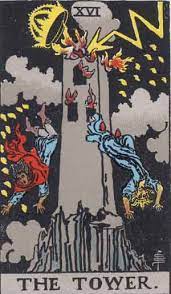
16. The Tower: With that realization, the Fool’s inner world comes crashing down. Discouraged and devastated, s/he sees that structural change and rebuilding (both inner and outer) is required, because his or her “tower” though apparently founded on rock is crumbling nonetheless. S/he looks to the stars for help. [This is a highly symbol-rich card. To begin with, its number, 16 = 1+6= 7; and that connects with#7 of the Major Arcana, viz., the Chariot card which is all about movement and finding control and mastery over opposing forces. Here the movement is downward and deconstructive as symbolized by the card’s black background and prominent gray clouds. Also centralized in the card is the couple we’ve already met in card #6 (the lovers) and in card #15 (the devil). We’re evidently watching the downfall of the basically masculine (phallic symbolled) ivory tower which has been struck by a bolt of lightning and is on fire. There are two crowns in this image, one at the top of the tower signifying the dissolution of some imperious order and the other on the head of the female figure who is falling upside down (i.e., in the hanged man position) on the card’s right. Her crown remains fixed firmly on her royal head. However, her spiritual viewpoint (designated by the color blue) is in complete transition. The same is true for the male figure whose accompanying passions are signified by the color red. This card suggests radical change.]

17. Star: The priestess’ star reappears when the Fool needs it most. The new, healthier ideas the stars represent guide the Fool into the future. “Follow your star” is the message here. [As opposed to the previous card, # 17 is calm and encouraging. This card is about cosmic order, hope, peace, ease, relaxation, persevering, and hanging on. The unclothed female figure has dropped all the pretense of royal robes, crowns, and symbols of power. She is concerned only with heavenly order, purifying water, connecting with the collective unconscious (symbolized by the pool) and with the earth itself (shown by her left-side intuitional knee kneeling on the earth’s surface). There are seven prominent but minor stars in the card’s image referring to the body’s seven chakras — as well as a large and bright golden central star that connects with the golden hair of the card’s central figure. The card’s protagonist is enlightened and following her star. Though her weight is on her forward foot, that foot is not submerged. The figure can walk on water. In some sense, she is the card’s star. In the background perched in something like the Tree of Life, a scarlet Ibis bird is about to take flight. In Egyptian mythology, the scarlet Ibis was considered the earthly manifestation of Thoth, the god of wisdom.]

18. Moon: The mystic moon provides relief from darkness. But it is mysterious and uncontrollable. The sleep suggested by the moon generates insights and clarity, but also nightmares, anxieties, and fears. [The moon card represents the 4th stage of spiritual unfolding (after the Devil, the Tower, and the Star). It evokes reflection on sleep and the insights that occur during that inevitable process. Sleep provides time for personal repair and reorganization at physical, psychological, and spiritual levels. In fact, this card means “Sleep Brings Counsel.” Its background mountains remind the querent not to be deceived by the highs and lows of any day or by the past itself. Instead, s/he’s called to advance steadily towards the uplifting mountainous horizons towards which a moon-illuminated golden path wends its way. The card is also about evolution. A dog and its evolutionary predecessor, a wolf, join together to bay at the moon. The dog, of course, has evolved from wolves to become the “best friend” nature has provided human beings. Similarly, the crayfish-like creature arising from the pool of the collective unconscious recalls our mind’s origins from that pool where both imagination and confusion reside. The twin towers that frame the card invite the querent to pursue wisdom beyond the boundaries of the known. The moon itself profiled in this 18th card reminds the attentive reader of the ninth (Hermit) card in the Major Arcana (1+8=9). Like the profiled hermit with his lamp, the profiled moon comes each night to teach us (through dreams and our especially precious thoughts just before sleep arrives) what we have learned during the day as well as during our entire lives.]

19. Sun: But the night doesn’t last forever. The sun shines brightly with a promise of homecoming and return. The Fool can now answer his child’s questions with joy, love, and positivity. At last s/he is at peace enjoying the good, the true, and the beautiful. [This card is about rebirth, happiness, and illumination. The haloed, reborn, and unclothed child finds her/his place bathing in the sun’s illuminating rays and seated on a white horse amid sunflowers. This is a triumphant card evoking joy and new beginnings.]

20. Judgment: The Fool has now returned to his interior ancestral castle. S/he is ready to share with others all that has been learned during a life of wandering, trial, and triumph. The Fool’s inner work has been completed. S/he is at peace with the past. [This card is about a journey completed. Its message is “Forgive yourself; lay your past to rest; let go of all past selves.” It is about resurrection and release. Note that the familiar man and woman from the Lovers’, Devil, and Tower cards have changed sides. The man now stands on the left, the woman on the right. This suggests that they have successfully appropriated their complementary animus or anima. The flag pictured below the angel’s right elbow is that of St. George noted for the bravery and chivalry it has taken to complete the Fool’s journey.]

21. The World: As a final step, the Fool embraces the world while knowing that the whole cycle is about to begin once again in life’s endless circle. However, this time his/her journey will not be foolish, but that of an evolved Page, Knight or Female Warrior — all to be centralized in Tarot’s Minor Arcana [Here notable symbols include those for the four Christian Gospels which we already saw on the corners of the Wheel of Fortune card (#10). Matthew is portrayed as an angel, Mark as a lion, Luke as an ox, and John as an eagle. Their appearance here indicates that the gospels’ overriding concern is Life here below not principally life al di la in the heavens. The same goes for the unclothed woman at the card’s center. We met her most recently as the Star in card #17. Here her presence and the card’s number 21 (2+1=3) suggests the High Priestess (the real 3rd card of the Tarot deck — when including the Fool’s “number,” 0) and the Empress card actually numbered as 3. The reference suggests that women, their mysteries, intuition, and closeness to nature are at the center of Life’s circle portrayed in this last card of the Major Arcana. Note that the circle is actually a green astrological ellipse tied together above and below with red ribbons. Their color symbolizes passion, energy, and fire. That same symbolism is conveyed by the Magician’s wands the card’s central figure grasps in her hands. In this last card the previously unconscious Magician and High Priestess are at last consciously integrated. It is interesting to see which figure attains most prominence at the end.]

Cave Dwellers and Cops in Granada’s Albaicin

Protestors gather at Granada’s City Hall to protest evictions of cave dwellers from their homes. The sign on the left reads “San Miguel Hill is a neighborhood.” The big black and white banner says “The Caves Resist.” One of the chants during the protest had us all shouting “La Cueva, Mi Techo, Es Mi Derecho” i.e., “The Cave, My Roof Is My Right!”

As everyone who follows this blog knows by now, Peggy and I have been living in Granada for the past five months. We’ve been in Spain with our daughter, Maggie, our son-in-law, Kerry, and their five children Eva (14 years of age), Oscar (12), Orlando (10), Markandeya (7), and Sebastian (3).

Maggie’s family has been here on sabbatical so that our grandchildren might learn Spanish by attending school where only that language is spoken. It has been a wonderful experience for all of us.

Now Peggy and I are about to return to the States for February and March. We’ll spend most of that time in Florida, and then come back to Spain in April. Our plan is to remain here till the end of June. We’ll then fly on to Rome, where we’ll spend a month or so with our son Brendan’s family. (Brendan State Department assignment will have him living there for the next three years.)

In the meantime, very unexpected things have happened to me in Granada. Here we’ve been living in its Albaicin barrio overlooking the famous 13th century Islamic city, the Alhambra. We’ve walked part of the Camino de Santiago, along with traveling to Madrid (and its Prado Museum), to Bilbao (and its Guggenheim Museum), as well as driving to Tarifa (with its nearby Roman ruins), to Valencia, and Cadiz (which so reminded us both of Havana).

However, most unexpected of all have been some friendships I’ve made with cave dwellers and street musicians here in the Albaicin. I’ve already written about that here and here. My new friendships have introduced me to a way of life that I truly admire. With one cave dweller I’ve studied the “Mayan Bible” (the Popol Vuh) and have been introduced to Tarot (which I never thought I’d study, but which now greatly fascinates and benefits me).

The cave dwellers are constantly harassed by the police — or as they call them, “the puta policia” (or effing cops). Last week, those harassers once again invaded the caves, cut off their access to water, and destroyed the property of my friends and their neighbors — all in the name of “protecting” those concerned from their unhealthy way of life.

The other day, I attended a rally by about 200 cave dwellers and sympathizers in front of Granada’s City Hall (pictured above). Some have taken to wearing black nail polish on their left hands as a sign of solidarity with the Cuevistas. I surprised (and maybe scandalized) my family members by doing so myself.

In any case, immediately below, you’ll find an account of all this in another of my poor attempts at poetry. I wrote the “poem” so I’d never forget these people I’ve come to cherish and treasure.

Cave Dwellers and Cops 
in the Albaicin’s Plaza Larga
(Jan. 27, 2023)

Since coming to the Albaicin
In Granada five months ago,
Its Plaza Larga has drawn me in,
Its cave dwellers have helped me grow.

Yes, they all live in Cuevas
Dug by gypsies and Moors
They’re troglodytes and drifters
Rebels all to their very pores.

They’re committed to music
Painting, poetry, and Life
Smoking hash and drinking cervezas
To peace and not the knife. 
.
Yes, the Larga’s a place
For outsiders like me
They’re poor, ill-clad
But happy
Living NOW as all can see.

One of them there
Wears a jellabiya on Fridays
And yells in a voice
Much too loud.

But no one’s upset by his antics
Or his shouting at the crowd
Instead, they roll eyes or support him.
Ridicule’s never allowed. 

I’ve met a man there called Simon
A street busker and shaman indeed
He helps me with my Spanish
Oblivious to any need

Because he’s rich, you see
Not with money, playthings, or goods
But with time, wisdom, and kindness
And absolute freedom from “shoulds.”

There’s another Simon
(I’ve met him).
Much younger and from France
There’s Ida from Denmark
And Ramon from north Spain
And Juan whose Traveler ancestors
Set the Cuevas as their reign. 

There’s a girl from Somalia called Filas
She’s dark, skinny, and profane.
She’s friendly and kissy and cheerful
Eats mushrooms and smokes in a chain.

And I’ve met 
A young man they call ‘Cesco’
He’s moving here this fall
From his home far away in Italia
(Perhaps he’s the wisest of all).

He’s a Bob Dylan scholar and tarotista
(He did my Tarot today)
He knows everything about Dylan
“Desolation Row,” and what his cards say.

So, I’m grateful to Andalusia
For giving me a gift so unexpected, and so fine
Of friendships with the Chusma
It’s been like draughting aged wine. 

Yes, I love crossing borders 
With campaneros like these
I’m grateful to Simon and the drifters
Who do whatever they please.

That is. . ..

If not for the “Puta Policia” . . ..
Anxious to show my friends who’s boss
They harass them and fine them. 
They smash their guitars
Understanding nothing about them
As if coming from Mars

They sack their poor Cuevas
Burn their goods and possessions
Interrupt their love making,
Their meditation sessions.

They render them homeless.
As if that were good
Can you imagine
Cops destroying their food?

But that’s the lot of drifters
Living everywhere it seems.
Of dropouts whose simple existence
Challenges our bourgeois dreams.

The system just can’t stand them
Detesting their sight and smell
So, it robs the poor of the little they have
And sends them all to hell.

I’d know nothing about this
If not for Simon and friends
If not for the Plaza Larga,
Where singing never ends.

If not for my new friendships
If not for Tarot and song
If not for gypsies and buskers
If not for my stay here so long.

So, despite the puta policia,
I’m grateful to be here
Learning from friends in the Plaza Larga
May God remove their fear.

Tarot: Cards 11-15

This is the third in my series on Tarot. I’ve been pleasantly surprised to discover for myself how helpful the cards have become for making sense of my spiritual and material life.

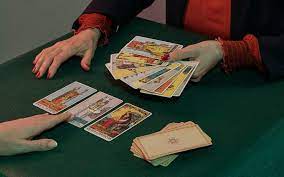
Each morning, first thing, I do a Tarot reading. As previously mentioned, I “throw” three cards. The first yields a preview of the coming day, since it is meant to express the hidden “energy” of what lies before me. The second card is about gratitude; it reminds me of what I’m particularly grateful for in my long life. The final card (which I place between the other two) suggests what or whom I should incarnate during the coming day. For instance, this morning the latter was Card 14 as pictured below. I took it as a call to incarnate my patron saint, Michael the Archangel. (Look below for the explanation.)

During the day, I leave the cards out. I glance at them as the day unfolds. Their meaning deepens as I do so.

As I’ve said before, Tarot is like a 78 page book. It’s living, dynamic, and interactive — and uncanny in its practical inspiration.

What follows are the cards of focus today. Remember, the Major Arcana outline everyone’s story of passage from status as a naive “Fool” (card zero) to deeper levels of awareness.

So far the Fool we’ve been following is unaware of his/her true inner Self, a blended Magician and mysterious Priestess. The Fool has received instruction from the mother figure in his/her life (the Empress), and from a father figure (the Emperor). The Fool has also gone to school and church, where s/he’s learned community traditions and rules from representatives of a Hierophant or Pope. Then came Love, Conflict, and the early dawning of some kind of critical awareness that imparted a kind of inner Strength to think autonomously. This drove the Fool to introspection in his/her Hermit phase which brought wisdom about the nature of life as a spin of the Wheel of Fortune with an accompanying need for self-forgiveness.

The story unfolds from there in the following 5 cards:

11. Justice: From introspection and the wisdom it imparts, the Fool realizes that justice – i.e., balance between worldly achievement and care for others – is necessary to start a new chapter in life. [Here Lady Justice is pictured as a royal figure. She holds the sword of clear thinking in her right hand and the scale of justice in her left (the side closest to her heart and its intuition). The red hue of Lady Justice’s robes indicates her passion for fairness. Her golden crown and corresponding cape as well as the “halo” above the violet background drape call attention to her connection with Life’s Great Source of enlightenment and illumination. Violet is the color of integration of masculine and feminine characteristics. Achieving justice is a highly spiritual affair that combines the best of both genders. The closed-in pillars on either side of Lady Justice indicate a commitment to a path that is “straight and narrow.”]

12. Hanged Man: Since the world is committed to injustice, the Fool now finds herself/himself suspended between two contradictory worlds. As a result, s/he feels called to adopt a new upside-down perspective on life. Though uncomfortable, s/he realizes that former perceptions of “truth” were nothing but simple repetitions of “teachers’” opinions. [Notice the golden halo around the upside-down figure. This is a stage of enlightenment that is highly spiritual (indicated by the Fool’s blue tunic). Enlightenment also includes coming to grips with the passion of the Fool’s root and sacral chakras (indicated by the figure’s red tights).

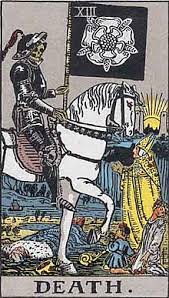
13. Death: Seeing the world upside-down makes the Fool realize that spiritual growth will demand “dying” to the inherited opinions which do not belong to the inner Magician/Priestess, but to the Empress, Emperor, Hierophant, and other lesser authority figures. The Fool is now ready for rebirth, improvement, and transformation. S/he is wiser and more confident – ready to begin Life’s next chapter. [Virtually everyone who has ever heard of Tarot know of the Death Card. Close examination, however, reveals nothing to fear. Though the card can be about impending physical illness and/or death, 99.9% of the time, it’s about change — death to old ways of thinking and acting and imminent new beginnings (indicated by the sun rising in the “eastern” part of this card framed by two “Towers of Hermes” — the ancient symbol for the boundaries of the known.) That the card is about spiritual death to the past and subsequent transformation is indicated by the very prominent white horse and the white rose adorning the the black flag. The skeleton riding the horse directs attention to the most lasting part of our physical form. The dead and crownless royal figure beside the horse tells the truth that death is the great leveller; it comes to everyone regardless of positions attained during life. Then there’s the young girl turned away from the approaching horse; she seems to be in denial. Meanwhile, the small child holding out a bouquet seems to be more open to death’s approach (as young children often are). The bishop in golden robes is facing the horse directly. Is he bargaining with death? Notice the river (Styx) in the background with a small boat floating down this traditional image for life’s journey. In summary, the Death Card represents the void between death and rebirth.

14. Temperance:  Preparing to enter that void involves living temperately – in peace, patience, balance, and harmony. It invites us to choose the middle path between extremes. [The powerful symbolism of this card is undeniable — especially for someone blessed with the name Michael. Notice the angel’s powerful wings tinged with red, the color of passion, energy, and activity. The angel is pouring water (the symbol of life itself) from one cup to another in a motion of giving and receiving (from the left, heart-centered hand, to the right, intellect-centered hand). Note that the angel has one foot on dry land and the other dipped in the water attempting to balance the mystical and physical realities of life. That same message of balance is indicated by the middle path behind the angel as it wends its way towards the sun. The flowers on the card are irises named after the Greek messenger-goddess. They are symbolic of hope, valor, trust and wisdom. The angel’s golden third eye under a head of golden hair also symbolize enlightenment and illumination. The gold triangle (spiritual energy) over “Michael’s” heart chakra is hemmed in by a black square (earth) again speaking of balance or temperance.

15. The Devil: But transformation and transfiguration also mean confronting the world and its extreme values of pride, covetousness, lust, anger, envy, sloth, and gluttony. It means confronting the devil, evil itself along with addictions and destructive impulses. The Fool now knows that s/he has a choice. S/he does not have to live like everyone else. [This is a very intense card – very dark (the background is entirely black). However, it signifies one’s desire to make a change. This 15th card is the first of the Major Arcana’s final seven cards that depict the seven stages of spiritual enlightenment. This initial stage is about “Consciousness of Bondage.” (If we don’t know we’re bound, we can never achieve freedom.) When the card comes up, it indicates that one is yearning for freedom. This devil card is about addictions, unhelpful habits, and giving our power away. Note that the man and woman pictured here are the same figures that appeared in card # 6, the Lovers’ Card. Here however they are bestialized with horns on their heads and now wearing long tails. The man’s tail is on fire signifying sexual passion. The woman’s tail relates to grapes perhaps connecting this picture with wine and alcohol. (As we all know, sex and alcohol are major human addictions.) Key to understanding the card is the hand gesture of the pictured devil. It is an ancient mudra that signifies “What you see is all there is.” That of course is the devil’s basic assertion – a denial of the unseen spiritual realm. It has the devil seated on a half-cube signifying his connection with half-knowledge rather than whole. This denial makes it easier for humans to sell their souls and make Faustian bargains. Unlike the Hermit’s lamp in card # 9, the devil’s torch is turned upside down setting aflame the man’s tail (passions?). In terms of escaping the devil’s thrall, it is interesting to note that the chains around the man and woman are very loose and could easily be removed. This suggests that the bondage in question is purely illusionary. Think of this card as the inverse of Tarot Card #1, the Magician, whose right hand was fully extended upward pointing to the reality of the spiritual realm. Questions suggested by this card include:

  • What am I addicted to?
  • What primal need are my addictions attempting to meet?
  • How can I meet them in a more constructive way?
  • Which addiction am I ready to break free from?
  • To whom or what am I giving my freedom away?
  • What fears relate to my addictions and/or unhelpful habits?

Stay tuned for my next installment on Tarot. It will address the final six cards of the Major Arcana.

“Indecent” Women Doing Liberation Theology Without Underwear: Saints Tina Turner & Chuck Berry

What is the connection between liberation theology and its feminist theologians refusing to wear underwear while writing their articles and books? That’s right: no underwear.

And what is the connection of their resulting theology with the poor lemon vendors in Buenos Aires who, also without underwear, squat defiantly in their full skirts and urinate on the sidewalks in front of watchful and disapproving city police? (Meanwhile, the lemon sellers complain about their “shi*ty priests”, “mafia politicians” and those “puta policia” – fu*kin’ cops).

And what about the mothers, grandmothers, and great-grandmothers, who proudly display their completely unrobed bodies on so many contemporary internet sites? Presumably many of them identify as Christians. But by religious standards, isn’t such display “indecent?”

And finally, is there any relationship between feminist theologians and those Argentine lemon sellers, on the one hand, and rock ‘n’ roll music, Tina Turner, and Chuck Berry on the other.

The late liberation theologian Marcela Althaus-Reid (1952-2009) provocatively raised and addressed questions like those during her brief career as Senior Lecturer in Christian Ethics, Practical Theology, and Systematic Theology at the University of Edinburgh in Scotland. In doing so, she shed light on women’s rebellions against oppressive patriarchal norms across the planet.

You know what I mean. Think about the reaction to the effective repeal of Roe v. Wade by the U.S. Supreme Court. Think of those Muslim women in Iran who cut their hair in public and refuse to obey the “morality police.” Even consider, if you can, the unspoken meaning behind those mature women around the world who provocatively display their unclothed bodies online for all to see.

Althaus-Reid argued that the above are all doing what she called “Indecent Theology.” Here the reference is to her thesis from her 2004 theological potboiler, From Feminist Theology to Indecent Theology: Readings on Poverty, Sexual Identity, and God.

Because of the important light the book sheds on the feminist rebellions just referenced, as well as on liberation theology itself, please consider with me what Althaus-Reid means. Consider the relevance of indecency to liberation theology and to issues like abortion, the morality police, what some might call “pornography,” as well as to patriarchy in general. Consider its connection to rock ‘n’ roll and to popular “saints” like the recently deceased Tina Turner (1939-2023) and Chuck Berry (1926-2017).

Female Indecency

Althaus-Reid begins by reminding readers that Christianity itself is a highly sexualized affair. It is claustrophobically decent. (In what follows, all references in parentheses are to the book just cited.)

She says it’s not that the morality of the Bible in any way endorses Victorian sexual standards. It does not. Instead, its main concerns are liberation in all the senses (economic, political, and spiritual) that the word “liberation” connotes.

That’s because the Biblical tradition was based on the freeing of slaves from Egypt. Its resulting concern was for the welfare of widows, orphans, and resident aliens. Its prophetic tradition boldly spoke radical truth to priests, kings, and other bosses who legislated against, ignored, and/or exploited the poor.

In general, the biblical tradition promised the latter a new and brighter future. The prophet Yeshua called that future the “Kingdom of God.” By that he meant what the world would be like if God were king instead of the world’s oppressive “Caesars.” Such a world would be turned upside down. Its standards of decency would be transgressed at every turn.

Yet despite such a clear emphasis on social justice, it was the biblical tradition itself that ended up doing a headstand instead of the imperial world order. The revolutionary thrust of “The Book’s” pivotal story was tamed by the kings, princes, and popes of the world (27, 28). Far from being scandalous and revolutionary, the Judeo-Christian tradition thus became the defender of the status quo. Its point became the social control of the revolutionary lower classes, with oppressive standards of decency, especially for women.

And why so much attention to women? It is because of their embodiment of the revolutionary energy that the Greeks called eros. As psychologists and philosophers such as Sigmund Freud and Herbert Marcuse have pointed out, eros represents the basic creative energy of the universe.

In a capitalist patriarchal order dependent on overwork, the powers of patriarchy identify eros in the form of female sexuality as the fundamental factor threatening to undermine their entire project. Hence the powers-that-be covertly vilify women for deliciously “tempting” men to find meaning, fulfillment, happiness, and joy in human (and sexual) relationships that undermine the system’s requirement of “surplus repression” in the form of overwork.

And so, repressive concepts of decency in general and of theological decency in particular emerge to dominate women and, by extension, their potential partners. Theological decency decrees that:

• The woman’s body is a source of temptation

• Therefore, it should be covered by layers of clothing.

• Women need men to regulate female bodies and behavior through special rules written by men and (depending on culture and historical period) governing the integrity of women’s sexual organs, their menstrual periods, and issues surrounding marriage, birth control, abortion, divorce, voting and the ability to own property.

• To do theology (i.e., to speak authoritatively about God even in relation to themselves and their bodily processes), women must earn professional degrees grudgingly bestowed by the patriarchal establishment of academia.

• Therefore, the “degrees” informally awarded by the “School of Life” with its deviant and indecent logic are invalid (14, 32, 137). So is the spirituality resulting from lemon vendors engaging in “witchcraft,” in the informal healing arts, working as midwives, abortionists, and spiritual guides.

Theological Indecency

With all this in mind, feminist liberation theologians like Althaus Reid insist on transgressing the limits of theological decency. They insist that:

• Doing theology is a profoundly sexual act (4, 76). To repeat: this is not because sex was central to Jesus’ preaching. Rather it is because the church has for centuries distorted the teachings of Jesus in the service of the empire, acting in the process as an instrument of social control as explained above. Therefore, theologians are forced to write endless pages refuting such distortions.

• Poor women provide the most radical view of theology (16). Their enforced “otherness” teaches us something new about life and about the Greater Queer that some still insist on calling “God” (19).

• Yes, God is Queer (9, 146) in the sense of exceeding all categories and definitions (175) while subverting decent bourgeois concepts like family. [For those who live on the peripheries of society – under bridges, in slums, favelas and shanty towns, “family” ends up being an oppressive category. It arrogantly invalidates alternative basic social groupings that are just as valid, functional (and dysfunctional) as their bourgeois counterparts (159, 160, 164).]

• Far from being a liberating model for Latin American women, the cult of the Virgin Mary ends up functioning as another instrument of social control, this one aimed directly at women (13, 23, 39, 55). After all, Mary is presented as “a gadget” (88) having sex with God without any pre-coital romantic relationship (85). She does not experience sexual pleasure or orgasm from the union (88). And then afterwards she enjoys no meaningful sex life with her husband, Joseph. Such factors are supposed to set an example for all Christian women.

• Similarly, Jesus himself is strangely asexual: a young Hebrew man with no compañera and no unambiguous sexual interests. He also serves as a model of sexual abstinence (45).

• Thus, Jesus was queer in the sense indicated above: an outcast who rejected and was rejected even by his own family. They thought he was crazy (Mark 3:21). He spent a lot of time in the desert. At least once he was tempted to commit suicide by jumping from the pinnacle of Jerusalem’s Temple itself (170).

• In addition, the evangelical representations of Jesus show him as a victim of the machismo of his own culture (45, 48, 51, 80). Yes, he comes to the aid of a woman considered “impure” because of a menstrual problem (Lk 8, 43-48); and yes, he rejects the male executioners of a woman sentenced to death for adultery (John 8: 1-11). However, Jesus never questions the misogynistic patriarchal laws that govern those situations. He does not reject the laws regarding the stoning of women caught in adultery, nor those that classified menstruating women as “unclean” (6, 13).

• In summary, if liberationists take Jesus’ poverty and otherness seriously along with Paul’s dictum that in Christ there is neither male nor female (Galatians 3:28), perhaps the best contemporary identification of “the Master” would be a twelve-year-old girl prostituted by two men in a public toilet in Buenos Aires (84).

Unclothed Theology in the U.S.

Those are just some of the reflections of Althaus-Reid operating as a professional theologian. Meanwhile, she points out, her less academically prepared Latinx sisters do their theology based on popular beliefs and practices. Their well-earned degrees come from the school of very hard knocks. Their insights, Althaus-Reid suggests, are no less valid than their sisters’ teaching in places like the University of Edinburgh.  

So, they defiantly continue to honor Santa Evita Perón. She, after all, secured voting rights for Argentine women over the objections of Argentine bishops (79). They also pray to Santo La Muerte (St. Death), Jesús Bandito, and local popular “gangster saints” who are seen as robbing and stealing from the real thieves and criminals who support those who run the government (161). They have “canonized” deceased popular singers like Rodrigo and Gilda offering them prayers and novenas in chapels dedicated to El Angel Rodrigo and La Santa Gilda (157). Those who honor such avatars kneel in church like Althaus-Reid herself without underwear, engulfed, she says, in the fragrance of female sex, and offering fervent prayers to rock stars no doubt considered “indecent” by church authorities.

All of which brings me to rock ‘n’ roll, Tina Turner, Chuck Berry, and those unclothed grandmas.

Take the grandmas first. Althaus-Reid I think would see them as doing a kind of negative theology protesting the false church-supported Victorian standards earlier referenced. They take indecency to the extreme not just rejecting underwear, but displaying their bodies completely unclothed — not for personal gain like strippers or aspiring models, but just for the hell of it.     

Their wordless indecency is consistent with Althaus-Reid’s identification of the female body as a privileged locus of rebellion against patriarchal systems of power (45). Such rebellion echoes the status of their sisters in the Global South as “single women” with no visible men (35).

After all, under patriarchy, the skirts that once signified femininity and even priesthood (37), now only convey a deep alienation (20). Set them all aside!

“Do you want indecency?” rebellious women seem to say. “Well, take a look at this! The patriarchs will not tell us how to behave and what to do with our bodies!”

As for rock ‘n’ roll, Tina Turner, and Chuck Berry. . ..  How much saintlier can you get?

During their lives, their music performed the basically feminine function of distracting millions from the overwork mandated by the reigning system denounced by Marcuse. In the process, they brought joy, fun, and happiness to millions of people who ended up attending and participating in the huge liturgies we call “concerts” – even over the protests and askance gazes of uptight Victorians and clergy.  

By the standards of Althaus-Reid nothing could be more constructively indecent and therefore holy. Thank you, Saint Tina! Thank you, holy Chuck! Thank you, dear Marcella.

The Popol Vuh: Its Creation Story

As I was saying, I've been studying the "Mayan Bible," The Popol Vuh, with a new friend of mine here in Grenada, Spain. He's a wise man, a cave-dweller, artist and street musician. I've already written about him here and here. I've summarized the introduction to the Popol Vuh here. This current posting summarizes what the book calls "The First Narration" of the Mayan classic. I hope it communicates the book's Spirit.   


Useless Humans Made of Mud, Straw, and Greed

In a hushed ancient Reality 
Without Time, Space, or Movement
But only sea and sky,
The Great Creators and Shapers,
The Trinity of
Tupeu, Gucumatz, and Huracan,
Wonderfully 
Manifested their 
Unbounded energy 
Sourced from divine meditation (45).

The Gods gave birth
To oceans, rivers, and streams
And to the earth itself
Sowing it 
With food from heaven
To nourish
Every creature to come.

All of it
Made the deities exceedingly happy
(And their council of Elders too, 47).
For theirs was an act 
Of holy evolution
Enabling their creatures
“To perfect themselves.”
Yes!
All mortals, they said,
Are called to perfection (48).

And so,
Lions, Tigers, and deer
Serpents, snakes, and vipers
Filled the earth (48).
Birds swarmed in the skies
Chanting wordless hymns 
Of praise and thanks
To the Creators and Shapers (49).

But sadly,
None of the new creatures
Found voice 
For conscious 
Expressions of thanks.

This saddened the Gods
Who therefore
Condemned the animals
To feed one another
With their own
Mute corpses (49).

So, the Great Ones changed course
Deciding to make 
A more perceptive 
And vocal creature
Capable of offering them
Conscious gratitude and praise.

First they made 
An Earth Creature of mud.
But it turned out to be
Weak, blind, immobile,
And impotent (50).
Worse still: It could not
Praise or thank
Grandmother Moon (Xmucane)
Or Grandfather Sun (Xpiyacoc 52).

Next, they created men of straw.
Yes, they could reproduce.
But their children
Were no more than dolls.
They lacked heart, soul, 
Understanding and consciousness. 
Empty and useless,
They wandered the earth
In disgrace (53). 

So, in fury Gods
Destroyed the earth
In a Great Flood
Of water and sticky resin.
The strawmen were
Slaughtered, crushed,
Eaten, decapitated
And thrown about
Like sacks of wheat
By all manner of animals.
Even dogs 
And household pots and pans
Got into the act (53-54).

But the evil Vacub Caqix 
Somehow survived it all.
Extraordinarily proud
And exceedingly rich,
His eyes could see nothing but silver.
He claimed to be sun and moon
Even before either was seen (55).

Vacub Caqix’s pride
Displeased the Gods
Who sent the heroes
Hun Ahpu and Ixbalanque
To teach the hard lesson
That Greatness is not measured
By wealth and possessions (57).

The two demigods
Inflicted Vacub with sickness
And a great toothache (60).
They knocked him
From the tree 
Whose fruit gave him life.
But not before
He disarmed (literally!) Hun Ahpu
And ordered Mrs. Vacub
To prepare the severed limb
For a cannibal supper (59-60). 

Indeed, Vacub Caquix
Was resilient. 
He begot 
Two powerful sons
Zipacna and Cabracan
Both movers and shakers
Who claimed 
They had made 
And could destroy
The earth itself.

As a result,
The Gods and their Elder Counselors
Decreed that 
Vacub’s Evil Trinity
Father and sons
Must die (60).

Disguising themselves
As dentist-healers
Hun Ahpu and Ixbalanque
Persuaded a reluctant Vacub
To let them pull 
His aching tooth
(Even though Vacub’s 
Teeth and silver-blinded eyes
Originated his power 62).

The demigods replaced
The pulled teeth
With dentures 
Made of white corn.
Defanged,
And unable to eat,
Vacub the Proud
Was vanquished!

His eldest son, Zipacna 
Was another story.
His great stupid strength
Caused everyone
To fear him.
Though he naively
Trusted others
And tried to help (63),
Everyone (including the Gods)
Wanted him dead.
Once 400 young bucks
Tricked him
Into digging his own grave.
But after three days
In the tomb,
He rose in fury
To kill them all.

But Hun Ahpu and Ixbalanque
Killed the famished monster
By making him pursue
A dinner of giant fake crab
Up a rocky peak
Until the mountain
Collapsed upon him
For good.

And then there was Cabracan
Vacub’s younger son,
The proud mountain destroyer (68).
Pretending to be wandering hunters,
Hun Ahpu and Ixbalanque
Sought the monster’s help
In reaching a mountaintop
Whose peak (they said)
Touched the sun. 
As they traveled up the slopes,
The demigods shot birds
With their blowguns (69).
At nightfall,
They seduced a hungry Cabracan
To eat a poisoned pigeon.
That’s how he died.

These are only samples
Of the great works
Of Hun Ahpu and Ixbalanque (70).

Their lesson:
Greatness is not a matter of wealth,
Or of physical strength,
Or destructive power.
It is a matter of living
Before the Gods
In praise and thanksgiving.

Simon: My Hermit Friend (Who’s No Perroflauta)

Simon, My Hermit Friend

Since my arrival in Spain (2 months ago), I’ve become friends with a man whom a Spanish acquaintance of mine dismissed as a perroflauta.

Don’t worry; until recently, I never heard that word either. But here’s the way it’s defined online: “A perroflauta (plural “perroflautas“, invariable in gender) is a normally young person with an appearance and behavior reminiscent of those of  the hippie movement .”

The flauta (flute) part of the term comes from the fact that most in the category are street musicians. The perro (dog) part refers to the buskers’ habit of taking their dogs along.

As I’ve mentioned in an earlier post, the one I’m referring to is called Simon. He’s Chilean. He plays guitar in the street (all the while dodging the police). And he’s lived here in Spain for the past 20 years.

But Simon is not young. He’s 60 years old. And has no dog accompanying him. Neither would I describe him as a hippie.

So, he’s no perroflauta — which (as Simon informed me) turns out to be a disrespectful, dismissive characterization.

Rather, I think of Simon as a kind of hermit, a cave-dweller (literally), a wise man, a philosopher, a seeker of truth, a sort of shaman. (The two of us plan to study the Mayan Popol Vuh together as part of his helping me with my Spanish.)

Simon himself jokingly refers to his kind as “troglodytes” — as cave dwellers, since many of them live in caves above the albaicin barrio here in Grenada — as I said, our home for the past couple of months.

In any case, last week I had the privilege of entering Simon’s cave. It took me a long time to get there. Usually, my daily exercise routine has me walking 4 miles. Last week, in order to get to Simon’s cave, I walked twice that distance — up and down severe inclines, along stony dirt paths, and narrow ridges.

My poor arthritic knees have been complaining about all that ever since. And this, even though Simon and I stopped several times so I could rest, while Simon rolled and smoked a couple of joints.

Following Simon to his cave

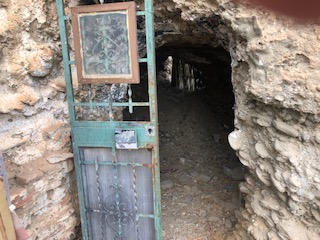
Below is an overview of Simon’s community. All its members live in caverns originally dug out by gitanos (gypsies) as far back as the 15th century — or maybe (Simon told me) by Arabs before them. Anyway, squatters like Simon have converted many of the dugouts into homes, some of them with electricity and running water:

An overview of our destination

Simon’s cave has no electricity and no water. The fridge in this picture merely serves as a cabinet for storing his food.

Simon’s “fridge” and gas “stove” where he’s brewing T-4-2

Here’s the cave from the outside:

The Cave from the Outside

And here’s Simon’s bedside “stuff” — including a candle and a couple of books on Tarot. My friend’s trying to learn all about it in case the police confiscate his guitar again — or fine him $300 to get it back. (Simon told me he’s had “about a thousand” guitars in is life, and that he’s like to write a book on “How to Lose 1000 Guitars and Still Stay in Business.”) In any case, Tarot reading, he says, would be an alternate source of income if the cops remove his livelihood. He only needs about 10 euros a day to get by.

Bedside Stuff

Here’s the wall hanging at the end of Simon’s bed:

Edvard Munch’s The Scream which the artist admitted “could only have been painted by a madman”

Simon’s bedside reading:

Leibniz, 1646-1716 — A philosophical theory about monads

On each side of Simon’s cave was another dugout about the size of his own dwelling. The floors in each were dirt, the walls still unwhitewashed. Using typical American reasoning, I asked my friend, “Why don’t you make a couple of more rooms for yourself in these caves? You could cover the dirt floors and whitewash the walls in both of them.” The hermit looked puzzled at my reasoning. He shook his head, “No,” he said, “I don’t need the space. And changes like that would only cause envy in the community. That wouldn’t be good for anyone.”

One of the empty caves alongside Simon’s

Towards the end of my visit, I asked Simon about the point of his life — about the point of my life. He paused a long time searching for words. He looked out the door of his cave . . .

The view from inside Simon’s Cave

and said, “I don’t know. I don’t think much about such things. I don’t think about the past or the future. It’s just about living in the present moment.

Do you see what I mean about my hermit friend and his simple wisdom?

Second Report from Spain

Flamenco Dancer in Elaborate Cave Home

As you may have noted from previous postings, Peggy and I have joined our daughter, Maggie, her husband, Kerry, and their five children (Eva 14, Oscar 11, Orlando 10, Markandeya 7, and Sebastian 3) in Granada, Spain. Peggy and I have been here just over two months. (Please forgive any repetitions here. But I want to tell the story from the beginning.)

It’s all been quite fascinating.

To begin with, the two of us came across from New York to Southampton on the Queen Mary 2.

Neither of us had ever traveled that way – seven nights at sea. And it was unforgettable. It included all you’d expect, fabulous meals, first class entertainment, live music that never stopped, dancing, lectures, films, and long hours in silence on deck chairs contemplating the Divine Presence of ocean and sky. It was all magnificent.

However, upon arriving at our destination, I came down with a severe case of COVID-19. So, I started out on the wrong foot. That called for 10 days or so of isolation and recovery.

Nonetheless, since arriving in Granada, the QB2 magic has continued. We’re in the city’s Albaycin neighborhood just above the famous 11th century Alhambra – a Moorish fortified city that draws tourists from all over the world. From the roof patio of our artistically decorated three-bedroom apartment you can see it all.

We can hear its uniqueness too, since we’re located right next to a Mesquita, a local mosque. When we’re on our patio we can see the muezzin and hear him sing the Salat calling his fellow religionists to prayer five times each day. Peggy and I treat it as a summons addressed to us as well.

Our barrio is also in the heart of what remains of Spain’s Gitano (Gypsy) culture with its famous Flamenco music and dance. On one high holiday here, Peggy and I stole a front row seat at a serious Flamenco performance in the square adjacent to our apartment. It was beautiful. Another night our whole family crowd attended a performance at a cave-turned-into-a-house in the nearby Sacromonte neighborhood. This area is covered with caves where people live. (But more about that later.)

Since our arrival, we’ve done some tourism too. For instance, we spent an unforgettable four days walking the famous Camino Santiago de Compostela. I tried to make it the spiritual experience reflecting its original intention (and rediscovered the rosary in the process).

It was also fun watching my grandchildren enjoying the same experience at a different level – all anxious to collect stamps recording their progress in their pilgrimage “passports.” For my part, arthritic knees confined my own advance to maybe 25 miles of walking over the 3 days of actual pilgrimage. My passport contains only a few stamps.

From there, we all traveled to Bilbao. We stayed a couple of nights there in a classy hotel. Visited the Guggenheim and a Fine Arts museum. Then it was on to Madrid and the Prado where, we enjoyed a guided tour pitched to the grandchildren’s interests and understandings. Of course, we barely scratched the museum’s surface.

Then a couple of weekends ago, Peggy and I traveled to Europe’s southernmost geographical point. We spent two nights in a beautifully simple hotel in Tarifa near the point where the Mediterranean and Atlantic Ocean flow into each other. We took in a newly excavated Roman City (Baelo Claudia) near Bolonia and Cadiz. There were also the remains of Moorish forts and palaces to see in Tarifa itself. All quite interesting.

As for my exclusively personal interests, I’ve been intent on recovering my understanding of the Spanish language and a greater fluency in expressing myself. So, I took “classes” for 10 days at a language school just down the street from us. The sessions consisted in conversations with 4 different professors. During the one-on-one periods, we mostly talked about Spain, its history and culture.

I was especially interested in the years during the dictatorship of Francisco Franco (1939-1975). I wanted to know how Spain made the transition from Franco’s fascism to its present situation where it’s governed by a coalition of the Spanish Socialist Workers’ Party (PSOE) and a rechristened Communist Party called Podemos (“Yes We Can!”). Of course, there remains a lot for me to learn there.

Since finishing my “classes,” my continued interest in improving my language and cultural understanding has moved away from the language school to the street. I’ve made friends with a very interesting street musician from Chile. He’s 60 years old and is a kindred spirit. He lives in a cave neighborhood across the valley from us and high above our apartment’s location. There are about 40 people like him living there. All live in caves; none pay rent. Many are ex-military who have been alienated from “normalcy” by their experiences in the army.

I’ve mentioned Simon in a previous posting. But I’ve been learning more about him. He knows I’ve been a writing teacher and wants my help in authoring his autobiography. He also wants us to study the Mayan Popol Vuh together. Just this morning he invited me to visit his cave community. I intend doing that tomorrow. I’ll soon tell you whatever I learn there.

Report from Spain: I Meet Simon the Street Busker

Since coming to Spain, I’ve made it my business to improve my Spanish. I recently met a very interesting and unlikely friend who’s helping me with that. Let me tell you about him.

But first a word about my Spanish.

I started learning it in 1985 in Nicaragua where I spent six weeks of study at a language school called Casa Nicaraguense de Español. The point there was to spend the mornings in class and the afternoons learning about the Revolution that was then celebrating its sixth anniversary. It was my first experience of living in a revolutionary situation.

Getting some fluency in Spanish wasn’t so hard for me, since I already had studied Latin, French, Italian, and Portuguese. So I could get along.

Seven years later, Peggy and I did an intensive three-month Spanish course in San Jose, Costa Rica at a school set up there to equip evangelical missionaries from the States to learn enough Spanish to convert Tico Catholics to evangelical Protestants.

Both Peggy and I did well enough in our courses for us to participate in a semester-long workshop on liberation theology in a think tank in San Jose called the Departamento Ecumenico de Investigaciones (DEI). We were the first North American “invited researchers” allowed into those hallowed halls where everyone was suspicious of Yankees. (I remember being told about worries that I might be CIA!)

But while Peggy’s Spanish has since taken off because of her work with Spanish-speaking immigrants and refugees, mine has remained where it was twenty years ago.

So, now that we’re in Spain long term, I find myself scrambling to get back on top of Español. To that end, I enrolled for ten hours of conversation with language teachers at a school just minutes away from our apartment in Granada’s picturesque Albaicin barrio. My intention was not just to improve my Spanish, but to learn about Spanish history. I was especially interested in knowing about the years when the fascist caudillo, Francisco Franco ruled the country (1939-’75). My four language teachers at the local school were happy enough to help me with that project.

I learned not only about Franco and how he came to power, but also about Spain’s current government which happens to be run by two left-wing parties, the socialist Spanish Workers’ Party, and a rechristened Communist party called Podemos (“Yes, we can!”). The country’s president is the socialist leader, Pedro Sanchez. But its most popular politician is the Podemos politician (and communist) Yolanda Diaz who is Spain’s Second Deputy Prime Minister.

All of that was fine. I really enjoyed conversations with the teachers just mentioned. But as my daughter, Maggie, said, “Why are you paying $50 an hour for conversations, when you could have the same experience for free with any elderly person sitting on a park bench down in the Plaza Larga?”

I had to admit she had a point. So, just recently I decided to locate such a person. I went down to the local Senior Center and struck up a conversation with a woman there. Her name was Carla. And she was very kind. However, she wasn’t really interested in conversational exchange. She just wanted someone to complain to about how terrible her life had become. The “conversation” was all one-way. On top of that, she spoke so quickly and with such dialect that I only understood about 20% of her complaints.

I decided to seek conversation elsewhere.

So, I approached an interesting looking busker playing at the entrance to the Plaza Larga which around here resembles an outdoor living room where locals gather at the many outdoor cafes and bars for cappuccinos and charlas.

The man’s name is Simon. He’s 60 years old and hasn’t a spare pound on his 5’3” frame. He wears a black tee, and at first peers out at you suspiciously from serious brown eyes framed with long and scraggly gray hair.

After I introduced myself and explained my language project, Simon warmed up and agreed to share a café con leche now and then and talk. He wasn’t interested in getting paid. “Just coffee,” he said.

Turns out that Simon is Chilean, living here for the last fifteen years without papers or passport. He plays a quietly thoughtful guitar.

I’d describe Simon as an old hippie. Looking out at the world, he sees a madhouse that he wants no part of. He’s discovered that he can live by singing and nothing other than his faith that Life will provide him with whatever he needs. It always does, he says. His busking brings him an income of about ten euros a day, sometimes a bit more. And that’s all he needs.  

Simon tells me that he lives in a simple house in San Miguel Arriba, a leisurely half-hour ‘s uphill walk from the Plaza Larga. At home, he cooks the vegetables he purchases at his local market on a butane stove. He defecates in a bag and disposes of his personal waste “more ecologically,” he said than the rest of us. It’s important, he says, to take care of his health, because he has no medical insurance.  

Simon’s mother died when he was very young. So, he was raised by his father who was an automobile mechanic usually paid in kind by his customers. His dad was an anarchist who always kept a statue of La Virgen prominently displayed in the house.

Simon was schooled by the Jesuits in Chile and went as far as his freshman year at a private university, where he studied special education for children suffering from dyslexia and other developmental problems. He left school though to become an artisan working in metal and wood.  

He took up with a woman he lived with for several years, fathering three children (ages 15 to 8) none of which (“sadly,” he says) he ever sees.

Simon is interested in theology and was amused by the fact that I had been a priest. The Jesuits, he said, taught him well and set him on a spiritual path that he’s followed ever since. It has led him to Shamanism and the Psycho-magic of the Chilean artist and filmmaker, Alexander Jodorowsky. Psycho-magic allows practitioners to heal and even perform operations using nothing but their imaginations.   

Simon now finds himself studying Tarot – as a fallback, he laughed, and source of income should he somehow become unable to busk any longer.

I thoroughly enjoyed my first conversation with Simon. On parting we agreed that we are somehow kindred spirits, and both look forward to future conversations.

Over his protests, I gave him ten euros anyway.