The New “Matthew 25” Christian Politicians

Readings for 33rd Sunday in Ordinary Time: Proverbs 31:10-13, 19-20, 30-31; Psalm 128:1-2, 3, 4-5; 1 Thessalonians 5:1-6; Matthew 25:14-30.

A recent New York Times article brings some welcome news. Progressive Democrats are finally discovering that Jesus has something to say about politics. And what he says has more to do with feeding hungry people and welcoming immigrants than with the religious right’s familiar obsessions.

The article describes a new crop of politicians who, like Senator Raphael Warnock, call themselves “Matthew 25 Christians.” They take their cue from Jesus’ identification with the hungry, thirsty, naked, sick, imprisoned and unwelcome. They connect those words with health care, immigration and our responsibility to care for one another. Good for them. It’s about time someone challenged the Republican Party’s claim to own Christianity. (See what Presbyterian seminarian and senator elect from Texas, James Talarico, says about this in the video above.)

However, the article also shows how easily Jesus’ teaching can lose its bite. It describes the final section of Matthew 25 as “softer and more soaring” than what precedes it. And it presents today’s gospel selection, the Parable of the Talents, as a lesson about making good use of our money and abilities. The writer even jokes that it teaches compound interest.

Apparently, Jesus wants us to make a killing in the market and then remember the poor. That interpretation should please J.D. Vance and his billionaire benefactor, Peter Thiel. But I doubt it would please Jesus. And Pope Leo XIV has been saying things that make that comfortable arrangement harder to defend.

To see why, let’s look again at today’s familiar parable. It’s about economics—about investment, profit-taking and a boss who expects other people to make him richer. It’s also about a servant who refuses to cooperate and suffers the predictable consequences.

Usually, we’re told that the boss represents God. The successful servants represent people who develop their God-given gifts. And the servant who buries his money represents the rest of us when we fail to live up to our potential. We should work harder, take some risks and stop wasting our talents.

But there’s another way to hear the story. Listen to it from the position of the people doing the work rather than the man collecting the profits. Then notice what the third servant says about his employer: he harvests where he hasn’t planted and gathers where he hasn’t scattered. In plain English, the boss lives off other people’s labor. He’s a hard-ass who expects his underlings to make him money while he’s away.

The first two servants go along. They double what he gives them, and he rewards them handsomely. They’re successful because they accept the arrangement and do what it takes to keep it going. The third servant refuses. He buries the money, gives it back and tells his boss to his face what kind of man he is.

Naturally, the boss throws him out. He also takes the servant’s money and gives it to the man who already has the most. Those who have get more. Those with little lose even that. We hardly need a Bible commentary to recognize that arrangement. We live with it every day.

Now, I realize this isn’t the interpretation most of us heard in Sunday school. But why should we automatically identify this particular rich man with God? Jesus told stories about unjust judges and dishonest managers too. We don’t have to turn every powerful character in his parables into God. Especially when the character admits that he expects to collect where others have done the planting.

Read this way, the third servant is the story’s troublemaker. He refuses to help the rich get richer. Worse still, he says aloud how the system works. Like Jesus and John the Baptist, he discovers that telling the truth about powerful people can cost you dearly.

And that brings us back to the Times article and its Matthew 25 Christians. The chapter’s concluding scene has Jesus judging people by what they’ve done for those at the bottom. But shouldn’t that lead us to ask how so many people got there? Who took their land? Who kept their wages low? Who made their health care unaffordable? Who benefited while they lost their homes?

Otherwise, we end up praising the successful servants for enriching the master and then congratulating ourselves for feeding some of the people his system leaves hungry. Surely Jesus is asking more of us than that.

Pope Leo seems to think so. In Dilexi Te, the document begun by Francis and completed and issued by Leo, the pope insists that Christians confront the causes of poverty. He repeats the condemnation of the “dictatorship of an economy that kills.” He refuses to leave human well-being at the mercy of markets and financial speculation. The poor need justice now. They cannot eat promises that prosperity will eventually trickle down.

That teaching creates problems for a Christianity tied to billionaire power. Consider Vance’s relationship with Peter Thiel. Vance worked for Thiel’s investment firm. Thiel later put $15 million into a super PAC supporting Vance’s Senate campaign. He also helped shape Vance’s religious thinking. That’s quite a combination: the boss, the political benefactor and an influence on the convert’s Christianity.

Thiel, for his part, once wrote, “I no longer believe that freedom and democracy are compatible.” Think about that. Ordinary people might use democracy to raise wages, tax fortunes or stop corporations from doing whatever they please. Apparently, that creates a problem for freedom—at least freedom as understood by a man with billions to protect.

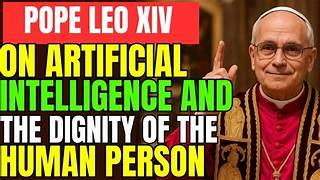
Leo approaches things differently. In his encyclical on artificial intelligence, Magnifica Humanitas, he asks what happens to the people whose work makes the new technology possible and whose livelihoods it may destroy. He calls for worker protections, participation and rules governing the changes. Investors don’t get to decide everything simply because they own the machinery.

That sounds like a reasonable application of Matthew 25. Before celebrating another technological fortune, ask who did the work and who will pay the price. Before praising the harvest, find out what happened to the people who planted it.

House Speaker Mike Johnson has found another way around the chapter’s demands. Asked about Leo’s appeal to Matthew 25 on behalf of immigrants, Johnson said the obligation to welcome strangers applies to individuals rather than civil authorities. Apparently, Jesus can tell us how to treat the immigrant next door, but he has nothing to say about what we authorize our government to do to that same person that he specifically identifies with. We shouldn’t mistreat Jesus, but governments can.

How convenient. We can offer a family groceries with one hand and support policies that tear it apart with the other. We can call the first act Christian charity and the second responsible government. Somehow, Jesus is supposed to approve of both.

But Matthew’s judgment scene begins by gathering “all the nations” before the Son of Man. That doesn’t give us a detailed immigration bill. It does make it hard to imagine that governments have been excused from treating people humanely. Where does Jesus say that kindness stops being obligatory when we enter public office?

And where does the Times get the idea that this is the chapter’s softer part? Jesus identifies himself with people we would rather ignore and makes our treatment of them the measure of our lives. Religious credentials don’t get us off the hook. Neither do patriotic speeches or claims that we were simply enforcing the law.

The new Matthew 25 Democrats should take that seriously too. I’m glad they’re talking about Jesus. But the test will come when feeding the hungry requires confronting the people who profit from keeping wages low. It will come when providing health care means challenging those making fortunes from sickness. It will come when their wealthy donors discover that these Christians mean what they say.

That’s when they’ll need the courage of the third servant. He doesn’t give a speech about compassion while continuing to enrich his boss. He refuses to cooperate. He tells the truth and accepts the cost.

The master calls that failure and throws him into the darkness. The wider gospel gives us reason to question the master’s verdict. Jesus himself was rejected by the powerful. And he promised God’s kingdom to people the powerful had pushed aside.

So yes, let’s welcome the return of Matthew 25 to our political conversation. But let’s hear the whole challenge. Feed hungry people, welcome strangers and care for the sick. Then ask why so many of our neighbors need rescuing in the first place—and why the people who benefit from their suffering keep getting richer.

Jesus wasn’t blessing the billionaires. It’s time his would-be followers stopped doing it for him.

Wisdom Is A Woman: Patriarchal Billionaires Like Peter Thiel Aren’t Listening.

Readings for 32nd Sunday in Ordinary Time: Wisdom 6:12-16; Psalm 63:2, 3-4, 5-6, 7-8; 1 Thessalonians 4:13-18; Matthew 25:1-13

Last Tuesday’s resounding Democratic victory over Trumpism has given us reason to hope. It suggests that Americans can recognize the connection between their daily struggles and a government that serves the wealthy while encouraging everyone else to blame immigrants, racial minorities, and one another. People struggling to pay for groceries, housing, and medical care have begun directing their anger upward. For those accustomed to ruling through division, that is dangerous.

The election hardly means that Democrats have become champions of liberation. Far from it! Too many remain beholden to the same donors, military interests, and corporate priorities as their Republican counterparts. However, voters have opened a door. The question now is whether those elected will walk through it —or once again squander this opportunity by prioritizing the interests of their wealthy sponsors.

Biblical Wisdom

That is where this Sunday’s readings enter the picture. Their theme is wisdom: the ability to recognize what is happening, receive instruction from unexpected sources, and make provision for the work ahead. And the first thing they tell us is that Wisdom is a woman. In a world whose most powerful men seem increasingly certain that their wealth entitles them to govern the rest of us, that deserves our attention.

Consider Peter Thiel. According to Christopher Hale’s account of a secretly recorded October 19 lecture, the billionaire concluded his Nashville series on the Antichrist by calling the city “arguably the global capital of Protestantism.” He urged his listeners to involve themselves in finance, technology, politics, and the battle of ideas. His final instruction was blunt: “get over your inferiority complex and fight.”

Fight whom? Read alongside Thiel’s attacks on Pope Leo XIV and his advocacy of safeguards for artificial intelligence, the appeal suggests a struggle over Christianity itself. Nashville’s Protestant constituency becomes a potential counterweight to Rome’s insistence that technological power must answer to human dignity. A billionaire whose interests are affected by public oversight is recruiting believers for a battle over the moral legitimacy of that oversight.

Theology Centralized

I never expected theology to become quite so openly relevant to our political struggles. Yet Thiel seems to understand something many Christians have forgotten: what we believe about God affects what we permit powerful people to do. A Christianity centered on private salvation can leave economic arrangements largely undisturbed. A Christianity that takes seriously Jesus’ good news to the poor eventually asks who owns everything, who makes the decisions, and who pays for the mistakes.

That second Christianity is troublesome for billionaires. It refuses to assume that the ability to develop a technology confers the right to impose its consequences on everyone else. It asks workers about displacement, parents about their children, and communities about surveillance and computerized warfare. From a liberation theology perspective, Leo’s demand for accountability belongs here. Those exposed to technological power deserve a voice in governing it.

Feminine Wisdom

Now listen to the alternative offered in today’s first reading. Wisdom comes looking for us. She waits at the gate, travels the roads, and meets those willing to receive her. She does not require an invitation to a closed-door lecture or admission to an exclusive circle. But she does require something that great wealth can make difficult: the willingness to be taught.

Her femininity matters. For centuries, churches have overwhelmingly pictured divine authority as male while restricting women’s authority to interpret it. Yet here Scripture places a woman before us as the embodiment of the understanding we need. She is active, searching, and persistent. Our task is to become receptive to her. That means surrendering the assumption that we already know because we hold the office, possess the money, or occupy the pulpit.

Liberation theology makes this receptivity concrete. It begins by listening to people whose experience prevailing arrangements teach us to dismiss. Ask a mother facing eviction whether the economy is working. Ask an immigrant harvesting our food what freedom means. Ask a Palestinian parent what our politicians mean by security. Ask a survivor of sexual exploitation how institutions protect their reputations while leaving children unprotected.

The poor and oppressed do not know everything. They do know things that their employers, landlords, generals, and benefactors can afford to ignore. That is the basis of their hermeneutical privilege—their particular ability to help us understand what is happening. The view from beneath the system exposes features that remain invisible from the boardroom. Wisdom requires allowing that testimony to change our minds and our policies.

Americans Not Hopelessly Divided

This is also why I question the endless insistence that Americans are hopelessly divided. Our disagreements are real, sometimes bitter. Nevertheless, most of us need the same basic things: affordable homes, adequate food, medical care, meaningful work, and a future for our children. There is also ground for solidarity in opposition to war, the destruction of Palestinians, sexual exploitation, and corruption. An election cannot prove agreement on all those questions. It can reveal an opening for bringing people together around them.

Divide-and-conquer politics works by concealing those possibilities. The immigrant becomes the explanation for low wages. The poor family becomes the explanation for public debt. Meanwhile, fortunes accumulate, weapons contracts multiply, and the people making the decisions present themselves as our protectors. Wisdom asks us to examine that diversion. Who benefits when the underpaid worker blames another underpaid worker?

The Epstein scandal gives this question a particularly ugly form. What I call the “Epstein Establishment” is the culture of access, deference, and protection surrounding people whose influence makes others reluctant to ask obvious questions. Association alone does not establish criminal guilt. But neither money nor political usefulness should shield anyone from investigation. Survivors deserve protection, the public deserves lawful disclosure, and credible evidence must be followed wherever it leads. The demand applies as firmly to church leaders as to financiers and presidents.

Here, too, wisdom is receptive. She listens to people whom institutions have trained themselves to disbelieve. She asks why a child’s account encounters so many obstacles while an influential man’s denial travels so easily. A church that preaches the social gospel must submit itself to that same scrutiny. Otherwise, its denunciations of worldly power become another exercise in protecting its own.

But today’s Gospel warns that recognizing injustice and welcoming an electoral victory are insufficient. Ten young women await a bridegroom. Five bring enough oil for a prolonged delay; five do not. All ten fall asleep. The wise women are as tired as the foolish ones. What distinguishes them is that they have made provision for a night longer than they expected.

That detail seems especially appropriate after Tuesday. Defeating Trumpism at the polls does not dismantle the interests that sustained it. They still possess money, institutions, media access, and the patience to wait for public enthusiasm to fade. Thiel’s appeal to fight should remind us that those interests are organizing. They intend to shape what comes next.

Our lamps need oil for that long night: organized communities, political education, independent sources of information, and habits of holding our own representatives accountable. We need people prepared to insist on affordable housing after the victory speeches end, to oppose war when their party supports it, and to defend immigrants when doing so becomes inconvenient. Those capacities develop through practice. They cannot be borrowed at midnight.

The psalm brings us back to thirst. Our souls thirst for God like dry earth thirsting for water. That image keeps spirituality close to the body and the land. People need actual water, actual bread, actual shelter. A religious language that turns those needs into mere metaphors allows us to feel spiritually nourished while our neighbors go hungry. The God for whom we thirst meets us in their demand to live.

Finally, Paul speaks to people grieving their dead. He assures them that those who have died will not be forgotten or left behind. For anyone struggling for liberation, that hope matters. The dead of war, exploitation, and preventable poverty are more than yesterday’s statistics. Their lives continue to make a claim on us. No election can bring them back, but the world we build can honor them or repeat the arrangements that killed them.

Conclusion

So let us welcome Tuesday’s victory and insist on what it makes possible. Let us listen before the consultants explain away the voters’ anger and the donors narrow the agenda. Wisdom is already at the gate. She may arrive as a woman whose testimony powerful men would rather dismiss, a worker they would rather replace, or a grieving parent they would rather keep off television. We will show that we have received her when their experience begins to govern our decisions. Until then, billionaires like Thiel will keep their hands on the switches—and call the arrangement Christian.

What Is Democracy For? China’s Whole-Process Democracy and the Common Good

My recent OpEdNews article, “China’s Example and the Need to Rethink Democracy Itself,” prompted an interesting response from editor-in-chief Rob Kall. He agreed that America’s inability to think beyond the next election is becoming one of our greatest national weaknesses. But he asked me to explain more fully what the Chinese call “whole-process people’s democracy.” How does it actually work? Is it merely another name for one-party rule, or does it embody a fundamentally different understanding of democracy?

Those questions deserve a careful answer because most Americans—including many progressives—know surprisingly little about China’s own explanation of its political system. We generally define democracy almost entirely by its procedures. If citizens vote, if competing parties contest elections, if freedom of speech is protected, and if power changes hands peacefully, we call a nation democratic. If those conditions are absent or limited, we usually do not.

Chinese political theory begins somewhere else.

Its proponents argue that democracy should be judged not only by how governments are chosen but also by what governments accomplish for ordinary people. The legitimacy of government lies not simply in electoral competition but in reducing poverty, expanding education, building infrastructure, protecting public health, caring for the environment, and planning for future generations. In that sense, China’s theory of “whole-process people’s democracy” is consequentialist. It asks citizens to judge government by its results.

Whether one ultimately accepts that understanding or not, it raises a larger question that reaches far beyond China.

What is democracy for?

As I reflected on Rob Kall’s question, I found myself thinking not only about Chinese political theory but also about Jesus, liberation theology, Catholic social teaching from Leo XIII to Pope Leo XIV, and even the Marxist ecological economist John Bellamy Foster. Strange as it may seem, these very different traditions converge around a remarkably similar principle. Political institutions should ultimately be judged by what they produce for human beings, especially for those who are most vulnerable.

Jesus expressed the principle with characteristic simplicity. “By their fruits you shall know them.” That sentence may be the clearest statement of consequentialist ethics ever uttered.

Jesus repeatedly judged persons and institutions by their consequences rather than by their claims. Good trees produce good fruit; bad trees produce bad fruit. In the parable of the Last Judgment, nations are evaluated not by their constitutions or political procedures but by whether they fed the hungry, welcomed the stranger, clothed the naked, visited prisoners, and cared for the sick. The decisive question is always: What happens to “the least of these” (Matthew 25: 31-46)?

Liberation theology extends precisely that biblical insight into politics and economics. Gustavo Gutiérrez famously defined theology as “critical reflection on praxis.” Orthodoxy must be tested by orthopraxis. Correct ideas alone are insufficient. A society is judged by the lives its institutions make possible, especially for the poor.

Enrique Dussel sharpened the point by distinguishing between what he called formal and material democracy. Formal democracy concerns procedures: elections, constitutions, legislatures, political parties, and legal rights. These are indispensable achievements. But they are not enough. Material democracy asks whether those institutions actually reproduce and enhance human life. Do they enable communities to flourish? Do they defend the excluded? Do they protect future generations? If they do not, procedural legitimacy alone cannot redeem them.

That distinction helps explain what Chinese theorists mean by “whole-process democracy.”

According to its proponents, democracy is not exhausted by election day. Citizens directly elect representatives at the village level, while higher-level people’s congresses are chosen through successive representative levels. Consultation continues throughout the policy process through congresses, advisory bodies, professional organizations, universities, business associations, workers’ organizations, and representatives of China’s many ethnic communities. Chinese scholars argue that democracy therefore consists not only of elections but of consultation, planning, implementation, evaluation, and revision.

Western observers frequently challenge aspects of this account, raising important questions about political pluralism, freedom of expression, and civil liberties. Those questions deserve serious discussion. Yet the Chinese model also asks a question Americans too seldom ask ourselves: What has our own democracy actually accomplished?

For decades Americans have watched infrastructure age, political polarization deepen, homelessness increase, life expectancy stagnate compared with many peer nations, and public confidence in institutions decline. Elections continue on schedule. Campaigns become ever more expensive. Every election is described as the most important in our lifetime. Yet many structural problems remain stubbornly unresolved.

One reason, I believe, lies in the nature of our political system itself.

The permanent competition between Democrats and Republicans makes sustained national planning extraordinarily difficult. Policies begun by one administration are often dismantled by the next—not necessarily because they have failed but because they belong to political opponents. The electoral calendar becomes stronger than the planning calendar.

China’s political system has evolved differently. Its supporters point to Five-Year Plans embedded within much longer strategic visions extending over decades. Whatever one thinks of particular policies, this institutional continuity makes it easier to pursue infrastructure projects, industrial strategies, poverty reduction, and technological development that require sustained public commitment.

Its advocates also note that senior leaders typically accumulate extensive administrative experience before reaching national office, usually serving at county, municipal, and provincial levels over many years. The underlying ideal is that governing capacity should be demonstrated before greater authority is entrusted.

Perhaps the greatest difference between the two systems concerns the relationship between political power and economic power.

Supporters of China’s system argue that the Communist Party’s historic responsibility is to ensure that concentrated private wealth does not capture the state. Whether contemporary China consistently fulfills that aspiration is a matter of legitimate debate. Yet the aspiration itself points toward an issue Americans can scarcely avoid.

Who governs our republic?

Increasingly, I fear it is what I have elsewhere called the “Epstein class.” By that phrase I do not mean wealthy people as such. Wealth honestly earned has enriched every civilization. I mean something more dangerous: an oligarchic class capable of converting immense private wealth into political influence, legal privilege, media power, and practical immunity from accountability. Jeffrey Epstein became, in my view, not the cause of this phenomenon but its most recognizable symbol.

Seen from this perspective, the defining political question of the twenty-first century is not capitalism versus socialism. Every major economy employs markets. The deeper question is whether markets govern society or whether society governs markets.

Here an unexpected convergence appears.

Beginning with Leo XIII’s Rerum Novarum, Catholic social teaching has consistently rejected both collectivist absolutism and laissez-faire capitalism. It has defended private property while insisting that ownership always carries social obligations. Markets are valuable instruments. They are not sovereign moral authorities. Economic life exists to serve the common good.

Pope Leo XIV develops that same tradition in Magnifica Humanitas. Reflecting on artificial intelligence, technological power, and global finance, he insists that technology, markets, and capital must remain subordinate to human dignity, ecological responsibility, and the integral flourishing of humanity. They are servants, never masters.

Remarkably, John Bellamy Foster reaches a strikingly similar conclusion from an entirely different intellectual tradition. He warns against what he calls the “fetishism” of artificial intelligence and of the market itself—the tendency to treat technological and economic forces as though they were beyond democratic control. Democratic societies, he argues, should consciously direct economic development toward ecological sustainability and human well-being rather than allowing markets alone to determine humanity’s future.

Franz Hinkelammert anticipated both arguments decades ago. He warned that modern capitalism easily transforms the market into an idol demanding endless sacrifice. Workers become expendable. Communities become disposable. Nature becomes merely another commodity. Against this idolatry, Hinkelammert proposed what he called “the criterion of life.” Every institution, every economy, every political system must finally answer one question:

Does it serve life?

Conclusion

Rob Kall asked me to explain China’s understanding of democracy.

In the end, I found myself confronting a much larger question, Viz., What is government for?

If its highest purpose is merely to organize elections, then the American model has much to teach the world. But if the purpose of government is to secure the common good, protect the vulnerable, subordinate economic power to democratic authority, preserve the earth for future generations, and enable human beings to flourish, then elections are not the end of democracy. They are only one of its instruments.

That is the challenge posed by China’s theory of whole-process democracy. Whether or not one ultimately accepts its answer, it forces us to ask whether democracy should be judged only by its procedures or also by its consequences.

Jesus had no hesitation about the answer.

He never said, “By their constitutions you shall know them.”

He never said, “By their elections you shall know them.”

He said, “By their fruits you shall know them.”

Perhaps that is the question the twenty-first century can no longer avoid. Not simply which nation is more democratic, but which political institutions consistently bear the fruits of justice, peace, sustainability, human dignity, and the common good.

Until we are willing to judge every political and economic system—including our own—by that standard, democracy will remain little more than a procedure. It will never become what it was always meant to be: a way of organizing society so that life, especially the lives of “the least of these,” may flourish.