What Does Prayer Mean in An Age of Empire? The Dangerous Simplicity of Pope Leo’s “Nonviolence”

Suddenly, everyone is talking about prayer and theology.

That comes as a surprise to many who, since Harvey Cox’s The Secular City, have assumed that secularization had effectively removed God from serious political consideration. Yet recent controversies have forced the issue back into public view.

The debate surrounding Pete Hegseth’s prayer about U.S. policy in Iran –so reminiscent of Mark Twain’s haunting “War Prayer” has reopened questions many thought settled.

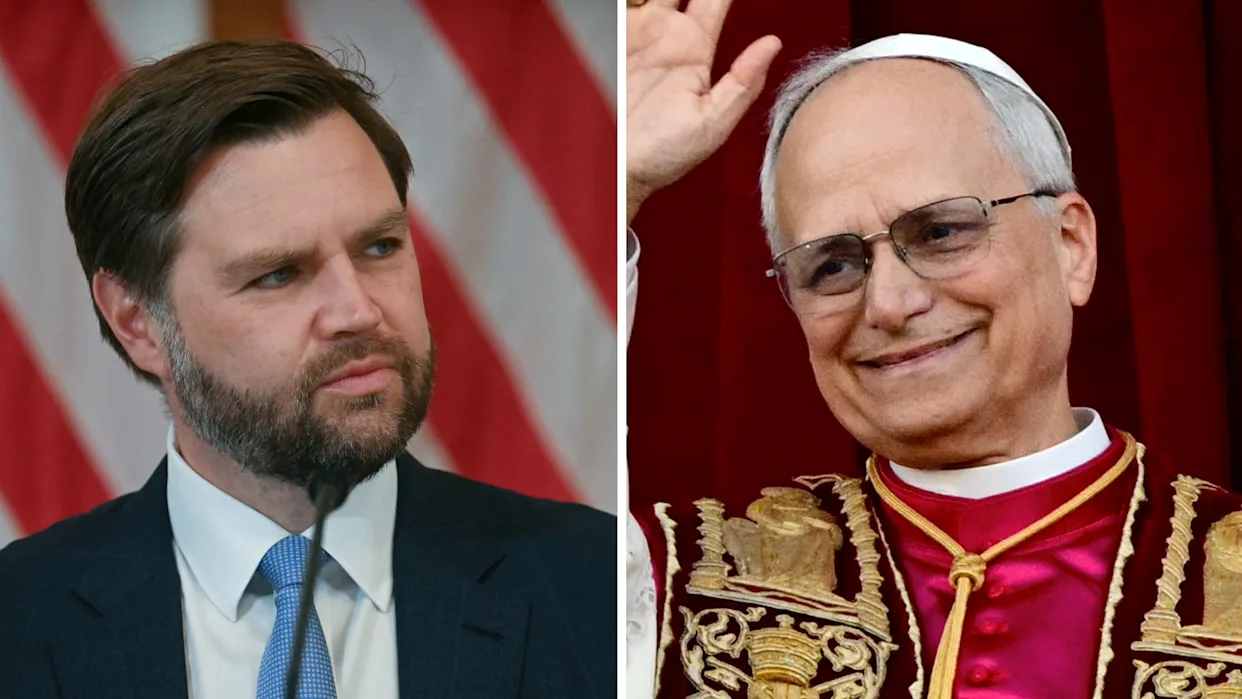
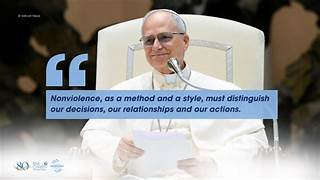
It has even produced the strange spectacle of Donald Trump adopting quasi-messianic language, while J.D. Vance publicly disputes Pope Leo XIV about whose prayers God hears and whose God ignores.

I have addressed those developments elsewhere. Here I want to press further into the deeper issue: What is prayer? What are its political implications? And what does the Bible itself reveal about the competing claims made in God’s name, especially about nonviolence?

What Does Prayer Mean?

To begin with, what exactly is being invoked when Hegseth appeals to the Psalms and asks God to “break the teeth” of enemies, to leave women widowed and children orphaned?

And what does the pope mean when he insists that Jesus rejects such petitions outright and stands unequivocally for nonviolence?

In both cases, the underlying assumption seems the same: a supernatural being “out there,” watching events unfold and selectively intervening on behalf of one side or another.

But can such imagery still be taken seriously?

We live in the age of the James Webb Space Telescope, which reveals a universe so vast that our planet becomes nearly invisible within it. We also live in the age of quantum physics, where matter dissolves into energy and probability. In such a world, the idea of a localized deity monitoring human conflicts and deciding which missiles hit their targets strains credulity.

Is God “up there” listening? Is Jesus literally seated at the Father’s right hand, weighing petitions and choosing sides?

Or are such images relics of an earlier worldview that no longer corresponds to what we know about reality?

And Then There’s the Bible

It is true that the Bible itself often reflects that older worldview. Its language presumes a cosmos structured in ways we now recognize as outdated.

Yet that does not render the Bible irrelevant. On the contrary, its enduring significance lies elsewhere.

As scholars such as Pablo Richard have emphasized, the Bible does not present a single, unified picture of God. Instead, it stages an internal conflict– a “struggle of the gods.”

On one side stands the God of Moses: the liberator of slaves, the defender of the poor, the protector of widows, orphans, and immigrants.

On the other side stands the God claimed by kings and elites, beginning with the royal ideology of David and Solomon, a God invoked to justify wealth, hierarchy, domination, and even genocide.

The prophets– Amos, Isaiah, Jeremiah– consistently take the side of the former against the latter.

Jesus clearly stands in that prophetic tradition: a marginal figure, an artisan, an outsider, a victim of imperial violence. His execution by crucifixion– Rome’s punishment for political dissidents– makes unmistakable where he stood.

In this sense, while the Bible does not address modern cosmology, it does address a far more urgent question: Whose side is Ultimate Reality on? Does Dr. King’s long arc of history really bend towards justice for the poor and marginalized?

The Bible refuses to let that question be answered cheaply.

Was Jesus Unequivocally “Nonviolent?”

This brings us to the claim that Jesus was simply “nonviolent.”

Stated without qualification, that claim risks obscuring more than it reveals. It can even function as a form of moral disorientation– especially for those subjected to systemic oppression.

“Violence” is not a single, simple category. It has at least four distinct forms.

First, there is structural violence: embedded in laws, institutions, and social arrangements that quietly destroy lives. Slavery, segregation, economic deprivation, denial of healthcare, and wars of aggression all belong here.

Second, there is defensive violence: the response of those who resist such conditions. When oppressed peoples fight back, their actions are immediately visible and condemned by the powers that be– yet they are widely recognized as legitimate, even under international law.

Third, there is repressive violence: the state’s attempt to crush resistance and restore the original injustice, often under the banner of “law and order.”

And finally, there is terroristic violence: the deliberate use of fear and destruction to achieve political ends– a practice historically employed most devastatingly and frequently by states, even as they label resisters “terrorists.”

In this light, to describe Jesus simply as “nonviolent” is not only inadequate; it risks distorting the reality of both his life and his context. The Roman authorities who executed him certainly did not regard him as harmless.

Conclusion

We are left, then, with the question that has been with us from the beginning: What does prayer mean in the world just described?

Whatever it means, it cannot be what figures like Hegseth, Trump, or even the pope seem to assume. Prayer is not a way of persuading a distant deity to intervene on behalf of our causes, bless our wars, or guarantee our victories.

Nor can the question of God’s allegiance be resolved by lifting isolated biblical texts or by invoking abstract slogans like “nonviolence,” as though such words settled anything at all.

The Bible itself will not allow that kind of evasion. It presents instead a conflict– deep, unresolved, and unavoidable– between competing visions of God, of humanity, and of justice. It exposes how easily “God” becomes the sacred cover for power.

But our problem runs even deeper. In the light of the James Webb Space Telescope and of quantum physics, the very notion of God must be rethought. The old image of a supreme off-planet being ” watching, judging, intervening, is no longer credible.

What we have called “God” must instead be understood as the creative energy of the universe– indeed, of a universe of universes– the living source in which everything participates, including the mysterious energy of consciousness itself. This is not an object among others, but the depth of reality, the Thou we may still address, not because it sits above us, but because it lives within and among us.

In biblical language, it is the Creator. In Paul’s words, it is “the one in whom we live and move and have our being.” Such a reality cannot be captured by any nation, claimed by any empire, or enlisted in any war. It recognizes no borders, no chosen peoples in the exclusionary sense, no privileged civilizations. The earth belongs to all. Its gifts are not the possession of a few, but the common inheritance of everyone– each of us entitled to no more than our one-eight-billionth share.

Seen in this light, prayer changes meaning entirely.

It is no longer a request for favors from above. It is an act of alignment with the deepest currents of reality itself. It is a way of opening ourselves to the creative, life-giving energy that stands against domination, exclusion, and death.

And so the issue returns to us, stripped of illusion.

When we pray, we are not stepping outside history. We are locating ourselves within it. We are aligning ourselves– consciously or not– with one side of an ongoing struggle between the forces that sustain life and those that diminish it.

This is not theology as speculation. It is theology as decision.

To pray is to choose.

And the choice we make– however piously we disguise it– places us either with the flourishing of the whole or with the systems that deny it.

So the question remains, now more demanding than ever:

When you pray, are you aligning yourself with the life of the whole– or with the powers that divide and destroy it?

Locked Doors: Faith After Iran, After Epstein

Readings for Second Sunday of Easter: Acts 2: 42-47; Psalm 118: 2-4, 13-15, 22-24; 1 Peter 1: 3-9; John 20: 19-31

What if life can be no different from what our senses relentlessly report? Turn on the news. Cities in Iran and beyond reduced to rubble. Children buried beneath concrete. Leaders speaking of “security” while entire populations live in fear.

And at the same time, the slow, unsettling revelations surrounding the Epstein files continue to expose networks of wealth, privilege, and exploitation that reach into the highest levels of our political and economic life. Taken together, such realities make it difficult to sustain even the most basic trust in the goodness of the world or the integrity of those who govern it.

In such a moment, it is not hard to recognize ourselves in doubting Thomas centralized in this morning’s gospel. His voice is not foreign to us. It speaks from deep within: life is tragic, death wins, power protects itself, and truth is buried along with its victims. Yeshua is gone, and anyone who imagines otherwise is clinging to illusion.

More than that, Thomas’s fear feels painfully contemporary. The forces that executed Jesus have not disappeared; they persist in new forms. They still silence, still threaten, still destroy. One can almost see him glancing toward the door: Are you sure it’s locked?

Today’s Gospel reading does not dismiss that voice or treat it with contempt. It takes Thomas seriously precisely because his doubt is grounded in what appears self-evident. Dead bodies do not return. Empires crush resistance. Those who challenge entrenched power rarely prevail. In that sense, Thomas is simply being realistic. And yet, in the midst of that closed and fearful space, something happens that exceeds every expectation.

Yeshua appears again among his fearful friends. Not as a denial of crucifixion, but bearing its marks. The wounds remain visible. Violence is neither erased nor explained away; it is exposed and, somehow, rendered powerless. He turns to Thomas not with reproach, but with warmth. “Look at my hands,” he says in effect. “It’s really me.” Thomas’s response is immediate and unguarded: “My Lord and my God.”

But what is striking is not Thomas’s confession so much as Yeshua’s response to it.

There is no rebuke. No shaming. Instead, one can almost hear an acknowledgment born of shared experience. You are only human, he seems to say, and I know what that means. On the cross, my own senses told me that I had been abandoned. I too felt the darkness closing in. I too knew what it was to stand at the edge of despair. Faith, in that moment, was anything but easy.

That recognition changes everything. It tells us that faith is not the absence of doubt, nor the refusal to see what is plainly before us. It is what emerges in spite of misgivings. And from there, the Gospel moves to its most challenging point.

What truly astonishes, what truly delights, is not simply that Thomas eventually believes, but that there are those who commit themselves to God’s future without the reassurance of seeing. Those who trust life’s ultimate goodness when the evidence points in the opposite direction.

Imagine that kind of trust in a world such as ours. Imagine holding fast to the conviction that another future is possible, a future with room for everyone, when war and exploitation seem to define the present. That is the faith Yeshua blesses. It is not credulity; it is courage.

At this point, the first reading from Acts takes on a new and unsettling clarity. The description of the early Christian community is not a sentimental aside. It is a direct social and economic alternative to the world Thomas fears and we recognize all too well. They held everything in common. No one claimed private ownership. There was not a needy person among them. In other words, they organized their life together around the conviction that God’s future had already begun to take shape in their midst.

Set that alongside what we see in our own time. A world where wealth is concentrated, where the vulnerable are exploited, where violence protects privilege, and where even the exposure of wrongdoing seems unable to bring about accountability. Against that backdrop, the Acts community stands as a quiet but radical contradiction. It embodies a different logic, one rooted not in fear or accumulation, but in shared life and mutual care.

This is what resurrection faith looks like when it takes flesh in history. Not an escape from the world’s suffering, but a refusal to let that suffering have the final word. Not a denial of death, but a commitment to life that persists even in death’s shadow. The doors may still be locked; the threats are real enough. But within those very conditions, another way of living becomes possible.

That is the invitation extended to Thomas, and to us. Not simply to believe a proposition about life after death, but to participate in a way of life that anticipates and embodies God’s promised future. A way of life that insists there can, and must, be a world where no one is left in need.

Working for that world, for fullness of life for everyone even when the evidence seems to deny its possibility, that is what faith finally means. May it be ours.

Easter Against the Empire of Death: Did Jesus Rise — Or Did His Movement?

Readings for Easter Sunday:ACTS 10:34A, 37-43; PS 118: 1-2, 16=17, 22-23; COL 3:1-4; JN 20: 1-4.

Did Jesus really rise from the dead? Or is belief in a bodily resurrection no more credible than belief in the Easter Bunny or Santa Claus?

That question, provocative as it sounds, is not new. It has been quietly — and sometimes not so quietly — asked by serious biblical scholars for more than a century. And today, voices within liberation theology and critical biblical scholarship are giving us fresh ways to approach it without abandoning faith, but by deepening it.

Everything depends, as always, on what we mean by “really.”

Let’s begin where the earliest Christians themselves began — not with doctrine, but with experience.

After Jesus’ execution, his followers were shattered. Their movement appeared finished. Rome had done what Rome always does: it crushed yet another threat to imperial order. The disciples scattered, returned to their former lives, and tried to make sense of their failure. Then something happened — something unexpected, transformative, and difficult to describe.

Women in the community reported experiences of Jesus as alive.

That detail is crucial. Scholars from across the spectrum — including liberation theologians like Gustavo Gutiérrez and feminist exegetes such as Elsa Tamez — emphasize that the prominence of women as first witnesses is historically significant. In a culture where women’s testimony was legally discounted, inventing such a story would have been counterproductive. The tradition preserves it precisely because something happened that could not be denied — even if it could not be neatly explained.

But what happened?

The earliest written testimony we have comes not from the gospels, but from Paul — writing around the year 50. And Paul is strikingly clear: his experience of the risen Jesus was visionary. He saw a light, heard a voice, and interpreted that encounter as equivalent to those of earlier disciples. “Last of all,” he writes, “he appeared also to me.”

Paul never met the historical Jesus. Yet he claims equal authority because his experience was of the same kind. That fact alone has led many contemporary scholars — including figures like John Dominic Crossan — to suggest that resurrection “appearances” were not encounters with a resuscitated corpse, but powerful visionary or communal experiences of presence.

When we turn to the earliest gospel, Gospel of Mark, the pattern deepens. There are no appearances of the risen Jesus at all. The tomb is empty; a young man announces that Jesus “has been raised”; the women flee in fear and say nothing to anyone. That’s where the original gospel ends.

No appearances. No triumphal conclusion. Just silence and trembling.

Later gospels — Gospel of Matthew, Gospel of Luke, and Gospel of John — add increasingly detailed stories. But even there, something curious persists. Jesus is consistently difficult to recognize. Mary mistakes him for a gardener. Disciples walk with him for miles without knowing who he is. Others see him — and doubt.

This is not what one would expect if the point were to describe a straightforward resuscitation.

Instead, the texts seem to be grappling with an experience that exceeded ordinary categories. As N. T. Wright himself — no skeptic about resurrection — admits, the gospel accounts point to something that is neither simple physicality nor mere metaphor. The language strains to express a transformed mode of presence.

Liberation theologians push this further.

For thinkers like Jon Sobrino, resurrection is not about the revivification of a corpse, but about God’s vindication of a life committed to the poor and executed by empire. In that sense, Easter is God’s “No” to crucifixion systems — and God’s “Yes” to the victims of history.

That insight changes everything.

It means resurrection is not primarily a claim about what happened to Jesus’ body. It is a claim about what happens to history when the victims of injustice are remembered, honored, and made present again in communities of resistance.

In that light, the resurrection stories begin to make new sense.

Jesus is encountered “in the breaking of the bread.” He is present where two or three gather in his name. He is identified with “the least of these.” These are not secondary theological ideas — they are the very substance of resurrection faith.

The community discovers that Jesus is still with them — not as a corpse returned to life, but as a living presence wherever justice, sharing, and compassion take flesh.

This is why the early Christian communities described in Acts held all things in common. They were not simply remembering Jesus; they were embodying him. Resurrection was not an abstract belief. It was a new way of living — a new social reality.

A different world had opened up.

And that world stood in sharp contrast to the dominant one — the world governed by empire, market logic, and systems of exclusion. As my friend and mentor Franz Hinkelammert would later put it, the struggle is always between a system that sacrifices human beings and a vision of “a world where everyone fits.”

Easter belongs to that second world.

So does belief in resurrection require us to imagine a corpse walking out of a tomb?

Not necessarily.

What it requires is something far more demanding: the recognition that the powers of death — political, economic, and cultural — do not have the final word. It asks us to believe that life can emerge from defeat, that community can arise from despair, and that the executed ones of history are not forgotten.

It asks us to live as if that were true.

In our own time — with images from Gaza, from war zones, from systems that bury the poor under literal and metaphorical rubble — the question of resurrection becomes painfully concrete. Are those lives simply extinguished? Or do they continue to cry out, to summon us, to demand a different world?

Easter answers that question.

It says that the crucified are not gone. They are present. They are calling. They are — in a very real sense — risen.

And so the real question is not whether Jesus rose from the dead.

The real question is whether we are willing to enter the world that his followers discovered — a world beyond domination, beyond fear, beyond the logic of death itself.

A world where, against all odds, life has the last word.

That is Easter.

And that, whatever else one believes, is anything but childish.

When Leaders Become School Shooters

I’m sure you noticed that on the very first day of the current U.S. war with Iran, American missiles struck a school compound. In that single horrendous attack 165 people (most of them little girls between the ages of 7 and 12) were slaughtered. Their classrooms became rubble. Their playground became a graveyard.

There’s no “fog of war” here. This was a first strike presumably meticulously planned before hostilities began. Put plainly: Trump’s and Netanyahu’s first targets in their completely illegal and immoral war were school children – little girls.

A War of Aggression

Even before considering the victims, let’s underline the war’s undeniable illegality. It was completely unprovoked. That makes it a war of aggression. In international law, initiating such a conflict is considered the gravest of crimes. The judges at the Nuremberg Trials famously declared that to launch a war of aggression “is not only an international crime; it is the supreme international crime, because it contains within itself the accumulated evil of the whole.” That principle was meant to ensure that powerful states would never again unleash violence against another country simply because they could.

Yet here we are.

Targeting Civilians

As I said, the opening strike on that Iranian school could hardly have been accidental. Moreover, it followed a pattern already well-established by Israel’s war in Gaza under Prime Minister Benjamin Netanyahu. Again and again, the world has seen images of bombed schools—places that had become shelters for displaced civilians, classrooms for children, or simply the last fragile spaces where families tried to survive. Critics have begun to describe this tactic grimly: the “Gaza-ing” of cities—systematic bombing of densely populated areas where civilians inevitably live.

Now that same logic appears in Tehran.

In this context, be reminded that dense urban neighborhoods are not empty landscapes. They contain apartment buildings, schools, hospitals, and nursing homes. They house women, children, the elderly, and the disabled — people who cannot easily flee when bombs begin to fall. When such areas are targeted, civilian casualties are not accidents. They are predictable consequences. They are intentional.

An Epstein War

And here the moral horror becomes even sharper. That fact that most of the victims of that first strike in Teheran were girls between the ages of seven and twelve, connects it unmistakably with Jeffrey Epstein scandal from which the Iran War seems anxious to distract us. (Some are even calling it “The Epstein War.”)

Once again, young girls are the victims. Once again, power stands on one side and vulnerability on the other.

No one is claiming that the dynamics of sexual exploitation and the Trump and Netanyahu school shootings are identical. But the pattern is deeply unsettling. Powerful men act with near-complete impunity; little girls suffer the consequences. When this happens repeatedly—whether in elite abuse scandals or in the conduct of war—it raises questions that go far beyond ordinary sexism. It points toward a culture in which the suffering of the most defenseless becomes politically invisible.

“Leaders” As School Shooters

Meanwhile, Americans continue to express horror at school shootings at home. The 2007 massacre at Virginia Tech where 32 people were killed shocked the nation and remains the deadliest school shooting in U.S. history. Americans rightly consider such crimes monstrous.

But what should we call it when a government destroys a school killing pupils and teachers with missiles?

I’ll tell you what I call it. It’s a school shooting. And Donald Trump and Benjamin Netanyahu are the most lethal school shooters on earth. The phrase shocks precisely because it strips away the language of strategy and exposes the reality for what it is.

And when national leaders behave this way, they do more than destroy buildings and lives. They set an example. Leadership shapes moral culture. If governments normalize violence against children abroad—bombing schools, flattening neighborhoods, “Gaza-ing” cities —why should we be surprised when violence seeps back into our own societies?

Conclusion

There I’ve said it: the two men just referenced are far worse school shooters than the worst we’ve seen. The moral logic in all cases is nonetheless frighteningly similar. They murder because they can. If we truly believe that children’s lives are sacred, that principle cannot stop at national borders. It reveals the slogan “pro-life” for the grotesque instrument it has become: a banner raised in defense of unborn life at home while bombs fall on little girls sitting in classrooms abroad.

Donald Trump’s Nakedness, His STFU SOTU Speech

Readings for the Second Sunday of Lent: Genesis 12: 1-4a; Psalm 33: 4-5, 18-19, 20,22; 2 Timothy 1: 8b-10; Matthew 17: 1-9

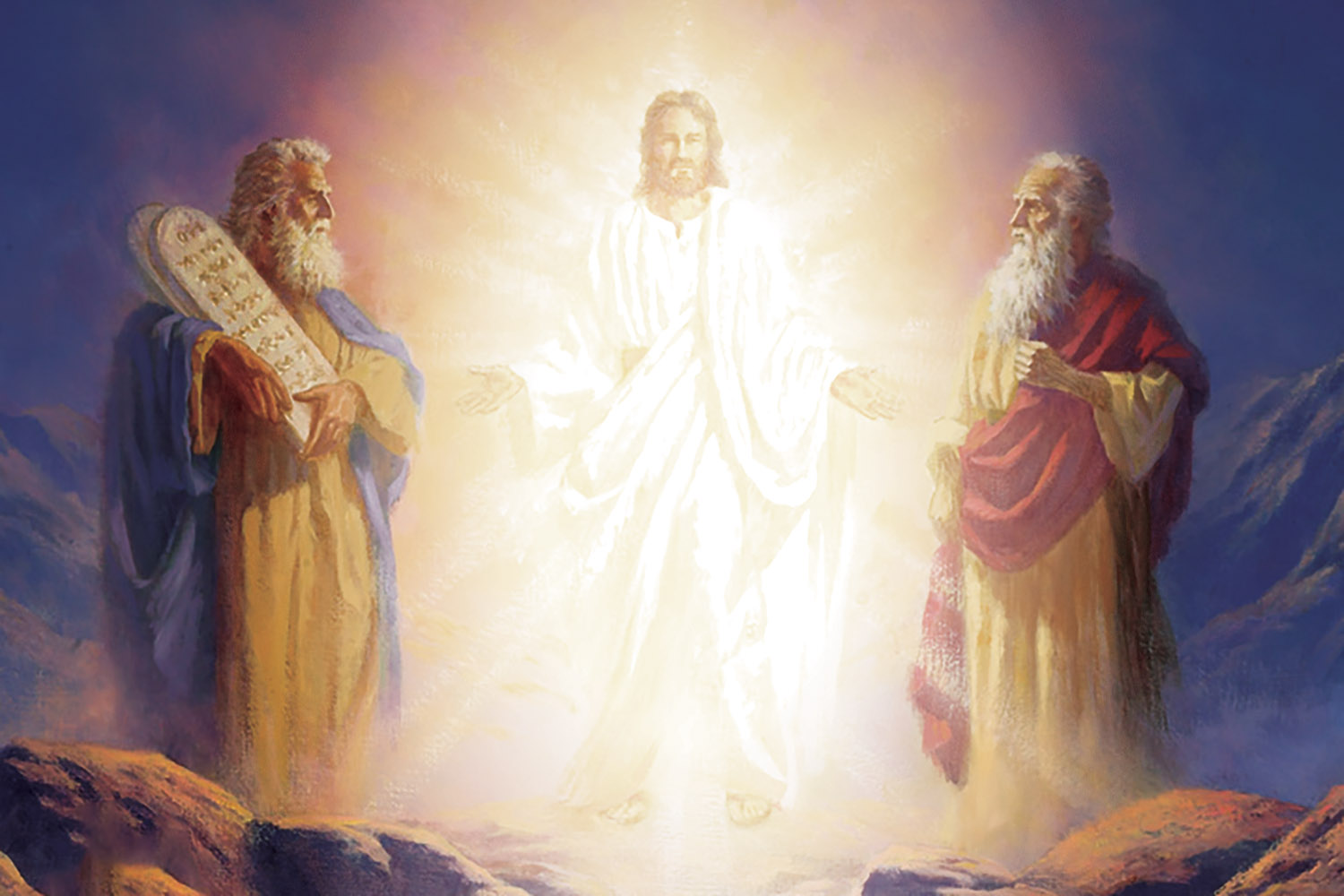
The Gospel reading for this Second Sunday of Lent is about the “transfiguration” of Jesus.

It’s about how the primitive Christian community’s understanding of Jesus and his significance changed following their experience of what they came to call his “resurrection.”

After that experience, whatever it was, they came to see him clearly as the New Moses and the New Elijah. As such he would introduce a New Order that would embody liberation of society’s most marginalized (Moses) and outspoken confrontation against the given imperial order (Elijah).

Jesus himself called that New Order the Kingdom of God.

It is what the world would look like if God were king instead of Caesar.

That vision should take on new meaning for Americans in the aftermath of Donald Trump’s disgraceful State of the Union Message last Tuesday. It should even embolden the profane response STFU.

Trump’s Un-transfigured World

If you watched the speech, you know what I mean.

It seemed like the dying gasp of the ruling Septuagenarian and Octogenarian classes.

It was a flailing, lie-filled proclamation of a Golden Age that never existed and that never will be if we follow the path the failed braggart president celebrated.

It was the opposite of God’s Kingdom – a world with room for everyone.

I mean, Trump’s SOTU celebrated division, wealth and power, and a militarism while targeting the poorest people on our planet. He had the staggering nerve to tone-deafly call them what the Epstein Files are revealing the political class itself to be: lawless rapists, pedophiles, robbers, drug dealers, gang members and murderers. And Trump’s crowd are blackmailers besides.

Making those allegations, the president revealed his own nakedness and that of his mindless Maga colleagues who mindlessly jumped to their feet to applaud the beauty of the Emperor’s non-existent robes.

Yes, the Files, the coverups, the sweetheart deals for Epstein and Maxwell, the redactions, the months-long failures to disclose, and the reduction of Pam Bondi’s Department of Justice to the President’s private law firm are revealing everything.

The Emperor indeed has no clothes. He’s shamelessly parading around stark naked and tiny.

And reminiscent of the Hans Christian Anderson story, it’s the little children he’s imprisoning (with their bunny ears and Spiderman backpacks) who proclaim the emperor’s embarrassing nudity.

No clothes! Naked!  Tiny. Or as Joseph N. Welch put it to Senator Joseph McCarthy “Have you no sense of decency, sir, at long last?”,

Jesus’ Transfigured World

The tale of Jesus’ Transfiguration tells an opposite story.

It’s the story of a poor construction worker – a former immigrant, a prophetic teacher of unconventional wisdom, the death row inmate whom empire jailed, tortured and submitted to imperial capital punishment – whose life and teaching revealed a New Order that was shining and pure because it had room for everyone.

And in today’s reading, it’s his transformed clothes and the spiritual company he keeps that tell the story.

Matthew puts it this way: “His face shone like the sun and his clothes became white as light. And behold, Moses and Elijah appeared to them, conversing with him.”

That is, the one whose imperialized class status would eventually reduce him to nakedness on Mt. Calvary is perceived by his first followers as magnificently clothed.

Even more, Matthew’s account of Jesus’ Transfiguration has him conversing with Moses and Elijah.

Moses, of course, is the great liberator of the enslaved and poor.

Elijah was the courageous prophet who not only spoke truth to power but resisted false gods who take the side of the rich and powerful rather than God’s truly chosen ones, the poor and oppressed.

Don’t Let the Democrats off the Hook

But none of this should let the Democrats off the hook just because some of them refused to attend the STFU SOTU affair. Don’t let them get away with just not being Trump.

It’s time for us to echo Zohran Mamdani, the most popular politician in the country.

In my novella, Against All Odds: How Zohran Mamdani Became President and Changed America Forever, I imagine a moment like this. Not because of special foresight, but because systems built on secrecy, oligarchy, militarism, and spectacle inevitably crack. In that story, hidden ledgers surface. Blackmail networks become visible. The machinery of power is exposed. The old guard responds the only way it knows how — with louder threats, more force, and louder applause.

Sound familiar?

But exposure alone is not liberation.

Which brings us back to the mountain of Transfiguration.

That scene depicted there is not mystical escapism. It is political theology. It declares that the authority of empire is provisional — that the true sovereignty belongs to the God who sides with slaves, captives, resident aliens, and the poor.

Luke makes the program explicit: “He has anointed me to preach good news to the poor… to proclaim liberty to captives… to set at liberty those who are oppressed.”

That’s a rival social order.

And if the imperial system is unraveling before our eyes — if its nakedness is becoming visible — then what must follow is not nostalgia or revenge, but reconstruction.

In Against All Odds, the answer to systemic collapse is not personality cult or partisan fury, but the institution of a Republic of Care. It is clarity. It is the articulation of a simple, material program centered on ordinary people’s lives. Among others, the items in such a program would include:

  • Affordability
  • Universal health care
  • Full employment
  • Higher wages
  • Free education through college
  • Environmental protection
  • Expanded voting rights
  • An end to oligarchic distortions like the Electoral College
  • Strict term limits in every branch of government
  • Drastic reductions in military spending.
  • No endless wars
  • Immigration reform rooted in dignity
  • The dismantling of structures whose primary function is coercion at home and abroad.

In liberationist terms, none of that is utopian dreaming. Mamdani’s election proved that. The reforms just listed are what happen when the needs of the poor become the criteria of policy.

Conclusion

Trump’s embarrassing speech was the voice of Caesar defending a crumbling temple.

The Transfiguration is the unveiling of another possibility altogether.

Empires grow louder when they weaken. They shout about enemies. They celebrate force. They promise greatness. That is what dying systems do.

But the biblical tradition suggests something else: when Pharaoh hardens his heart, liberation accelerates. When Ahab clings to power, Elijah’s voice sharpens. When Rome crucifies, resurrection faith spreads.

Lent invites us to see clearly — to recognize naked empire and to imagine, without apology, a transfigured order grounded in justice for the poor.

Our petite impotent emperor is exposed.

The question now is whether we have the courage to climb the mountain with Peter, James and John to see what comes next.

AI, Environmental Justice, and Who Pays the Bill

I recently wrote an essay suggesting that artificial intelligence might serve as a kind of moral companion in our political and spiritual confusion. Not a burning bush. Not divine revelation. Just a disciplined interlocutor — one that helps clarify arguments, test assumptions, and deepen moral imagination.

I’ve experienced that personally while writing Against All Odds. AI has helped me structure ideas, sharpen analysis, and think more clearly. That led me to wonder: might this technology assist moral discernment in a fractured age?

A former student of mine at Berea College answered with a bracing reality check.

He wasn’t interested in metaphors. He was interested in data centers.

He described attending a town hall meeting after a hyperscale data center opened in a predominantly Black and poor community near him. Residents were worried about air quality, water consumption, constant noise, diesel backup generators, and long-term health effects. Wealthier neighborhoods had blocked similar facilities. This one could not.

His point was simple and unsettling:

How can you call AI morally promising when its infrastructure burdens marginalized communities?

He added that AI consumes far more energy than a standard web search. It requires massive computational power. It uses water for cooling. It relies on an electrical grid still heavily dependent on fossil fuels. And these facilities are rarely built in affluent suburbs.

In short: Who pays for your moral imagination?

That is not a frivolous question. It is a liberation theology question.

And he’s right to ask it.

If we celebrate the benefits of AI without naming its environmental footprint, we risk drifting into technological romanticism. It is easy to praise illumination while ignoring cooling towers and diesel generators.

But here’s where the conversation deepens.

AI did not invent the data center economy. Streaming services, cloud storage, cryptocurrency, social media, Zoom calls, online shopping — all of these already depend on massive server farms. Most of us participate in that system daily.

AI increases demand. It accelerates the curve. But it sits inside a digital infrastructure we were already using without much moral scrutiny.

So the real issue isn’t “AI versus no AI.”

The issue is how the digital economy externalizes its costs onto communities with the least political power.

That’s the environmental justice problem.

And it doesn’t disappear if we stop using chatbots while continuing to stream movies and store photos in the cloud.

The AI system I consulted about my student’s critique did something interesting. It didn’t defend itself. It acknowledged the material burden — and then widened the frame.

The core problem isn’t whether AI can clarify moral thought.

The core problem is governance.

Who regulates data centers?
Who decides where they are built?
Who enforces environmental protections?
Who ensures the transition to renewable energy?
Who protects poor communities from becoming sacrifice zones?

If AI use is not accompanied by advocacy for sustainable energy, fair siting practices, and strong environmental regulation, then my student’s critique stands.

But here’s the tension we cannot ignore.

AI is also uniquely capable of analyzing environmental injustice. It can process zoning data, identify discriminatory siting patterns, correlate health outcomes, expose regulatory capture, and help activists build evidence-based arguments.

The same technology that depends on infrastructure can help scrutinize that infrastructure.

That is not hypocrisy. It is the modern condition.

Every industrial system carries costs. The question is not whether costs exist. The question is whether we are honest about them — and whether we organize politically to reduce them.

My student was not telling me to stop thinking. He was telling me to widen the moral frame.

He was right.

If I speak about AI as morally useful, I must also speak about its environmental footprint. I must name who bears the burden. I must advocate regulation, renewable transitions, and community protections.

Hope without cost-accounting is naïve.

But cost-accounting without imagination is sterile.

The real challenge is integration.

AI is not a miracle descending from heaven. It is an industrial artifact embedded in an unequal economy. Any moral use of it must include political responsibility.

At the same time, dismissing AI as irredeemably immoral risks abandoning a tool that can assist critical thought and even environmental justice itself.

So where does that leave me?

More cautious.
More grounded.
But not retreating.

The exchange clarified something important.

The moral question is not: “Is AI good or bad?”

The moral question is: “Who benefits? Who pays? And what are we willing to change?”

If this technology is to be morally serious, it must be paired with environmental reform. If we use it, we must demand cleaner energy, tighter regulation, and just siting practices.

Otherwise, we are merely consuming another invisible convenience while someone else breathes the exhaust.

That is the debate.

And it is one worth having — not to score points, but to raise the standard of our moral speech.

Because in the end, the most important thing AI did in this exchange was not generate prose.

It forced a deeper conversation about justice.

And that conversation — not the code — is where moral progress begins.

Why Isaiah and Jesus Sound Like Marx (Again)

Readings for the 5th Sunday in Ordinary Time: Isaiah 58:7-10; Psalm112:4-9; 1 Corinthians 2:1-5; Matthew 5:13-16.

For the past two weeks, I’ve been saying (here and here) something that makes some people nervous: that the teachings of Jesus and the practice of the earliest Christian communities contain themes that can only be described as Marxist, socialist, even communist. Not in the caricatured sense tossed around on talk shows. Not in the Cold War sense. But in the deeply biblical sense—rooted in shared bread, structural justice, and God’s bias toward the poor.

Today’s readings don’t retreat from that claim. They double down.

Let’s start with the prophet and then move on to the Psalms, Paul, and Jesus.

Isaiah 58: God’s Politics of Bread

In Book of Isaiah 58, God is not interested in private piety detached from public justice. Isaiah says: Share your bread with the hungry. Shelter the oppressed and the homeless. Clothe the naked. Remove oppression from your midst.

This is not charity as a hobby. This is social reorganization. The prophet does not say, “Pray more and the hungry will be spiritually nourished.” He says: share your bread. Bread is economic. Bread is material. Bread is about who owns what and who eats.

The prophet assumes something structural: hunger is not accidental. Homelessness is not random. Oppression is not an individual moral failure; it is embedded in systems. And the remedy is not spiritualization—it is redistribution.

Psalm112:4-9

The Responsorial Psalm is often read as describing personal virtue. But listen carefully.

“Lavishly he gives to the poor.”
“He conducts his affairs with justice.”

The psalmist describes someone whose economic behavior is transformed. The just person lends without exploitation. He is not shaken by “evil report.” He is steadfast in justice.

This is not the portrait of a nationalist strongman obsessed with dominance. It is not the image of someone defending borders, hoarding wealth, or equating divine favor with market success. It is the image of someone who destabilizes unjust systems by generosity.

Franz Hinkelammert, the German-Latin American economist and theologian, warned that modern capitalism turns the market into an idol—demanding sacrifice of human lives in the name of “efficiency.” Hinkelammert argued that when profit becomes sacred, people become expendable.

Psalm 112 offers a different sacred center: the poor.

The just person’s heart is firm not because he has secured his investments—but because he trusts in the Lord while giving away resources.

That is profoundly anti-idolatrous. And therefore, profoundly political.

Paul in Corinth: Power in Weakness

In First Epistle to the Corinthians 2, Paul says something revolutionary:

“I did not come with sublimity of words or wisdom… but with Jesus Christ, and him crucified.”

The crucified one is not a nationalist hero. He is an executed victim of empire. (Crucifixion was the form of capital punishment reserved for insurrectionists.) Paul refuses rhetorical domination. He refuses identification with the elite. He centers the cross—an instrument of state terror.

Liberation theology has always emphasized this: the cross reveals God’s identification with victims. God is not neutral between oppressor and oppressed. God is found among those crucified by history.

Paul’s refusal of “persuasive words of wisdom” is also a critique of ideological manipulation. Faith must not rest on elite rhetoric, but on divine power manifest in solidarity with those empire hates and kills.

That is why Christian nationalism feels threatened by the cross.

Christian nationalism prefers triumph. It prefers cultural dominance. It prefers flags draped over crosses.

But Paul gives us a broken body instead.

Jesus: Salt and Light

Now the Gospel.

In Gospel of Matthew 5, Jesus says: “You are the salt of the earth.” “You are the light of the world.”

Salt preserves from decay. Light exposes what is hidden.

This is not a call to privatized spirituality. It is a call to public transformation.

Notice: your light must shine so that others see your good deeds.

What deeds?

Isaiah has already told us: feeding the hungry, housing the homeless, dismantling oppression.

Jesus is not inventing a new ethic here. He is intensifying Isaiah’s.

A city set on a mountain cannot be hidden. This is a communal image. It evokes not isolated believers but a visible alternative society.

The earliest Christian communities took this seriously. They held goods in common. They redistributed resources so that “there was not a needy person among them.” That sounds dangerously close to socialism—because it is.

And here is where we must address the tension with voices like Charlie Kirk‘s, which argue that Christianity is fundamentally about individual salvation, private morality, and national strength.

In that framework, the market is sacred, property rights are absolute, and any talk of structural redistribution is labeled “Marxist” as if that ends the conversation.

But here’s the irony: Isaiah sounds more Marxist than the commentators who condemn Marx. Jesus sounds more socialist than the pundits who wave Bibles at rallies.

When Christians share bread, dismantle oppression, and organize communal life around the needs of the poor, they are not betraying the Gospel. They are embodying it.

Why This Theology Was Targeted

This is why liberation theology (i.e. authentic biblical theology informed by modern scripture scholarship) was perceived as dangerous.

In the early 1980s, the Reagan administration and policy strategists behind what became known as the Santa Fe Document explicitly identified liberation theology as a threat in Latin America. It aligned peasants and workers with biblical faith. It exposed structural injustice. It challenged U.S.-backed regimes.

So, it had to be neutralized.

The strategy was twofold: (1) Portray liberation theology as “Marxist infiltration,” and (2) Promote a privatized, depoliticized Christianity compatible with neoliberal economics.

    The result?

    • U.S.-sponsored death squads.
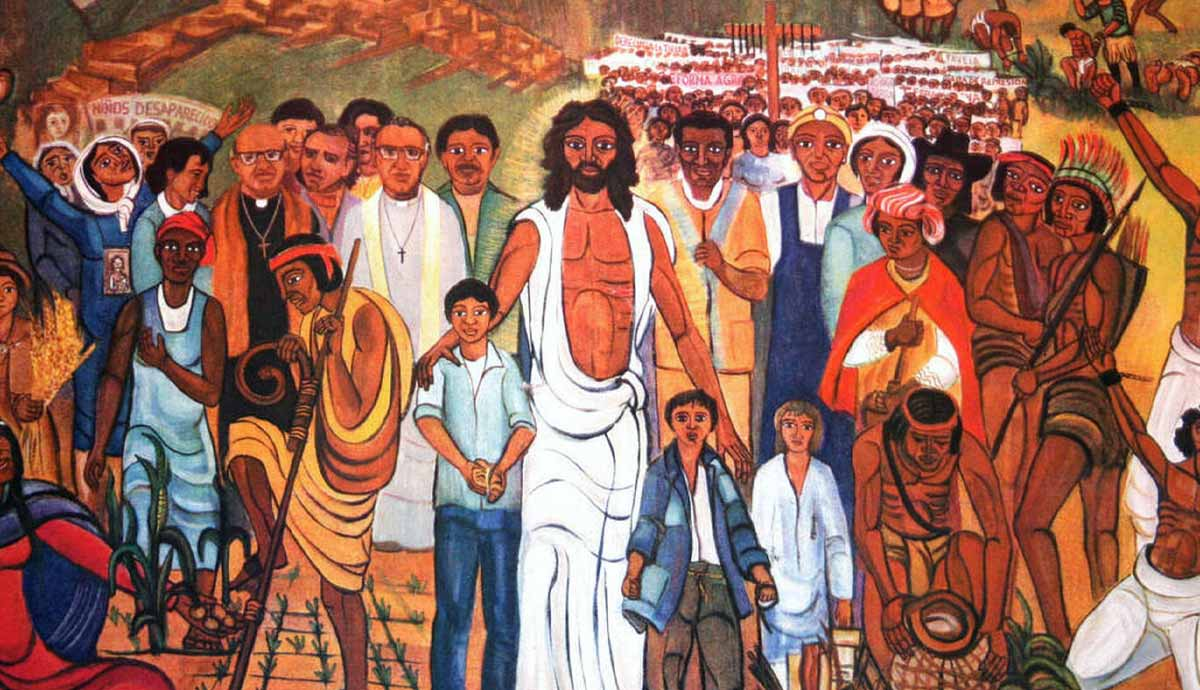
    • Assassinations of priests, nuns, and catechists. (Recall the slogan in El Salvador, “Be a patriot; kill a priest.”)  
    • A generation of Christians taught to fear the word “justice” if it implied systemic change.
    • A generation trained to equate patriotism with piety.
    • A generation suspicious of any theology that speaks of class.

    And so, the Left weakened—because it surrendered theological imagination — and often faith itself. Meanwhile, the Right grew strong—because it wrapped market ideology in biblical language.

    But Isaiah is still there.

    Paul is still there.

    Jesus is still there.

    And they continue to say: share your bread. Remove oppression. Shine with good deeds.

    The Conflict Today

    The conflict is not between Christianity and atheism. It is between two versions of Christianity. One blesses empire. The other stands with the crucified. One Christianity defends borders above human beings. The other remembers that Jesus himself was a refugee. One Christianity fears the language of class. The other recognizes that the Bible is saturated with it—rich and poor, debtor and creditor, slave and free.

    Christian nationalism proclaims, “Make the nation great again.” Biblical theology proclaims, “Make the poor visible again.”

    Christian nationalism identifies God with power. Biblical theology identifies God with victims.

    And today’s readings make clear which side the biblical text leans toward.

    Salt That Has Not Lost Its Taste

    Jesus warns: salt can lose its taste.

    What does that mean? It means faith can lose its transformative power. It can become bland, domesticated, harmless. When Christianity ceases to confront structural injustice, it becomes tasteless. When the Church fears being called “socialist” more than it fears ignoring the hungry, it has lost its saltiness. When Christians defend systems that produce homelessness while quoting Scripture about personal morality, the light dims.

    But when bread is shared, light breaks forth like dawn. When oppression is removed, darkness becomes midday. When communities embody economic justice—God says, “Here I am.”

    That is the promise of Isaiah.

    That is the power of the cross.

    That is the calling of salt and light.

    Conclusion

    For the past two weeks, I’ve suggested that Marx did not invent concern for the poor. The prophets did. Jesus did. The earliest Christians did.

    Marx analyzed exploitation. Isaiah condemned it. Jesus embodied resistance to it.

    To acknowledge this is not to baptize every socialist experiment in history. It is not to deny the complexities of economics. It is simply to be honest about the text.

    The Bible does not defend hoarding. It does not sanctify inequality. It does not idolize the nation-state. It calls for justice. And justice, in Scripture, is not abstract. It is bread, shelter, clothing, and dignity.

    So, if someone says that such preaching is “Marxist,” perhaps the better question is: why does Marx sound like Isaiah?

    If someone claims that Christian faith is about national power, perhaps we should ask: what do we do with the crucified Messiah?

    If someone insists that the Church should avoid politics, perhaps we should re-read Isaiah 58.

    The readings today are not subtle. They do not whisper. They’re about salt and light, bread and justice, capital punishment and resurrection.

    They do not endorse empire, domination or nationalism disguised as faith. Instead, they announce that authentic worship is inseparable from economic justice.

    And when that justice begins to take shape—when bread is shared, when the afflicted are satisfied—then, Isaiah promises, “your light shall rise in the darkness.”

    May we have the courage to let it shine.

    A Failure Already? Bill Maher Declares Zohran Mamdani “A Straight Up Communist”

    How respectable liberalism helps defend systems it claims to oppose.

    One of the earliest dynamics I imagined in my recent novella (Against All Odds: How Zohran Mamdani Became President & Changed America Forever) was not triumph, but backlash. The story assumes that the moment entrenched systems are seriously challenged, the response will not be curiosity or patience, but immediate verdicts of failure — long before structural change has even had time to begin. That reflex is not accidental. It is part of how power protects itself.

    Which is why the speed with which Zohran Mamdani has been declared a disappointment is not surprising at all. Three weeks into office and New York’s housing crisis remains. Imagine that — after three whole weeks!! Rents are still unaffordable. Shelters are still crowded. Families are still doubling up, and young people are still leaving the city they love because they cannot imagine building a stable future there.

    But what has been just as revealing as the impatience is the source of much of the outrage. Some of the loudest denunciations of Mamdani have come not only from the right, but from television personalities who still market themselves as liberals — most notably Bill Maher — who appear genuinely appalled that a major American city might elect someone who does not instinctively genuflect before market solutions.

    Forgetting about our nation’s history of racially segregated neighborhoods and ghettoes, ignoring real estate and banking redlining, gated communities, white flight, and the exclusionary practices of the Trump family itself, Maher ridicules the obvious fact that home ownership in the U.S. has been and remains racist and an instrument of white supremacy. Think about it. Think about the racial impact of using property taxes to determine the quality of public schools. Yes, Mr. Maher, home ownership in America is racist.

    However, by the standards of contemporary political commentary, such amnesia and willful ignorance has apparently provided enough time to declare defeat.

    What is more striking still however is how little these attacks have to do with actual housing policy. They are not debates about zoning law, construction finance, or tenant protections. They are ideological rituals. Mamdani is denounced not only as a “socialist,” but as (in Maher’s words) “a straight-up communist,” as if these were self-explanatory epithets rather than political terms with long and very specific histories.

    Red-baiting, once a reliable weapon of the right, has now become comfortable entertainment for liberal audiences.

    One might reasonably expect professional commentators to understand the vocabulary they deploy so confidently. However, they evidently do not. Instead, we are offered ideological pantomime: capitalism good, socialism bad; privatization efficient, public ownership corrupt; taxes theft, regardless of what they fund or whom they protect. These slogans are not arguments. They are incantations — repeated not to clarify reality, but to prevent serious discussion of alternatives that might threaten existing concentrations of wealth and power.

    Yet after just a few dinner-table conversations, even my own middle school grandchildren could explain what Maher and others seem either not to know or not to care to acknowledge. My grandkids knew that socialism refers to public ownership of the means of production, the use of regulated markets, and limits on extreme wealth through progressive taxation. They knew that communism, in classical political theory, is not a description of any society that exists or has ever existed, but a hopeful vision of a future. It’s a North Star goal in which abundance is shared, class divisions disappear, and even the state itself — always a structure used to enforce class hierarchy — withers away.

    My little grandchildren also knew what most economists acknowledge without controversy: that every functioning economy in the world today is a mixed economy. They all combine public and private ownership, regulated and freer markets, and redistribution through taxation. To repeat, they are “mixed economies” — every one of them. The question is however, in whose favor are they mixed — in favor of the rich or of the poor? In the U.S., it’s the rich. In China, it’s the working class.

    Moreover, what Maher and others call “communism” has already proven to work in the United States. They called it the New Deal. They called it Keynesianism, and it gave us workers Social Security, minimum wage laws, unemployment insurance, workers’ compensation for injury on the job, and a 40 hour work week. It made unions legal and provided jobs, income, and socially valuable work for millions of impoverished Americans when the government stepped in as employer of last resort. Its creation of the national park system made the U.S. government the country’s biggest land owner — the master of the planet’s most important “means of production.”

    None of this is radical. It is introductory political economy.

    What is radical, apparently, is saying any of this out loud on American television without first wrapping it in nervous apologies.

    Housing policy then becomes not a question of long-term public investment and institutional redesign, but a morality play in which reformers are expected to perform miracles on cue — and are mocked when they cannot.

    Yet the truly unrealistic position is believing that deregulated housing markets will somehow, after decades of failure, suddenly begin producing widespread affordability. The evidence is overwhelming that they will not. Left to themselves, housing markets maximize return on investment, not human stability. Luxury construction thrives; low-income units stagnate. Rent rises faster than wages. Speculation accelerates displacement. Public housing deteriorates under chronic underfunding while private capital flows freely into high-yield developments.

    To call this “natural” is to mistake policy choices for inevitability.

    If anything, the realistic position is the one Mamdani actually represents: that reversing these dynamics will take sustained political will, public investment, and institutional rebuilding — none of which can be accomplished by executive decree or cable-news bravado.

    This is why ideological labels matter less than practical institutional policies. Passing tenant protections may not make headlines, but it changes lives. Securing funding streams for public housing repair may not trend on social media, but it prevents future crises. Rewriting zoning laws to allow denser, community-controlled development may not satisfy the appetite for spectacle, but it reshapes what becomes possible over time.

    In other words, housing reform requires democracy — not performance.

    In Against All Odds, accountability is not about scapegoats. It is about public reckoning with systems that were allowed to persist because they benefited the powerful and numbed the rest of us into acceptance. That kind of reckoning, whether in fiction or in real cities, cannot happen instantly. It unfolds through institutions slowly being repurposed for the common good rather than private extraction.

    What Mamdani’s first weeks in office really reveal is not failure, but the size of the inheritance: decades of bipartisan accommodation to a housing system that treats insecurity as an acceptable cost of growth.

    If we are honest, the scandal is not that housing has not been fixed in three weeks. The scandal is that it was allowed to deteriorate for thirty years while political leadership congratulated itself on “vibrant markets” and “urban renewal.”

    Progressive politics, if it is to mean anything beyond branding, must be judged not by speed alone but by direction: by whether public institutions are being rebuilt rather than hollowed out, by whether power is shifting toward those who have long been excluded from shaping their own living conditions, and by whether economic life is being reorganized around human needs rather than speculative return.

    Those metrics take time to register.

    The Arc of Justice Alliance grew out of this same realization: that without new public imagination — and new public institutions to match it — we will remain trapped in systems that treat structural injustice as unfortunate but inevitable. Stories, movements, and policies must reinforce one another if democratic repair is to be more than a slogan.

    That is why I write fiction alongside essays like this one. Not because stories replace politics, but because they can help us picture futures that our current institutions make difficult to imagine — and therefore difficult to fight for.

    Three weeks is not a verdict. It is barely the opening scene.

    The real question is not whether Zohran Mamdani has solved housing yet, but whether liberal America is willing to stop mistaking ideological comfort for political realism — and to admit that serious reform will always look dangerous to those who have grown accustomed to a system that works, more or less, for them.

    A Second Excerpt From “Against All Odds”— Chapter Seven, “The Sovereign Ledger”

    Editor’s Note / Author’s Introduction

    I recently shared here and at OpEdNews the opening chapter of my novella Against All Odds: How Zohran Mamdani Became President & Changed America Forever. I published the novella in the belief that narrative can sometimes open moral and political reflection in ways that formal analysis does not.

    Rather than continuing sequentially, I’m offering today a later, stand-alone chapter — Chapter Seven, “The Sovereign Ledger.” I chose this chapter because of its real-life echoes of The Epstein Files. Like the latter, this chapter confronts a question that democratic societies routinely avoid: how do nations acknowledge wrongdoing, make accountability public, and prevent political reconciliation from becoming mere collective amnesia?

    Although this chapter occurs well into the story, it does not depend on detailed knowledge of earlier events. It represents a turning point where personal courage gives way to institutional reckoning — and where justice becomes a matter of public structure rather than private virtue.

    I offer it in the hope that it may prompt reflection not only about the future imagined in this story, but about the present we are still struggling to shape.

    Chapter Seven: The Sovereign Ledger

    “There are moments when a nation learns that its worst suspicions were not paranoid enough.”
    — Arc of Justice Alliance, Internal Briefing, March 2026

    The first sign was not outrage. It was nausea.

    People would later remember where they were when the Ledger surfaced, but few would remember what they felt in those first minutes.

    Not anger. Not disbelief. Something colder. Something intimate. As if a locked room inside the American psyche had been opened, and the air that escaped was foul beyond imagination.

    The file appeared without announcement.
    No whistleblower stepped forward.
    No press conference was called.
    No government agency took credit or responsibility.

    At 2:14 a.m. Eastern Time, mirrored across thousands of servers worldwide, a compressed archive appeared under a single title:

    THE SOVEREIGN LEDGER
    Internal Records of Federal Continuity, 1998–2028

    Within minutes, links propagated across independent newsrooms, encrypted forums, municipal networks, and university servers. By sunrise, attempts to suppress it had already failed. The file had been copied too many times, by too many hands, in too many jurisdictions.

    It was not a leak. It was an exhumation.

    The Ledger was not one scandal. It was a system. Thousands of pages documented how power in the United States had long operated through a shadow economy of indulgence, coercion, and silence.

    What the public had been encouraged to understand as “isolated incidents” appeared instead as recurring patterns—engineered, financed, and protected.

    There were private air manifests tied to shell corporations. There were sealed settlements paid with public funds.
    There were non-prosecution agreements signed by federal prosecutors who later received corporate board appointments.

    And there were the names.

    Lawmakers.
    Judges.
    Intelligence officials.
    Media executives.
    Foreign dignitaries.

    Some appeared once. Others appeared again and again.

    The most disturbing files concerned what the Ledger referred to—with chilling bureaucratic neutrality—as “leverage assets.” Young women. Underage girls.
    Migrants without documentation.
    Runaways pulled from foster systems.

    They were trafficked not primarily for profit, but for control. Sex was the currency. Shame was the collateral.

    The Ledger documented how parties, retreats, “philanthropic conferences,” and private residences were used to compromise powerful individuals—and how those compromises were then archived, categorized, and deployed when obedience was required.

    One internal memo summarized the logic plainly: “Exposure risk ensures policy compliance across administrations.”

    What shocked readers most was not the existence of depravity—Americans had learned to expect that—but the scale of institutional cooperation required to keep it hidden.

    FBI investigations were quietly reassigned. Victims were pressured into silence through civil settlements.
    Journalists were warned off stories by editors citing “national stability.” Judges were persuaded to seal records indefinitely. Even deaths the public had been told were suicides appeared in the Ledger as “containment events.”

    One line, buried deep in a Justice Department review, froze the nation:

    “Subject’s death neutralized further reputational cascade.”

    The Ledger did not accuse. It docu-mented. Emails. Bank transfers.
    Flight logs. Surveillance transcripts.

    It showed that the system had not merely tolerated abuse—it had absorbed it, metabolized it, and used it as governance.

    By midmorning, the country had stopped pretending. Trading halted on multiple exchanges. Congressional offices closed without explanation. Cable news anchors struggled to read prepared statements with steady voices. Parents read the Ledger and felt ill. Survivors read it and wept. And millions who had never trusted Washington finally understood why.

    It wasn’t incompetence. It wasn’t polar-ization. It wasn’t gridlock. It was rot.

    Trust did not collapse slowly. It vanished.

    Zohran Mamdani read the Ledger alone.

    He sat in the Blue Room at City Hall long after staff had gone home, the city glowing beneath the windows like a living organism unaware of its diagnosis. He read until his eyes burned.

    What struck him was not outrage—that came later—but grief. The Ledger did not describe monsters hiding in shadows. It described men in suits, speaking softly, shaking hands, protecting one another. It described a republic that had confused continuity with morality.

    When he reached the annex detailing municipal pressure programs—how cities like New York were financially squeezed into compliance, how mayors were surveilled, how reform efforts were quietly strangled—he closed the laptop.

    “So,” he said aloud, “this is why nothing ever changes.”

    Naomi entered without knocking. Her eyes were red.


    “They’ll deny it,” she said.

    “They already are,” he replied. “They’ll say it’s foreign disinformation.”

    “Too many fingerprints,” she said.

    “They’ll say it doesn’t matter.”

    “It matters,” Zohran said, “because people believed them once.”

    She hesitated. “Do you know what this means?”

    He nodded slowly. “It means the country is going to look for someone who isn’t in that file.”

    The Ledger did what no election, protest, or ideology had managed to do. It made the old system unbelievable. Not unjust—unbelievable.

    People stopped asking which party was responsible and began asking whether the system itself deserved to survive.

    Governors issued contradictory statements. Federal agencies fell silent. Courts postponed hearings without explanation. And in living rooms, kitchens, union halls, and classrooms across the country, the same realization settled in: We were governed by people who could not govern themselves.

    When authority evaporates, something always rushes in to replace it. In New York, the Arc of Justice Alliance released a single statement:

    “Legitimacy is not inherited. It is earned—and it can be lost.”

    Zohran said nothing publicly for three days. When he finally spoke, he did not attack Washington. He did not cite the Ledger. He did not accuse. He said only this: “Power that survives by hiding crimes forfeits the right to rule.”

    The silence afterward was absolute.

    Somewhere between that moment and the next sunrise, the republic crossed a line it could not uncross. The Sovereign Ledger had not merely exposed corruption. It had revealed that the American government no longer governed by consent—but by concealment.

    And once concealment failed, nothing remained.

    Concluding Reminder

    Against All Odds: How Zohran Mamdani Became President & Changed America Forever, explores questions of political accountability, public trust, and democratic repair through narrative rather than policy argument.

    Readers interested in the complete story can find information about the book by clicking here. All proceeds from the novella’s sales go to the Arc of Justice Alliance which is applying for tax-exempt status.